(By Khalid Masood)
I. Introduction: The Echo in the Corridors
“In diplomacy, nothing is more dangerous than the illusion of a fresh start.” — Adapted from Henry Kissinger
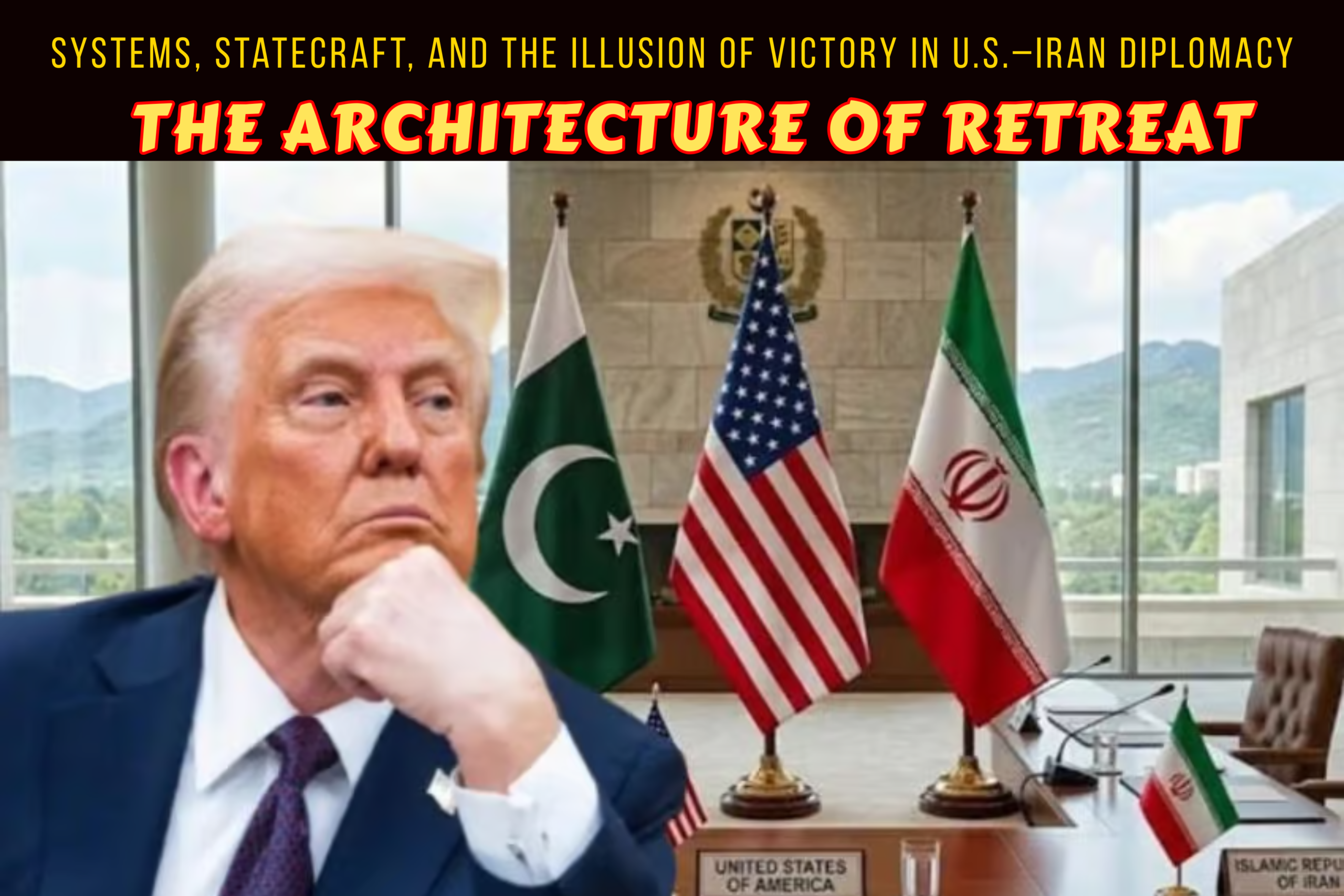
In the corridors of power in Washington, this maxim finds renewed resonance as the familiar refrain—“We are close to a big deal”—echoes once again through the West Wing and Foggy Bottom. Donald Trump’s recent public statements, suggesting Iran’s willingness to cap its nuclear program, entertain timelines spanning five to twenty years, and prepare for intensive “weekend talks,” have been hastily framed by some as a diplomatic breakthrough. Yet beneath the rhetoric lies a quieter, more consequential reality: this is not a new strategy, but a return to an old one.
The emerging framework mirrors the technical and political architecture of the 2015 Joint Comprehensive Plan of Action (JCPOA), a deal Washington once abandoned and now appears to be reconstructing. After years of maximum pressure, regional escalation, and strategic expenditure, the United States finds itself negotiating toward parameters it already deemed acceptable a decade ago. The pressing question is no longer what Washington stands to gain from a renewed agreement, but what it has already lost in the interim. In contemporary statecraft, the line between strategic patience and strategic drift is drawn by consequences, not declarations.
| Era | Key Phrase | Context | Outcome |
|---|---|---|---|
| 2013–2015 | “We are close to a historic deal” | Obama/Kerry negotiations | JCPOA signed (2015) |
| 2018 | “Maximum pressure will force a better deal” | Trump withdrawal | JCPOA collapse; Iranian escalation |
| 2021–2022 | “A return to compliance is possible” | Biden revival attempts | Stalemate; Iranian enrichment advances |
| 2026 | “We are close to a big deal” | Trump 2.0 negotiations | Parameters mirror 2015 framework |
II. The Anatomy of a Familiar Deal: JCPOA Redux
“The devil is not in the details; the devil is in the repetition.” — Diplomatic aphorism
Diplomatic frameworks, unlike military campaigns, rarely begin from a clean slate. The technical skeleton of the prospective agreement aligns almost precisely with the JCPOA’s original design: enrichment thresholds capped near 3.67 percent, centrifuge counts restricted to early-generation models, stockpile limits calibrated to civilian energy needs, and phased verification regimes overseen by the International Atomic Energy Agency. Even the proposed duration—varying between ten and twenty years with sunset provisions—reiterates the same diplomatic compromise that defined the Obama era.
| Parameter | JCPOA (2015) | Proposed 2026 Deal | Strategic Implication |
|---|---|---|---|
| Enrichment Cap | 3.67% U-235 | 3.67%–5% (negotiable) | Civilian use only; weapons threshold ~90% |
| Centrifuge Limit | 5,060 IR-1 machines | 4,000–6,000 (est.) | Minimal change; advanced centrifuges restricted |
| Stockpile Limit | 300 kg UF6 | 300–500 kg (est.) | Insufficient for weapon without breakout |
| Duration | 10–15 years (sunset clauses) | 5–20 years (variable) | Uncertainty creates leverage/instability |
| Verification | IAEA continuous monitoring | Enhanced access (proposed) | Trust mechanism; Iranian resistance likely |
| Sanctions Relief | ~$100B frozen assets | Partial/unphased (TBD) | Economic reintegration vs. political cost |
This recurrence is neither accidental nor indicative of diplomatic stagnation. Rather, it reflects the immutable physics of nuclear diplomacy. Enrichment levels, centrifuge efficiency, and breakout timelines are bound by technical realities that resist ideological maneuvering. The 3.67 percent threshold, for instance, remains the internationally recognized boundary between civilian fuel and weapons-grade material. Similarly, IAEA monitoring protocols require continuity to function; disruptive verification frameworks collapse under political friction. What has changed is not the blueprint, but the context in which it is deployed. Washington’s return to these parameters suggests a pragmatic acknowledgment: when maximum pressure fails to alter an adversary’s strategic trajectory, the architecture of containment inevitably reverts to its baseline. The critical inquiry, then, is not whether the deal’s technical provisions are novel, but what strategic capital was expended to arrive at them.
III. The Cost of the Interim: What Washington Lost While Waiting
“The most expensive thing in diplomacy is time — and we have spent it lavishly.” — Attributed to George Shultz
The years between the JCPOA’s collapse and the current negotiations have not been a strategic vacuum; they have been a period of measurable depreciation. Prolonged confrontation was sold as a pathway to superior leverage, yet the ledger tells a more complicated story. Oil markets have oscillated violently, fueling inflation and accelerating diversification away from dollar-denominated energy trade. Global financial architecture has adapted, with alternative clearing mechanisms and regional payment networks gaining traction. Meanwhile, U.S. military posture in the Middle East has grown more expensive, more exposed, and less decisive.
| Domain | Cost/Loss | Metric | Strategic Impact |
|---|---|---|---|
| Economic | Oil price volatility | $60–$120/barrel swings | Global inflation; energy security concerns |
| Financial | Sanctions enforcement | $300B+ in frozen/redirected trade | Erosion of dollar hegemony; alternative payment systems |
| Military | Regional deployments | 45,000+ U.S. troops; $8B/year | Opportunity cost; force readiness degradation |
| Diplomatic | Alliance cohesion | EU/US divergence on JCPOA | Transatlantic strain; multipolar alignment |
| Nuclear | Iranian breakout time | 2015: 12 months → 2026: ~2–4 weeks | Leverage inversion; crisis instability |
| Regional | Proxy empowerment | Hezbollah arsenal: 150K → 200K rockets | Deterrence asymmetry; escalation risks |
The paradox of maximum pressure is now evident: while it constrained Iran’s immediate nuclear ambitions, it simultaneously accelerated Tehran’s strategic hedging. Breakout times shrank from over a year to a matter of weeks. Regional alignments shifted as Washington’s allies recalibrated their threat assessments. Transatlantic coordination frayed under the weight of unilateral sanction regimes. The United States did not emerge from this period with enhanced leverage; it emerged with heightened liabilities. The question that now confronts policymakers is straightforward: Has Washington secured a stronger negotiating position, or has it merely purchased time at a premium it can no longer afford?
IV. The Proxy Calculus: Nuclear Limits vs. Regional Realities
“Tehran does not need a bomb to be dangerous; it needs allies with missiles.” — Regional security analyst
A narrow nuclear constraint, however meticulously verified, does not equate to strategic containment. Iran’s regional influence operates through a decentralized but highly coordinated network of allied militias, political movements, and asymmetric deterrents. These forces function independently of, yet in alignment with, Tehran’s strategic calculus. A ceasefire in Lebanon or a reduction in overt hostilities may lower the temperature, but it does not dismantle the architecture.
| Proxy Force | Region | Estimated Strength | Iranian Support | Strategic Role | Deal Impact Risk |
|---|---|---|---|---|---|
| Hezbollah | Lebanon | 100K fighters; 200K rockets | $700M–$1B/year | Deterrence vs. Israel; political leverage | Low (independent agenda) |
| Houthis (Ansar Allah) | Yemen | 200K+ fighters; drones/missiles | $100–300M/year | Red Sea disruption; Saudi pressure | Medium (ceasefire fragile) |
| Iraqi Militias (PMF) | Iraq | 100K+ fighters; integrated forces | $200–500M/year | U.S. force threat; political influence | High (escalation risk) |
| Hamas/PIJ | Gaza/West Bank | 40K+ fighters; tunnel networks | $50–$100M/year | Israeli distraction; Arab street mobilization | Medium (post-ceasefire uncertainty) |
| Syrian Regime Forces | Syria | Integrated command; basing rights | $3–6B/year (total support) | Land bridge to Lebanon; regional entrenchment | Low (existential alliance) |
The current diplomatic framework addresses the nuclear file while leaving the regional balance of power largely untouched. Hezbollah’s arsenal continues to grow, Iraqi militias remain embedded within state security structures, and Houthi capabilities have evolved into a persistent maritime threat. Even temporary ceasefires, while valuable for crisis management, lack the verification mechanisms and political commitments required for structural peace.
| Dimension | 2026 Ceasefire | Structural Peace Requirement | Gap Analysis |
|---|---|---|---|
| Hezbollah Disarmament | Not addressed | UN Resolution 1701 implementation | Wide (political impossibility) |
| Border Demarcation | Temporary understanding | Formal Lebanon–Israel treaty | Medium (technical, not political) |
| Iranian Arms Transfers | Unmonitored | Verification mechanism | Wide (enforcement deficit) |
| U.S./Israeli Deterrence | Maintained | Integrated regional defence | Medium (coordination challenge) |
This decoupling creates a strategic asymmetry. Washington may secure nuclear latency while conceding regional influence to a network that operates below the threshold of conventional warfare. The diplomatic challenge, therefore, is not merely whether Iran will cap its centrifuges, but whether it will recalibrate its proxy posture. Without parallel mechanisms addressing regional deterrence, a limited nuclear deal risks legitimizing Tehran’s broader strategic footprint. Can Washington accept constrained nuclear progress while acquiescing to an entrenched regional architecture? The answer will determine whether this agreement stabilizes the Middle East or merely manages its volatility.
V. The System Behind the Signature: Presidential Agency vs. Institutional Gravity
“The president proposes, but the system disposes.” — Washington insider aphorism
“Nixon went to China because the system allowed it — not because he wanted to.” — Henry Kissinger, on structural imperatives
American foreign policy is rarely the product of a single mind. It is the output of a complex ecosystem: Pentagon force posture assessments, Treasury Department sanction architectures, intelligence community threat matrices, alliance coordination frameworks, and the relentless signals of global capital markets. Presidents navigate this system; they do not command it.
| Institution | Primary Interest | Constraint/Pressure | Influence Mechanism |
|---|---|---|---|
| Pentagon | Force protection; regional stability | Readiness costs; escalation risks | Military planning; threat assessments |
| Treasury | Sanctions efficacy; dollar hegemony | Financial market stability; ally coordination | OFAC designations; SWIFT access |
| State Department | Diplomatic credibility; alliance management | Bureaucratic inertia; career expertise | Negotiation frameworks; multilateral coordination |
| Intelligence Community | Nuclear monitoring; proxy tracking | Analytic consensus; political independence | NIEs; IAEA liaison; covert action |
| Congress | Domestic politics; oversight | Partisan divides; election cycles | Legislation; hearings; funding restrictions |
| Federal Reserve/Markets | Oil prices; inflation; dollar stability | Global capital flows; energy shocks | Interest rates; currency interventions |
| Allies (EU/GCC/Israel) | Regional security; economic interests | Divergent threat perceptions | Diplomatic pressure; intelligence sharing |
History offers a clear precedent. Richard Nixon’s normalization of relations with China was not a sudden ideological pivot but a structural imperative. Henry Kissinger’s backchannel diplomacy, facilitated quietly through Islamabad, succeeded because institutional stakeholders recognized that strategic equilibrium required realignment, not confrontation. Today’s reports of third-party mediation in U.S.–Iran talks—particularly through Pakistani and Omani channels—are not historical anomalies. They are institutional continuity.
| Dimension | Nixon–China Normalization | Trump–Iran Negotiations | Structural Similarity |
|---|---|---|---|
| Backchannel | Kissinger–Zhou via Pakistan | Trump team via Oman/Pakistan | Third-party mediation essential |
| Domestic Opposition | Conservative Republicans; Taiwan lobby | Hardliners; Israel/Saudi lobby | Ideological resistance predictable |
| Strategic Driver | Counterbalance USSR; Vietnam exit | Stabilize oil; pivot to China/Russia | Systemic imperative over ideology |
| Institutional Support | State Dept. realists; business interests | Pentagon pragmatists; energy sector | Bureaucratic coalition enables deal |
| Public Narrative | “Peace through strength” | “Better deal than Obama” | Victory framing required |
| Outcome | Geopolitical realignment | Crisis management (projected) | Systemic stability prioritized |
The Nixon–China parallel illuminates a broader truth: when systemic pressures converge, presidential rhetoric adjusts to accommodate them. The current diplomatic trajectory reflects not a victory for any single administration, but the gravitational pull of institutional pragmatism. Military planners seek predictable threat environments. Treasury officials require sanction frameworks that do not fracture global finance. Intelligence agencies demand continuous monitoring. Allies expect coordinated deterrence. When these vectors align, compromise becomes inevitable. The troubling question that emerges is whether presidents have been reduced to operators of a system that prioritizes stability over ambition. And if so, has that system grown so reactive that it no longer shapes events, but merely manages them?
V.1. The Islamabad Lens: Mediators, Not Spectators
“Washington measures compliance. We measure survival. A deal that ignores regional sovereignty is not diplomacy; it is delayed coercion.”
— Dr. Arif Siddiqui, Senior Fellow, Institute of Strategic Studies, Islamabad
From Islamabad’s vantage point, the U.S.–Iran negotiation is not a binary contest between proliferation and containment. It is a structural recalibration of a region long treated as a laboratory for external policy experiments. Pakistani strategic analysts, many with deep ties to Middle Eastern diplomatic corridors, view the current trajectory not as an American triumph, but as an overdue acknowledgment of multipolar reality.
Iran’s regional posture, they argue, cannot be dismantled through financial strangulation or diplomatic isolation. It is rooted in historical grievances, geographic necessity, and a calculated doctrine of strategic depth. The proxy architecture is not an Iranian invention; it is a regional response to vacuum, intervention, and asymmetric threat environments. When Washington frames the nuclear file as the sole axis of negotiation, it overlooks the foundational truth that Tehran’s leverage is territorial, political, and ideological—not merely technical.
| Strategic Framing | Washington Perspective | Islamabad/Regional Perspective |
|---|---|---|
| Core Objective | Nuclear rollback & verification | Regional equilibrium & sovereignty |
| Sanctions Utility | Coercive leverage | Economic collateral damage |
| Proxy Networks | Illegitimate extensions of state | Asymmetric deterrence & historical alignment |
| Diplomatic Success | Compliance thresholds signed | Crisis de-escalation without humiliation |
| Long-Term Vision | Managed containment | Multipolar stability & strategic autonomy |
Pakistan’s historical role as a quiet conduit—dating to Kissinger’s 1971 backchannel and extending through contemporary Omani-Pakistani mediation—is not accidental. It is geographic, cultural, and strategically necessary. Islamabad understands that regional stability cannot be engineered from overseas capitals. It requires patient calibration, face-saving mechanisms, and recognition that regional actors will not surrender strategic depth for temporary sanction relief.
The tone shift in regional diplomatic circles is subtle but decisive: the question is no longer “Will Iran comply?” but “Will Washington finally recognize that the Middle East cannot be managed through unilateral pressure?” A deal that returns to JCPOA parameters without addressing regional security architectures is not a resolution. It is a postponement dressed as progress.
VI. Redefining Victory in the 21st Century
“Victory is no longer a destination; it is a managed condition.” — Contemporary statecraft maxim
“The question is not whether we won, but whether the world believes we did.” — Diplomatic perception theory
The twentieth century measured diplomatic success in definitive terms: treaties signed, regimes changed, territories secured, adversaries defeated. The twenty-first century has replaced triumph with equilibrium. In an era of interconnected markets, distributed threat networks, and multipolar competition, statecraft is measured not by how decisively a crisis is resolved, but by how sustainably it is contained.
| Dimension | 20th Century Victory | 21st Century Victory | Application to Iran Deal |
|---|---|---|---|
| Metric | Territorial gain; regime change | Crisis de-escalation; stability | Nuclear constraints without regime change |
| Timeframe | Definitive endpoint | Continuous management | Sunset clauses; rolling negotiations |
| Legitimacy | Military triumph; treaties | Multilateral endorsement; market confidence | IAEA verification; EU/China buy-in |
| Narrative | Unambiguous success | “Best achievable outcome” | “Better than Obama” vs. “Return to square one” |
| Adversary Status | Defeated/contained | Managed/deterred | Iran constrained but not isolated |
| Domestic Politics | Rally-around-flag | Polarized interpretation | Partisan framing inevitable |
This paradigm shift explains why the current Iran negotiations provoke such polarized reactions. To traditionalists, returning to JCPOA-like parameters after a decade of confrontation reads as capitulation. To institutional pragmatists, it reads as risk mitigation. The reality lies in the perception that will follow the signature. Allies will assess whether U.S. credibility has been preserved or diluted. Adversaries will calculate whether Washington’s constraints are reversible or enduring. Global markets will price in stability or anticipate disruption. The agreement’s text will matter less than the narrative it generates.
“The question is not whether we won, but whether the world believes we did.” In contemporary diplomacy, perception is not ancillary to policy; it is policy. Success will be measured not by clauses and sunset provisions, but by whether the international community interprets the deal as a restoration of order or a postponement of crisis. When institutional limits dictate compromise, victory is redefined as the avoidance of catastrophic failure.
VII. Conclusion: The Diplomatic Ledger
“Diplomacy is the art of letting someone else have your way.” — Michele Capasso
“History does not record victories; it records consequences.” — Attributed to Bismarck
The prospective U.S.–Iran agreement is not an endpoint. It is a mirror reflecting the maturity, constraints, and recalibrations of American statecraft. It reveals a Washington that has learned, through expenditure and escalation, that strategic patience without structural leverage yields diminishing returns. It reveals a system that prioritizes stability over spectacle, continuity over conquest, and management over triumph.
| Scenario | Probability | Conditions | Outcome |
|---|---|---|---|
| Stable Equilibrium | 30% | Full compliance; regional de-escalation; economic reintegration | 10-year stability; renewed negotiations |
| Fragile Modus Vivendi | 50% | Partial compliance; proxy tensions continue; sanctions snapback risk | Cyclical crises; managed containment |
| Collapse & Escalation | 20% | Violation accusations; Israeli/U.S. military action; Iranian breakout | Regional war; nuclear crisis; global economic shock |
The trajectory that follows will depend not on the signing ceremony, but on the statecraft that accompanies it. Will integration mechanisms be paired with regional deterrence postures? Will alliance coordination replace unilateral improvisation? Will verification regimes adapt to technological and political realities? These questions will determine whether the agreement becomes a foundation for durable equilibrium or a temporary reprieve in a cycle of managed crises.
In contemporary statecraft, victory is rarely declared. It is often merely managed. And in the corridors of power, where echoes of old deals meet the realities of new constraints, that may be the most honest accounting of all.