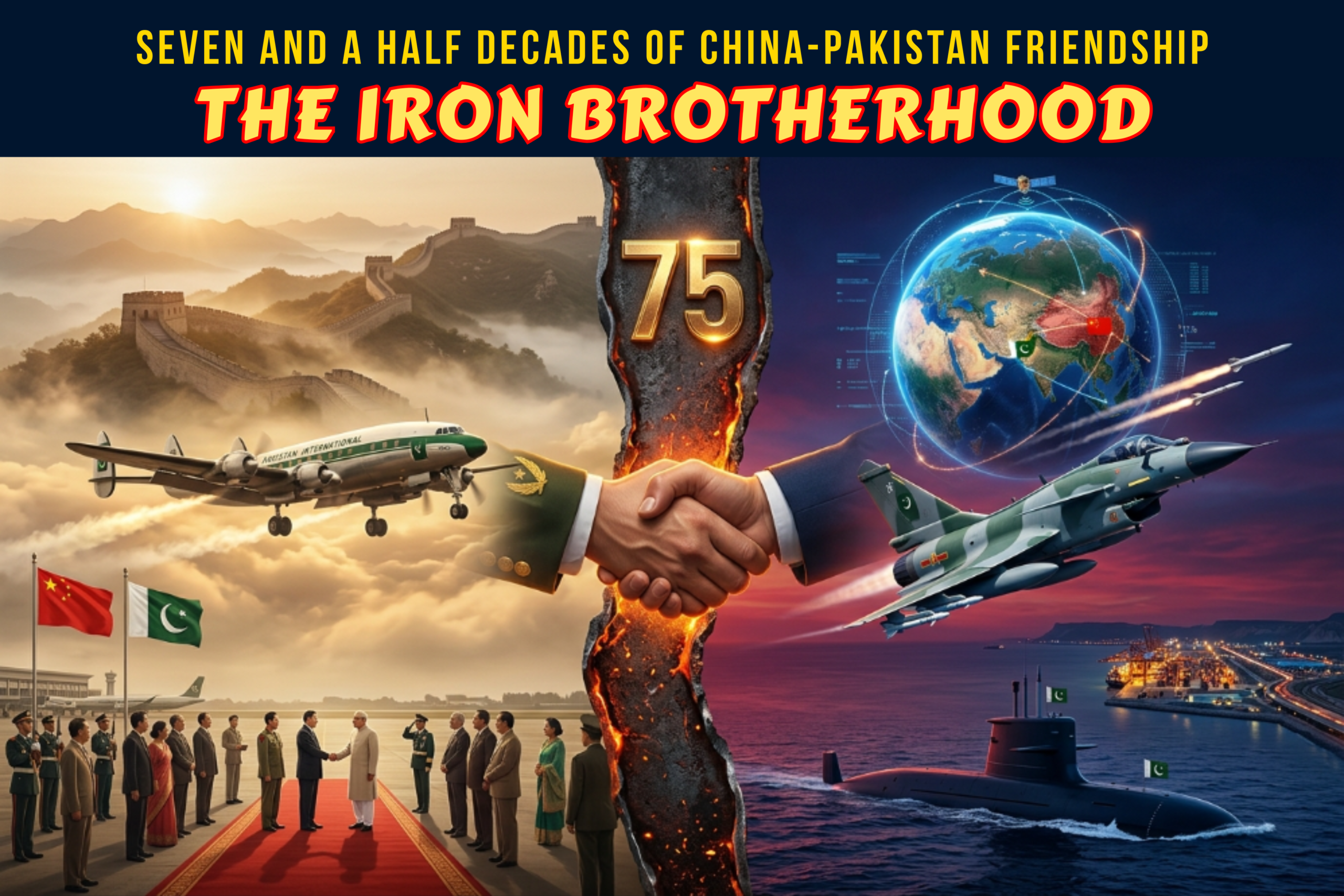
The Iron Brotherhood: Seven and a Half Decades of China-Pakistan Friendship
(By Khalid Masood)
I. Introduction: A Friendship Forged in Isolation
In the annals of modern diplomacy, few relationships have defied the corrosive tides of geopolitical fashion as resolutely as the friendship between the People’s Republic of China and the Islamic Republic of Pakistan. As both nations commemorate seventy-five years of this extraordinary bond in 2026, the world is invited not merely to observe a diplomatic anniversary, but to bear witness to a survival partnership that transformed the destinies of two great nations.
This is not the story of a transactional alliance, subject to the arithmetic of quarterly interests. It is the chronicle of two countries that, at their respective moments of maximum vulnerability, chose to see in each other not opportunity, but brotherhood. Pakistan became China’s window to the world when the world had slammed its doors shut on Beijing. China, in turn, lifted Pakistan in every conceivable field—economic, military, technological, and diplomatic—even when doing so carried immense risk. And when the ultimate test arrived in May 2025, the world watched, and India learned, what seventy-five years of unwavering solidarity truly means when translated into steel, silicon, and strategic resolve.
II. The Window Era: When Pakistan Was China’s Only Door to the World (1951–1972)
The Air Bridge: PIA’s Historic Landing
In the early years of the People’s Republic, China existed under a near-total Western embargo. The United States and its allies enforced a suffocating cordon of diplomatic isolation and economic blockade. Airspace was closed. Trade routes were severed. The young communist state was encircled, contained, and condemned to diplomatic suffocation.
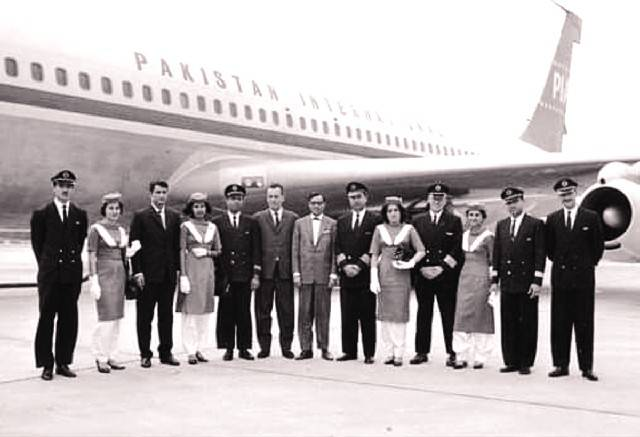
It was Pakistan, alone among the community of nations, that refused to participate in this strangulation. Pakistan International Airlines (PIA) became the first international carrier to establish regular air links with China, literally connecting a besieged Beijing to the skies of the world. When no Western airline would touch Chinese soil, PIA jets landed at Beijing Capital Airport, carrying not just passengers and cargo, but a message of defiant solidarity. That runway was more than tarmac; it was a lifeline. Pakistan had become, in a very literal sense, China’s window to the world.
The Secret Road to Beijing: Kissinger and the Diplomatic Revolution
The full measure of Pakistan’s role as China’s diplomatic gateway reached its historic apogee in July 1971. The world was about to be reshaped, and Islamabad was the anvil upon which the new order was forged.
When U.S. National Security Advisor Henry Kissinger needed to travel to Beijing for the clandestine meetings that would ultimately lead to President Richard Nixon’s groundbreaking 1972 visit, no neutral capital could provide the necessary cover. The operation required absolute secrecy, flawless discretion, and a government that could be trusted with the most sensitive diplomatic maneuver of the Cold War.
Pakistan provided that cloak. Kissinger arrived in Islamabad, feigned a diplomatic illness, and vanished from public view. From the Pakistani capital, he was spirited to Beijing in a Pakistani aircraft, his passage arranged and protected by Pakistani hands. The world learned of the opening only after it had succeeded. Pakistan had not merely facilitated history; it had guaranteed its safety. Islamabad had become the indispensable bridge between two powers that had spent decades in frozen hostility.
The 1971 Crucible: Unwavering in the Hour of Darkness
The truest test of any friendship is not its performance in sunshine, but its resilience in the storm. For Pakistan, the tragedy of 1971 was the darkest chapter in its national history—a moment of secession, war, and profound national grief. The world watched, and many nations calculated their responses with cold pragmatism.
China did not calculate. Beijing did every possible and conceivable thing within its power to support Pakistan during that catastrophe. Despite its own internal convulsions—the lingering chaos of the Cultural Revolution—and despite the strategic risks of antagonizing both the Soviet Union and the global order arrayed against Islamabad, China stood firm. Diplomatic support was extended at the United Nations. Military supplies were expedited. The message was unambiguous: Pakistan would not stand alone.
This was not merely policy. It was principle. China had chosen, in Pakistan’s darkest hour, to be its most reliable friend.
III. The Reversal: China Lifts Pakistan Across Every Frontier (1972–2024)
The Economic Engine: From Aid to Architecture
If the first quarter-century of this friendship was defined by Pakistan’s service as China’s window, the subsequent decades witnessed a magnificent reversal. As China embarked upon its historic reform and opening, its economic miracle became Pakistan’s ladder.
The China-Pakistan Economic Corridor (CPEC), inaugurated in 2015, was not a sudden departure but the natural evolution of that early air bridge. Where PIA had once connected China to the world through the sky, CPEC would connect Pakistan to prosperity through the earth—thousands of kilometers of highways, railways, energy pipelines, and the strategic deep-water port of Gwadar. Power plants that had been dark for decades were illuminated. Transportation networks that had been decrepit were modernized. Special Economic Zones promised industrial transformation.
China did not offer Pakistan charity. It offered architecture—the structural framework upon which a modern economy could be built.
The Military Modernization: From Supplier to Strategic Enabler
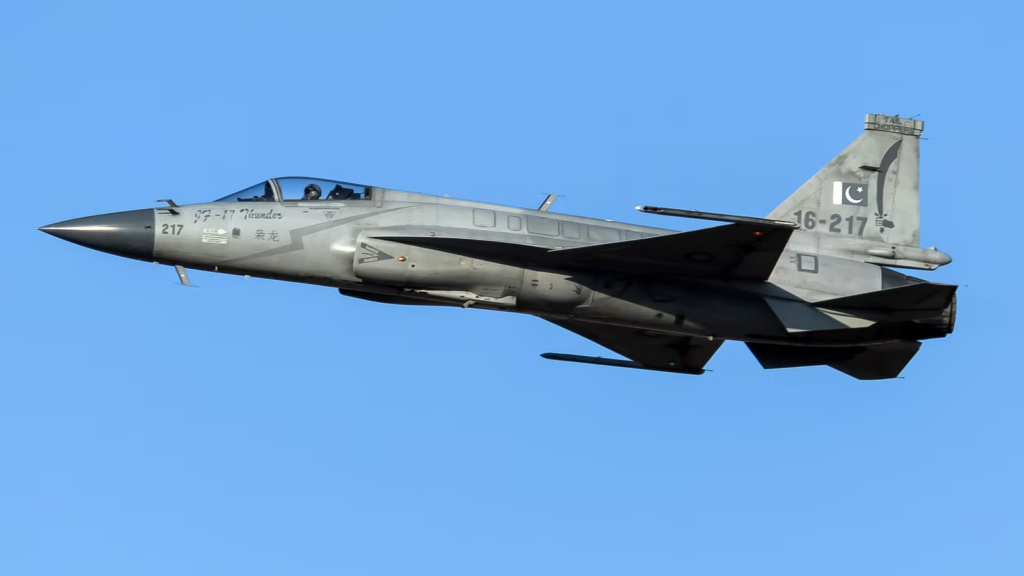
China’s commitment to Pakistan’s security evolved from the provision of equipment to the transfer of capability. The JF-17 Thunder fighter aircraft, co-developed by the two nations, became the symbol of this evolution—not merely a weapon sold, but a technology shared. Pakistan was not a client; it was a partner.
Beyond the JF-17, China provided integrated air defense systems, naval vessels, armored platforms, and, critically, the underlying electronic and cyber architectures that bind modern warfare into a coherent system. This was not the arms trade of a vendor and a buyer. It was the strategic entrustment of a nation’s security ecosystem.
The Diplomatic Shield: The Veto That Never Wavers
In every international forum where Pakistan has faced isolation or condemnation, China has been its unwavering shield. At the United Nations Security Council, Beijing’s veto has protected Pakistan from punitive resolutions. In multilateral bodies, China’s voice has consistently defended Pakistan’s sovereignty and territorial integrity.
This diplomatic protection extended beyond the formal chambers of global governance. When Pakistan faced pressure over its nuclear program, China provided the implicit assurance that Pakistan would not be abandoned to strategic coercion. When Kashmir required international attention, China ensured that the issue retained its moral and legal salience. The diplomatic shield was not merely reactive; it was preventive, deterring adversaries from contemplating actions they knew Beijing would not tolerate.
Human Capital: Lifting Minds, Not Just Machines
China’s contribution to Pakistan transcended infrastructure and armaments. Thousands of Pakistani students received scholarships to Chinese universities. Technical training programs transferred expertise in engineering, medicine, agriculture, and information technology. Chinese institutions partnered with Pakistani counterparts to build capacity from within.
This investment in human capital represented the deepest form of national lifting—not the temporary relief of aid, but the permanent empowerment of a people. China was building not just Pakistan’s roads and grids, but its intellectual and professional foundations.
IV. The Test of Fire: May 2025 — When Technology Proved the Friendship
The Gathering Storm
By the spring of 2025, the Indo-Pakistani subcontinent stood at the precipice of a conflict that would test every assumption about regional power. India, buoyed by Western military supplies and confident in its numerical superiority, initiated aggressive military operations that threatened Pakistan’s territorial integrity and national survival.
The world watched with apprehension. Historical precedents suggested that isolated Pakistan, however brave, would ultimately succumb to the weight of a larger adversary backed by global capital and conventional might. But history, in May 2025, was about to be rewritten.
The Shield Activates: Superior Chinese Technology in Pakistani Hands
What the world—and particularly India—had failed to comprehend was that seventy-five years of Chinese support had constructed something far more formidable than a collection of imported weapons. China had built, within Pakistan, an integrated strategic ecosystem.
The JF-17s, operating at standoff distances and networked through Chinese-derived command-and-control architectures, demonstrated precision and coordination that neutralized India’s numerical air advantage. Integrated air defense batteries, manned by Pakistani crews trained to Chinese doctrinal standards, created defensive bubbles that Indian airpower could not penetrate. Electronic warfare systems, cyber defense architectures, and satellite-linked reconnaissance platforms—all bearing the imprint of decades of Chinese technological partnership—functioned as a unified organism.
This was not merely equipment. It was the crystallization of seventy-five years of trust, translated into operational supremacy.
The J-10C and PL-15: A New Dimension in Air Dominance
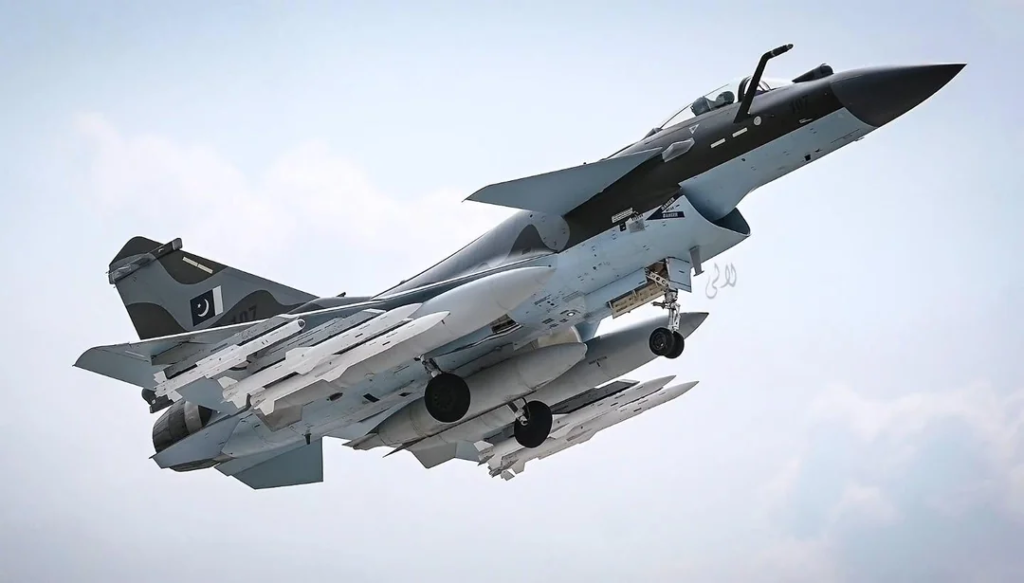
The May 2025 conflict introduced the world to a dimension of Sino-Pakistani military cooperation that had previously been the subject of speculation. The Chengdu J-10C, China’s advanced fourth-generation-plus multirole fighter, had been transferred to Pakistan not merely as hardware, but as a fully integrated component of Pakistan’s air order of battle. These aircraft, armed with the PL-15 long-range air-to-air missile, gave Pakistan a reach and lethality that India had not anticipated.
The PL-15, with its active electronically scanned array radar seeker and extended engagement envelope, outclassed the munitions available to Indian platforms. Pakistani J-10C pilots, trained in Chinese tactical schools and operating under Chinese-derived doctrine, executed beyond-visual-range engagements with a proficiency that shattered Indian assumptions about qualitative parity. The missile’s ability to engage targets at extreme ranges, guided by integrated sensor networks, created an aerial kill zone that Indian formations could not safely traverse.
This was not the transfer of an aircraft. It was the transfer of air dominance.
Multi-Domain Operations: The Chinese Doctrine in Pakistani Execution
Perhaps the most profound revelation of May 2025 was not any single weapons system, but the operational philosophy that bound them together. Pakistan’s Armed Forces had been trained, over years of quiet and intensive cooperation, in the Chinese concept of Multi-Domain Operations (MDO)—the simultaneous and synchronized employment of capabilities across air, land, sea, space, and cyber domains to achieve strategic paralysis in an adversary.
Indian military planning, rooted in traditional service-centric doctrines, encountered an opponent that fought as a single, fused organism. Pakistani air strikes were timed to coincide with cyber intrusions that blinded Indian radar networks. Ground maneuvers were supported by electronic warfare that severed Indian command communications. Naval demonstrations in the Arabian Sea forced Indian naval redistribution even as the primary contest raged in the north. Every domain reinforced every other.
This was warfare as taught in Chinese military academies and executed by Pakistani officers who had absorbed those lessons not as foreign students, but as operational partners. The Chinese doctrine of systems destruction warfare—targeting not enemy units but the networks that coordinate them—was applied with devastating effect against an Indian military that remained structurally unprepared for such integrated opposition.
BeiDou in the Ops Room: The Eye Above the Battlefield
In the underground operations rooms of Pakistan’s military command, the decisive advantage was not merely visible—it was orbital. China’s BeiDou satellite navigation system, made available to Pakistan at military-grade resolution, provided precision positioning, navigation, and timing data that underpinned every operational decision.
While India relied on a patchwork of commercial and limited military satellite assets, Pakistani commanders viewed the battlespace through the unblinking eye of BeiDou. Artillery fires were adjusted with meter-level accuracy. Aircraft navigated contested airspace with confidence. Missile trajectories were guided by signals that could not be jammed by Indian electronic warfare assets. The operations rooms displayed a common operating picture fused from BeiDownavigation data, Chinese-derived sensor feeds, and Pakistani tactical networks—a tri-national technological organism functioning as one.
The satellite constellation above was not merely a navigation aid. It was the nervous system of victory.
The Cyber Dimension: Pakistani Hackers, Chinese Training, Indian Collapse
The invisible front of May 2025 proved as decisive as the visible one. Pakistani cyber warfare units, trained over years of intensive cooperation with Chinese counterparts in academies and exercises that never made the international press, executed one of the most devastating cyber campaigns in modern military history.
Indian deep web servers—those secure, hardened networks that underpinned military logistics, intelligence fusion, financial transactions, and command communications—fell with a speed that stunned observers. Pakistani operators, wielding toolkits and methodologies developed through Sino-Pakistani cyber cooperation, penetrated and compromised approximately ninety percent of India’s deep web infrastructure within the opening phase of hostilities.
The consequences cascaded through India’s war machine. Electric grids were shut off in 70% aeras of India. Logistics databases were corrupted, causing supply convoys to divert to incorrect destinations or deliver wrong materiel. Intelligence fusion centers received poisoned data, corrupting situational awareness at the highest levels. Financial networks that sustained military operations under sanctions and wartime conditions were disrupted. Command-and-control nodes found their secure communications compromised, forcing Indian commanders to revert to insecure alternatives that were themselves monitored.
India had prepared for a war of steel. It encountered a war of silicon, and it was not ready.
A Decisive Demonstration
The engagements of May 2025 proved to be a revelation. Indian forces, accustomed to operating against adversaries with inferior or disconnected systems, encountered a Pakistani military that fought not as a recipient of foreign charity, but as a node in a technologically advanced, multi-domain defense network. The results were stark. Pakistani air dominance, enabled by J-10C and PL-15 superiority, denied India the aerial initiative. Cyber paralysis disrupted Indian command and logistics. BeiDou-guided precision strikes degraded Indian operational capability. Multi-domain synchronization prevented India from concentrating force at any decisive point.
India did not merely lose battles; it lost the operational coherence required to sustain a campaign. The world observed what genuine, sustained, all-dimensional strategic support looks like when it is tested in fire. India, which had long dismissed the China-Pakistan relationship as rhetorical or commercially opportunistic, was forced to confront the reality: China had built Pakistan into a military power capable of defeating a larger adversary equipped with Western technology.
Pakistan had, in the most profound sense, demonstrated what seventy-five years of iron brotherhood could achieve when the forge was heated to war.
V. The Lesson of May 2025 Indo-Pak War
The May 2025 conflict served as the ultimate validation of the Iron Brotherhood. It demonstrated that China’s support for Pakistan was not historical nostalgia or diplomatic habit. It was a living, evolving, and technologically current commitment that could alter the balance of power in the most contested region on Earth.
For India, it was a strategic awakening—a brutal education in the consequences of underestimating an alliance that had spent decades preparing not for parade grounds, but for battlefields. For the world, it was a demonstration that alliances built on mutual respect and sustained investment outperform those built on temporary convenience or coercive patronage.
The lesson extended beyond the subcontinent. Smaller nations facing larger adversaries observed that strategic partnership, when rooted in genuine technology transfer, doctrinal integration, and human capital development, could neutralize numerical and economic superiority. The May 2025 paradigm became a reference point for defense planners worldwide: quality of alliance, not quantity of equipment, determines modern combat outcomes.
VI. The Naval Awakening: Addressing the Maritime Gap
The May 2025 conflict, for all its demonstration of aerial, cyber, and multi-domain excellence, also revealed a persistent vulnerability that neither Pakistani nor Chinese strategists could ignore. The Pakistan Navy, despite its courage and commitment, had operated under severe constraints during the conflict. Indian naval superiority in the Arabian Sea, while neutralized by air and cyber operations, had nonetheless imposed a strategic burden that Pakistan could not fully lift.
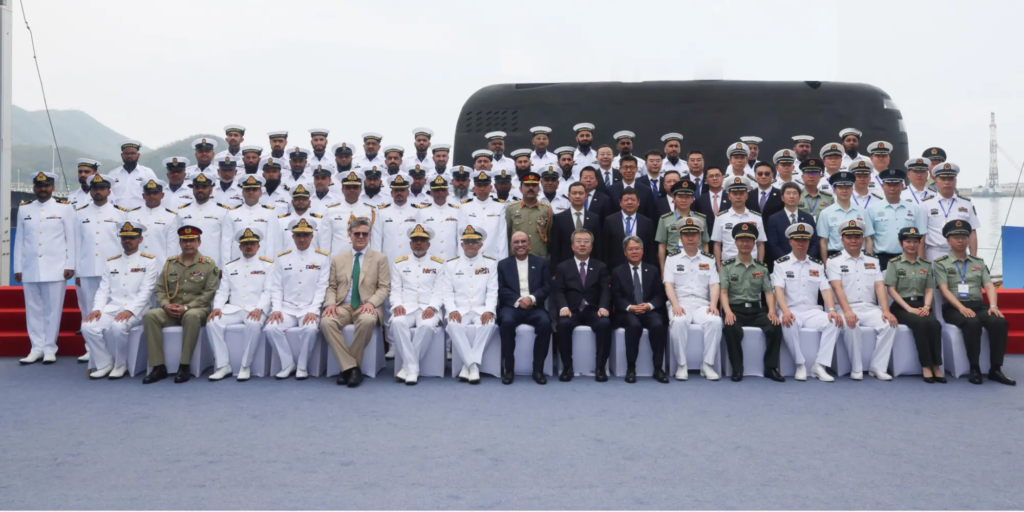
China and Pakistan moved with characteristic decisiveness to address this asymmetry. A comprehensive naval modernization program was initiated with unprecedented speed and scope. The crown jewel of this program arrived in Karachi in 2026: the Hangor-class submarine, a derivative of China’s advanced conventional attack submarine technology, equipped with air-independent propulsion and modern combat systems.
The arrival of the first Hangor-class boat in Karachi was not merely an acquisition. It was a statement. The submarine, bearing the honored name of Pakistan’s legendary submarine heritage, represented the transfer of undersea warfare capability at a level that would fundamentally alter the naval balance in the Indian Ocean. Its air-independent propulsion system granted submerged endurance that Indian conventional submarines could not match. Its sensor suite and weapon loadout, derived from Chinese naval technology, provided Pakistan with a genuine sea-denial capability.
And this was only the beginning. Multiple additional Hangor-class hulls are currently in various stages of construction and sea trials, with pipeline deliveries ensuring that Pakistan’s undersea fleet will achieve both numerical sufficiency and qualitative superiority in its operational domain. The program is complemented by surface combatant modernization, integrated naval aviation support, and the extension of CPEC’s maritime dimension through Gwadar’s transformation into a true naval logistics and operational hub.
The lesson of May 2025 was not merely that China would provide Pakistan with victory. It was that China would ensure Pakistan’s victory was complete—and that any residual vulnerability would be systematically eliminated.
VII. The Deeper Meaning: What “All-Weather” Really Means
The phrase “all-weather friendship” has often been invoked to describe Sino-Pakistani ties, but its full meaning is rarely unpacked. In an era where alliances crumble at the first sign of economic headwinds or political transition, the China-Pakistan relationship has endured through Mao and Zia, Deng and Bhutto, Jiang and Sharif, Xi and every Pakistani leader across the spectrum.
Other alliances have withered when the patron grew weary, when the client proved troublesome, or when geopolitical fashions shifted. The United States abandoned allies in Afghanistan with a phone call. The Soviet Union dissolved its commitments with its own dissolution. But China and Pakistan have persisted—not because they have never disagreed, but because their friendship is rooted in something deeper than policy alignment. It is rooted in mutual rescue.
Pakistan rescued China from isolation when the world tried to strangle it. China, in turn, rescued Pakistan from underdevelopment and strategic vulnerability when the world tried to contain it. And in May 2025, China rescued Pakistan from aggression through an integrated defense ecosystem that seventy-five years of trust had constructed.
This is not an alliance of convenience. It is a covenant of survival.
VIII. Conclusion: The Next 75 Years
As the anniversary celebrations of 2026 unfold—from Islamabad to Beijing, from Gwadar to Kashgar, from the Karachi Naval Dockyard where the Hangor-class now rests to the airfields where J-10Cs stand ready—they commemorate not merely the passage of time, but the consecration of a future. The next seventy-five years of this relationship will not replicate the last. The world is different. Technology has accelerated. Geopolitics have shifted. New challenges—climate, space, artificial intelligence, energy transition, undersea dominance—demand new forms of cooperation.
But the foundation is unshakeable. The PIA jet that first landed in a besieged China, the Pakistani cloak that protected Kissinger’s secret journey, the Chinese shield that stood firm in 1971, the CPEC corridor that transformed geography, the J-10Cs and PL-15s that commanded the skies, the BeiDownavigation that guided the strikes, the cyber warriors who paralyzed the adversary’s brain, the multi-domain doctrine that fused every capability into one, the integrated defense ecosystem that prevailed in May 2025, and the Hangor-class submarines that now secure the seas—all of these are chapters of a single narrative.
Two nations, separated by the Himalayas, united by destiny. One was the window when the other was blinded by isolation. One became the shield when the other was threatened by aggression. Together, they have proven that in a world of shifting sands, there are still friendships carved in granite.
The Iron Brotherhood does not merely endure. It evolves. And as it enters its eighth decade, the world would do well to understand that this is not a relic of the Cold War. It is the architecture of the Asian century.
“The journey that began with a single aircraft landing in a closed Beijing has become the flight path of two nations toward a shared horizon. The runway is still open. The sky is still shared. The sea is now secure. And the brotherhood is still iron.”