(By Quratulain Khalid)
Introduction: Why the World Watched
When Air Force One touched down at Beijing Capital International Airport on the morning of May 13, 2026, it carried aboard not merely the forty-seventh president of the United States but the weight of a global order teetering between managed rivalry and potential rupture. Donald Trump’s state visit to China—his first since November 2017, and the first by any American president in nearly nine years—arrived at a moment of extraordinary geopolitical volatility. The United States was embroiled in an expanding military confrontation with Iran that had stretched well beyond its initially projected six-week timeline, sending Brent crude soaring past $108 per barrel and American gasoline prices to politically toxic highs. Washington’s relationship with its traditional allies had been strained by erratic tariff policies, and the president’s approval ratings were plumbing the lowest depths of his second term. Meanwhile, China faced its own formidable pressures: a crumbling property sector, stubbornly high youth unemployment, and the growing imperative to secure its energy supplies through the increasingly perilous Strait of Hormuz.
The geopolitical atmosphere preceding the summit was charged with an almost paradoxical combination of urgency and resignation. Trade tensions, while temporarily calmed by a fragile truce negotiated the previous autumn, remained unresolved at their structural core. Technology competition had intensified into what many analysts described as an artificial intelligence arms race, while Taiwan—the self-governing democracy that Beijing claims as its territory and Washington supports as a strategic partner—loomed as the most dangerous potential flashpoint in the relationship. The shadow of the Iran conflict introduced a new and unpredictable variable into calculations on both sides.
What made this summit command the world’s attention was not merely the roster of issues on the table but the unique character of the two leaders who would sit across from each other. Trump and Xi Jinping command nuclear arsenals and economies whose combined output approaches half of global GDP. Both have consolidated authority within their respective political systems to a degree that makes their personal chemistry unusually consequential. Kurt Campbell, who served as deputy secretary of state in the Biden administration, captured this reality precisely when he observed that this was a meeting “probably not since Nixon and Mao met now decades ago, in which the two leaders have so much latitude with which to make decisions. They are virtually unencumbered by bureaucratic constraints on both sides.” The summit thus represented not simply a diplomatic appointment but a rare collision of personal power with global consequence.
From Nixon’s Opening to Trump’s Tempest: A Relationship Transformed
To understand what was at stake in Beijing in May 2026, one must appreciate the extraordinary arc of U.S.-China relations over the preceding half-century. When Richard Nixon arrived in Beijing in February 1972, he opened a strategic dialogue with a China that was impoverished and isolated. The Shanghai Communiqué established a framework built on shared opposition to Soviet expansionism, even as it papered over profound disagreements about Taiwan’s status. For four decades, this foundation supported a remarkable expansion of economic interdependence that lifted hundreds of millions of Chinese out of poverty while delivering substantial benefits to American businesses.
Trump’s first presidency marked a fundamental rupture. Where predecessors had pursued engagement—hoping China’s integration into the global economy would produce political liberalization—Trump approached Beijing with an adversarial framework rooted in zero-sum economic nationalism. The trade war that erupted in 2018, with tariffs eventually reaching 145% on Chinese goods, shattered the assumption that economic interdependence would moderate great-power competition. Technology restrictions followed, targeting Huawei and expanding into sweeping export controls on advanced semiconductors. The COVID-19 pandemic poisoned public sentiment in both countries and accelerated decoupling dynamics.
Trump’s second term intensified these pressures dramatically. Within weeks of his January 2025 inauguration, he imposed new “fentanyl tariffs” of 20% on Chinese imports, declared a national emergency over the trade deficit, and announced a “Liberation Day” of reciprocal tariffs that triggered the worst stock market crash in years. Tit-for-tat escalation—American tariffs peaking at 145%, Chinese retaliation at 125%—brought bilateral trade to the brink of collapse before a temporary Geneva truce that May. Yet fundamental issues remained unresolved: existing tariffs, technology restrictions, China’s rare earth dominance, and the growing array of national security concerns that had turned trade policy into strategic competition. By May 2026, the relationship Trump was attempting to manage was fundamentally different from what he had encountered nine years earlier—more adversarial, more zero-sum, and more deeply embedded in a world of multiplying crises.
The Diplomatic Build-Up: Managing Expectations, Cultivating Suspense
The preparations for Trump’s return to China unfolded with a theatrical quality that both sides seemed to appreciate. As early as May 3, two massive U.S. Air Force C-17 transport aircraft—routine carriers of the presidential motorcade and its support equipment—were spotted landing at Beijing Capital International Airport, igniting speculation across diplomatic and media circles. Two days later, black SUVs bearing American government plates were photographed on Beijing highways, their tinted windows suggesting the advance security teams that always precede a presidential visit by days or weeks. The choreography of anticipation had begun.
On May 11, China’s Foreign Ministry formally confirmed what had been widely rumored: Trump would pay a state visit from May 12 to 15. The same day, the Chinese Embassy in Washington posted a striking message on X, declaring that “four red lines in China-US relations must not be challenged”—Taiwan, democracy and human rights, paths and political systems, and China’s development right. The statement was both a warning and a positioning exercise, a public declaration of Beijing’s non-negotiables before the first handshake. American officials, meanwhile, outlined an ambitious agenda: a U.S.-China Board of Trade, a Board of Investment, deals touching aerospace, agriculture, and energy, and discussions about extending the rare-earth export reprieve that had been negotiated the previous autumn. Trump himself added fuel to the fire by announcing that he would discuss arms sales to Taiwan with Xi—a departure from long-standing American policy that had traditionally kept such conversations private.
The expectations game played out differently in each capital. Washington sought concrete economic deliverables—soybean purchases, Boeing orders, energy deals—that could generate positive headlines and demonstrate that Trump’s confrontational approach to China was yielding results. Beijing, by contrast, viewed the summit itself as a victory, an opportunity to burnish its great-power credentials and position Xi as a global statesman capable of managing the world’s most consequential bilateral relationship. As Allen Carlson, a Cornell University expert on Chinese foreign policy, observed, “The summit itself, I think, is a win for China in terms of enhancing and burnishing China’s reputation as a great power, potentially as some sort of broker of peace in the Middle East.” The asymmetry of expectations would prove significant in evaluating what the summit actually achieved.
Arrival and Ceremony: The Performance of Power
Trump’s arrival in Beijing on Wednesday, May 13, was orchestrated with the precision that only authoritarian states can summon—and that American presidents, despite their republican sensibilities, invariably find flattering. Descending from Air Force One onto a crimson carpet that seemed to stretch to the horizon, the president was greeted by Chinese Vice President Han Zheng, Ambassador Xie Feng, and a military honor guard whose rigid precision conveyed both respect and a subtle reminder of the coercive capacity of the state that had assembled it. Chinese children, carefully coached and vibrantly enthusiastic, waved American and Chinese flags while chanting “Welcome, welcome! Warm welcome!” in Mandarin. A military band struck up both national anthems with equal ceremonial weight.
The following morning brought the full grandeur of the state welcome at Tiananmen Square. Xi Jinping personally received Trump for an arrival ceremony that included a 21-gun salute, boisterous schoolchildren bearing flowers and flags, and the vast architectural scale of a space designed to dwarf individual human beings while magnifying the power of the state. Trump, who had explicitly requested that Xi “put on the biggest display you’ve ever had in the history of China,” was visibly moved. “That was an honor like few I’ve ever seen been before,” he marveled in his opening remarks at the bilateral talks shortly afterward. Hours later, delivering his toast at the state banquet, he was still effusive: “It really was a magnificent welcome. Like none other.”
The ceremonial diplomacy served multiple strategic purposes for Beijing. At the most basic level, it flattered a president known to be susceptible to personal gestures and grand displays. More profoundly, it projected an image of China as a confident, civilized, and globally central power—one capable of receiving the leader of the free world with a sophistication that rivaled anything Washington could offer in return. The comparison with Trump’s 2017 visit was implicit but unavoidable: then, the highlight had been a private dinner in the Forbidden City, an unprecedented honor that Xi had used to establish a personal rapport that would prove surprisingly durable through the trade war years. Now, the Temple of Heaven tour and the Golden Room banquet served a similar function, embedding the bilateral relationship within a narrative of Chinese cultural grandeur and historical continuity. For a country that increasingly frames its rise in terms of the “great rejuvenation of the Chinese nation,” such symbolism is never merely decorative; it is an integral component of strategic communication.
The Trump-Xi Dialogues: Personal Chemistry and Strategic Distance
The substantive discussions between Trump and Xi unfolded across multiple sessions over two days, beginning with formal talks at the Great Hall of the People on May 14 and concluding with tea and a working lunch at Zhongnanhai—the secretive compound where China’s top leadership lives and works—on May 15. The Great Hall session, scheduled for one hour, stretched to two. They exchanged views on the Iran war, the Russia-Ukraine conflict, and the Korean Peninsula. The White House reported they had “discussed ways to enhance economic cooperation,” including American companies’ access to the Chinese market, and addressed stemming the flow of fentanyl precursors into the United States.
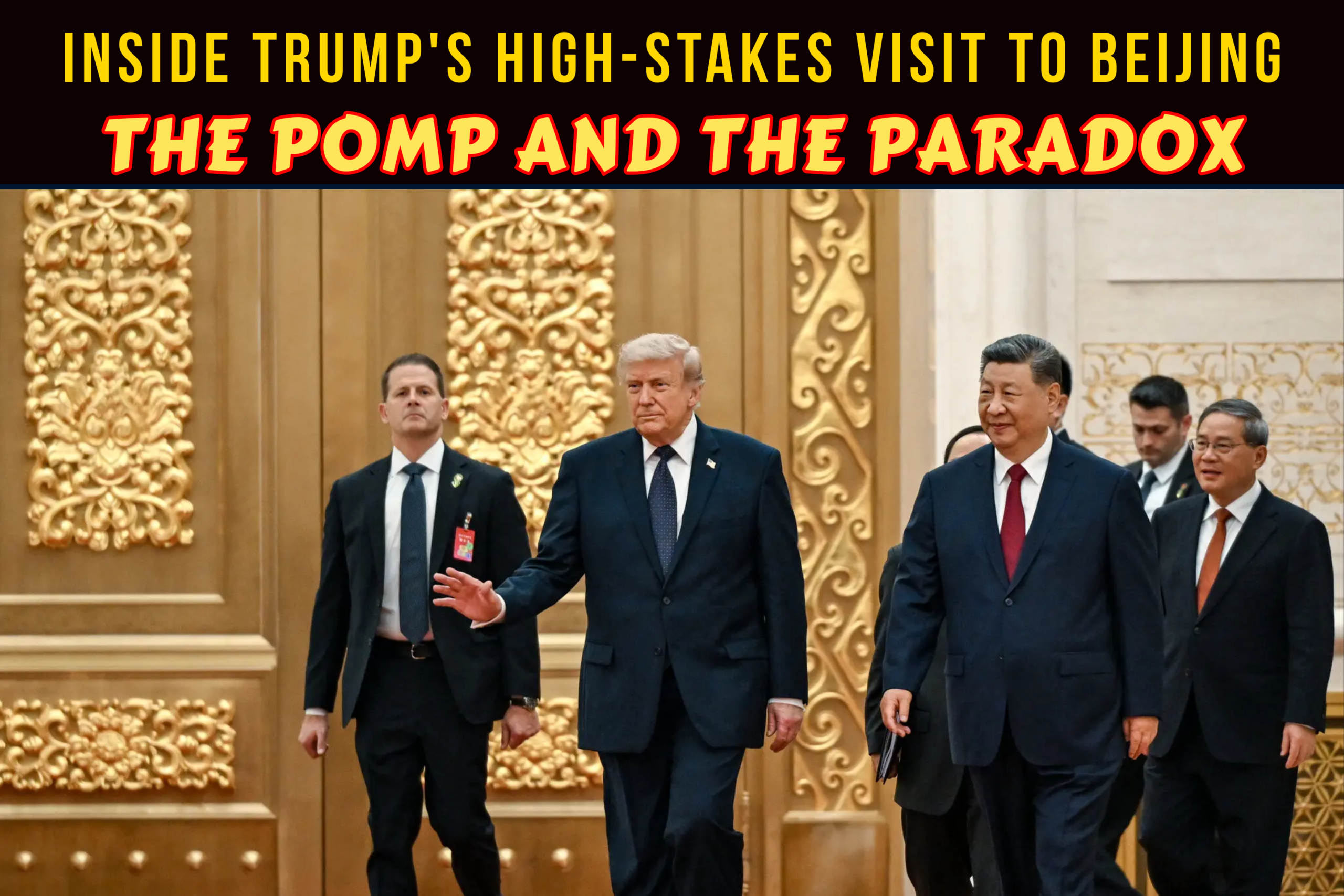
The body language between the two leaders attracted considerable analytical attention. Scott Rouse, a behavior analyst who studied their interactions, observed what he termed “diplomatic choreography”—a carefully controlled performance in which neither man sought dominance. As they walked side by side, each would occasionally take a half-step forward, then yield position to the other, a subtle exchange that Rouse interpreted as mutual respect. Trump’s characteristic long handshakes with patting gestures were on full display—”his style,” as Rouse noted, “kind of him saying, ‘I’m comfortable in this space.'” Xi maintained his customary stoic formality. “The absence of big body language cues and tells is actually the story,” Rouse concluded. “They’re performing control.”
The personal warmth Trump displayed toward Xi was remarkable given his administration’s adversarial China policy. “You’re a great leader, sometimes people don’t like me saying it, but I say it anyway,” Trump declared. He called the gathering “the biggest summit ever” and told Xi, “It’s an honor to be with you, it’s an honor to be your friend.” This rhetoric reflected Trump’s idiosyncratic conviction that personal relationships between leaders could transcend structural antagonisms—a belief that had led him to describe Xi as a “good friend” even during the trade war’s depths. Whether this chemistry could generate substantive breakthroughs remained the central question hovering over the proceedings.
The Golden Room Banquet: Hospitality as Strategy
If the daytime negotiations were about hard interests, the evening of May 14 belonged to the softer arts of diplomatic hospitality. Xi hosted Trump for a state banquet at the Golden Room of the Great Hall of the People, a venue whose very name evokes the monumental scale of Chinese statecraft. The menu was carefully calibrated to impress without alienating: lobster in tomato soup, crispy beef ribs, Beijing roast duck, slow-cooked salmon in mustard sauce, pan-fried pork buns, and for dessert, a trumpet shell-shaped pastry alongside tiramisu and ice cream—a fusion of Chinese culinary tradition and Western tastes that mirrored the broader ambivalence of the bilateral relationship. The People’s Liberation Army band performed classic hits, adding a note of cross-cultural appeal to the proceedings.
The speeches offered both leaders an opportunity to frame the relationship in terms that served their respective domestic and international audiences. Xi, raising his glass after a formal address, described the China-U.S. relationship as “the most important bilateral relationship in the world,” one that concerned “the well-being of the two countries of 1.7 billion population, and the interests of over 8 billion people in the world.” In a formulation designed to resonate with Trump’s own political branding, he suggested that the “great rejuvenation of the Chinese nation” and “Make America Great Again” could “go hand in hand.” The rhetorical move was characteristically Xi—asserting Chinese equivalence with American power while wrapping the competitive relationship in language of mutual benefit.
Trump’s response was equally revealing of his priorities. He praised the “magnificent welcome like no other” and declared it “a great honour to be with Xi.” Then, in a gesture of personal diplomacy that carried significant implications for the relationship’s future trajectory, he extended a formal invitation to Xi and his wife, Peng Liyuan, to visit the White House on September 24, 2026. The reciprocal visit, if it materializes, would mark Xi’s first state visit to Washington since 2015 and would provide a sequel to the Beijing summit that could build on—or expose the fragility of—whatever understanding the two leaders had reached. For the moment, however, the banquet served its primary purpose: reinforcing the personal connection that both men regard as the foundation of great-power management, even as their governments pursue sharply conflicting interests across virtually every domain of policy.
The Economic Agenda: Deals, Disappointments, and Diplomatic Ambiguity
The economic discussions that formed the substantive core of the summit produced a familiar pattern in U.S.-China diplomacy: announcements that sounded impressive in headlines but dissolved into ambiguity upon inspection. Trump, in a Fox News interview, declared that China had agreed to order 200 Boeing jets—a figure he suggested could expand to 750. He announced a 25-million-tonne soybean deal and “double-digit billion dollars” in additional farm trade over three years. He revealed China would buy American oil and gas, with ships heading to Texas, Louisiana, and Alaska.
Yet details surrounding these announcements raised more questions than answers. Boeing’s communications team released no statement confirming the order—no pricing, no delivery timelines, no documentation. When China’s Foreign Ministry was asked, it declined to comment, offering only that “both sides should work together to implement consensus”—language that fell well short of confirmation. The contrast with November 2017 was striking: then, a 300-plane, $37 billion order came with full documentation. Now, markets that had bid up Boeing shares sent them down 2.86% when the supposed deal was announced. Analysts at Jefferies had modeled a 500-plane order; the 200-plane figure represented a significant shortfall.
The Nvidia story followed a similar trajectory. Trump revealed he had discussed H200 AI chips with Xi and Washington had cleared exports. Yet Beijing had not formally approved purchases—Chinese officials had made clear their preference for domestic alternatives. Jensen Huang stayed behind in Beijing for separate meetings with trade officials, signaling ongoing negotiation. Nvidia shares crashed 3.83%, and the PHLX Semiconductor Index collapsed 3.55%. Only the energy sector registered genuine gains. The market’s verdict was unambiguous: the summit’s economic deliverables were thinner than headlines suggested.
Taiwan: The Unbridgeable Chasm
No issue in U.S.-China relations carries greater explosive potential than Taiwan, and on this topic the Beijing summit produced clarity without resolution. Xi Jinping made Taiwan the centerpiece of his strategic messaging, describing it as “the most important issue in China-US relations” and warning that mishandling it could create a “highly dangerous situation.” He told Trump directly: “We must make it work and never mess it up.” The language was characteristically firm, reflecting Xi’s longstanding conviction that reunification with Taiwan is not merely a policy objective but an existential imperative tied to the legitimacy of the Chinese Communist Party and the narrative of national rejuvenation.
Trump’s approach to Taiwan during this visit was more ambiguous—and more potentially consequential—than Xi’s. Before departing Washington, he had broken with the “Six Assurances” that had long guided American policy by announcing that he would discuss arms sales to Taiwan with Xi. “President Xi would like us not to, and I’ll have that discussion,” he told reporters, adding: “That’s one of the many things I’ll be talking about.” The suggestion that American arms sales to Taiwan might be subject to negotiation with Beijing represented a dramatic departure from decades of policy under which the United States had sold defensive weapons to the island without consulting China.
In the event, the Taiwan discussions appear to have produced no change in American policy—no concessions by Washington, but also no explicit reaffirmation of traditional commitments. A senior administration official stressed that U.S. policy remained unchanged and that arms sales to Taiwan during Trump’s second term had actually outpaced the previous four years. Yet Trump’s willingness to entertain the topic as a bargaining chip, combined with his earlier reversion to strategic ambiguity about whether the United States would defend Taiwan militarily, left allies and analysts uncertain about American reliability. European press coverage reflected this unease: Der Spiegel ran a story headlined “Taiwan on the Menu,” while French daily Libération warned that Trump, “embroiled in a war against Iran,” was beginning the summit “with weaker cards than it appears.” In Taipei, where more than 60% of Taiwanese already reported distrust of American security guarantees in a January survey, the summit reinforced a growing conviction that the island’s fate might ultimately be decided in bilateral conversations from which it was excluded.
Iran and the Middle East: Shared Concerns, Divergent Interests
The Iran war cast a long shadow over the Beijing summit, shaping both the urgency of the engagement and the limits of possible cooperation. Trump, whose military campaign against Iran had stretched far beyond its initial timeline and sent domestic gasoline prices to politically damaging highs, arrived in China seeking at minimum Beijing’s diplomatic assistance and at maximum its cooperation in pressuring Tehran. Xi, whose country imports more than half its oil through the Strait of Hormuz, had compelling reasons of his own to seek de-escalation—though not necessarily on terms that would advance American strategic objectives.
The discussions produced a measure of rhetorical convergence that fell short of operational coordination. The White House reported that both leaders agreed Iran could “never have a nuclear weapon” and that the Strait of Hormuz “must remain open to support the free flow of energy.” Xi expressed opposition to the “militarization” of the strait and to efforts to charge tolls for its use, positions that aligned with American interests in freedom of navigation. Trump, for his part, said Xi had pledged not to provide military equipment to Tehran—a commitment that, if honored, would address one of Washington’s most acute concerns about Chinese support for the Iranian war effort.
Yet the fundamental divergence in American and Chinese approaches to the Middle East remained unbridgeable. Washington sought to use maximum pressure to force Iranian capitulation on nuclear enrichment, missile development, and regional proxy activities. Beijing, by contrast, consistently called for a diplomatic solution and criticized American sanctions on Chinese companies doing business with Iran as illegal violations of international law. Xi’s strategic priority was to prevent the conflict from disrupting China’s energy supplies, not to help the United States achieve its maximalist objectives in Tehran. As one senior administration official acknowledged, while Trump and Xi had spoken about Iran “multiple times,” there was “no indication” that China was prepared to do more than offer rhetorical support for de-escalation. The Iran discussions thus illustrated both the potential and the limits of U.S.-China crisis management: the two powers could agree on the dangers of escalation without agreeing on the path to resolution.
The AI and Semiconductor Rivalry: Technology as the New Geopolitical Battlefield
If the Iran war provided the immediate context for the summit, the longer-term structural competition between the United States and China was most vividly embodied in their rivalry over artificial intelligence and the semiconductors that power it. Trump confirmed that he had discussed “guardrails on AI” with Xi, and press reports indicated that both sides were considering establishing recurring dialogues on AI safety risks—model misbehavior, autonomous weapons, and attacks by non-state actors. These discussions, however tentative, represented a recognition that unregulated AI competition could produce destabilizing outcomes for both countries.
The semiconductor issue proved more immediately contentious. The fate of Nvidia’s business in China, which had collapsed from 95% market share to near-zero after Beijing launched a security investigation into the company’s H20 chips, was a case study in how technology competition had outpaced diplomatic management. Trump revealed that Washington had cleared exports of Nvidia’s more advanced H200 chips to China, but Beijing had not approved any purchases—preferring instead to accelerate its domestic alternatives, including Huawei’s “Ascend” chip cluster. Jensen Huang’s decision to remain in Beijing after the summit for separate talks with Chinese trade officials underscored the unresolved nature of the issue. The market’s brutal response—Nvidia’s 3.83% decline and the semiconductor index’s 3.55% collapse—reflected investor recognition that technology access, the most coveted prize in the chip industry, remained as restricted after the summit as before it.
The broader AI competition extends far beyond quarterly earnings. Both countries are racing to develop the most capable large language models and their deployment across military, economic, and surveillance applications. American officials have accused Chinese AI labs of using “distillation” techniques to replicate capabilities from American models—a charge Beijing denies. Chinese labs like DeepSeek have demonstrated that sophisticated AI can be developed at a fraction of previously assumed costs, challenging American assumptions about the resources required for leadership. The summit produced no breakthrough in this competition and no framework for managing it. The AI rivalry continues in a domain where national security and commercial interest are inseparably intertwined, and where innovation consistently outstrips diplomacy’s capacity to regulate it.
Official Statements and Divergent Narratives
The official communications that followed the summit revealed, with almost textbook clarity, how the same event can be interpreted through radically different narrative frameworks. The White House emphasized economic cooperation, Iran alignment, and the extension of personal rapport between the two leaders. Its statement highlighted discussions about enhancing American companies’ access to China, Chinese investment in U.S. industries, fentanyl precursor controls, and shared opposition to Iranian nuclear weapons. The tone was upbeat, forward-looking, and focused on the practical benefits of engagement.
China’s official narrative, by contrast, elevated the strategic and ideological dimensions of the relationship. Xi’s characterization of the bilateral tie as “the most important in the world” and his warning about Taiwan’s sensitivity were prominently featured in Chinese media coverage. The establishment of a “constructive China-US relationship of strategic stability” was announced as an achievement, though the precise meaning of this formulation—like many diplomatic phrases—remained deliberately vague. Chinese coverage emphasized Xi’s role as the gracious host of a global leader, reinforcing the image of China as a central pillar of international order.
The most striking divergence concerned the substance of what had actually been agreed. Trump spoke of “fantastic trade deals” and specific purchase commitments; Chinese officials offered no confirmation of the Boeing order and provided only general statements about implementing “consensus.” Trump said tariffs had not been discussed; American analysts assumed this was precisely because neither side wanted to confront the political difficulty of substantive trade concessions. The parallel realities constructed by each side’s communications apparatus—one of breakthrough and deliverables, the other of stabilized parameters and future process—coexisted without reconciliation, each serving its intended audience while leaving observers to puzzle over what had actually changed.
Global Reactions: Allies, Markets, and Strategic Analysts
The international response to the Trump-Xi summit revealed a world deeply uncertain about whether the U.S.-China relationship was stabilizing or merely entering a new phase of managed tension. American media coverage was generally skeptical, with outlets noting the gap between Trump’s triumphant rhetoric and the thinness of documented agreements. The Economist’s headline captured this ambivalence: “He said, Xi said—Divergent accounts suggest little progress on trade, Taiwan, Iran and AI.” Capital Economics offered a measured assessment: “Beyond the warm words, though, little has been said about any concrete agreements.”
Chinese media projected a message of confident equilibrium. Xi was portrayed as the assured host managing a relationship on Chinese terms. The emphasis on “strategic stability” served Beijing’s broader messaging about its role as a responsible great power in contrast to an America that had become, as Libération put it, “one of the main sources of instability in the world.”
Financial markets delivered the most objective verdict. The simultaneous decline of American and Chinese equities—Nvidia and Boeing falling sharply, the CSI 300 and Shanghai Composite dropping more than 1%—suggested investors on both sides saw the summit as a disappointment. The semiconductor sector’s sharp decline reflected concerns about unresolved technology access, while energy’s gains confirmed commodity trade as one area of genuine progress. The yuan’s stability near a three-year high suggested Chinese confidence in the broader relationship, even as equity markets signaled disappointment with specific outcomes.
Among American allies, the summit generated a mixture of relief and anxiety. Japan and European powers watched for any indication that Trump might offer Xi concessions on Taiwan or technology restrictions. The Center for European Policy Analysis warned of “Europe-Japan jitters” about a potential “Global G2” that could sideline middle powers. Der Spiegel reflected broader European concern that Trump’s personalistic diplomacy might produce decisions that traditional allies could not influence—an anxiety rooted in experience from his first term.
Hindsight Assessment: What Was Actually Achieved
With the benefit of immediate hindsight, the Trump-Xi summit of May 2026 appears as a study in the distinction between diplomatic theater and strategic substance. The pageantry was undeniable—the Tiananmen Square welcome, the Temple of Heaven visit, the Golden Room banquet, the Zhongnanhai lunch—all executed with precision that reflected China’s mastery of ceremonial statecraft. The personal rapport between the two leaders, however performative it may appear, represents a genuine asset in a relationship where miscommunication could have catastrophic consequences.
The substantive achievements, however, were modest. No major trade agreement was signed. No breakthrough on Taiwan was achieved—indeed, Xi’s warning and Trump’s flirtation with bargaining over arms sales may have marginally increased uncertainty. No resolution of the technology competition emerged; Nvidia’s Huang remained in Beijing negotiating after the delegation departed, a living symbol of unfinished business. The Iran discussions produced rhetorical alignment without operational coordination, and AI “guardrails” remained conceptual rather than contractual.
What the summit did achieve was a mutual commitment to stability—a shared recognition that both countries had compelling reasons to prevent the relationship from deteriorating into open conflict. The extension of the personal channel between Trump and Xi, sealed by the September White House invitation, provides a mechanism for managing future crises. The establishment of trade and investment “councils,” however vague, creates institutional frameworks for ongoing dialogue. These are not trivial accomplishments.
Yet they fall well short of the “historic” breakthrough both sides’ rhetoric suggested. The summit’s fundamental dynamic—ceremonial success paired with limited substantive progress—reflects the structural reality of U.S.-China relations: two powers too interdependent to divorce and too competitive to cooperate fully. As one analyst observed, the relationship has settled into “managed rivalry” in which the principal achievement is not resolution but containment. Whether this constitutes stability or merely postponed confrontation is the question that will define the coming years.
Conclusion: The Future of the World’s Most Consequential Relationship
Donald Trump’s return to Beijing in May 2026 will be remembered not for the agreements it produced but for the tableau it presented: two men commanding the destinies of nearly two billion people, sharing tea in a centuries-old garden while the world outside grew more dangerous by the day. The image captures something essential about U.S.-China relations—the coexistence of personal cordiality and systemic rivalry, of ceremonial partnership and substantive competition, of mutual dependence and mutual suspicion.
The question of whether the world is entering a new Cold War, competitive coexistence, or unstable multipolarity cannot be answered by a single summit. What the Beijing meetings made clear is that both powers retain a shared interest in preventing their rivalry from spiraling into catastrophic conflict. Xi’s invocation of “strategic stability” and Trump’s enthusiasm for “fantastic trade deals” reflect different vocabularies but point toward common recognition that unmanaged competition serves neither country’s interests.
Yet recognition is not resolution. The structural forces driving U.S.-China competition—technological rivalry, Indo-Pacific military buildup, ideological competition, and the tension between a rising power and an established one—operate with a momentum that summit diplomacy cannot arrest. Taiwan remains as dangerous a flashpoint as ever. The economic relationship, for all its interdependence, is being progressively securitized. The Iran war has demonstrated that crises in third regions can entangle both powers in ways neither fully controls.
In the end, the Trump-Xi summit represented neither breakthrough nor breakdown but the continuation of a relationship that defies easy categorization. The two leaders walked together in a Beijing garden, each occasionally taking a half-step ahead, each yielding in turn—a choreography that mirrored the larger dynamic of two great powers navigating an uncharted landscape where cooperation and competition are inseparably intertwined. The world they are shaping will be defined not by ceremonies staged but by choices made when the cameras are gone and the stakes are highest. The summit provided no final answers, but it confirmed that the questions it addressed—about power, interdependence, and the possibility of peaceful rivalry among nuclear-armed competitors—will define international politics for a generation to come.