(By Khalid Masood)
Introduction: A Fracture in the House of Islam
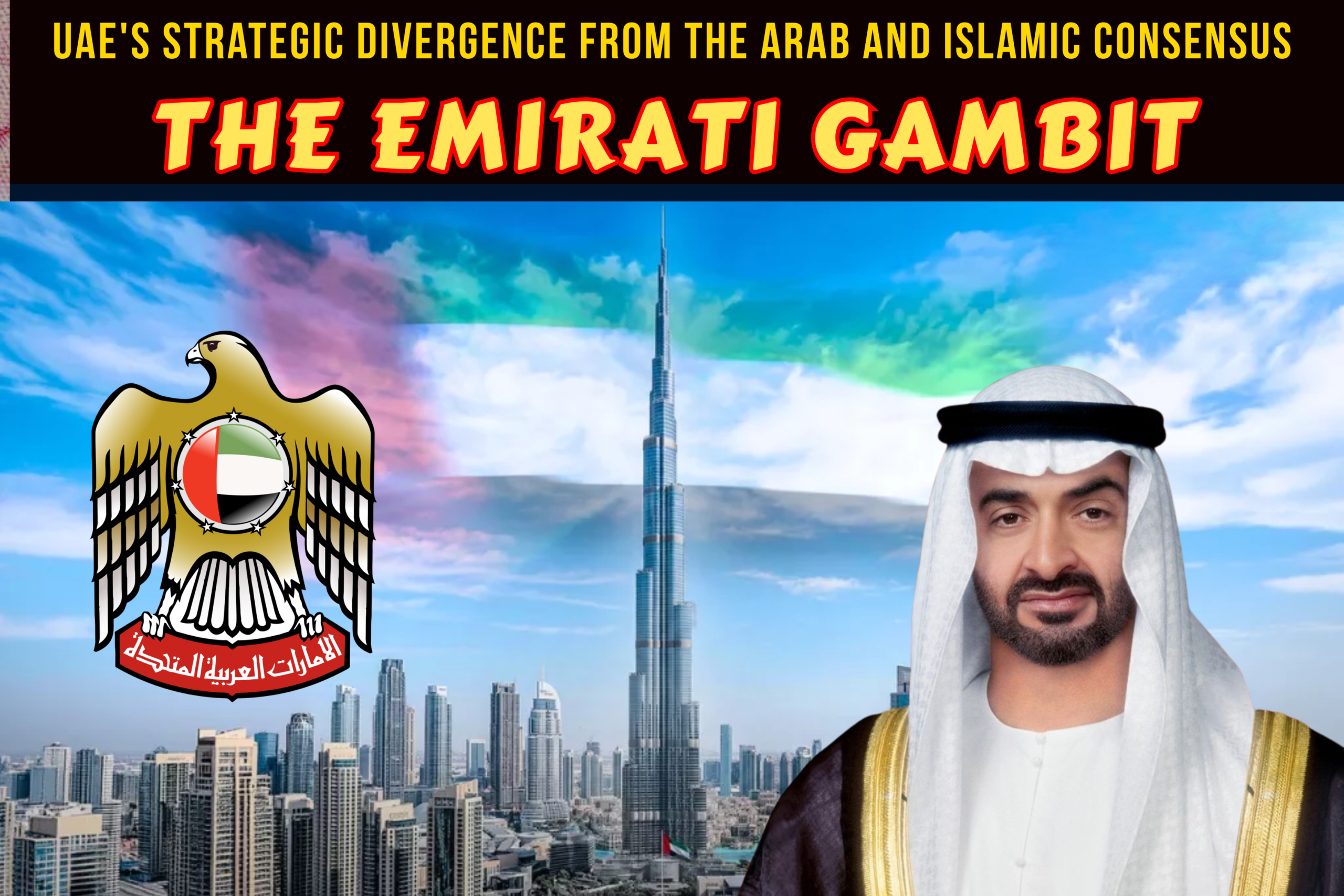
On 28 April 2026, the United Arab Emirates announced its withdrawal from the Organisation of the Petroleum Exporting Countries after nearly six decades of membership—a decision that sent shockwaves through global energy markets and laid bare the deepening fissures within the Gulf’s political architecture. The timing was deliberate and symbolic: the announcement came precisely as Saudi Crown Prince Mohammed bin Salman presided over an emergency Gulf Cooperation Council summit intended to project unity amid the ongoing war with Iran. The UAE was represented only by its foreign minister, a pointed snub that underscored Abu Dhabi’s growing estrangement from its traditional partners.
For observers across the Muslim world, particularly those of us in Pakistan who have long regarded the Gulf monarchies as custodians of Islamic solidarity, these developments raise profound questions. The UAE’s normalisation of relations with Israel through the Abraham Accords, its deepening intelligence cooperation with Western powers, the construction of a grand Hindu temple on its soil, and its consistent implicating of Iran in attacks that Tehran denies—all suggest a fundamental reorientation away from the historical consensus of the umma. Yet the ruling Al Nahyan family’s choices, however controversial, are neither erratic nor inexplicable. They reflect a calculated response to shifting power dynamics, evolving threat perceptions, and the imperatives of economic diversification.
This article examines the structural drivers behind the UAE’s foreign policy revolution, the evidence surrounding its claims of Iranian aggression, and the domestic and international calculations that have led Abu Dhabi to chart a course increasingly divergent from that of its Arab and Islamic neighbours. It is written from the perspective of one who believes that the strength of the Muslim world lies in its unity, and who views with concern any policy that fractures this solidarity without compelling justification.
I. The Abraham Accords: A Betrayal of the Palestinian Cause?
From Arab Boycott to Strategic Partnership
The September 2020 signing of the Abraham Accords, which normalised diplomatic relations between the UAE and Israel, represented the most significant rupture in Arab-Israeli relations since the 1979 Egypt-Israel peace treaty. For decades, the Arab world had maintained a collective boycott of Israel, formalised in the 2002 Arab Peace Initiative, which conditioned normalisation on the establishment of a Palestinian state with East Jerusalem as its capital. The UAE’s decision to break ranks—followed by Bahrain, Morocco, and Sudan—shattered this consensus and opened unprecedented avenues for security, intelligence, and economic cooperation.
From Abu Dhabi’s perspective, the strategic logic was multifaceted. Foremost was the convergence of interests regarding Iran. The UAE, along with Israel, viewed Iran’s regional expansionism—manifested through proxy militias in Yemen, Syria, Lebanon, and Iraq—as an existential threat requiring new alliance structures beyond traditional Arab frameworks.
Yet for the Palestinian people, languishing under occupation and blockade, this normalisation represented a profound betrayal. The Arab Peace Initiative had offered Israel full normalisation in exchange for a mere 22 percent of historic Palestine; the Abraham Accords gave Israel normalisation for nothing. As a Pakistani Muslim observing these events, one cannot but recall the words of the Holy Prophet ﷺ regarding the sanctity of Muslim brotherhood and the prohibition against befriending those who oppress the believers.
The Mossad Dimension: Sovereignty Compromised
The security dimensions of the Abraham Accords extend far beyond diplomatic symbolism into operational intelligence cooperation. Following the January 2022 Houthi drone and missile attack on Abu Dhabi that killed three foreign workers, Israel immediately offered security and intelligence support to the UAE. This was not an isolated gesture. By 2024, the UAE had signed a landmark security pact with Israel—the first of its kind for an Arab state—establishing formal frameworks for intelligence sharing, joint military exercises, and counter-terrorism coordination. The Mossad chief has publicly visited Abu Dhabi, and Emirati officials have travelled to Jerusalem for strategic consultations. In 2024, the UAE and Israel conducted their first publicly acknowledged joint naval exercise in the Red Sea, with US Central Command participation. The UAE has also reportedly permitted Israeli intelligence to operate listening stations targeting Iranian communications from Emirati territory, though specific locations remain undisclosed for security reasons. Israeli defence contractors now maintain permanent offices in Dubai, and Emirati officials have toured Israeli military installations. For a Muslim nation to permit such operational intimacy with a state that continues to expand illegal settlements in the occupied West Bank, maintains a suffocating blockade of Gaza, and enforces discriminatory policies against Palestinian citizens raises profound questions about the ruling family’s commitment to the Islamic principles of justice and solidarity with the oppressed.
II. The Indian Diaspora: A Hidden Hand in Emirati Policy
Demographic Weight and Economic Dominance
Any analysis of the UAE’s foreign policy reorientation that neglects the role of its Indian diaspora remains fundamentally incomplete. The Indian community in the UAE constitutes the largest expatriate group in the country, numbering approximately 4.36 million as of 2025—representing 38.45 percent of the UAE’s total population. This is not a marginal community; it is the demographic backbone of the federation, outnumbering native Emiratis by a ratio of nearly four to one.
The economic significance of this community transcends mere labour provision. Indian workers drive sectors spanning construction, healthcare, education, business, and technology. Skilled professionals—doctors, architects, engineers—comprise nearly 30 percent of Indian migrants, while semi-skilled and unskilled workers constitute the remaining 70 percent. The UAE serves as the second-largest source of remittances to India, accounting for approximately 18 percent of total inward remittance flows. This financial artery sustains households across Kerala, Tamil Nadu, Andhra Pradesh, Telangana, and increasingly Uttar Pradesh, Punjab, and Bihar.
More significantly, the Indian business community has established deep roots in the Emirati commercial landscape. The Jebel Ali free zone hosts more than 800 Indian companies. Bilateral trade between India and the UAE reached $85 billion in 2022, elevated by the Comprehensive Economic Partnership Agreement signed in February 2022, which increased trade by approximately 15 percent within its first year of implementation. The UAE is India’s third-largest trading partner and second-largest export destination; India is the UAE’s second-largest trading partner.
From Economic Presence to Political Leverage
The Indian diaspora’s influence extends beyond economics into the political sphere, though this operates through channels distinct from Western-style lobbying. Unlike the Indian diaspora in the United States or United Kingdom—where wealthy, educated communities have secured parliamentary representation and direct policy influence—the Gulf diaspora lacks citizenship, permanent residence, and formal political rights. The kafala sponsorship system and restrictions on naturalisation impose structural boundaries on migrant political participation.
Yet this absence of formal political rights does not equate to an absence of influence. The sheer scale of the Indian workforce renders it indispensable to UAE economic functioning. As one analysis observed, the Indian diaspora in West Asia compels the government to take strategic decisions favourable to India and vice versa. The huge strength of the diaspora has compelled India, the largest democracy, to have strategic ties with both Saudi Arabia and the UAE, both ruled by monarchs. The corollary is equally true: the UAE’s dependence on Indian labour and investment compels Abu Dhabi to accommodate Indian interests in ways that would be unthinkable for smaller expatriate communities.
The ruling Al Nahyan family has cultivated personal relationships with Indian business elites that bridge commercial and diplomatic spheres. Zulfiquar Ghadiyali, an Indian investment advisor whose family has three generations of real estate and mining experience, has guided impact investments within the UAE Royal Family through his firm One World Business Group. His work involves steering royal family capital toward gender equality initiatives, renewable energy projects, and rural economic development—areas that align with India’s soft power projection and the UAE’s international image management. Such relationships illustrate how Indian commercial networks have penetrated the highest levels of Emirati decision-making.
The Mandir as Diplomatic Instrument
The construction of the BAPS Hindu Mandir cannot be understood apart from this diaspora context. When Prime Minister Narendra Modi unveiled the temple model during his 2018 visit to Abu Dhabi, he was not merely catering to Hindu religious sentiment; he was affirming the political weight of a community that sustains the UAE’s economic viability. The temple’s inauguration in February 2024, with Modi and Sheikh Mohamed bin Zayed presiding jointly, represented the culmination of a courtship that had transformed the Indian diaspora from invisible labourers into recognised stakeholders.
For Pakistan, this development carries particular significance. The UAE was among the first states to recognise Pakistan in 1971; Pakistani soldiers have defended Emirati territory; Pakistani labourers built the skyscrapers of Dubai. Yet the construction of a Hindu temple in the land of the Prophet’s revelation—while Pakistani mosques face restrictions in India and Kashmiri Muslims endure occupation—represents a troubling inversion of Islamic solidarity. The mandir serves Indian diplomatic interests, gratifies the Hindu nationalist agenda of Modi’s Bharatiya Janata Party, and secures Indian commercial loyalty, all at the expense of the theological integrity of the Arabian Peninsula.
The Indian diaspora’s role in this transformation is not conspiratorial but structural. Their presence creates economic interdependence that shapes policy options. Their remittances bind India’s economy to Gulf stability. Their cultural celebrations—Diwali, Holi, Onam—have become integrated into the UAE’s multicultural calendar, normalising Hindu religious expression in a Muslim polity. Their political quietism—acceptance of second-class status in exchange for economic opportunity—provides a model of exploitable labour that the Emirati ruling family finds preferable to the more politically assertive Arab or Pakistani workforces.
The Geopolitical Triangle: India, Israel, and the UAE
The Indian diaspora’s influence intersects critically with the Abraham Accords. India’s own strategic partnership with Israel—spanning defence procurement, intelligence sharing, and agricultural technology—predates the UAE’s normalisation. The triangular relationship that emerged post-2020 serves Indian interests in containing Pakistan’s Gulf alliances, securing energy routes, and countering Chinese influence through the China-Pakistan Economic Corridor and Gwadar port.
The UAE’s willingness to host Israeli intelligence operations, conduct joint naval exercises, and integrate its security architecture with Tel Aviv aligns with Indian strategic preferences. New Delhi has long sought Gulf partners willing to balance against Pakistani and Turkish influence in the Islamic world; the Abraham Accords provided the mechanism. The Indian diaspora’s commercial and cultural presence in the UAE lubricates this alignment, ensuring that anti-Israel sentiment—widespread among Arab populations—does not translate into policy reversal.
From a Pakistani Muslim perspective, this triangular nexus represents a convergence of threats. India, which occupies Muslim Kashmir and implements discriminatory citizenship laws, finds in the UAE a partner that prioritises commerce over justice. Israel, which continues its genocidal assault on Gaza and expands settlements in the West Bank, gains an Arabian foothold. And the Indian diaspora, rather than leveraging its demographic weight to resist these arrangements, serves as the compliant labour force that enables them.
III. OPEC Exit: Economic Pragmatism or Arab Solidarity Abandoned?
The Economics of Discontent
The UAE’s withdrawal from OPEC was not a sudden impulse but the culmination of years of frustration with production quotas that Abu Dhabi viewed as economically punitive. The Abu Dhabi National Oil Company had invested approximately $150 billion to expand production capacity to nearly 5 million barrels per day by 2027, yet OPEC+ quotas constrained actual output to roughly 3.5 million barrels daily. This gap between capacity and permitted production imposed an estimated annual opportunity cost of $50–70 billion.
The structural asymmetry was galling to Emirati officials. The UAE could balance its budget at oil prices below $50 per barrel, while Saudi Arabia required prices near $90 per barrel to fund its ambitious Vision 2030 transformation. This divergence in fiscal break-even points created fundamentally incompatible interests: Riyadh needed restricted supply to maintain high prices, while Abu Dhabi sought to maximise output before global energy transition rendered hydrocarbon reserves stranded assets.
Tensions erupted publicly in 2021 when the UAE blocked an OPEC+ deal extension, with Energy Minister Suhail al-Mazrouei protesting that the baseline used to calculate cuts was unfair and did not account for Emirati capacity expansion. A compromise was eventually reached, but the underlying conflict festered. When the UAE announced its exit in April 2026, Mazrouei framed it as a pure policy change aligned with long-term market fundamentals, but the subtext was unmistakable: Abu Dhabi would no longer subsidise Saudi price management.
War as Catalyst
The 2026 Iran war transformed a chronic grievance into an urgent imperative. Since 28 February 2026, Iran had launched 537 ballistic missiles, 2,256 drones, and 26 cruise missiles against the UAE, killing 13 people and wounding 224. ADNOC facilities were struck, fires burned at Palm Jumeirah and the Burj al-Arab, and Dubai International Airport sustained damage. The carefully cultivated image of the UAE as a sanctuary of stability—a foundation of its tourism, finance, and services economy—lay shattered.
The response from fellow Arab OPEC members was, in Abu Dhabi’s assessment, woefully inadequate. Anwar Gargash, senior presidential adviser, delivered a blistering assessment:
“The Gulf Cooperation Council countries supported each other logistically, but politically and militarily, I think their position has been the weakest historically… I haven’t expected it from the GCC and I am surprised by it.”
This perceived abandonment by traditional allies—particularly Saudi Arabia—during existential crisis fundamentally altered the UAE’s calculus regarding multilateral institutions. Yet one must ask: if the GCC’s response was weak, did this justify dismantling the very institution rather than reforming it? The Muslim tradition emphasises islah (reform) over inqilab (rupture); the UAE’s choice suggests a preference for sovereign convenience over collective perseverance.
The war also created immediate economic pressures. The Strait of Hormuz closure reduced UAE crude production by 44 percent to approximately 1.9 million barrels per day in March 2026. While the Habshan-Fujairah pipeline provided partial bypass capacity of 1.5–1.8 million barrels per day, the disruption was catastrophic. Exiting OPEC during the strait’s closure limited immediate market impact while positioning Abu Dhabi to ramp production aggressively once shipping lanes reopened.
Washington’s Shadow
The timing of the exit suggested deeper strategic coordination with Washington. In the weeks preceding the announcement, UAE central bank officials raised with US Treasury Secretary Scott Bessent the possibility of conducting oil transactions in Chinese yuan if dollar liquidity tightened—a direct challenge to petrodollar architecture. On 24 April, Bessent publicly backed emergency dollar swap lines for Gulf allies; four days later, Abu Dhabi announced its OPEC departure. While no direct evidence of explicit coordination emerged, the incentive alignment was stark: the UAE secured financial insurance and freedom from cartel constraints, while the United States obtained a weakened OPEC and a Gulf ally choosing Washington over multilateral Arab institutions.
IV. Iranian Aggression: Attribution, Evidence, and the Question of Justice
The Houthi Threat and Iranian Patronage
The UAE’s repeated implicating of Iran in missile and drone attacks rests on a complex evidentiary foundation that merits careful parsing. The 17 January 2022 attack on Abu Dhabi—where drones struck ADNOC facilities and an airport extension, killing three foreign workers—was claimed by Yemen’s Houthi rebels. Forensic analysis confirmed the presence of ballistic and cruise missiles, while satellite imagery revealed scorch marks and white fire-suppressing foam at the ADNOC facility.
The Houthi capability to strike targets 1,200 kilometres from Yemen represents a significant advancement in asymmetric warfare. Open-source investigations documented Houthi claims of possessing multiple drone models, including the Sammad-3 with an alleged range exceeding 1,400 kilometres. Conflict Armament Research found that the Qasef-1 drone was Iranian-manufactured in design and construction, establishing a supply chain from Tehran to Sana’a. The US Defense Intelligence Agency confirmed that Iran’s Islamic Revolutionary Guard Corps-Quds Force has been smuggling weapons and weapon components to the Houthis, which has enabled the advancement of the Houthis’ military capabilities.
However, the evidentiary chain regarding direct Iranian command and control remains circumstantial. The Houthis possess indigenous operational capacity and have claimed responsibility for attacks that served Yemeni strategic objectives—specifically, retaliation for UAE-backed counteroffensives in Shabwah province. The 2022 Abu Dhabi attack followed military defeats inflicted by Emirati-trained Giants Brigades, suggesting Houthi autonomous motivation rather than Iranian direction.
As a Pakistani observer, one notes the asymmetry of attribution. When Houthi attacks serve Emirati interests in framing Iran as an existential threat, Tehran is implicated. When the same Houthis strike Saudi oil installations, the attribution is similarly directed at Iran. Yet the principle of justice (adl) in Islam demands certainty before condemnation. The Quran instructs: “O you who have believed, be persistently standing firm in justice, witnesses for Allah, even if it be against yourselves or parents and relatives” (4:135). The UAE’s consistent attribution of Houthi actions to Iranian direction, despite Tehran’s denials and the absence of irrefutable command-and-control evidence, raises questions about whether political convenience is being substituted for juridical rigour.
The 2024 Rabbi Assassination and Direct Iranian Action
More compelling evidence of direct Iranian involvement emerged in 2024 with the assassination of a rabbi residing in the UAE. According to Heritage Foundation analysis, the 2024 assassination of a rabbi who lived and worked in the UAE was sponsored and coordinated by Iran. The suspects were apprehended and sentenced to death, marking the first terrorist attack on UAE soil in decades and representing a qualitatively different threat than proxy operations.
During the 2024–2025 Iranian missile attacks on Israel, the UAE cooperated with US Central Command to intercept missiles over its airspace—an operational integration that would have been unthinkable before the Abraham Accords. This military cooperation against Iranian aggression underscored the transformation of the UAE from a neutral party to an active participant in the anti-Iran coalition.
Tehran’s Denials and Alternative Hypotheses
Iran has consistently denied direct responsibility for attacks on the UAE, attributing Houthi operations to Yemeni sovereign decisions. This denial strategy serves multiple purposes: maintaining plausible deniability, avoiding direct military retaliation, and preserving the fiction of proxy autonomy that provides Tehran leverage without accountability.
Alternative explanations for some attacks merit consideration. The 2018 Houthi claims of striking Abu Dhabi and Dubai airports, for instance, yielded no open-source evidence of damage—no passenger footage, no satellite imagery, no airport disruption beyond routine operational incidents. This suggests either failed attacks or Houthi propaganda exaggeration, complicating efforts to assess true threat levels.
The evidentiary standard for attributing specific attacks to Iranian direct control versus Houthi autonomous action remains contested among intelligence analysts. What is unambiguous is Iran’s provision of advanced weaponry and training; what remains disputed is the degree of operational command exercised from Tehran. For the Muslim world, the danger lies in allowing sectarian enmity to override the evidentiary caution that Islamic jurisprudence demands.
V. The BAPS Hindu Mandir: Religious Pluralism or Violation of Sacred Trust?
A Monument to Tolerance—or to Expediency?
The 14 February 2024 inauguration of the BAPS Shri Swaminarayan Mandir in Abu Dhabi—performed by Indian Prime Minister Narendra Modi and Sheikh Mohamed bin Zayed Al Nahyan—represented a watershed in the UAE’s religious diplomacy. Constructed on 27 acres of land donated by the Emirati government, the 108-foot tall structure became the first traditional Hindu stone temple in the Middle East.
For the UAE’s approximately 3.5 million Indian residents, the mandir fulfilled long-standing spiritual needs. But its significance transcended domestic policy. As one analysis observed, the temple is also a strong visual metaphor for the spirit of religious tolerance that has become an article of faith for the country’s leadership and a key pillar of its foreign policy architecture.
Theological Controversy and Political Calculation
The construction of a Hindu temple in a Muslim-majority nation inevitably raises theological questions that cannot be dismissed as mere fundamentalism. Classical Islamic jurisprudence regarding non-Muslim places of worship in Muslim lands derives from the Pact of Umar and subsequent dhimmi arrangements, which historically restricted public religious expression by non-Muslims. The Prophet Muhammad ﷺ, in his final sermon, declared: “Beware of Satan, for the safety of your religion. He has lost all hope that he will ever be able to lead you astray in your big actions, so beware of following him in your small actions.” The construction of houses of worship for polytheistic religions in the heart of the Arabian Peninsula—a land sanctified by the Prophet’s mission—strikes many believers as precisely such a small action that accumulates into profound spiritual deviation.
Contemporary interpretations vary widely, with some scholars arguing that modern nation-states possess sovereign authority to regulate religious affairs through maslaha (public interest) and darura (necessity) principles. The UAE’s ruling family has articulated its religious pluralism not as theological innovation but as pragmatic statecraft. The federation hosts not only the BAPS mandir but also Dubai’s Guru Nanak Darbar (the Gulf’s largest Sikh gurdwara, opened in 2012), multiple churches, and—following the Abraham Accords—a growing Jewish community with appointed rabbis.
Yet one must ask: where does pragmatism end and principle begin? The Prophet ﷺ, when offered wealth and power by the Quraysh in exchange for compromising his message, refused. The early Muslims endured persecution rather than sanction polytheistic worship in their midst. The UAE’s justification of the mandir through economic necessity—attracting Indian investment, securing energy partnerships, positioning the UAE as a neutral commercial hub—echoes the very logic of muda’ana (accommodation) that Islamic history has consistently warned against.
VI. Theoretical Frameworks: Hedging, Balancing, and the Crisis of Sovereignty
From Strategic Hedging to Hard Balancing
Academic analysis of UAE foreign policy has traditionally emphasised strategic hedging—maintaining cooperative relations with multiple powers simultaneously to maximise flexibility and minimise risk. One scholarly examination found that the UAE hedging strategy towards Iran allowed maximising the political and economic returns from the cooperation with Iran and mitigating the long-range national security risks without breaking up the consistent and beneficial ties with other regional and global powers.
However, the post-2011 period, and particularly the post-2020 Abraham Accords era, witnessed a decisive shift toward hard balancing against Iran. The Arab Spring upheavals, which threatened monarchical rule across the region, convinced Abu Dhabi that Iranian revolutionary ideology posed an existential threat requiring active confrontation rather than managed coexistence. The UAE’s intervention in Yemen, its support for Libyan strongman Khalifa Haftar, and its normalisation with Israel all reflected this more assertive posture.
The Small State Imperative
The UAE’s behaviour also reflects the structural constraints facing small states in anarchic international systems. With a native population under 1.5 million and territory dwarfed by neighbours, the federation cannot achieve security through self-help alone. Its strategy has consequently emphasised strategic dynamism—cultivating multiple great power relationships while developing niche military capabilities.
This explains the apparent paradox of UAE foreign policy: deepening ties with Washington and Jerusalem while simultaneously expanding economic cooperation with Beijing and Moscow. The UAE has resisted American pressure to exclude Huawei from its 5G infrastructure, hosted Chinese vaccine manufacturing during COVID-19, and pursued comprehensive strategic partnership status with Beijing. This is not ideological confusion but calculated diversification: avoiding over-reliance on any single patron who might prove unreliable—as the Obama administration’s pivot to Asia suggested the United States might.
Sovereignty versus Solidarity
The tension between state sovereignty and Islamic solidarity lies at the heart of debates over the UAE’s conduct. The OPEC exit exemplifies this dynamic: Abu Dhabi prioritised its national production capacity over cartel cohesion, just as it had prioritised bilateral Israeli relations over the Arab Peace Initiative. Anwar Gargash’s lament about GCC weakness during the Iran war revealed the ruling family’s evolving assessment—that multilateral Arab institutions had failed to deliver security and were therefore dispensable.
Yet this sovereignty-first approach contradicts the very essence of Islamic political ethics. The Quran declares: “And hold fast to the rope of Allah all together and do not become divided” (3:103). The Prophet ﷺ established the first Muslim polity in Medina precisely to transcend tribal particularism in favour of umma solidarity. To reduce this divine mandate to mere solidarity structures that may be discarded when inconvenient is to misunderstand the ontological priority of Muslim brotherhood over national interest.
VII. Regional Reactions and the Future of Gulf Politics
Saudi Arabia’s Dilemma
The Saudi-Emirati rupture poses the most significant challenge to Gulf stability. The two states have clashed over regional conflicts in Sudan and Yemen, competed for multinational corporate headquarters, and now diverged fundamentally on oil strategy. Crown Prince Mohammed bin Salman’s Vision 2030 requires sustained high oil prices to fund transformation; the UAE’s exit threatens this fiscal model by adding production capacity that will exert downward price pressure.
Personal estrangement between MBS and MBZ (Mohamed bin Zayed) has compounded structural tensions. The December 2025 Mukalla strike—reportedly the first Saudi military action against GCC-linked assets—signalled that the bilateral relationship had moved beyond diplomatic friction into potential confrontation. The OPEC exit confirmed this antagonism at the institutional level.
The GCC’s Irrelevance
The Gulf Cooperation Council, established in 1981 to coordinate security and economic policy, has proven incapable of managing the Iran war or internal rivalries. The UAE’s decision to announce its OPEC departure during an emergency GCC summit—while sending only its foreign minister—demonstrated Abu Dhabi’s assessment that the institution had become a hollow shell.
This institutional decay extends beyond the GCC. Analysts have warned that the OPEC exit is only a prelude to more institutional disruption, including in the Organisation of Islamic Cooperation, the Arab League, and the GCC. For smaller Gulf states, the lesson is clear: bilateral arrangements with great powers offer more reliable security than multilateral solidarity with unreliable partners.
Yet this lesson is precisely the wrong one for the Muslim world to internalise. The Prophet ﷺ did not abandon the fledgling Muslim community at Uhud when it faltered; he remained to reform and strengthen it. The disintegration of the GCC, OPEC, and potentially the OIC represents not the failure of collective action but the failure of leadership commitment to collective action. The UAE, by withdrawing rather than reforming, accelerates this disintegration.
Global Implications
The UAE’s realignment has reshaped Middle East geopolitics. The Abraham Accords created a new axis of Israel-Gulf cooperation that bypasses the Palestinian issue entirely. The OPEC exit weakens the cartel’s price management capacity and accelerates the trend toward producer independence. And the UAE’s religious pluralism—however commercially motivated—establishes a model of secular governance in an Islamic context that challenges traditionalist narratives.
For the United States, the UAE offers a valuable if complicated partner: militarily cooperative but commercially independent, anti-Iranian but commercially engaged with China, formally allied but operationally autonomous. This complexity reflects the UAE’s success in transcending the client state model to become what one analysis termed a sophisticated global partner.
VIII. Analytical Tables
Table 1: Comparative Strategic Postures of Major Muslim Gulf States
Table
| Dimension | UAE (2020–2026) | Saudi Arabia (2020–2026) | Qatar (2020–2026) |
|---|---|---|---|
| Israel Relations | Full normalisation (Abraham Accords); intelligence sharing; military coordination | Initial rejection; gradual thaw (2023–2024); no formal treaty | Maintained boycott; limited commercial contacts |
| Iran Posture | Hard balancing; active containment; missile interdiction cooperation with US/Israel | Hedging; diplomatic reopening (2023); continued proxy conflict in Yemen | Engagement; shared gas field development; diplomatic mediation |
| OPEC/GCC Commitment | Withdrawal (April 2026); minimal GCC representation | Maintained OPEC leadership; GCC summit host | Maintained OPEC compliance; active GCC diplomacy |
| Religious Pluralism | Hindu temple; Sikh gurdwara; Jewish community; multiple churches | Restricted; Vision 2030 entertainment liberalisation but no non-Abrahamic worship sites | Limited; Christian churches permitted; no Hindu/Sikh temples |
| Great Power Alignment | Multi-aligned: US (security), China (technology/trade), India (labour/investment) | US (security), China (investment), hedging on Russia | US (Al Udeid base), Turkey (ideological), Iran (pragmatic) |
Table 2: Timeline of UAE Policy Divergence from Arab/Islamic Consensus
Table
| Date | Event | Consensus Broken | Immediate Impact |
|---|---|---|---|
| September 2020 | Abraham Accords signed with Israel | 2002 Arab Peace Initiative; Arab League boycott | $23 billion US arms package; Israeli intelligence access |
| January 2022 | Houthi attack on Abu Dhabi; UAE implicates Iran | Yemeni sovereignty; Houthi autonomous claims | Security and intelligence support from Israel offered immediately |
| 2021–2023 | OPEC+ quota disputes; UAE blocks deal extensions | OPEC cartel discipline; GCC economic coordination | Production baseline disputes; bilateral tension with Saudi Arabia |
| February 2024 | BAPS Hindu Mandir inaugurated | Classical dhimmi restrictions; Pact of Umar traditions | Indian diplomatic embrace; domestic pluralism signalling |
| 2024 | Rabbi assassination; UAE-Iran proxy war escalation | Iranian denials; evidentiary uncertainty | Death sentences for perpetrators; anti-Iran coalition solidification |
| April 2026 | UAE withdraws from OPEC | 60-year cartel membership; GCC summit protocol | Oil market volatility; Saudi-Emirati institutional rupture |
IX. Conclusion: The Al Nahyan Calculus and the Fate of the Umma
The ruling family of the UAE has not chosen a path tangent to the rest of the umma out of caprice or ideological deviation. Their decisions reflect a coherent, if ruthless, assessment of national interest in a transforming region. The Abraham Accords addressed the Iranian threat through Israeli technological and military partnership when Arab solidarity proved insufficient. The OPEC exit liberated production capacity constrained by Saudi fiscal needs. The Hindu mandir secured Indian partnership in an emerging multipolar order. And the consistent implicating of Iran—whether through direct attribution or proxy association—justified the security architecture these choices necessitated.
Whether this strategy succeeds remains uncertain. The UAE’s bet on unconstrained oil production assumes global demand will persist long enough to monetise expanded capacity—a wager contradicted by accelerating energy transition. Its alignment with Israel risks popular backlash if Palestinian suffering continues to mobilise Muslim opinion. And its estrangement from Saudi Arabia leaves it vulnerable in a region where size still matters.
What is clear is that the Al Nahyan family has concluded that traditional frameworks of Arab and Islamic solidarity no longer serve Emirati interests. In their place, Abu Dhabi has constructed a foreign policy of sovereign calculation—pragmatic, transactional, and unburdened by historical obligation. For a Pakistani Muslim observing these developments, this represents not merely a policy shift but a spiritual crisis: the reduction of umma solidarity to a disposable luxury rather than a divine imperative.
The question for the broader Muslim world is whether this model represents necessary adaptation or dangerous fragmentation. As great power competition intensifies and climate change reshapes the geopolitics of energy, the UAE’s choices may prove prescient—or they may reveal the ultimate loneliness of nations that sacrifice collective security for sovereign advantage. What remains undeniable is that the old order, built on Arab boycott, OPEC solidarity, and Islamic consensus, has passed into history. The UAE was simply the first to bury it.
Yet the Muslim tradition offers an alternative. The Prophet ﷺ, when faced with the persecution of his companions, did not abandon them for expedient alliances. He endured hardship, built solidarity, and ultimately prevailed through divine assistance and human perseverance. The UAE’s ruling family, in choosing the path of least resistance, may have secured temporary advantage. But they have also severed the bonds that have sustained Muslim civilisation through fourteen centuries of challenge. In the final analysis, the umma is not a policy option to be exercised or discarded according to cost-benefit analysis. It is the very definition of Muslim identity. To betray it is to betray oneself.
Summary
The UAE’s foreign policy revolution—encompassing normalisation with Israel, withdrawal from OPEC, construction of a Hindu temple, and consistent Iranian attribution—represents a calculated break from Arab and Islamic solidarity frameworks. The Indian diaspora, comprising 38 percent of the UAE’s population and serving as the economic backbone of the federation, exerts structural influence that shapes these policy choices through labour dependency, remittance flows, and commercial networks penetrating the highest levels of Emirati decision-making. Driven by threat perceptions, economic diversification imperatives, and sovereign convenience, the Al Nahyan family has prioritised bilateral great-power partnerships over multilateral umma cohesion. While these choices address immediate security and fiscal pressures, they fracture the collective structures—GCC, OPEC, Arab boycott—that historically protected smaller Muslim states. From a Pakistani Muslim perspective committed to Islamic unity, this trajectory risks reducing divine solidarity to disposable policy, substituting transactional pragmatism for the perseverance that sustained Muslim civilisation through fourteen centuries of adversity.