(By Khalid Masood)
Introduction: The Announcement That Changed the Conversation
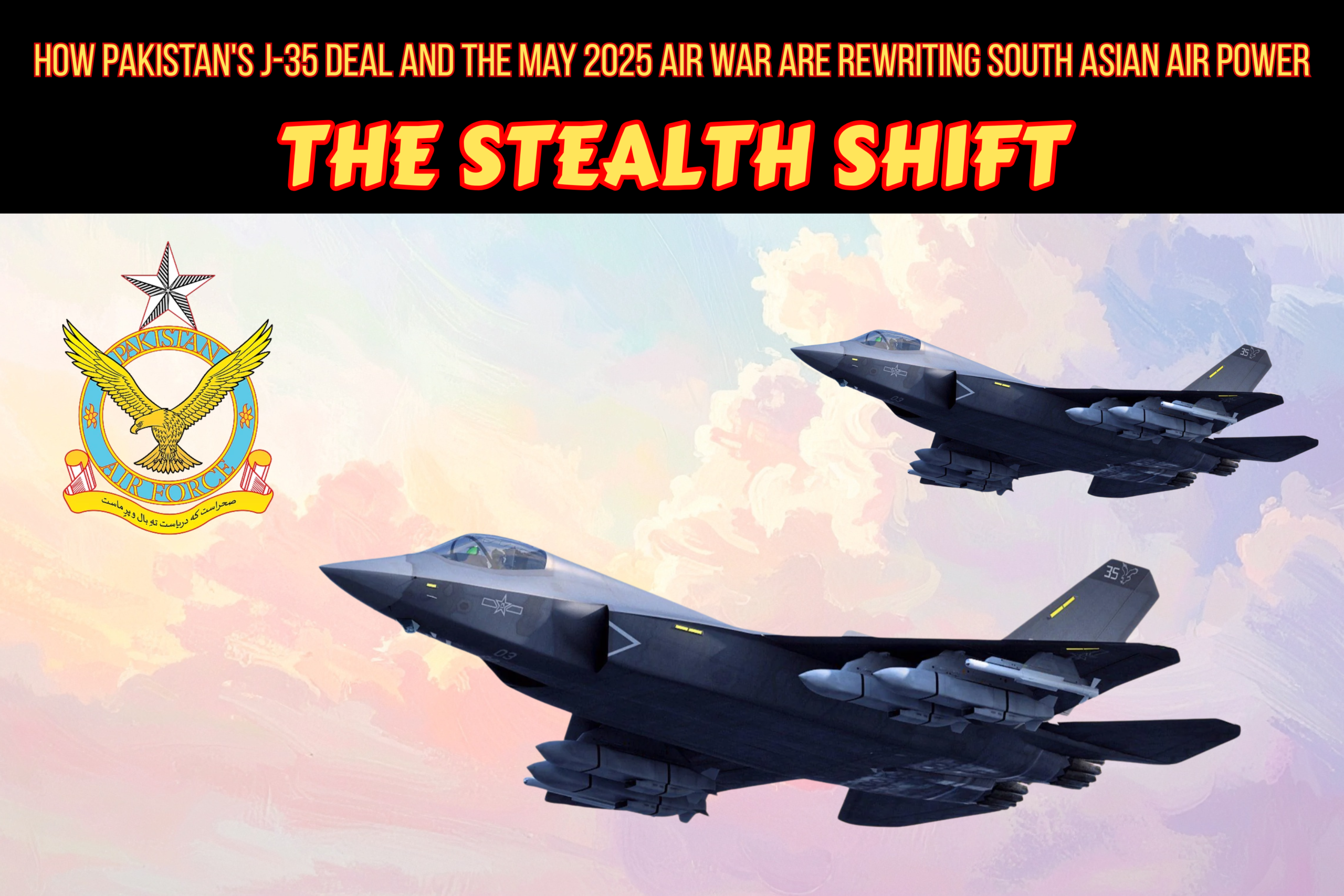
In May 2026, Air Vice-Marshal Tariq Ghazi, Pakistan’s Deputy Chief of Air Staff, confirmed what defence analysts had speculated for months. Standing before the press in Islamabad, he stated that Islamabad had laid the “foundations… for the acquisition of advanced capabilities”—including long-range precision weapons, next-generation platforms, “additional” J-10C aircraft, and “much upgraded” JF-17 Thunder variants. Most critically, he confirmed an “initial collaborative agreement” for the Shenyang J-35A stealth fighter, making Pakistan the world’s first confirmed export operator of a Chinese fifth-generation platform.
The strategic signal was unambiguous. If deliveries proceed as speculated—potentially beginning with a small initial batch by late 2026—Pakistan will field a stealth capability at least half a decade before India operationalises anything comparable.
The ripples were immediate. Across the border, the Indian Air Force (IAF) faces a modernisation crisis that has been decades in the making. Authorised for 42 fighter squadrons, the IAF currently fields an estimated 28 to 32 operational squadrons, a shortfall driven by the accelerated retirement of Soviet-era MiG-21, MiG-23, and MiG-27 fleets and the agonisingly slow induction of indigenous Tejas light combat aircraft. Pakistan Air Force (PAF) squadron numbers, typically estimated between 20 and 25, have remained stable, but more importantly, the PAF has pursued a doctrine of fleet commonality—standardising around the F-16, JF-17, and now J-10C—that reduces logistical overhead and simplifies pilot conversion.
The J-35 announcement cannot be analysed in isolation. It arrives less than a year after Operation Sindoor, the 88-hour air campaign of May 2025 that constituted the most intense aerial combat between the two rivals since 1971. That conflict produced contested claims, confirmed losses, and a doctrinal shock on both sides. To understand what the J-35 means for the future, one must first understand the present imbalance, the recent past, and the technical realities of stealth in a subcontinent already bristling with long-range missiles and integrated air defences.
The Squadron Arithmetic: Quantity, Quality, and Logistical Tail
The IAF’s squadron crisis is not a new story, but it is acute. Against an authorised strength of 42 squadrons, the service is operating approximately 28 to 32 squadrons, depending on whether one counts conversion training units and aircraft awaiting retirement. The gap is structural. MiG-21 Bisons, once the backbone of the force, have been phased out faster than Tejas Mk1A fighters can replace them. The Rafale acquisition—36 aircraft in two squadrons—added a world-class omnirole capability but did not solve the numerical deficit. The Su-30MKI, the IAF’s heaviest hitter with over 260 airframes, is undergoing Super-30 upgrades to receive new AESA radars and electronic warfare suites, but the process is incremental.
The PAF, by contrast, has pursued a medium-weight multirole philosophy. Its fleet centres on three platforms: the F-16 (approximately 75 airframes across Block 15 MLU and Block 52 variants), the indigenously co-produced JF-17 (roughly 140+ airframes across Block I, II, and III standards), and the recently inducted J-10C (approximately 36 aircraft). This commonality means fewer engine types, fewer radar formats, and a supply chain increasingly consolidated under Chinese manufacturing.
Table 1: IAF vs. PAF Force Structure Snapshot (2026)
Table
| Metric | Indian Air Force (IAF) | Pakistan Air Force (PAF) |
|---|---|---|
| Authorised Squadrons | 42 | ~25 |
| Operational Squadrons | ~28–32 | ~20–25 |
| Primary Heavy Fighter | Su-30MKI (260+) | — |
| Primary Omnirole Fighter | Rafale (36) | J-10C (~36) |
| Indigenous/Light Fighter | Tejas Mk1A (inducting) | JF-17 (140+) |
| Legacy Western Fighter | Mirage 2000 (~50) | F-16 (~75) |
| Primary BVR Missile | Meteor, R-77 | PL-15, PL-17, SD-10 |
| AEW&C Fleet | Netra, Phalcon (IL-76) | KJ-500, Saab 2000 Erieye |
| 5th-Gen Fighter Status | AMCA (first flight late 2029) | J-35A (initial agreement signed) |
The squadron gap tells only part of the story. The IAF has more airframes but greater fleet diversity, which complicates maintenance and spares. The PAF has fewer squadrons but higher interoperability and a clear BVR ecosystem. That ecosystem was battle-tested in May 2025.
The 2019 Balakot Legacy: Contested Narratives and Doctrinal Shifts
To understand the psychology of both air forces entering 2025, one must revisit February 2019. Following the Pulwama terror attack, the IAF conducted Operation Bandar, a cross-Line of Control airstrike carried out during the early hours using Mirage 2000s armed with SPICE 2000 precision-guided munitions. India claimed the strike destroyed a Jaish-e-Mohammed training camp, while Pakistan acknowledged the intrusion but denied that any damage had occurred.
The following day, in broad daylight on February 27, 2019, one of the most disputed air-to-air engagements in modern military history unfolded. Pakistan claims that its F-16s and JF-17s shot down two Indian aircraft — a MiG-21 Bison and a Su-30MKI — and captured Wing Commander Abhinandan Varthaman after he ejected over Pakistan-administered Kashmir. India acknowledges the loss of one MiG-21 Bison and the capture of Abhinandan but denies the loss of any Su-30MKI aircraft. A few days later, India claimed that its pilot had shot down a PAF F-16. Islamabad denies any F-16 loss, and independent verification remains inconclusive.
What is not disputed, however, is the political and military fallout. The 2019 crisis demonstrated that Pakistan was both willing and capable of contesting Indian air superiority in disputed airspace. For the IAF, it underscored the vulnerability of legacy platforms in a contested beyond-visual-range (BVR) environment. For the PAF, it validated investments in Chinese-origin BVR missiles and airborne early warning and control (AEW&C) integration. The doctrinal divergence that followed — India moving toward heavier standoff strike capabilities and network-centric warfare, and Pakistan focusing on layered air defence and long-range air-to-air engagement — ultimately set the stage for 2025.
Operation Sindoor: The 88-Hour Air War of May 2025
The May 2025 conflict, triggered by the April Pahalgam terror attack and India’s subsequent precision strikes on nine locations in Pakistan and Pakistan-administered Kashmir, was fundamentally different from 2019. It was larger in scale, more technologically complex, and arguably more instructive about the future of aerial warfare in South Asia.
The Opening Exchanges (May 7)
In the early hours of May 7, the IAF launched Operation Sindoor, employing Rafales, Mirage 2000s, Su-30MKIs, and MiG-29UPGs in a multi-axis strike package. Standoff weapons — including SCALP cruise missiles, Hammer precision-guided munitions, and possibly BrahMos supersonic cruise missiles — were used to engage targets while minimising exposure to Pakistani air defences.
Pakistan’s response was immediate and, by most accounts, effective during the initial phase. PAF J-10Cs, supported by KJ-500 AEW&C aircraft, reportedly fired PL-15 missiles at extreme range. The result was a contested but significant Indian loss. Independent analyses by Reuters, The Washington Post visual investigation team, and the Swiss Military Study reportedly indicated that India may have lost between two and four aircraft on the first day. Wreckage identified through open-source intelligence reportedly included at least one Rafale, one Mirage 2000, and possibly either a MiG-29UPG or a Su-30MKI.
“Air warfare communities in China, the United States, and several European countries were extremely interested in trying to establish as much ground truth as possible regarding tactics, techniques, procedures, the equipment used, and what worked or failed,” noted Douglas Barrie, senior fellow for military aerospace at the International Institute for Strategic Studies.
Pakistan claimed a higher tally — between six and eight Indian aircraft, including three Rafales — and asserted that the shock of these losses forced the IAF to suspend crewed strike operations. India strongly denied these assertions. During a press briefing marking the one-year anniversary of the conflict, Air Marshal AK Bharti stated that India had destroyed nine terror camps, struck 11 Pakistani airfields, and damaged 13 aircraft during the four-day conflict, while rejecting Pakistani claims regarding downed Indian fighters.
Critics, however, argue that these Indian claims appear exaggerated, noting that no such assertions were publicly made during or immediately after the conflict. They also point out that independent observers did not report losses on the scale later claimed. According to these critics, the narrative was subsequently shaped largely for domestic political and public consumption.
Table 2: Operation Sindoor — Contested Narratives vs. Verified Outcomes
| Claim / Event | Pakistani Narrative | Indian Narrative | Independent / OSINT Consensus |
|---|---|---|---|
| Indian Aircraft Lost (May 7) | 6–8 aircraft, incl. multiple Rafales | 1–2 aircraft (acknowledged losses minimal) | 2–4 confirmed losses; Rafale & Mirage 2000 wreckage verified |
| PAF Aircraft Lost | None | 13 aircraft/assets damaged/destroyed | No verified PAF crewed fighter losses; – A radar sites hit confirmed |
| IAF Operational Pause | IAF pulled back 300 km, grounded for 48+ hrs | Tactical regrouping; operations intensified by May 10 | ~48-hour pause in large crewed strikes; shift to drones/standoff |
| Airfields Struck | Own loss -None 13 x IAF bases and Brahmos Depot attacked | 11 PAF airfields struck, incl. Nur Khan, Sargodha | Confirmed precision strikes on both sides |
| Strategic Outcome | PAF achieved air superiority from outset | IAF achieved air superiority by May 10 | Stalemate |
The Fog of War and the Drone Campaign
What remains verifiable is that India paused large-scale crewed strike sorties for approximately 48 hours after May 7, relying instead on unmanned platforms and standoff systems. Pakistan, meanwhile, launched a massive drone swarm operation — with estimates ranging from 300 to 400 loitering munitions and reconnaissance UAVs — targeting Indian airfields, radar installations, and military infrastructure. Although India claimed that its defences, including Akash surface-to-air missile systems, the newly operational Akashteer command-and-control network, and conventional anti-aircraft artillery intercepted the majority of these drones, the attack reportedly triggered widespread panic and exposed serious vulnerabilities within India’s air defence grid.
“There will be audits of what works and what does not work, but I think the other overlay is the proverbial fog of war,” observed Byron Callan, a Washington-based defence expert and managing partner of Capital Alpha Partners.
India retaliated with Harop and Harpy anti-radiation loitering munitions, targeting Pakistani radar and communication nodes. However, on May 9, Pakistan escalated the conflict under Operation Bunyan-un-Marsoos, carrying out long-range missile and precision strikes against around 15 Indian air bases and military installations. Pakistani officials stated that the targets included major Indian Air Force facilities at Pathankot, Adampur, Sirsa, Suratgarh, Bathinda, Halwara, Srinagar, Jammu, Udhampur, Ambala, and Awantipur, along with missile storage depots, radar stations, logistics hubs, and command centres. Pakistan described the operation as a precise and calibrated response designed to degrade India’s military capabilities while showcasing the growing sophistication and reach of Pakistan’s missile and precision-strike arsenal.
Indian authorities rejected many of these claims, arguing that the reported scale of damage was exaggerated and part of wartime information warfare. Nevertheless, by May 10, India reportedly sought a ceasefire through US mediation, which Pakistan agreed to in the interest of regional stability. The 88-hour conflict ended without a decisive strategic victory for either side, but India emerged facing significant equipment losses, operational setbacks, and considerable reputational damage in the eyes of many regional and international observers.
The Assessment
The emerging independent assessment of Operation Sindoor points toward a complex yet revealing outcome. In the opening phase of the conflict, the PAF appears to have secured a clear tactical advantage through superior beyond-visual-range (BVR) coordination, disciplined battle management, and highly effective AEW&C integration. The PL-15 missile, launched from J-10Cs at ranges that reportedly kept Pakistani fighters outside the engagement envelope of Indian missiles, demonstrated the growing maturity and lethality of Pakistan’s air combat doctrine.
India, despite possessing a numerically larger force structure, a broader inventory of standoff weapons, and greater overall resources, struggled to significantly degrade Pakistan’s integrated air defence network through combined kinetic and electronic operations. Pakistani air defences remained operational throughout the conflict, highlighting both the resilience of the PAF’s defensive architecture and the limitations of India’s offensive planning under contested conditions.
The central lesson of the conflict was not the superiority of any single aircraft platform, but the decisive importance of systems warfare. Modern aerial combat increasingly depends on how effectively a military integrates sensors, shooters, electronic warfare assets, airborne early warning systems, and real-time data links into a unified combat network. On May 7, the PAF demonstrated a notably higher degree of operational cohesion in this regard. The IAF, by contrast, appeared rattled by the early losses and failed to regain operational momentum or impose meaningful strategic costs on Pakistan during the remainder of the engagement.
It is precisely this systems-centric reality that makes Pakistan’s prospective acquisition of the J-35 so consequential — and deeply concerning for Indian defence planners.
The S-400 Strike: PAF’s Most Daring Mission
Amidst the chaos of Operation Sindoor, one mission stood out as a testament to PAF pilot skill, tactical innovation, and sheer audacity—the destruction of an Indian S-400 Triumf air defence battery. The S-400, acquired from Russia at enormous cost and touted as India’s impenetrable anti-access shield, represented the crown jewel of the IAF’s integrated air defence network. Its destruction sent shockwaves through Indian military command and demonstrated that no system, however advanced, is invulnerable in the hands of determined adversaries.
The mission was assigned to a flight of JF-17 Block III fighters from the PAF’s elite squadron, supported by KJ-500 AEW&C cueing and electronic warfare coverage. The challenge was formidable. The S-400 battery was deployed deep inside Indian territory, protected by layered short-range air defence systems, fighter combat air patrols, and the S-400’s own long-range engagement envelope extending to 400 kilometres. Conventional standoff weapons lacked the penetration speed to overwhelm the system’s tracking radars and interceptor missiles.
The solution lay in a newly integrated capability—the CM-400AKG hypersonic air-to-surface missile, carried on the JF-17’s centreline hardpoint. With a reported terminal velocity exceeding Mach 5 and a steep dive profile, the CM-400AKG was designed specifically to defeat hardened and time-critical targets. The PAF had quietly integrated this weapon onto JF-17 Block III airframes in the months preceding the conflict, a detail that Indian intelligence had apparently underestimated.
The mission profile was next to impossible by conventional standards. The JF-17 flight would need to penetrate the S-400’s outer engagement envelope, launch at extreme range while under active radar tracking, and egress before Indian fighters could intercept. To accomplish this, the PAF employed a sophisticated deception plan. J-10Cs conducted aggressive feints along the northern sector, drawing Indian Rafales and Su-30MKIs away from the axis of attack. Electronic warfare aircraft saturated Indian low-band radars with false returns, creating ambiguity about the size and direction of the strike package.
The JF-17 pilots flew at terrain-hugging altitude, using terrain masking to break line-of-sight with Indian ground radars. As they approached the launch basket, the flight leader initiated a rapid climb, acquired the target through the KJ-500’s data-link, and ripple-fired two CM-400AKG missiles. The hypersonic weapons covered the final 100 kilometres in under 90 seconds. The S-400’s engagement radar, designed primarily for aircraft and subsonic cruise missiles, had insufficient reaction time to track and engage the diving threats. Both missiles struck the battery’s 92N6E gravestone engagement radar and command vehicle, obliterating the system’s nerve centre.
The JF-17s dived back to low level and egressed at maximum speed, rendezvousing with a tanker aircraft in friendly airspace. The entire mission, from penetration to egress, was completed without loss—a feat that defence analysts described as one of the most technically demanding strikes in modern air warfare.
The destruction of the S-400 had immediate strategic consequences. It forced the IAF to pull back its remaining high-value air defence assets, creating corridors for subsequent PAF operations. More profoundly, it shattered the myth of Russian air defence invincibility that had underpinned Indian procurement strategy. For the PAF, the mission validated years of investment in pilot training, Chinese weapons integration, and networked warfare. For the IAF, it was a humbling reminder that superior equipment means nothing without the tactical ingenuity to employ it—and to counter an enemy who possesses both.
The J-35 Gambit: Entering the Stealth Era
The J-35A (previously developed as the FC-31 Gyrfalcon) is a twin-engine, medium-weight stealth fighter designed by Shenyang Aircraft Corporation. It features an internal weapons bay to preserve low observability, an AESA radar, and advanced avionics intended to rival the F-35, though it remains significantly lighter and is not yet in operational service with the People’s Liberation Army Air Force. If Pakistan proceeds with induction, it will be the first foreign operator of the type.
Technical Profile and Strategic Value
The J-35’s primary advantage is reduced radar cross-section. In a battlespace saturated with long-range missiles like the PL-15 and Meteor, detectability is survivability. A stealth platform can, in theory, penetrate contested airspace, act as a sensor node for non-stealthy wingmen, or open an engagement from a position of tactical surprise. For Pakistan, which lacks the IAF’s numerical depth, a small fleet of stealth fighters offers an asymmetric counter to India’s heavy fighters.
However, the J-35 is not without risks. The aircraft is not yet combat-proven. Its engines—reportedly based on the WS-19 or derivative—may not yet deliver the thrust and reliability required for sustained operations in South Asian heat and dust. Stealth coatings require climate-controlled hangars and specialised maintenance regimes that will strain PAF infrastructure. Most critically, the J-35’s data-links and mission software must integrate with Pakistan’s existing Chinese-supplied C4ISR architecture; any friction in that integration could degrade the very systems warfare advantage the PAF cultivated in 2025.
The Layered Modernisation
The J-35 does not arrive alone. AVM Ghazi’s announcement referenced additional J-10Cs and upgraded JF-17s. The J-10C, already the PAF’s most capable crewed fighter, offers a mature platform with an AESA radar and PL-15 carriage. Adding more squadrons would allow the PAF to retire aging F-16 Block 15s and standardise further. The “much upgraded” JF-17 likely refers to a Block IV standard, potentially incorporating an AESA radar, improved electronic warfare, and compatibility with newer Chinese munitions.
There are also reports—unconfirmed but strategically logical—of Pakistan seeking the KJ-500 AEW&C in larger numbers and possibly the HQ-19 ballistic missile defence system. If realised, this would create a layered, Chinese-supplied defence ecosystem: stealth fighters for offensive counter-air, J-10Cs for BVR dominance, JF-17s for multirole bulk, KJ-500 for battlespace awareness, and HQ-19 for high-altitude interception.
India’s Dilemma: The AMCA Timeline Crunch
For the IAF, the J-35 announcement lands at the worst possible moment. India has no operational fifth-generation fighter, and its indigenous Advanced Medium Combat Aircraft (AMCA) is years from squadron service. First flight is projected in the late 2020s, with Mk1 induction unlikely before the mid-2030s. That leaves a window—potentially a decade—where Pakistan could operate stealth platforms while India fields only 4.5-generation aircraft.
Interim Options
New Delhi faces unpalatable choices. Expanding the Rafale fleet is possible; the F4 standard offers enhanced connectivity and electronic warfare, but Dassault’s production queue and cost (over $200 million per airframe with weapons and support) make large-scale expansion fiscally painful. Re-engaging with Russia on the Su-57 Felon, after India withdrew from the FGFA joint development programme years ago, is politically and technically fraught, though Moscow has reportedly offered full technology transfer and local production to sweeten the deal.
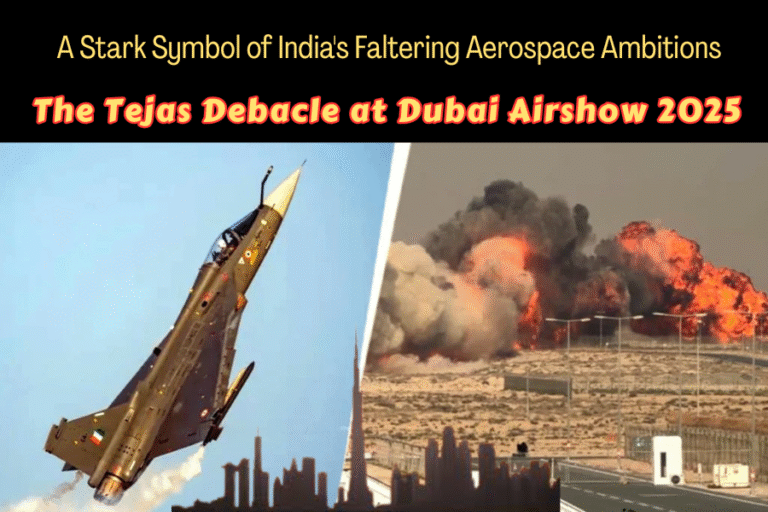
The Tejas Mk1A and upcoming Mk2/Medium Weight Fighter programmes are critical to arresting the squadron decline. The Mk1A, with its EL/M-2052 AESA radar and Derby/Meteor compatibility, is a capable light fighter, but production rates at Hindustan Aeronautics Limited have been sluggish. The IAF needs 12–16 new squadron equivalents in the next decade; current Tejas output suggests a struggle to meet even half that requirement.
There’s no comparison. The Rafale is superior by far. The skirmish in early May was not a simple one-on-one dogfight—it was a comprehensive battlefield engagement involving air, ground, and cyber warfare, said retired Indian Army officer and aviation expert Abhinay Dogra, though he acknowledged that the PL-15’s range and electronic warfare environment complicated the engagement.
Counter-Stealth Strategy
India is not defenceless against a small J-35 fleet. The IAF operates the S-400 Triumf long-range air defence system, which includes counter-stealth radar modes, and is developing indigenous AWACS (Netra Mk2) with Uttam AESA radars. The Integrated Air Command and Control System ties together ground radars, airborne platforms, and SAM batteries into a unified network. In theory, a dense, multi-spectrum sensor network can detect and track stealth aircraft, particularly when they open weapons bays or use external fuel tanks.
But theory is not practice. The May 2025 conflict revealed gaps in India’s electronic warfare and data-link integration. If the PAF fields even a squadron of J-35s by 2028—perhaps 4 to 12 initial aircraft, with a long-term goal of 40—the IAF will face the prospect of fighting an enemy it cannot reliably see until it is already inside missile range.
Future Scenarios: South Asian Air Power in 2030
By 2030, three broad scenarios are plausible.
Scenario A: Pakistani Asymmetric Advantage. If the J-35 achieves initial operational capability by 2028, and if Pakistan successfully integrates it with J-10Cs, KJ-500s, and long-range SAMs, the PAF could hold localised air superiority in the first 48 to 72 hours of a future conflict. India’s numerical advantage would be offset by the difficulty of massing non-stealth fighters against a stealth-enabled defence.
Scenario B: Indian Recovery Through Mass and Network. If India adds 36 or more Rafale F4s, accelerates Tejas Mk2 production, and leverages its larger economy to field more standoff weapons and drones, it could overwhelm a small J-35 fleet through sheer mass and network saturation. Stealth is powerful but not magical; a stealth fighter carrying internal weapons has limited magazine depth.
Scenario C: Mutual Deterrence and Systems Stalemate. The most likely outcome is a continued arms race that produces mutual deterrence. Both sides will invest in layered air defence, long-range missiles, and drone swarms. Direct crewed air combat may become too costly for either side to initiate, shifting conflict toward standoff missile duels and cyber-electronic warfare.
Conclusion: Platforms, Networks, and the Next War
The May 2025 air war proved a paradox: the side with the heavier, more expensive fighters did not win the first day, but the side with the deeper, more integrated network won the campaign. The PAF’s J-10Cs and PL-15s bloodied the IAF’s nose on May 7, yet India’s ability to absorb losses, reconstitute, and strike deep into Pakistan’s air defence network ultimately forced a ceasefire. It was a lesson in systems over platforms.
The destruction of the S-400 battery by JF-17s carrying hypersonic missiles added another dimension to this lesson. It demonstrated that pilot skill, tactical innovation, and the right weapon at the right moment can defeat systems that cost ten times as much. The PAF pilots who executed that mission did so with precision, courage, and a mastery of their aircraft that no procurement budget can buy.
The J-35 threatens to alter the equation further. Stealth is not merely another platform; it is a systemic disruptor. A fighter that cannot be reliably tracked degrades the entire network it faces. If Pakistan successfully inducts the J-35 and integrates it into its Chinese-supplied kill chain, the IAF will face a qualitatively different challenge than it did in 2025—one that its current modernisation timeline is not prepared to meet.
For India, the J-35 deal is not just a Pakistani procurement story. It is a warning that numerical superiority and individual platform excellence are insufficient without speed of acquisition, interoperability, and the ruthless integration of sensors and shooters. The squadron gap was already a crisis. The stealth gap may become an emergency.
As one Pakistani military official remarked dryly during the post-May 2025 information war: “Rafale is a very potent aircraft… if employed well.” The remark, dripping with the confidence of a force that had just bloodied a larger opponent, captures the new reality of South Asian air combat. In this unforgiving airspace, the next war will not be won by the side with the most aircraft. It will be won by the side that sees the enemy first—and remains unseen the longest.