(Faraz Ahmed)
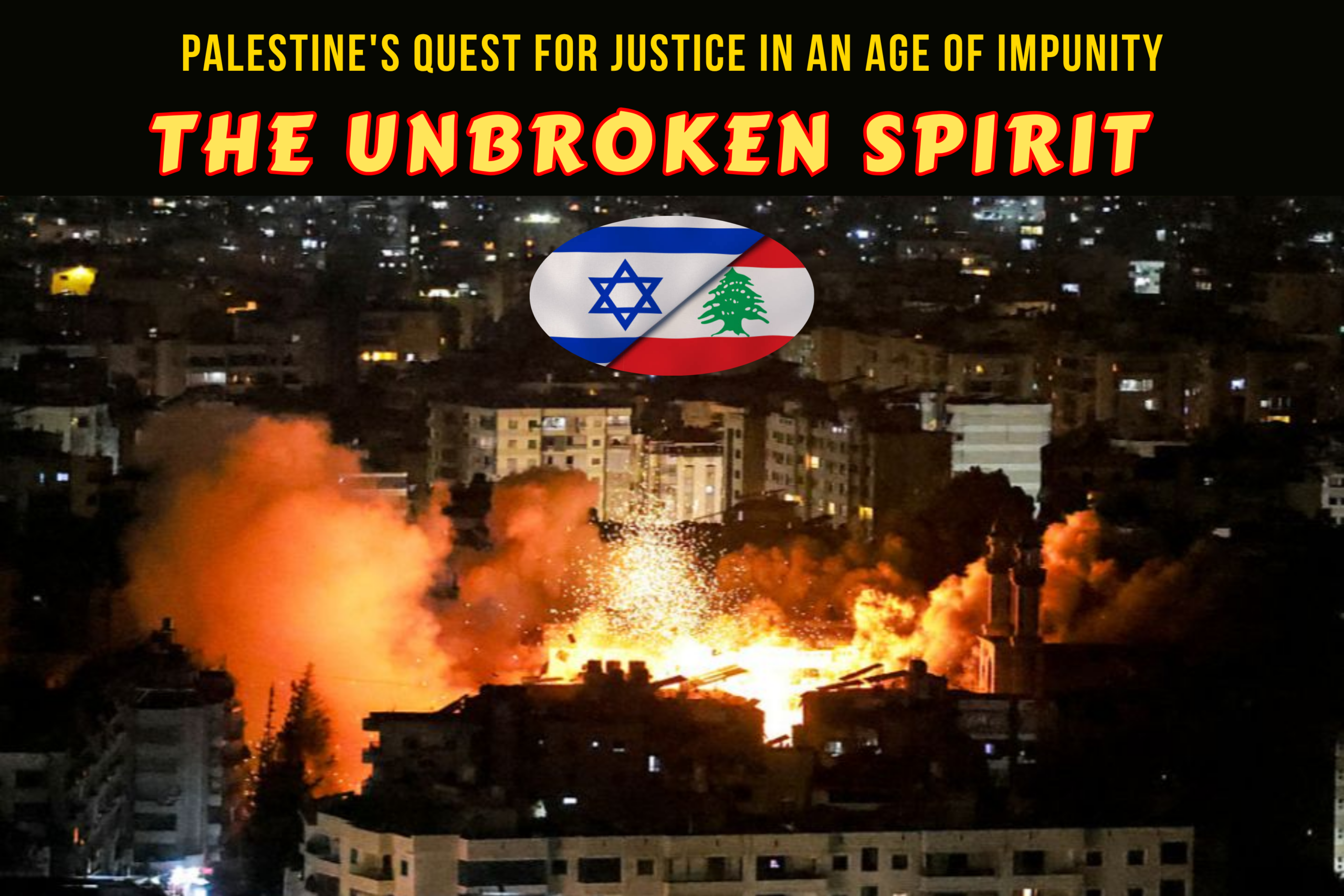
In the shadow of olive trees that have witnessed generations of struggle, a people endure. As Israeli airstrikes once again pound Lebanese soil and Gaza’s rubble-strewn landscape, the Palestinian question remains not merely a regional dispute, but a profound test of our collective commitment to human rights, international law, and the very principle that all lives possess equal worth. This article centres Palestinian voices, experiences, and legal entitlements—not as partisan advocacy, but as a necessary corrective to narratives that have too often marginalised the oppressed in favour of the powerful.
A Legacy of Dispossession: Context Matters
To understand the present anguish, one must acknowledge the historical continuum. The Palestinian experience of displacement did not begin in 2023, nor in 1967, but finds its roots in the Nakba of 1948—when over 750,000 Palestinians were expelled from their homes during the creation of the State of Israel. This was not a spontaneous exodus, but a systematic campaign of depopulation, documented by Israeli historians themselves, including Ilan Pappé and Benny Morris.
Since then, Palestinians have lived under military occupation, fragmented governance, and a regime of legal discrimination. The West Bank remains carved by illegal settlements—home to over 700,000 Israeli settlers—connected by a network of checkpoints that strangle movement, commerce, and dignity. East Jerusalem, annexed in violation of international law, sees Palestinian families face daily threats of eviction, as in the neighbourhoods of Sheikh Jarrah and Silwan. Gaza, under a 17-year land, air, and sea blockade, has been described by successive UN officials as an “open-air prison”.
These are not abstract grievances. They are lived realities, verified by human rights organisations including Amnesty International, Human Rights Watch, and B’Tselem—all of which have concluded that Israel’s practices amount to apartheid under international legal definitions.
The Human Cost: Beyond the Headlines
When missiles strike, statistics can numb us to suffering. Behind each number is a story.
Consider the words of Dr. Ghassan Abu-Sittah, a Palestinian-British surgeon who worked in Gaza during the latest escalation: “We are not treating wounds; we are managing catastrophes. Children arrive without parents, parents without children. The hospital runs on generators, the blood bank is empty, and the world watches.” His testimony, echoed by Médecins Sans Frontières and the World Health Organization, underscores a deliberate pattern: the targeting of healthcare infrastructure, the obstruction of aid, and the weaponisation of starvation.
The figures are staggering. According to the Gaza Ministry of Health (figures cross-referenced by UN OCHA), over 35,000 Palestinians have been killed in Gaza since October 2023, nearly 70 per cent of them women and children. Over 1.9 million—more than 85 per cent of Gaza’s population—are internally displaced. Entire neighbourhoods have been reduced to rubble; the UN estimates that 60 per cent of housing units have been destroyed or damaged.
Yet beyond the physical devastation lies a deeper trauma: the psychological scarring of a generation. UNICEF reports that nearly all children in Gaza exhibit symptoms of toxic stress—nightmares, regression, anxiety. Schools lie in ruins; the educational future of an entire cohort hangs in the balance.
In the West Bank, violence tells a different but equally urgent story. Since October 2023, Israeli settler attacks have surged, with over 1,000 incidents recorded by the UN, including arson, livestock theft, and physical assault. Palestinian farmers find their olive groves—symbols of rootedness and heritage—burned or uprooted. The Israeli military, far from intervening, often provides escort to settlers or conducts raids that result in Palestinian casualties. In 2024 alone, over 500 Palestinians have been killed in the West Bank, including more than 100 children.
International Law: The Framework Ignored
Palestinian rights are not aspirational; they are codified. The Fourth Geneva Convention prohibits the transfer of an occupying power’s civilian population into occupied territory—yet settlements expand daily. The Rome Statute defines deliberate attacks on civilians, hospitals, and schools as war crimes. The Genocide Convention obliges states to prevent and punish acts intended to destroy, in whole or in part, a national, ethnical, racial or religious group.
The International Court of Justice (ICJ), in its January 2024 advisory opinion, found it “plausible” that Israel’s acts in Gaza could amount to genocide, ordering provisional measures to prevent irreparable harm. The International Criminal Court (ICC) has sought arrest warrants for leaders of both Hamas and Israel, including Prime Minister Benjamin Netanyahu, for alleged war crimes and crimes against humanity.
Yet enforcement remains elusive. The United States, wielding its veto power in the UN Security Council, has repeatedly shielded Israel from accountability. Western governments, while expressing concern over civilian casualties, continue to supply arms that fuel the conflict. The UK, despite parliamentary motions calling for an arms embargo, has licensed over £500 million in military exports to Israel since 2023.
This impunity is not merely a diplomatic failure; it is a moral one. When international law is applied selectively—condemning violations by some actors while excusing others—the entire architecture of global justice is undermined. Palestinians are not asking for special treatment; they are demanding the universal application of rights they are legally entitled to.
Centring Palestinian Voices: Agency, Not Pity
Too often, Palestinian narratives are filtered through external lenses—framed as victims to be saved, or as political pawns in regional games. This article seeks to restore agency by amplifying Palestinian perspectives on their own terms.
“We are not a humanitarian crisis,” says Raji Sourani, a Gaza-based human rights lawyer and director of the Palestinian Centre for Human Rights. “We are a people under occupation, demanding freedom. Aid is necessary, but it is not a substitute for justice.”
This distinction matters. Humanitarian assistance addresses symptoms; political justice addresses causes. Palestinians across the spectrum—from secular activists in Ramallah to community organisers in Gaza—consistently articulate three core demands: an end to occupation, the right of return for refugees as affirmed by UN Resolution 194, and equal rights for all under a just political framework.
Young Palestinians, in particular, are redefining resistance through cultural expression. Poets like Mosab Abu Toha (whose library in Gaza was bombed) use verse to document loss and hope. Artists in Haifa and Nazareth employ graffiti, film, and music to assert identity amid erasure. Digital activists bypass traditional media gatekeepers, sharing raw footage and testimonies that challenge dominant narratives.
This is not mere symbolism. It is a strategic assertion of presence: We are here. We remember. We will endure.
The Regional Dimension: Solidarity and Sovereignty
The Palestinian cause resonates far beyond historic Palestine. Across the Arab and Muslim world, public opinion remains overwhelmingly supportive of Palestinian rights—a fact that governments ignore at their peril. The normalisation agreements between Israel and several Arab states (the Abraham Accords) have been met with widespread popular scepticism, viewed by many as betrayals of Palestinian solidarity.
Yet regional dynamics are shifting. The war in Gaza has reignited grassroots mobilisation from Morocco to Indonesia. Protests in London, New York, and Cape Town reflect a global awakening, particularly among younger generations who frame Palestine within broader struggles against colonialism, racism, and inequality.
Critically, Palestinian leadership must also reckon with internal divisions. The political rift between Fatah in the West Bank and Hamas in Gaza has long hampered unified strategy. However, the current crisis has spurred renewed calls for reconciliation—not merely as a tactical manoeuvre, but as a moral imperative. As Palestinian intellectual Dr. Karma Nabulsi argues: “Liberation cannot be achieved through fragmentation. Unity is not optional; it is foundational.”
A Path Forward: Justice, Not Just Ceasefires
Ceasefires are necessary but insufficient. History teaches that temporary halts to violence, absent political resolution, merely reset the clock for the next escalation. What Palestinians require—and what international law demands—is a durable peace grounded in rights.
Several principles must guide this path:
- Immediate and Unconditional Humanitarian Access: Aid must flow without obstruction, predicated on need, not political leverage. The siege of Gaza must end, permanently.
- Accountability Mechanisms: Independent investigations into alleged war crimes must proceed, free from political interference. The ICC and ICJ processes must be supported, not undermined.
- Ending the Occupation: A credible timeline for Israeli withdrawal from occupied territories, coupled with dismantlement of settlements, is non-negotiable under international law.
- Refugee Rights: UN Resolution 194 affirms the right of return for Palestinian refugees. Any just solution must address this core grievance through negotiated, rights-based mechanisms.
- Equal Citizenship: Whether in a two-state framework or a single democratic state, all inhabitants must enjoy equal rights, protection, and representation.
The UK, with its historical mandate responsibility and current diplomatic influence, bears a particular duty. British foreign policy must move beyond rhetorical support for a two-state solution—which has eroded into meaninglessness without concrete action—and towards tangible measures: recognising Palestinian statehood, imposing arms embargoes, and supporting multilateral accountability efforts.
Conclusion: The Moral Imperative of Our Time
To stand with Palestine is not to endorse any armed faction; it is to affirm a universal principle: that no people should live under military occupation, that no child should grow up knowing only the sound of drones, that no family should face eviction because of their identity.
The Palestinian struggle is, at its heart, a human struggle—for home, for dignity, for self-determination. It mirrors other movements for justice across the globe, from South Africa’s anti-apartheid fight to Indigenous rights campaigns in the Americas. To dismiss it as “complicated” or “intractable” is to abdicate our responsibility as global citizens.
As the olive harvest approaches in the West Bank—a ritual of resilience performed despite the threat of settler violence—Palestinians continue to plant trees whose shade they may never sit under. This act, both practical and profoundly symbolic, encapsulates their ethos: hope rooted in reality, perseverance forged in adversity.
The world watches. History judges. The question before us is not whether Palestinians deserve freedom—they unequivocally do—but whether we possess the courage to align our policies with our professed values. In the words of Palestinian poet Mahmoud Darwish: “On this land, there is that which deserves life.”
It is time we ensured that life is allowed to flourish.