(By Quratulain Khalid)
I. Introduction
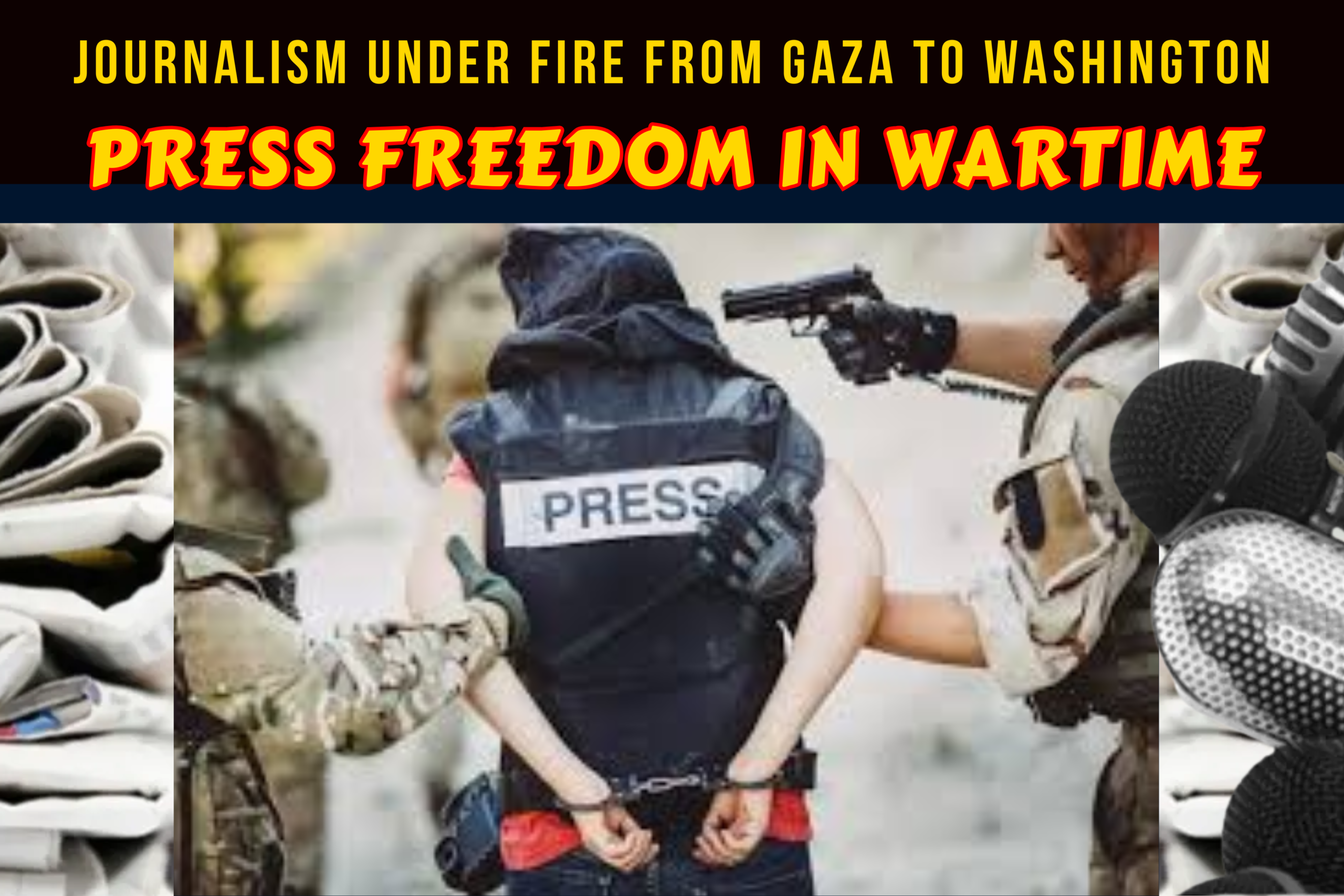
In an era defined by instant global connectivity, real-time satellite imagery, and algorithmically amplified discourse, one would expect conflict reporting to be more transparent than ever. Yet the reality is starkly different. According to the 2026 Reporters Without Borders (RSF) World Press Freedom Index, global press freedom has fallen to its lowest point in twenty-five years. The Committee to Protect Journalists (CPJ) has verified that over 220 journalists have been killed in Gaza alone since October 2023, while global impunity rates for crimes against media workers consistently exceed 90 per cent. What is unfolding is not merely a tragic byproduct of modern warfare; it is a deliberate restructuring of how information is controlled, contested, and weaponised.
This article examines press freedom as a geo-strategic variable rather than a collateral casualty. From the rubble of Gaza to the policy corridors of Washington, the erosion of journalistic protections reveals a broader transformation: warfare is increasingly fought across information infrastructures, economic supply chains, and legal jurisdictions. Understanding this shift requires moving beyond conventional casualty tallies to analyse how states, non-state actors, technology firms, and international institutions intersect in shaping what the world sees, hears, and ultimately remembers.
“When journalists are systematically targeted, it is not only truth that is silenced. The very architecture of accountability is dismantled.”
— UNESCO Director-General, Address on the Safety of Journalists (2025)
II. The Global Landscape: Press Freedom at a Structural Low
The decline in wartime press freedom is neither isolated nor accidental. It reflects a structural recalibration of how states manage information during crises. Across the Middle East, Eastern Europe, the Sahel, and parts of the Indo-Pacific, physical violence against reporters is increasingly complemented by legal harassment, financial strangulation, and digital suppression. Independent outlets face licence revocations, frozen assets, and algorithmic demotion, while state-aligned or state-funded media benefit from preferential bandwidth, diplomatic protection, and cross-border distribution agreements.
Three primary drivers underpin this trend:
- Militarisation of information ecosystems: Conflict zones are now treated as data domains. Access is rationed, verification is bottlenecked, and narrative control is integrated into military planning.
- Surveillance and data localisation: Journalists operating near frontlines face unprecedented exposure to commercial spyware, biometric tracking, and mandatory data storage laws that compromise source protection.
- Economic warfare on media: Sanctions regimes, advertising boycotts, and platform revenue fluctuations disproportionately impact independent outlets, forcing consolidation or editorial self-censorship.
As RSF notes, the modern battlefield extends well beyond trenches and airspace; it encompasses server farms, undersea cables, and content moderation dashboards. Journalism, once viewed as a civilian profession operating parallel to conflict, is now embedded within hybrid warfare architectures.
“The impunity rate for attacks on journalists has plateaued above 90 per cent for over a decade. That is not a failure of law enforcement; it is a structural feature of contemporary conflict governance.”
— CPJ Senior Director for Research & Advocacy (2025)
Table 1: Journalist Safety & Press Freedom Indicators (2023–2026)
| Region | Journalists Killed (2023–2026) | Impunity Rate | Press Freedom Index Rank (Avg. 2025) | Primary Suppression Mechanisms |
|---|---|---|---|---|
| Middle East & N. Africa | 312 | 94% | 138 | Physical targeting, access denial, telecom control |
| Eastern Europe | 87 | 91% | 112 | Legal harassment, state media monopolisation |
| Sub-Saharan Africa | 64 | 88% | 127 | Economic pressure, surveillance, licensing bans |
| Indo-Pacific | 41 | 86% | 109 | Digital censorship, platform restrictions |
| Americas | 29 | 79% | 84 | Polarisation, cartel violence, legal intimidation |
Sources: CPJ Fatalities Database, RSF World Press Freedom Index, UNESCO Safety of Journalists Programme (2025–2026 consolidated reports). Figures represent verified cases and regional averages.
III. Gaza: The Epicentre of a Modern Media War
Gaza has become the most intensely documented conflict in history, yet it is also one of the most informationally restricted. The casualty figures among journalists are unprecedented in both scale and velocity, but the operational reality extends far beyond physical danger. Permit systems, curfews, telecommunications blackouts, and the destruction of media shelters have created an environment where independent verification is structurally inhibited.
What distinguishes the current environment is the dual reliance on social media and open-source intelligence (OSINT) alongside traditional reporting. Local journalists and citizen documentarians transmit footage via encrypted channels, while international correspondents navigate fragmented access points and stringent editorial verification protocols. This has given rise to a new paradigm: distributed journalism, where truth is assembled algorithmically, geographically, and temporally across thousands of data points.
Legally, journalists in conflict zones are protected under Additional Protocol I to the Geneva Conventions, which explicitly grants civilian status to media workers unless they take direct part in hostilities. However, the applicability of international humanitarian law (IHL) in dense urban environments, asymmetric engagements, and multi-actor conflicts remains heavily contested. The threshold for distinguishing between combatant infrastructure and civilian communication networks is increasingly blurred, leaving journalists caught in legal grey zones.
“In Gaza, we are not just reporting on a conflict. We are operating inside an information laboratory where access, narrative, and survival are negotiated in real time.”
— Veteran Conflict Correspondent & OSINT Analyst, Middle East Desk (2025)
The broader implication is clear: Gaza is not an anomaly but a prototype. The mechanisms tested there—telecom rationing, narrative fragmentation, verification bottlenecks, and the weaponisation of digital footprints—are being replicated, adapted, and scaled across other theatres of conflict.
IV. Washington’s Dual Role: Norm Defender or Policy Disruptor?
The United States has long positioned itself as a global champion of press freedom, embedding media protection clauses in diplomatic frameworks, funding independent journalism initiatives, and condemning attacks on reporters through multilateral channels. Yet Washington’s approach reveals a persistent tension between normative advocacy and strategic calculation.
On the policy front, U.S. diplomatic leverage frequently conditions media access and funding on alignment with broader foreign policy objectives. Aid packages, security cooperation agreements, and trade negotiations increasingly incorporate information governance provisions that prioritise strategic messaging over editorial independence. Domestically, media trust has eroded amid political polarisation, while federal resource reallocations—such as the reassignment of investigative personnel to immigration and national security portfolios—have indirectly impacted foreign correspondence capacities.
Simultaneously, the U.S. tech ecosystem plays an outsized role in shaping global information flows. Platform policies on content moderation, algorithmic amplification, and data transparency directly influence how conflict reporting is distributed and monetised. The ongoing legislative debates surrounding Section 230, digital sovereignty, and AI-generated content further complicate the operational environment for journalists, particularly those operating under threat or in sanctioned jurisdictions.
“American foreign policy speaks of press freedom as a universal value, yet practises it as a strategic asset. That dissonance shapes how journalists are perceived, protected, or exposed abroad.”
— Former U.S. State Department Advisor on Media & Digital Policy (2024)
The result is a fragmented advocacy landscape. While U.S.-backed NGOs and multilateral bodies continue to document violations, diplomatic realpolitik often tempers enforcement. This duality does not negate American contributions to media safety, but it underscores a structural reality: in an era of great power competition, information freedom is increasingly treated as negotiable infrastructure rather than inviolable principle.
V. Geo-Strategic & Geo-Economic Dimensions of Media Control
The control of wartime journalism is no longer confined to physical checkpoints or editorial censorship boards. It operates through geo-economic leverage, technological architecture, and regulatory frameworks that collectively determine who reports, what is visible, and how narratives are monetised.
Telecommunications monopolies, satellite bandwidth allocation, and undersea cable routing have become critical nodes in conflict information management. States with advanced infrastructure capabilities can prioritise or restrict data flows during hostilities, effectively creating information chokepoints. Meanwhile, commercial spyware vendors, often unregulated or lightly licensed, supply surveillance tools to state and non-state actors alike, compromising journalist-source confidentiality and endangering investigative networks.
Economically, independent media faces a triple threat: sanctions-induced banking restrictions, platform revenue volatility, and state-backed media expansion. Government-funded broadcasters such as RT, Al Jazeera, Xinhua, TRT, and others operate with cross-border distribution agreements, diplomatic immunity in certain contexts, and substantial production budgets. This creates an asymmetrical information environment where well-resourced state narratives often outpace fragmented independent reporting, regardless of factual accuracy.
“The commodification of truth is the defining feature of 21st-century information warfare. Journalists are not just reporting on conflict; they are navigating an economic ecosystem designed to favour scale over verification.”
— Senior Fellow, Institute for Strategic Dialogue (2025)
Table 2: Geo-Economic & Technological Levers Affecting Wartime Journalism
| Lever | Mechanism of Impact | Primary Actors | Journalistic Consequence |
|---|---|---|---|
| Telecom & Satellite Control | Bandwidth rationing, routing restrictions | State telecom regulators, commercial providers | Delayed reporting, verification bottlenecks |
| Commercial Surveillance | Spyware deployment, metadata harvesting | Private tech firms, state intelligence | Source exposure, operational insecurity |
| Platform Algorithmics | Content ranking, demonetisation, takedown | Social media companies, AI moderation | Narrative fragmentation, visibility bias |
| State Media Funding | Cross-border distribution, diplomatic cover | Government broadcasters, sovereign funds | Asymmetric reach, resource imbalance |
| Sanctions & Banking | Transaction freezes, correspondent account closures | Financial regulators, compliance bodies | Operational paralysis, cross-border reporting limits |
Sources: International Telecommunication Union (ITU) reports, OSINT verification networks, financial compliance analyses, platform transparency disclosures (2024–2026).
VI. International Law, Accountability & Institutional Responses
The legal architecture protecting journalists in conflict is robust on paper but fragile in practice. The Geneva Conventions, UN Security Council Resolution 2222 (2015), and subsequent UNSC statements explicitly condemn attacks on media workers and call for their protection. Yet enforcement remains disjointed. Jurisdictional conflicts, diplomatic immunities, and evidentiary challenges in digitally fragmented environments severely limit accountability.
International bodies such as UNESCO, the UN Special Rapporteur on Freedom of Expression, and NGOs like CPJ and RSF maintain documentation networks, issue rapid response alerts, and advocate for safe passage protocols. However, these mechanisms lack binding enforcement capacity. The International Criminal Court (ICC) has pursued cases involving attacks on journalists, but jurisdictional limitations and state non-cooperation often stall proceedings.
A persistent structural gap exists between normative protection and operational reality. IHL was designed for conventional state-on-state conflicts with clear frontlines and identifiable civilian zones. Modern conflicts feature non-state actors, urban warfare, hybrid tactics, and information domains that do not align neatly with traditional legal categories. Consequently, journalists operating in these environments fall into regulatory blind spots where accountability is diffuse and impunity is institutionalised.
“International law provides a moral compass, but not a operational roadmap. Without decentralised verification, binding safe-corridor protocols, and cross-jurisdictional enforcement, legal protections remain aspirational.”
— Professor of International Humanitarian Law, European University Institute (2025)
Table 3: Legal Frameworks vs Enforcement Realities for Journalist Protection
| Framework | Intended Protection | Enforcement Gap | Institutional Workaround |
|---|---|---|---|
| Geneva Conventions (Additional Protocol I) | Civilian status for journalists | Blurred combatant/civilian thresholds | NGO documentation, OSINT verification |
| UNSC Resolution 2222 (2015) | Condemnation & safe passage calls | Non-binding, state-dependent compliance | Diplomatic pressure, UN task forces |
| ICC Jurisdiction | War crimes prosecution | Limited state ratification, evidentiary hurdles | Hybrid tribunals, national prosecutions |
| UNESCO Safety Programme | Capacity building, rapid response | No enforcement mandate, funding volatility | Cross-border journalist networks |
| Regional Human Rights Courts | Binding rulings on press violations | Delayed proceedings, political non-cooperation | Parallel advocacy, sanctions conditioning |
Sources: ICRC Legal Commentary, UN Security Council Archives, ICC Case Database, UNESCO Programme Reports (2020–2026).
VII. The Path Forward: Safeguarding Truth in Conflict Zones
Addressing the systemic erosion of wartime press freedom requires moving beyond reactive condemnation towards proactive institutional architecture. Several pathways merit serious consideration:
- Binding Protocols & Independent Corridors: Multilateral agreements establishing demilitarised media access zones, enforced by UN-monitored safe passage mechanisms, could reduce targeting risks and improve verification capacity.
- Decentralised Communication Infrastructure: Investment in satellite journalism networks, mesh networking, and encrypted verification tools would reduce dependency on state-controlled telecoms and commercial platforms.
- Cross-Border Funding & Protection Mechanisms: Establishing independent journalist protection funds, insulated from sanctions regimes and platform revenue volatility, would sustain investigative capacity in high-risk environments.
- Platform Transparency & Algorithmic Auditing: Mandatory disclosure of content ranking criteria, takedown appeals, and AI moderation thresholds would reduce arbitrary narrative suppression and improve editorial predictability.
- Geo-Strategic Coordination on Media Infrastructure: Targeted sanctions against deliberate attacks on press infrastructure, coupled with multilateral intelligence sharing on journalist safety, could elevate media protection to a diplomatic priority.
“Journalism is not a luxury in conflict zones. It is essential infrastructure for accountability, historical record, and post-war reconstruction. Treating it otherwise guarantees information monopolies.”
— Director, Global Media Freedom Initiative (2025)
The transition from ad hoc protection to institutionalised resilience requires recognising journalism as critical conflict infrastructure, analogous to medical facilities, humanitarian corridors, and communication networks. When this recognition is embedded in diplomatic frameworks, funding architectures, and technological standards, press freedom ceases to be negotiable.
VIII. Conclusion
Press freedom in wartime is no longer a peripheral concern; it is a central determinant of how conflicts are fought, understood, and resolved. From Gaza’s information chokepoints to Washington’s policy calculations, the targeting of journalists reflects a broader strategic shift: the battle for narrative dominance is as consequential as the battle for territory. Where reporters are silenced, accountability collapses. Where verification is obstructed, historical record is rewritten. Where media infrastructure is commodified, truth becomes a privilege rather than a public good.
The data, legal frameworks, and geo-economic realities all point to the same conclusion: reactive diplomacy and institutional fragmentation are insufficient. Protecting wartime journalism requires binding protocols, decentralised infrastructure, cross-border funding resilience, and multilateral coordination that treats information access as foundational to global stability. Without such measures, hybrid warfare will increasingly dictate conflict trajectories, shape post-war reconstruction, and redefine the boundaries of democratic accountability.
In an era where truth is systematically contested, the safety of journalists is not merely a human rights issue. It is a geo-strategic imperative. And how states, institutions, and civil society respond to it will determine not only how future wars are reported, but how they are remembered, judged, and ultimately prevented.