(By Khalid Masood)
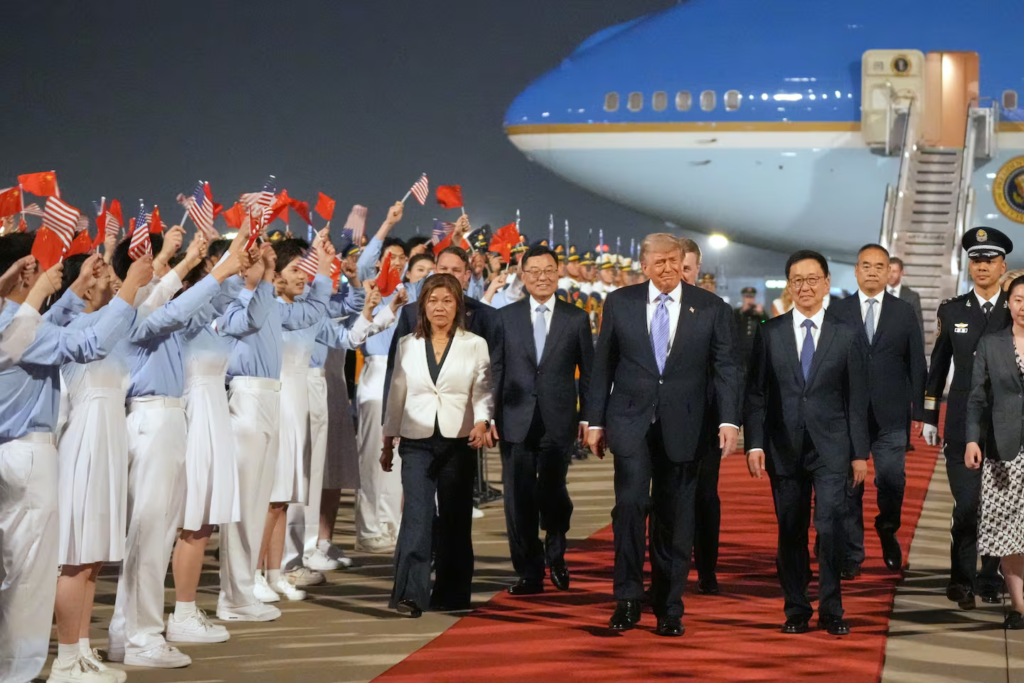
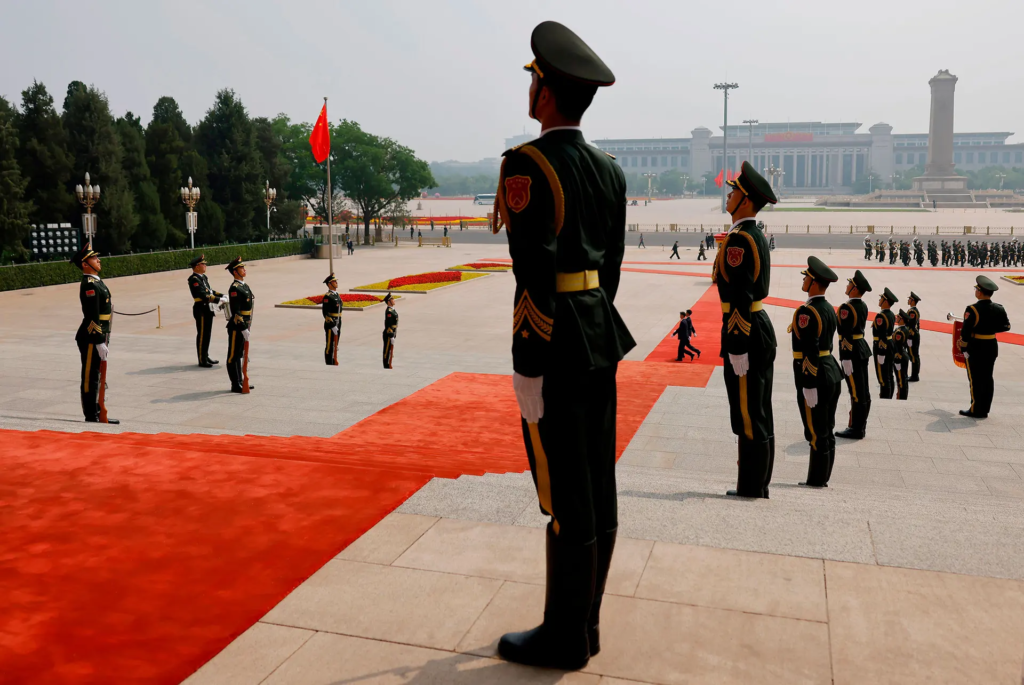
The air outside the Great Hall of the People was cool, the kind of crisp autumn weather Beijing often reserves for moments it wishes to remember. When Air Force One touched down, the ceremony unfolded with the precision of a state choreographed to project permanence. Twenty-one guns saluted. Military bands played. Honor guards stood at rigid attention. American and Chinese flags, nearly identical in height, caught the morning light. For the cameras, it was a tableau of parity. For the diplomats watching from the sidelines, it was a reminder that in an era defined by structural rivalry, diplomacy has become less about resolving differences and more about managing their pace.
President Donald Trump’s state visit to China and his meetings with President Xi Jinping drew global attention not because they promised a reconciliation, but because they tested whether the world’s two most powerful economies and militaries could avoid sliding from competition into confrontation. The visit arrived against a backdrop of unresolved tensions: a trade landscape still scarred by tariffs and supply chain recalibrations; a technology war over artificial intelligence and advanced semiconductors; simmering disagreements over Taiwan that continue to shape Indo-Pacific security architectures; and a Middle East where American and Chinese strategic priorities increasingly diverge. Markets, allies, and adversaries alike watched to see whether personal diplomacy could carve out breathing room in an increasingly crowded strategic landscape.
What emerged was a summit defined by careful symbolism, working-level mechanisms, and an unspoken acknowledgment that neither side possesses the appetite for escalation, nor the capacity for decisive victory. The visit did not rewrite the rules of American–Chinese relations. Instead, it refined them. In hindsight, it stands as a case study in modern great-power diplomacy: a masterclass in crisis management, a demonstration of strategic ambiguity sustained at the highest level, and a quiet admission that managed rivalry has replaced partnership as the default setting of the twenty-first century.
From Ping-Pong Diplomacy to Great-Power Competition: A Historical Arc
To understand the weight of this visit, one must trace the arc of a relationship that has undergone more transformations in six decades than most bilateral ties experience in centuries. Richard Nixon’s 1972 journey to Beijing was not merely a diplomatic breakthrough; it was a geopolitical pivot. Faced with Soviet expansion and the quagmire of Vietnam, Washington recalibrated toward engagement, betting that economic integration and diplomatic inclusion would gradually liberalize Beijing’s domestic order and align its interests with the global status quo. For decades, that calculus held. China’s accession to the World Trade Organization in 2001, the expansion of cross-border supply chains, and the steady growth of American university campuses, corporate headquarters, and military-to-military exchanges created an interdependence that seemed irreversible.
But interdependence, as history has repeatedly shown, is not immunity from rivalry. By the late 2010s, the foundation of that post–Cold War consensus began to fracture. The Obama administration’s pivot to Asia, followed by a growing congressional consensus in Washington that China’s rise required containment as much as cooperation, signaled a strategic reorientation. Then came Trump’s first presidency. Where earlier administrations treated China through the lens of gradual engagement, Trump approached it through the lens of transactional leverage. The result was a wholesale recalibration: bilateral tariffs that reshaped global trade flows, export controls that targeted advanced semiconductors and dual-use technologies, institutional reforms like the CHIPS and Science Act, and a rhetorical shift that framed China not as a partner in globalization but as a systemic competitor.
Xi Jinping’s China, meanwhile, consolidated its own strategic vision. The Communist Party’s emphasis on “self-reliance,” the acceleration of domestic technology development, the modernization of the People’s Liberation Army, and the projection of economic statecraft through initiatives like the Belt and Road reflected a leadership increasingly comfortable with strategic autonomy. Where Nixon’s China sought integration to survive, Xi’s China seeks integration only where it strengthens its position, and decoupling where it preserves sovereignty.
This visit, therefore, did not emerge in a vacuum. It was a test of whether two systems that have moved from reluctant partners to strategic competitors could still find language to prevent miscalculation. Historical parallels are instructive but imperfect. Nixon’s 1972 Shanghai Communiqué was possible because both sides shared an immediate enemy in Moscow and because ideological and technological parity had not yet hardened into institutionalized competition. Today’s summit lacked those conditions. Both sides recognize that rivalry is structural, not situational. The question was no longer whether competition would endure, but whether it could be contained within predictable boundaries.
The Machinery of Expectation: Preparations and Diplomatic Forecasting
Summits of this magnitude are rarely improvised. Long before Air Force One taxied onto Beijing’s tarmac, diplomatic machinery was already in motion. Working groups on trade, technology, and security exchanged dozens of briefings. Backchannel communications tested red lines. Protocol teams rehearsed seating arrangements, translation cues, and camera angles. In Washington, the calculus was clear: stabilize economic friction, secure reliable communication channels, reassure allies of a coordinated Indo-Pacific posture, and avoid any rhetorical escalation that could be exploited by domestic political opponents or foreign adversaries.
In Beijing, the objectives were equally deliberate but differently framed. Chinese diplomats emphasized “strategic stability,” “mutual respect,” and the preservation of China’s “developmental space.” There was an understanding that the United States would not concede on core security or technological restrictions, so the focus shifted to damage limitation: preventing further tariff escalation, securing predictable agricultural and energy trade flows, and ensuring that Washington’s alliance networks did not coalesce into an overt containment architecture.
Expectations were carefully calibrated. Neither side announced grand ambitions. Instead, diplomats spoke in the language of “pragmatism” and “responsibility.” Concerns extended beyond bilateral economics. The war in Ukraine, though not a central agenda item, cast a long shadow, reminding both capitals that great-power competition is increasingly multilateral. Iran’s nuclear trajectory and maritime security in the Persian Gulf raised questions about whether Washington and Beijing could coordinate on regional stability or whether their divergent economic and security priorities would limit cooperation. Taiwan, as always, remained the most volatile variable. And the race to dominate artificial intelligence and advanced computing ensured that technology would be treated not as a commercial sector, but as a strategic domain.
Allies watched closely. Japan and South Korea, caught between American security guarantees and Chinese economic gravity, monitored the summit for signs of realignment. European capitals, already navigating their own tech and trade dependencies on both powers, looked for clues about whether Washington would push for coordinated export controls or unilateral restrictions. In Taipei, officials braced for rhetorical pressure while quietly reinforcing defense preparedness. Gulf states, aware of China’s growing energy investments and America’s shifting Middle Eastern footprint, observed how the two superpowers framed regional security.
The diplomatic build-up was less about breakthroughs than about boundary-setting. Both sides understood that in an era of fragmented global order, summits serve a different function than they once did. They are no longer designed to produce historic accords, but to prevent historic failures.
Red Carpets and Honor Guards: The Theater of Arrival
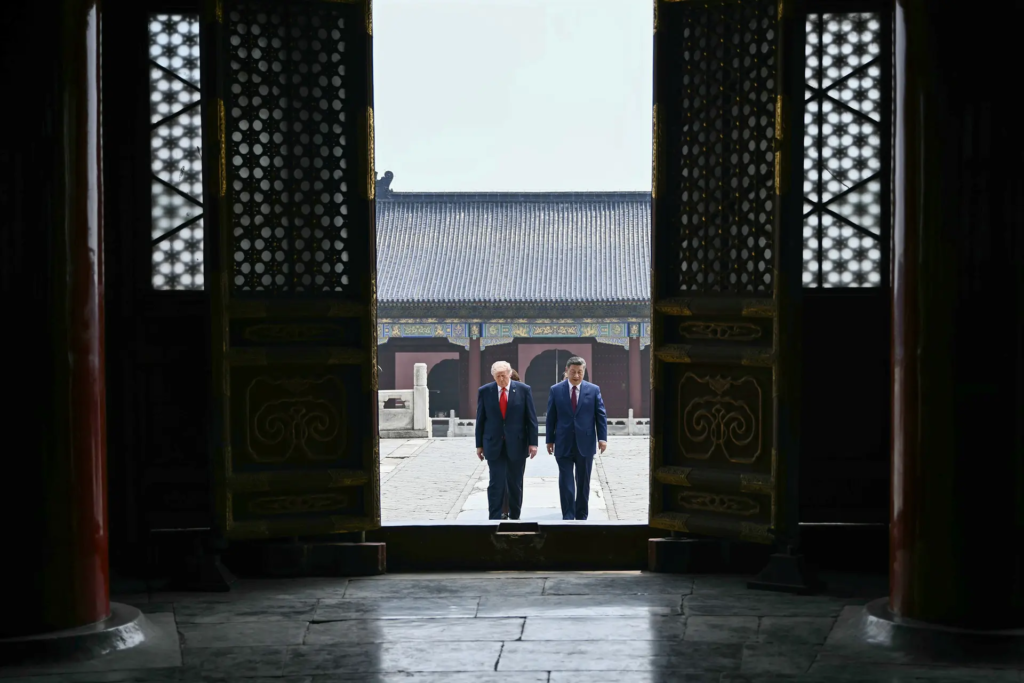
Diplomacy, at its highest level, is as much theater as it is policy. China has long understood this. The reception for a visiting American president is not merely a courtesy; it is a statement of civilizational confidence and strategic parity. As Trump stepped from Air Force One, he was met by Xi Jinping at the top of the tarmac staircase—a gesture of symmetry, not subordination. The honor guard marched in precise formation. The military band played a medley of American and Chinese compositions. The flags, carefully measured to identical height, stood side by side against a sky the color of polished slate.
Such ceremonial precision is deliberate. In Chinese diplomatic tradition, state ritual is a language of its own. The scale of the welcome, the formality of the protocol, and the choreography of movement all signal respect, but also equality. There is no bowing, no deference, only parallelism. For a visiting leader accustomed to Western informality, the spectacle can feel both imposing and impersonal. For the domestic audience watching on state television, it reinforces a narrative of China’s return to its historical centrality.
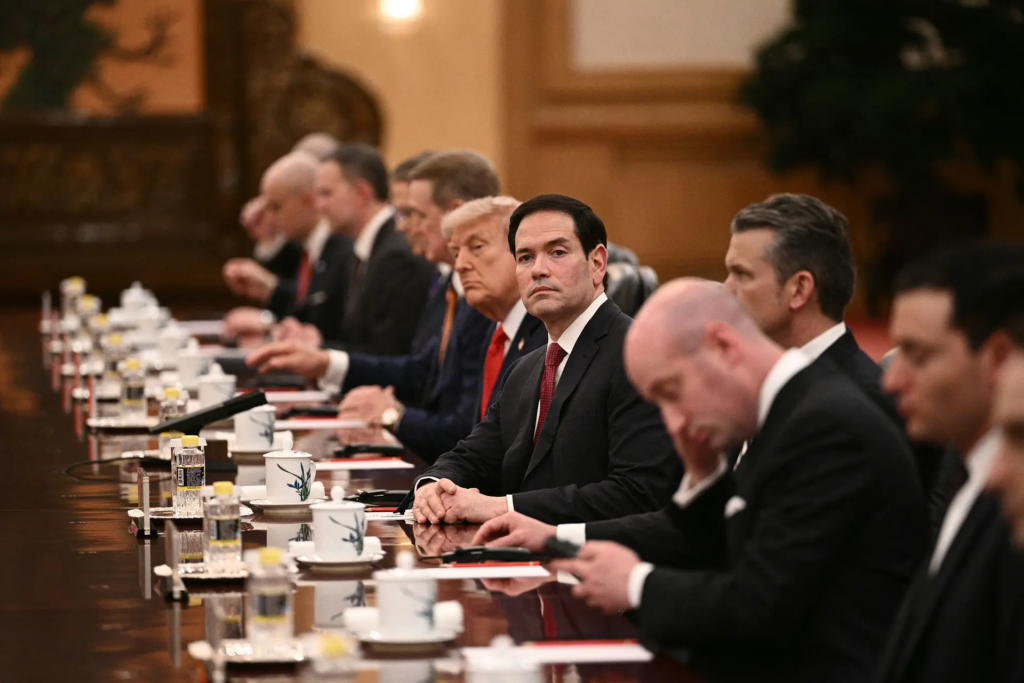
The symbolism extended beyond the airfield. The route through Beijing was controlled. The motorcade moved along avenues lined with security checkpoints and minimal public presence. Inside the Great Hall of the People, the interior design emphasized symmetry: mirrored halls, balanced seating, and a visual language that suggests permanence rather than transience. Every detail, from the placement of microphones to the spacing of water glasses, was calibrated to project order.
Western analysts often dismiss ceremonial diplomacy as mere optics. But in great-power relations, optics are a component of strategy. When trust is low, ritual becomes a substitute for confidence. The precision of the welcome signals that both sides are operating within a shared framework of state-to-state interaction, even when policy frameworks diverge. It also communicates to third parties that neither capital intends to let rivalry degenerate into disorder. In a world of unpredictable conflicts and fragmented alliances, predictability itself becomes a diplomatic asset.
The Art of the Summit: Trump, Xi, and the Choreography of Power
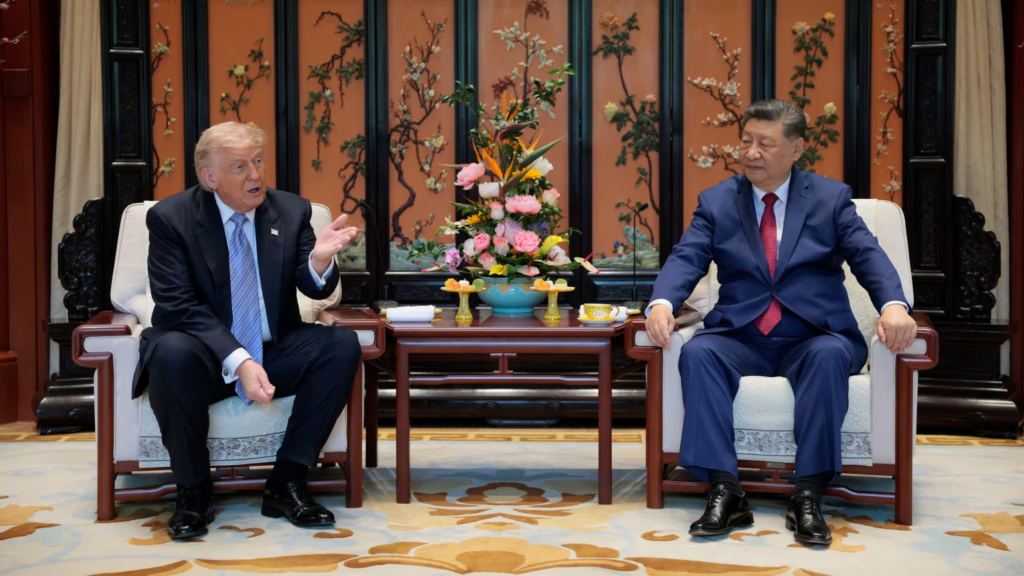
The core of the visit unfolded in a series of one-on-one meetings, followed by expanded working sessions. These encounters, stripped of public audiences and ceremonial flanking, revealed the underlying dynamics of the relationship. Trump’s negotiation style, as in previous engagements, leaned toward transactional framing: emphasis on measurable outcomes, skepticism of multilateral constraints, and a preference for direct leader-to-leader communication. Xi’s approach, by contrast, was measured, ideological, and systemic. He spoke in terms of long-term strategic vision, civilizational continuity, and the necessity of mutual respect for sovereignty.
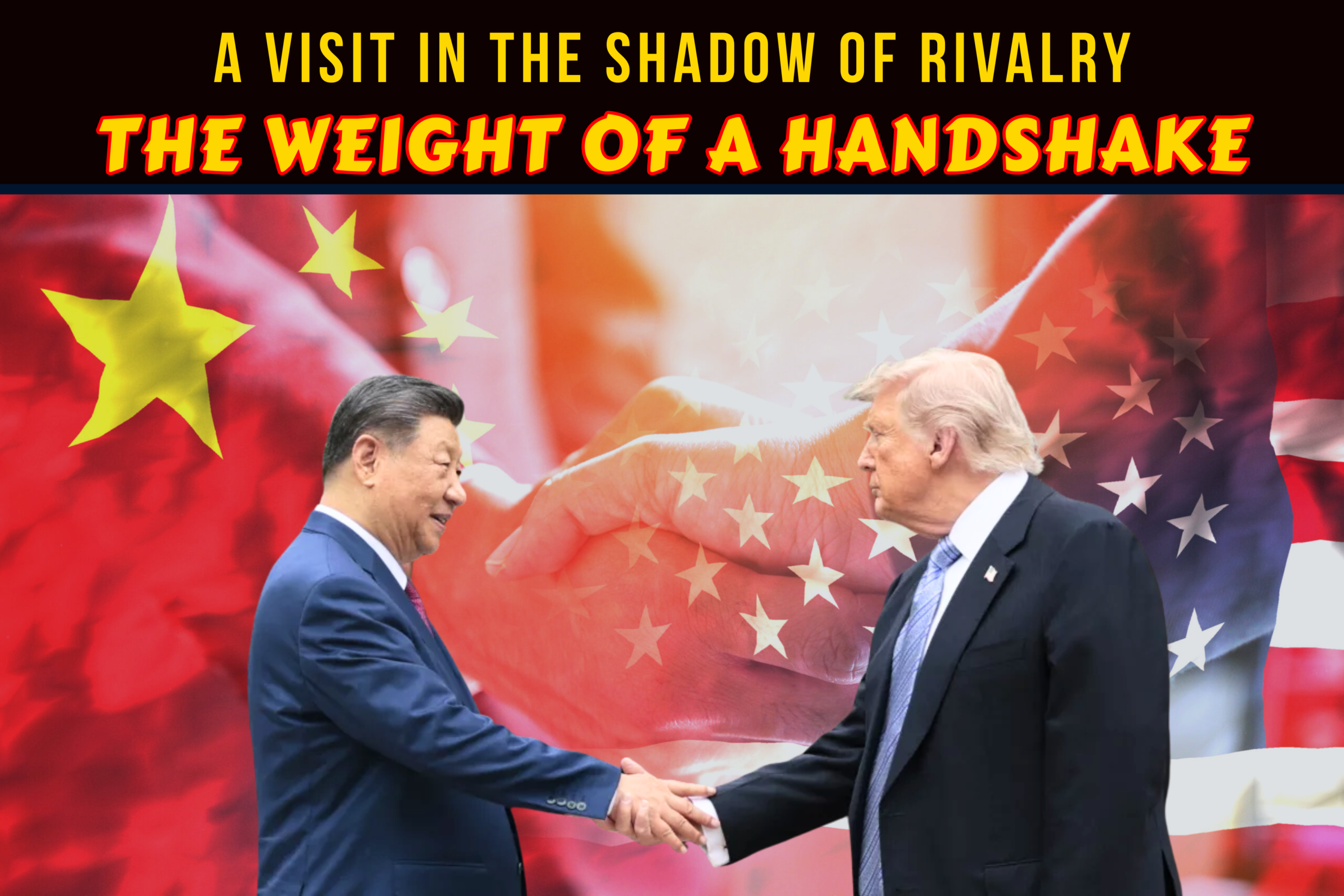
Body language and tone offered subtle clues. There were moments of levity, carefully placed, designed to humanize the encounter for domestic and international audiences. There were also moments of friction, visible only in the careful phrasing of interpreters and the slight pauses before responses. On trade, both leaders acknowledged the mutual damage caused by prolonged tariff wars, but neither offered unilateral concessions. On technology, they recognized competition but stopped short of endorsing cooperative frameworks. On Taiwan, language remained deliberate and guarded, emphasizing dialogue while avoiding commitments that could constrain future policy.
Personal diplomacy still matters, but its function has changed. In the post–Cold War era, summits were expected to produce breakthroughs. Today, they are expected to produce boundaries. The Trump–Xi meetings did not resolve structural disagreements, but they established communication channels that can prevent miscalculation during crises. They reaffirmed that even in rivalry, leaders prefer negotiation to escalation. And they demonstrated that personal rapport, while insufficient for strategic alignment, remains useful for crisis management.
The discussions also revealed a shared understanding of limits. Washington would not abandon its technology restrictions or Indo-Pacific alliance architecture. Beijing would not concede on core sovereignty claims or accept external interference in its domestic development trajectory. What both sides could agree on was the necessity of maintaining dialogue, avoiding accidental escalation, and preserving economic channels that benefit their respective populations. In strategic terms, this is not détente. It is compartmentalization.
Banquets and Bilaterals: Hospitality as Strategic Soft Power
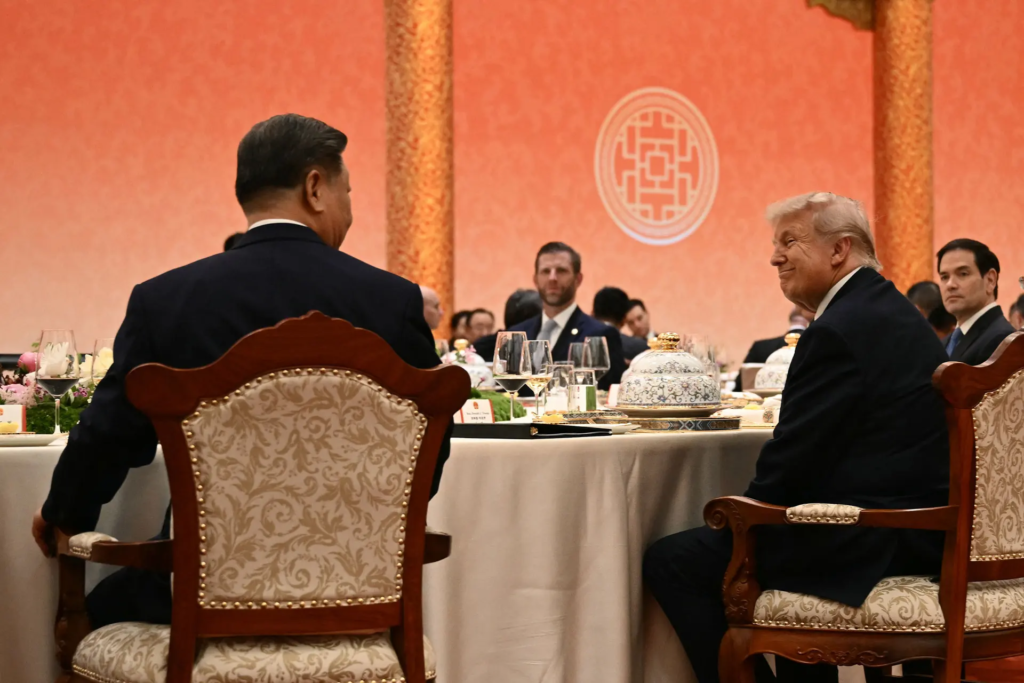
The state banquet, held in the Great Hall’s ceremonial dining room, was a masterclass in diplomatic hospitality. The menu balanced regional Chinese dishes with American ingredients, a culinary metaphor for interdependence. Cultural performances highlighted traditional arts, emphasizing continuity and civilizational depth. Toasts were delivered with careful wording, emphasizing friendship, mutual benefit, and shared responsibility for global stability.
China’s use of hospitality as soft power is neither new nor accidental. Historically, the host-guest dynamic has been a tool for signaling respect while asserting parity. The scale of the banquet, the selection of guests, the sequencing of speeches, and the cultural programming all serve to project an image of a confident, stable, and culturally rooted state. For foreign leaders, the experience is designed to be memorable but non-confrontational; for domestic audiences, it reinforces national pride without overt triumphalism.
Compared to earlier summit traditions, the banquet reflected a shift in diplomatic expectations. The Reagan–Gorbachev summits were marked by ideological tension but a shared desire to reduce nuclear risk. The Nixon–Zhou Enlai meetings were characterized by mutual curiosity and the thrill of a new alignment. Today’s banquet carried neither the urgency of arms control nor the novelty of rapprochement. Instead, it reflected a mature, if guarded, recognition that two systemic competitors can still share a table. The warmth was ceremonial; the coolness was structural.
Still, hospitality diplomacy serves a purpose. In an era of fragmented information ecosystems and domestic polarization, shared moments of state-to-state decorum remind global audiences that diplomacy has not been abandoned. They also provide leaders with a controlled environment to test rhetorical boundaries and gauge reactions without committing to policy shifts. The banquet, therefore, was not an epilogue to the summit, but an extension of it: a space where symbolism could do the work that substance could not.
Ledgers and Leverage: The Economics of Interdependence
Trade and economics remain the most tangible, and most contentious, dimension of American–Chinese relations. Discussions during the visit covered tariffs, agricultural exports, supply chain resilience, rare earth materials, semiconductor manufacturing, and investment screening. Each topic revealed the complexity of an interdependence that has become both a buffer and a vulnerability.
Washington’s position emphasized fairness, reciprocity, and the reduction of trade imbalances. American officials pointed to decades of market asymmetries, intellectual property concerns, and state-supported industrial policies that have disadvantaged U.S. firms. They also highlighted the strategic risks of overreliance on Chinese manufacturing for critical goods, from pharmaceuticals to advanced electronics. The objective was not decoupling, but de-risking: diversifying supply chains while maintaining commercial engagement where it serves mutual interest.
Beijing’s position framed trade as a matter of mutual benefit and sovereign development rights. Chinese officials argued that tariffs have disrupted global supply chains, increased costs for American consumers, and slowed economic growth in both countries. They emphasized China’s role as a stabilizer in global manufacturing and highlighted its contributions to poverty reduction, infrastructure development, and technological advancement. On rare earths and critical minerals, China maintained that resource management is a domestic policy matter, while acknowledging the need for stable global supply chains.
The outcome was neither breakthrough nor breakdown. Working-level mechanisms were established to monitor trade flows, review tariff impacts, and facilitate agricultural purchases. No major agreements were signed. No unilateral concessions were made. Instead, both sides agreed to maintain dialogue and avoid further escalation. In hindsight, this reflects a realistic understanding of economic diplomacy in an era of strategic rivalry: trade can be managed, but it cannot be decoupled from security, technology, or ideology.
The broader lesson is structural. American–Chinese economic interdependence is no longer a source of automatic stability. It is a terrain of leverage, where each side uses market access, investment screening, and supply chain control as tools of strategic competition. The summit did not change this reality. It merely acknowledged it.
The Taiwan Equation: Ambiguity, Assertiveness, and the Indo-Pacific
Few issues test the limits of American–Chinese diplomacy more than Taiwan. During the summit, both sides addressed the topic with careful wording, emphasizing dialogue while avoiding commitments that could constrain future policy. China reiterated its position that Taiwan is an inalienable part of Chinese territory, a claim rooted in sovereignty, historical continuity, and domestic political legitimacy. The United States reaffirmed its policy of strategic ambiguity, emphasizing non-interference in cross-strait affairs while maintaining arms sales, official engagements, and security assurances that deter coercion.
The language used during the summit was deliberate. Phrases like “managed differences,” “constructive communication,” and “peaceful resolution” appeared in both sides’ statements. These are not empty formulations; they are diplomatic tools designed to prevent escalation while preserving strategic flexibility. For Washington, ambiguity allows deterrence without provocation. For Beijing, it preserves the option of future pressure without immediate confrontation.
Military implications remain significant. The Indo-Pacific balance of power is shaped by American alliance networks, forward-deployed forces, and joint exercises that signal resolve. China’s military modernization, including advancements in naval capacity, missile systems, and cyber capabilities, reflects a leadership determined to defend what it views as core interests. The summit did not alter this calculus. It merely reaffirmed that both sides recognize the risks of miscalculation.
In hindsight, Taiwan remains the most volatile variable in the relationship. The summit did not ease tensions, but it prevented them from dominating the agenda. By compartmentalizing the issue, both sides preserved the possibility of dialogue on other fronts while acknowledging that resolution remains distant. This is not a failure of diplomacy; it is a reflection of its limits.
Tehran, Tehran, and the Strait: Energy, Security, and Middle Eastern Fault Lines
Middle Eastern diplomacy, though not the summit’s centerpiece, revealed another dimension of American–Chinese strategic divergence. Discussions touched on Iran’s nuclear program, regional security, and maritime stability, particularly in the Strait of Hormuz. China’s energy dependence on Gulf oil and its economic investments in the region have positioned it as a key stakeholder in Middle Eastern stability. Washington’s approach, by contrast, has emphasized deterrence, sanctions, and alliance coordination.
During the summit, both sides acknowledged the importance of regional stability but stopped short of joint frameworks. China emphasized dialogue, economic development, and opposition to unilateral sanctions. The United States stressed the necessity of nuclear non-proliferation, counterterrorism cooperation, and freedom of navigation. The Strait of Hormuz, a chokepoint through which a significant portion of global oil passes, was mentioned in the context of maritime security and commercial stability, but no coordinated security arrangement emerged.
This reflects a broader reality: China prefers economic engagement over security commitments in the Middle East. It avoids direct military entanglements, focusing instead on trade, infrastructure, and diplomatic mediation. The United States, while reducing its forward presence in some regions, maintains security guarantees, naval deployments, and alliance networks that shape regional deterrence. The summit did not bridge these approaches, but it acknowledged that competition in the Middle East must be managed to prevent escalation.
In hindsight, the discussions on Iran and the Strait reveal a pattern: great-power rivalry is increasingly multilateral, but cooperation remains limited to areas of mutual interest. Stability, not alignment, is the shared objective.
Chips, Code, and Competition: The AI and Semiconductor Front
Artificial intelligence and advanced semiconductors represent the new frontier of strategic competition. During the summit, both sides addressed technology policy with the understanding that this domain cannot be decoupled from national security. Washington’s export controls on advanced chips, including restrictions on Nvidia’s highest-tier processors, reflect a strategy of containment: preventing China from acquiring computing power that could accelerate military modernization, surveillance capabilities, or autonomous systems development.
China’s response has been to accelerate domestic substitution, expand state-led R&D, and build alternative supply chains. Discussions during the visit acknowledged competition but stopped short of endorsing cooperative frameworks. Both sides emphasized “responsible” development and the need for international standards, but neither offered concessions on core restrictions. The underlying reality is that technology rivalry is structural, not negotiable. Chips and code are no longer commercial products; they are strategic assets.
The implications extend beyond bilateral relations. Global supply chains, research collaboration, and technological standards are increasingly fragmented along systemic lines. The summit did not reverse this trend, but it recognized its inevitability. In hindsight, the technology discussions confirm that twenty-first-century rivalry is fought not only on battlefields, but in laboratories, data centers, and semiconductor fabs.
Reading the Record: Press Conferences and Diplomatic Framing
The press conferences following the summit offered a clear window into how each side framed the encounter. White House statements emphasized “respectful dialogue,” “economic stabilization,” and “enhanced communication channels.” The language was transactional, focusing on measurable outcomes and crisis management. Chinese government statements, by contrast, emphasized “equality,” “mutual benefit,” and “opposition to hegemony,” framing the visit within a broader narrative of systemic competition and civilizational parity.
Tone differences were deliberate. Washington’s messaging avoided ideological framing, focusing instead on practical cooperation and risk management. Beijing’s messaging reinforced long-term strategic vision, emphasizing sovereignty, development rights, and multipolar governance. Both sides emphasized control of narrative, avoiding concessions while projecting stability.
In hindsight, the press conferences reveal a broader shift in diplomatic communication. In an era of domestic polarization and fragmented media ecosystems, summits are judged not by breakthroughs, but by the absence of breakdowns. Messaging is calibrated to reassure allies, satisfy domestic audiences, and signal resolve without provocation. The record, therefore, is less a document of agreement than a reflection of managed competition.
Echoes Across Markets and Ministries: Global Reactions
Global reactions to the summit were measured, reflecting a recognition that rivalry is structural, not situational. American media coverage oscillated between cautious optimism and skepticism over durability. Chinese state media emphasized parity and strategic confidence. European and Asian allies expressed relief at the absence of escalation but remained vigilant about technology restrictions and alliance coordination. Financial markets experienced temporary rallies, followed by reversion to fundamentals as investors recognized that no major breakthroughs had occurred.
Strategic experts largely agreed that the summit represented managed rivalry, not détente. The focus shifted from whether cooperation was possible to whether competition could be contained. This is a significant evolution in diplomatic expectations. The world no longer asks whether great powers will compete; it asks whether they will compete responsibly.
Optics Over Outcomes: A Hindsight Assessment
In hindsight, the summit was less about substance than about structure. It did not produce major agreements, but it prevented escalation. It did not resolve Taiwan, Iran, or technology disputes, but it established communication channels that can mitigate miscalculation. It did not change strategic realities, but it refined them.
Who gained? Neither side decisively. Both avoided losses. The visit confirmed that tactical cooperation can exist within strategic competition, but it did not suggest that competition itself was negotiable. In strategic terms, the summit was about controlling the pace of rivalry, not ending it. It was a demonstration of strategic ambiguity sustained at the highest level, a recognition that managed rivalry is the new default.
The Long Game: Managing Rivalry in an Unstable Order
The future of American–Chinese relations will not be defined by summits, but by structures. Technology decoupling, alliance networks, supply chain resilience, and domestic political trajectories will shape the trajectory far more than any single diplomatic encounter. The world is not entering a new Cold War, nor is it returning to post–Cold War partnership. It is settling into competitive coexistence: a fragile, multipolar order where competition is institutionalized, escalation is managed, and diplomacy serves as a buffer rather than a bridge.
The summit did not change this reality. It merely reflected it. In a world of unpredictable conflicts and fragmented alliances, the greatest diplomatic achievement may be the absence of failure. And for now, that may be enough.