(By Khalid Masood)
1. Introduction
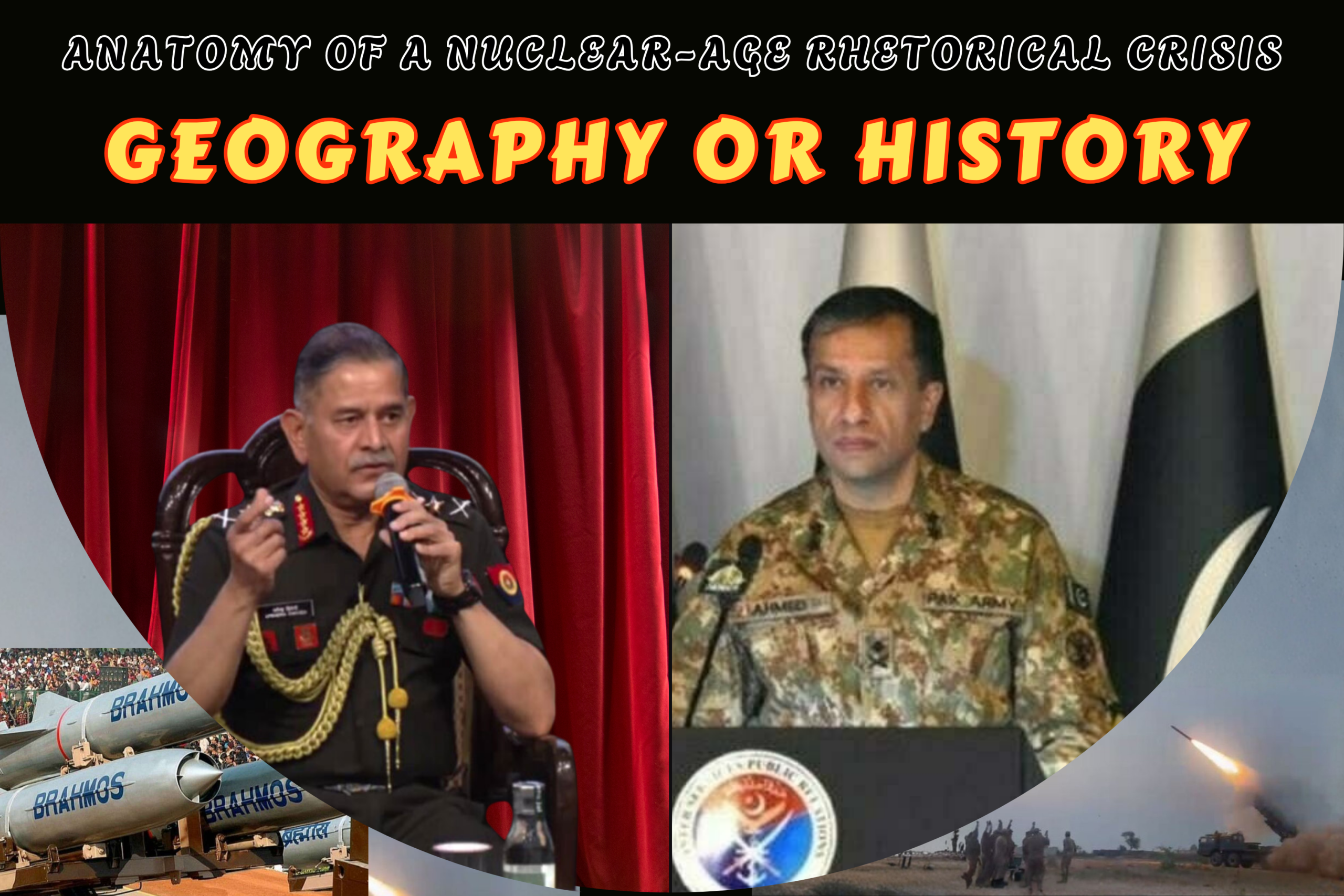
The May 2026 exchange between Indian Army Chief General Upendra Dwivedi and Pakistan’s Inter-Services Public Relations (ISPR) represents a dangerous escalation in declaratory policy between two nuclear-armed adversaries still recovering from the May 2025 Operation Sindoor crisis. Dwivedi’s warning that Pakistan must choose whether to remain “part of geography or history“—delivered on the first anniversary of the most serious India-Pakistan military confrontation in decades—was met by ISPR with charges of “madness and warmongering” and explicit nuclear-era reminders that “geographic obliteration would certainly be mutual and comprehensive.” This article deconstructs the rhetoric, compares proxy warfare allegations against available evidence, analyzes the divergence between hardline military signaling and parallel dialogue advocacy by retired officials, and assesses the implications for deterrence stability in a region where the stability-instability paradox has already produced one near-catastrophic crisis within the past year.
2. The Original Statement: Exact Wording, Context, Timing, and Strategic Framing
Exact Wording and Forum
On 16 May 2026, General Upendra Dwivedi, Chief of the Army Staff (COAS) of the Indian Army, delivered a stark message during Sena Samvad, a civil-military interaction held at the Manekshaw Centre in New Delhi. When asked how the Indian Army would respond if circumstances similar to those that triggered Operation Sindoor were to recur, Dwivedi stated:
“Pakistan, if it continues to harbour terrorists and operate against India, then they have to decide whether they want to be part of geography or history or not.”
Context and Timing
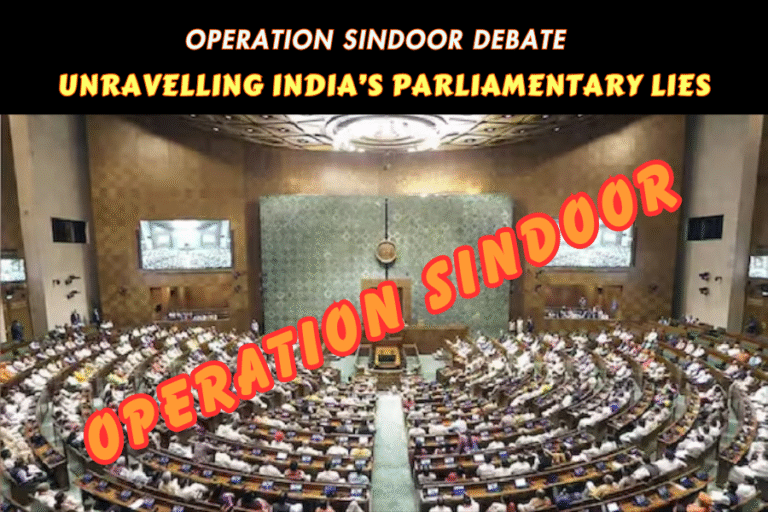
The remarks carried deliberate temporal weight. They came just days after India marked the first anniversary of Operation Sindoor (7–10 May 2025), the military confrontation launched following the 22 April 2025 Pahalgam terror attack that killed multiple civilians. Operation Sindoor involved Indian precision strikes on targets inside Pakistan and Pakistan-administered Kashmir, followed by Pakistani counter-offensives, an 88-hour engagement, and a U.S.-brokered ceasefire on 10 May 2025.
Strategic Framing
Dwivedi’s formulation—”geography or history”—represents what deterrence theorists term declaratory policy: a public articulation of consequences designed to influence adversary cost-benefit calculations. By framing the choice as existential (geographic existence versus historical oblivion), the statement went beyond standard deterrence signaling into the realm of existential compellence. The choice of a public, non-combat forum (a civil-military dialogue) rather than a classified communication channel suggests the message was intended for multiple audiences: Pakistani decision-makers, the Indian domestic constituency, and third-party observers.
The statement also reinforced India’s post-2019 doctrinal shift—often described as the “new normal”—whereby terrorist attacks on Indian soil are treated as acts of war attributable to Pakistan, erasing the distinction between non-state actors and state sponsors.
3. Pakistan’s Official Rebuttal: Direct Quotes, Key Themes, and Diplomatic Framing
The Inter-Services Public Relations (ISPR), the media wing of the Pakistan Armed Forces, issued a sharply worded statement on 17 May 2026, within 24 hours of Dwivedi’s remarks.
Direct Quotes from ISPR
- On Pakistan’s status: “Contrary to the delusional and hallucinational belief system and despite the omnipresent ill wishes that prevail in Hindutva-led India, Pakistan is already a country of consequence at global level, a declared nuclear power and an indelible part of South Asia’s geography and history.”
- On Indian strategic learning: “The Indian leadership has neither been able to reconcile with the very idea of Pakistan, nor has it learnt the right lessons, even after the passage of eight decades.”
- On the nature of the threat: “Threatening a sovereign nuclear neighbour with elimination from geography is not strategic signalling or brinkmanship; it is sheer bankruptcy of cognitive capacities, madness and warmongering despite knowing the reality that such geographic obliteration would certainly be mutual and comprehensive.”
- On responsible nuclear behavior: “Responsible nuclear states reflect restraint, maturity, and strategic sobriety. They do not speak the language of civilisational supremacy or national erasure.”
- On Indian motivations: “Delhi’s aggressive posturing stems less from confidence and more from frustration at its inability to harm Pakistan, that has been brutally exposed during Marka-e-Haq.”
- On consequences: “Any attempt to target Pakistan can trigger consequences that shall neither be geographically confined nor strategically or politically palatable for India.”
Key Themes and Diplomatic Framing
Table
| Theme | Pakistani Framing | Strategic Purpose |
|---|---|---|
| Nuclear Responsibility | Contrasts India’s rhetoric against norms of “restraint, maturity, and strategic sobriety” | Delegitimizes Indian signaling in international forums; appeals to P-5 and non-proliferation regimes |
| Historical Grievance | India has not “reconciled with the very idea of Pakistan” after eight decades | Mobilizes domestic nationalism; frames conflict as existential rather than territorial |
| Mutual Vulnerability | “Geographic obliteration would certainly be mutual and comprehensive” | Invokes nuclear deterrence logic to neutralize Indian conventional superiority |
| Reverse Terrorism Allegation | India is a “harbinger of terrorism,” “state sponsor of terrorism,” practitioner of “transnational assassinations” | Inverts the terrorism narrative; references Canadian/U.S. investigations into Indian extraterritorial operations |
| Civilizational Discourse | “Hindutva-led India,” “civilisational supremacy or national erasure” | Frames conflict in ideological terms; appeals to Muslim-majority constituencies and OIC forums |
The ISPR statement was notably issued on the first anniversary of what Pakistan terms Marka-e-Haq (the 2025 conflict), indicating deliberate calendar synchronization for maximum domestic and international resonance.
4. Historical Pattern: Decades of Rhetorical Escalation and Deterrence Signaling
The Dwivedi-ISPR exchange fits a well-documented pattern in India-Pakistan relations where public rhetoric serves as both domestic political performance and strategic communication. However, the intensity and existential framing of this exchange place it at the upper end of the escalatory spectrum.
Historical Precedents
- 2001–02 Standoff (Operation Parakram): Following the Indian Parliament attack, India mobilized nearly 500,000 troops. Both sides engaged in sustained nuclear signaling, including missile tests and explicit threats, before de-escalation via U.S. diplomacy. The crisis demonstrated that even mass conventional mobilization could be contained under the nuclear shadow—but at enormous economic and human cost.
- 2019 Pulwama-Balakot: The Balakot airstrikes marked India’s shift to “below-the-threshold” retaliation. Pakistan’s conventional counter-response (including the downing two Indian Fighter jets and capturing of Wing Commander Abhinandan) challenged assumptions about Indian escalation dominance. Nuclear signaling remained muted but present, including reported deployment of an Indian nuclear submarine.
- May 2025 (Operation Sindoor/Marka-e-Haq): The most serious confrontation since 1971. India struck deep into Pakistan’s Punjab province; Pakistan immediately responded with conventional counterforce downing six Indian jets including three state of the art Rafale. The crisis illustrated what analysts term “escalation gone meta”—where each retaliatory move responds not merely to the immediate provocation but to an accumulated historical narrative of mistrust.
Pattern Analysis
| Era | Indian Rhetorical Posture | Pakistani Counter-Framing | Nuclear Signaling |
|---|---|---|---|
| 2001–02 | Mass mobilization; “coercive diplomacy” | “We will respond with full force”; missile tests | Explicit; elevated alert |
| 2016 (Uri) | “Surgical strikes” as new normal | Denial + counter-claims | Minimal |
| 2019 (Pulwama) | “Pre-emptive strikes” justified | “Quid pro quo plus” response | Submarine deployment rumored |
| 2025 (Sindoor) | “Operation suspended, not ended” (Modi) | “Full-spectrum decisive response” | Muted but present |
| 2026 (Dwivedi) | “Geography or history” existential threat | “Madness and warmongering”; mutual obliteration warning | Explicit mutual vulnerability reminder |
The trajectory reveals a progressive normalization of existential rhetoric. Where earlier crises confined existential threats to implicit nuclear deterrence postures, the 2026 exchange features a serving army chief explicitly framing the adversary’s continued existence as conditional—a qualitative shift in declaratory policy.
5. Proxy Warfare Allegations: Critical Comparison of Claims and Evidentiary Standards
Both India and Pakistan routinely accuse the other of sponsoring cross-border terrorism. A rigorous analytical approach requires distinguishing official claims, independent verification, and analytical inference.
Indian Claims vs. Pakistani Claims: Comparative Table
Critical Analytical Observations
- Asymmetry in Designation: The U.S. has designated both TRF (as LeT proxy) and BLA/Majeed Brigade as Foreign Terrorist Organizations, lending third-party validation to both sides’ non-state adversaries. However, designation does not automatically confirm state sponsorship.
- The Attribution Problem: Both governments conflate non-state actor operations with state direction. The BLA’s March 2025 Jaffar Express hijacking and the TTP’s 2025–2026 campaign demonstrate lethal capability, but Pakistani claims of Indian direction remain largely based on intelligence assessments that have not been independently corroborated. Conversely, Indian claims of Pakistani control over LeT/JeM operational cells face similar verification gaps.
- Danger of Uncorroborated Attribution: In the May 2025 crisis, both sides used proxy allegations to justify cross-border strikes. When attribution is weaponized for domestic consumption without evidentiary transparency, it creates self-fulfilling escalation cycles where retaliatory strikes “confirm” the adversary’s guilt regardless of actual command-and-control relationships.
- The “Fitna al-Hindustan” Frame: Pakistan’s formal designation of BLA/TTP as “Fitna al-Hindustan” (Indian Sedition) represents a narrative consolidation effort, but independent analysts note that both groups have indigenous grievances (Baloch resource nationalism; Deobandi anti-state ideology) that predate and exist independently of Indian involvement.
6. The “Mixed Signals” Phenomenon: Rhetorical Positioning vs. Operational Intent
A striking feature of the current environment is the simultaneous presence of hardline military rhetoric and dialogue advocacy from different segments of the Indian establishment.
The Dialogue Track
Earlier in the same week as Dwivedi’s statement, Dattatreya Hosabale, General Secretary of the Rashtriya Swayamsevak Sangh (RSS), called for stronger people-to-people contact between India and Pakistan. General M.M. Naravane (Retd.), former Indian Army Chief, publicly backed Hosabale’s position, stating: “Common people have nothing to do with politics.” Pakistan’s Foreign Office spokesperson Tahir Andrabi welcomed these remarks as a “positive development.”
Analyzing the Divergence
| Actor | Position | Function | Audience |
|---|---|---|---|
| General Dwivedi (Serving COAS) | Existential compellence; “geography or history” | Deterrence signaling; domestic morale | Pakistani military; Indian public; international observers |
| General Naravane (Retd.) | People-to-people dialogue; de-politicized contact | Track-II normalization; institutional memory | Pakistani diplomatic corps; Indian liberal/conservative constituencies |
| Hosabale (RSS) | Civil society engagement | Ideological flexibility; Hindu nationalist constituency management | RSS base; BJP government signaling |
| Pakistan Foreign Office | Welcomes dialogue overtures | Diplomatic positioning; contrast with military rhetoric | International community; domestic moderates |
Why Serving Officials Issue Hardline Warnings
- Deterrence Credibility: Serving military chiefs must maintain credible coercive postures. Softening rhetoric by active duty officers risks signaling weakness to adversary intelligence assessments.
- Domestic Political Economy: In India’s current political environment, anti-Pakistan rhetoric aligns with ruling party electoral strategies. The Army Chief operates within this discursive ecosystem, even while maintaining institutional professionalism.
- Anniversary Effect: Dwivedi’s remarks were calibrated to coincide with the Operation Sindoor anniversary, when domestic attention to Pakistan is heightened.
Why Retired Officials Advocate Dialogue
- Institutional Memory: Retired generals possess direct knowledge of war’s costs and nuclear risks, often moderating views post-retirement.
- Political Cover: Retired officials can voice positions that serving officers cannot, providing the government with diplomatic flexibility without undermining deterrence posture.
- Track-II Legitimacy: Former COAS statements create space for backchannel exploration without formal commitment.
Analytical Distinction
The mixed signals phenomenon does not necessarily indicate a split within Indian policy. Rather, it reflects functional differentiation: serving officials maintain deterrence credibility while retired figures and civil society actors preserve diplomatic off-ramps. However, when existential rhetoric from serving chiefs dominates the information space, it risks crowding out de-escalation signals and creating misperception in adversary decision-making.
7. Nuclear Deterrence & Escalation Risks: Why Existential Rhetoric Destabilizes Crisis Management
The Theoretical Framework
The India-Pakistan nuclear relationship is the archetypal case of the stability-instability paradox: nuclear deterrence at the strategic level inhibits total war but encourages risk-taking at lower levels of conflict. As Belfer Center analysts noted following the May 2025 crisis: “Nuclear deterrence does not guarantee strategic stability… there is virtually no escalatory buffer, no meaningful space to fight and contain conflict once thresholds are crossed.”
Current Force Postures
| Dimension | India | Pakistan | Stability Implication |
|---|---|---|---|
| Warhead Estimates | ~180 | ~170 | Rough parity; no first-strike incentive |
| Doctrine | No First Use (NFU) + Massive Retaliation | Full-Spectrum Deterrence + Calibrated Escalation | Asymmetric doctrines create ambiguity about escalation thresholds |
| Delivery Systems | Agni-V, Rafale, SLBM (INS Arighat) | Shaheen-II, Babur cruise missile, Nasr (tactical nuclear) | Pakistan’s tactical nukes lower nuclear use threshold; India’s sea-based deterrent introduces maritime crisis instability |
| Geographic Constraint | Large landmass; strategic depth | Narrow geography; limited strategic depth | Pakistani vulnerability incentivizes early use or launch-on-warning; Indian strikes on Punjab approach existential threshold |
Why Dwivedi’s Rhetoric is Escalatorily Dangerous
- Erosion of Ambiguity Management: Responsible nuclear states rely on calculated ambiguity to maintain deterrence without provoking preemption. By explicitly framing Pakistan’s existence as conditional, Dwivedi’s statement collapses ambiguity into existential clarity—paradoxically undermining stability.
- Pakistani Doctrine Response: Pakistan’s “full-spectrum deterrence” explicitly contemplates early nuclear use if conventional defense fails. Existential framing by India validates Pakistani doctrinal assumptions about Indian intentions, potentially lowering Islamabad’s nuclear threshold.
- The “Madness” Frame: ISPR’s characterization of Indian rhetoric as “madness and warmongering” is not merely insult—it is strategic communication to international audiences that India has become an unreliable nuclear actor. This framing, if accepted by third parties, could alter great-power behavior during future crises.
- Compressed Geography = Compressed Decision Time: South Asia lacks the strategic depth of Cold War Europe. A future crisis would offer minutes, not hours, for leadership decision-making. Existential pre-crisis rhetoric primes decision-makers for worst-case assumptions, increasing accidental escalation risk.
- Prospect Theory and Loss Framing: As deterrence theorists apply prospect theory to South Asia, decision-makers under threat accept greater risks to avoid losses than to achieve gains. Dwivedi’s statement, combined with the anniversary timing, activates loss frames on both sides—India framing itself as perpetually victimized by terrorism, Pakistan framing itself as existentially threatened by a conventionally superior neighbor.
Historical Precedent: May 2025
The May 2025 crisis demonstrated that even “calibrated” strikes (India targeting “terrorist infrastructure,” Pakistan responding with “quid pro quo plus”) can rapidly approach nuclear thresholds. The crisis required U.S. presidential intervention to broker a ceasefire. As the International Crisis Group observed: “By erasing the distinction between militants and alleged state patrons in Pakistan, India’s new military doctrine heightens the risk of another conflict.”
8. Analytical Conclusions: Evidence-Based Takeaways
a. Rhetoric Has Become an Independent Variable
In South Asia’s nuclear dyad, public statements by serving military chiefs are no longer mere commentary—they are inputs into adversary strategic calculations. Dwivedi’s “geography or history” formulation and ISPR’s “mutual and comprehensive” obliteration warning constitute a rhetorical arms race that operates in parallel to kinetic capabilities. Analysts and policymakers must treat declaratory policy as a measurable escalation indicator.
b. Verification Gaps Enable Escalation
Both sides’ proxy warfare allegations suffer from asymmetric transparency: each demands evidentiary standards from the adversary that it fails to meet itself. The absence of internationally credible, transparent investigation mechanisms for cross-border terrorism allegations means that attribution remains politically weaponized. The international community’s reliance on national intelligence assessments (e.g., U.S. FTO designations) provides partial validation but does not substitute for independent forensic verification.
c. Mixed Signals Require Careful Parsing
The coexistence of Dwivedi’s existential threats with Naravane/Hosabale dialogue advocacy illustrates strategic polyphony rather than policy incoherence. However, in crisis conditions, adversaries typically weight the most escalatory signal as the true indicator of intent. Without explicit clarification, hardline rhetoric from serving officials will systematically dominate softer signals from retired or civil society figures.
d. Deterrence Requires Institutionalized De-escalation
Nuclear deterrence alone has proven insufficient to prevent repeated crises (1999, 2001–02, 2019, 2025). What is missing is a robust crisis management architecture: functional hotlines, pre-negotiated off-ramps, and regular military-to-military communication. The 1988 Agreement on the Prohibition of Attack against Nuclear Facilities has held for nearly four decades because it is specific, reciprocal, and verifiable. Similar specificity is needed for conventional-nuclear threshold management.
e. Media Literacy and Narrative Deconstruction Are Security Imperatives
Nationalist media ecosystems on both sides amplify official rhetoric without critical interrogation. The Pakistani press’s uncritical reproduction of “Fitna al-Hindustan” claims and the Indian media’s framing of Operation Sindoor as unalloyed victory both contribute to perception gaps that make future escalation more likely. Independent journalism, academic analysis, and international observer access are not luxuries—they are stabilizing necessities.
f. Human-Centered Reporting Must Prevail
Behind every strategic calculation are civilian populations who bear the costs of deterrence failure. The Pahalgam victims, the passengers of the Jaffar Express, the families of soldiers on both sides—these human realities are routinely obscured by abstract “geography vs. history” framing. Analytical neutrality does not require moral neutrality: the prevention of nuclear war remains the paramount ethical obligation.
9. Conclusion
The exchange between General Dwivedi and Pakistan’s ISPR is not merely a war of words but a stress test for South Asia’s nuclear order, one that exposes how easily declaratory policy can outpace strategic stability when existential framing replaces calculated ambiguity. As the May 2025 crisis demonstrated, even “calibrated” military actions between India and Pakistan can compress decision-making timelines to minutes and require great-power intervention to prevent catastrophe; when such operations are preceded by rhetoric that treats an adversary’s very existence as negotiable, the margin for miscalculation narrows to a razor’s edge. The coexistence of hardline military warnings with parallel dialogue advocacy reveals not policy incoherence but functional differentiation—yet in crisis conditions, adversaries inevitably weight the most escalatory signal as the authentic expression of intent. Moving forward, both capitals must recognize that deterrence without de-escalation architecture is a treadmill of recurring confrontation, and that the human costs of nuclear miscalculation—borne by civilians in Pahalgam, Balochistan, Punjab, and beyond—render the abstraction of “geography versus history” not only strategically reckless but morally untenable. Ultimately, the evidence suggests that neither side can rhetoric its way to security; only verifiable restraint, transparent attribution standards, and institutionalized crisis communication can transform this nuclear dyad from a perpetual near-catastrophe into a managed, if uneasy, equilibrium.