(By Khalid Masood)
Introduction & Diplomatic Significance
The Twenty-Fifth Anniversary and Symbolic Timing
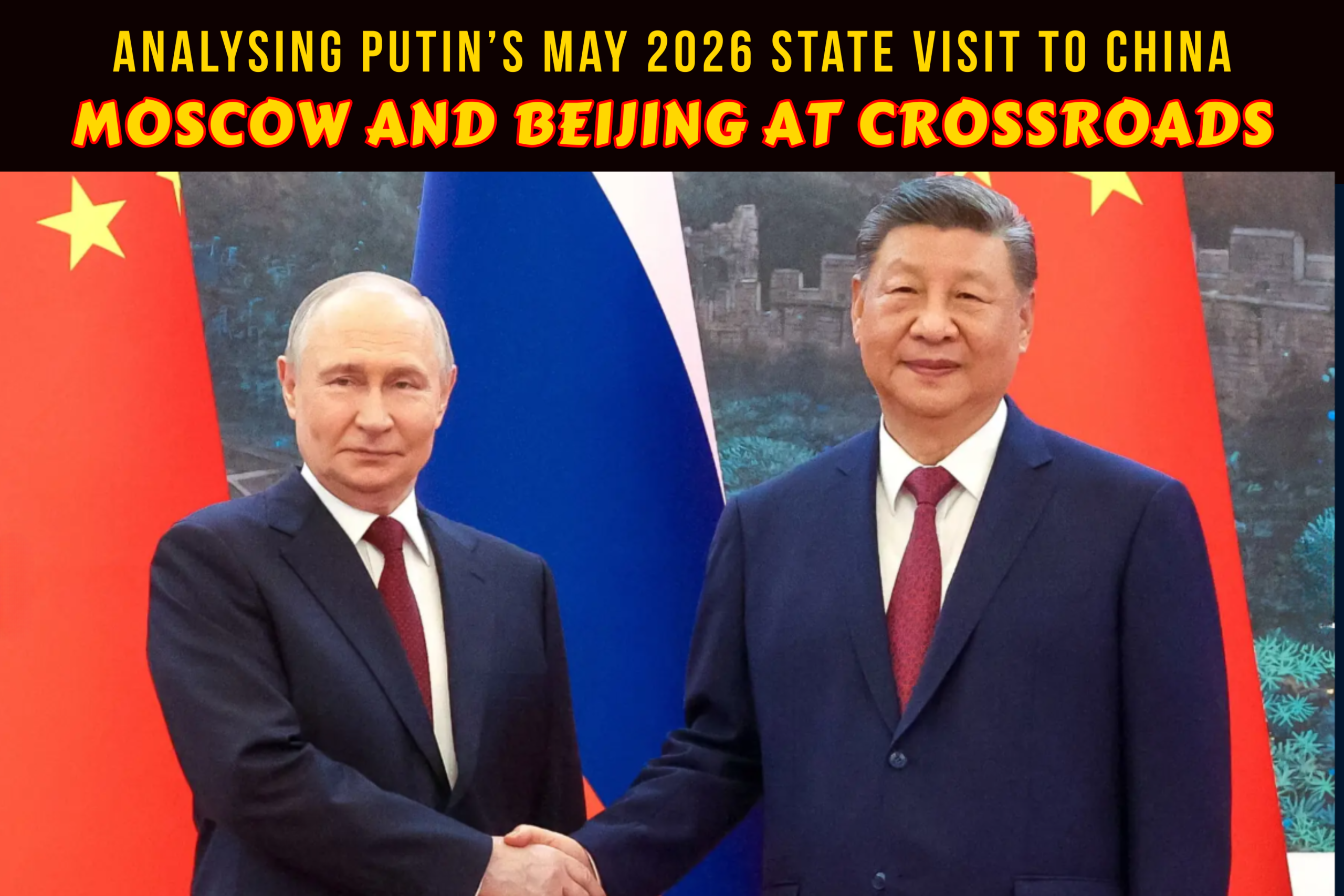
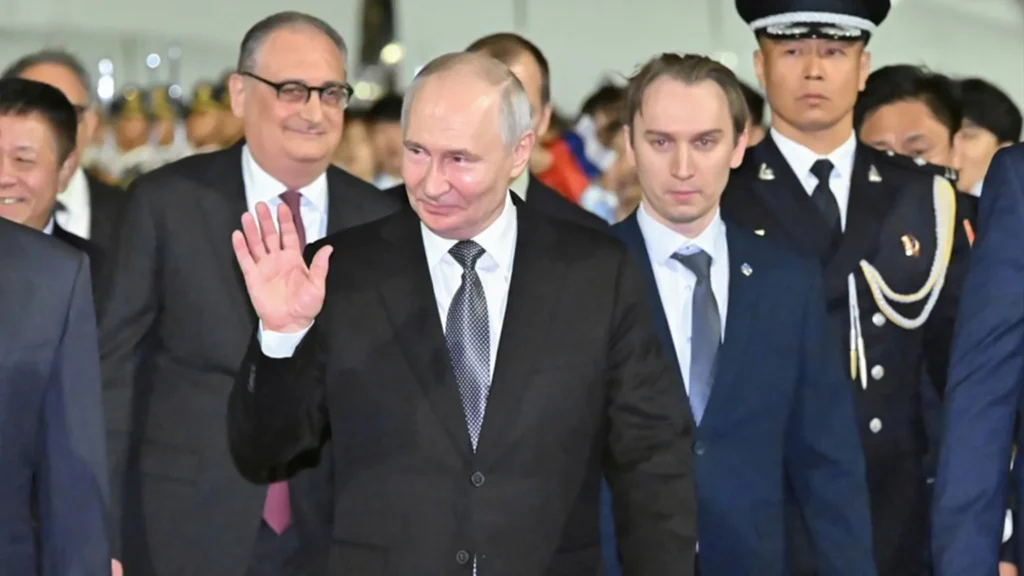
The Great Hall of the People in Beijing provided the backdrop for a carefully choreographed diplomatic milestone in May 2026, as Russian President Vladimir Putin arrived for a state visit that coincided precisely with the twenty-fifth anniversary of the Treaty of Good-Neighbourliness and Friendly Cooperation. Signed in 2001, the treaty originally established a framework for resolving border disputes, promoting economic exchange, and institutionalising regular high-level dialogue. A quarter of a century later, the anniversary has been transformed into a ceremonial anchor for what both capitals now describe as a comprehensive strategic partnership. State banquets, joint press conferences, and the signing of supplementary implementation protocols were deliberately timed to project continuity, resilience, and institutional maturity. For Beijing, the anniversary reinforces its narrative of long-term strategic patience; for Moscow, it underscores the durability of its eastern pivot amid prolonged geopolitical strain.
The “No Limits” Rhetoric as a Stabilising Narrative
The phrase “no limits”, first articulated in the joint statement of February 2022, has evolved from a declarative flourish into a working diplomatic framework. During the 2026 visit, both leaders reiterated that their partnership is not an exclusionary bloc but a stabilising counterweight in an increasingly fragmented international system. Chinese officials frame the relationship as a pillar of strategic autonomy, insulating Eurasian economies from what they describe as Western coercion and unilateral sanction regimes. Russian counterparts, meanwhile, present the partnership as a necessary recalibration of global power distribution, arguing that a multipolar architecture reduces systemic volatility and prevents the weaponisation of international institutions. The rhetorical emphasis on stability is deliberate: it allows both capitals to project responsibility whilst simultaneously challenging the post-Cold War liberal order.
Strategic & Geopolitical Context
The Ukraine Conflict, Sanctions, and Chinese Neutrality
The visit unfolded against the enduring backdrop of the conflict in Ukraine and the most extensive Western sanctions architecture imposed on Russia since the Cold War. China’s official posture remains one of strategic neutrality, characterised by public calls for dialogue, refusal to supply lethal military aid, and consistent voting patterns at the United Nations that avoid direct condemnation of Moscow whilst rejecting the legitimacy of unilateral economic warfare. Yet this neutrality is highly calibrated. Chinese financial institutions, state-owned enterprises, and private exporters have systematically filled supply chain vacuums created by Western disengagement, providing Russia with critical industrial components, consumer goods, and capital market access. From Beijing’s perspective, this approach preserves diplomatic flexibility and shields China from secondary sanctions, whilst advancing its broader objective of preventing Western strategic consolidation. Moscow, in turn, views Chinese economic lifelines and diplomatic cover as indispensable to sustaining its wartime economy and international standing.
Architecting a Multipolar World Order
A central theme of the 2026 meetings was the shared commitment to institutional pluralism. Both leaders reiterated support for reforming the United Nations Security Council, expanding the BRICS+ framework, and strengthening the Shanghai Cooperation Organisation as alternative platforms for global governance. Russian diplomacy emphasises the dismantling of what it terms a “unipolar hegemony”, arguing that concentrated Western control over financial clearing, technology standards, and security architectures creates systemic fragility. Chinese strategy complements this by promoting the concept of “community with a shared future for mankind”, which advocates for developmental sovereignty and non-interference. The convergence of these narratives has produced coordinated diplomatic initiatives in the Global South, including debt restructuring frameworks, alternative payment rails, and South–South technical cooperation programmes. Neither capital seeks immediate institutional rupture; rather, they aim to dilute Western centrality through incremental parallelism and strategic hedging.
Economic & Energy Cooperation
Trade Expansion and Sectoral Integration
Bilateral trade volumes approached the $240 billion annual threshold by early 2026, reflecting a structural reorientation rather than a temporary wartime surge. The composition of this trade has diversified significantly. Chinese automotive manufacturers, particularly electric vehicle producers, have captured a dominant share of the Russian passenger car market following the withdrawal of European, Japanese, and American brands. Agricultural flows have expanded in tandem, with Russia increasing exports of wheat, soy, beef, and seafood to Chinese ports, whilst China supplies processed foods, agricultural machinery, and greenhouse technology. Technology and industrial cooperation have deepened through joint ventures in semiconductor packaging, telecommunications infrastructure, and precision engineering. Both governments have established cross-border industrial parks in the Russian Far East and north-eastern China to streamline logistics, reduce tariff barriers, and harmonise technical standards. This sectoral integration reduces vulnerability to external supply shocks whilst creating interdependent domestic industries.
Energy Corridors, De-Dollarisation, and Financial Architecture
Energy remains the strategic bedrock of the partnership. The operational Power of Siberia pipeline continues to deliver natural gas to north-eastern China, whilst negotiations over Power of Siberia 2 have progressed towards finalising pricing mechanisms and transit agreements through Mongolia. Liquefied natural gas projects in the Yamal and Arctic regions are being co-developed with Chinese financing and engineering capacity, complemented by joint ventures in nuclear energy and renewable grid integration. Parallel to physical infrastructure is the accelerating shift away from dollar-denominated transactions. Yuan–ruble settlements now exceed ninety per cent of bilateral trade, facilitated by the integration of China’s Cross-Border Interbank Payment System (CIPS) with Russia’s System for Transfer of Financial Messages (SPFS) as a SWIFT alternative. Digital currency pilot programmes and commodity-backed settlement mechanisms are under evaluation. From Moscow’s standpoint, this architecture mitigates exposure to Western financial leverage and sanctions enforcement. For Beijing, it internationalises the yuan, deepens regional financial influence, and creates a template for non-Western monetary cooperation that can be exported to emerging markets.
Military & Security Dimensions
Joint Exercises and Defence Technology
Military coordination has advanced through a calibrated programme of joint exercises, intelligence exchanges, and defence industrial collaboration. Recent iterations of the Vostok strategic exercises have incorporated combined-arms drills, air defence integration, and long-range precision strike simulations across eastern Russia and the Russian Far East. Naval exercises in the Sea of Japan and the East China Sea have featured anti-submarine warfare, maritime interdiction, and joint command post drills, whilst strategic bomber patrols near Japanese and Alaskan airspace demonstrate operational interoperability. Defence technology cooperation has expanded into aerospace components, early warning systems, cyber security frameworks, and unmanned aerial platforms. Both militaries benefit from shared tactical doctrines, joint training curricula, and standardised communication protocols that reduce friction during multilateral operations under SCO or BRICS security mandates.
Strategic Coordination Without a Formal Alliance
Despite the depth of military engagement, the partnership deliberately avoids the institutional trappings of a formal defence alliance. There is no mutual defence clause, no integrated command structure, and no obligation for automatic troop deployment in the event of conflict. This asymmetry is intentional. Beijing preserves strategic autonomy to manage relations with the United States, Europe, and the Indo-Pacific without being legally bound to Russian military contingencies. Moscow accepts this limitation because it gains substantial capability enhancement and geopolitical deterrence without requiring Chinese blood or treasury commitments for distant conflicts. The implications for regional security are nevertheless significant. In the Indo-Pacific, the axis complicates freedom of navigation calculations and introduces additional complexity to Taiwan Strait contingency planning. In Central Asia, Russia’s traditional security primacy is increasingly complemented by Chinese economic and diplomatic weight, managed through SCO coordination mechanisms to prevent friction. In the Arctic, joint icebreaker development and resource exploration projects coexist with careful boundary demarcation and environmental governance frameworks, illustrating how military and economic cooperation is carefully ring-fenced to avoid overcommitment.
Personal Diplomacy & Leadership Dynamics
The Optics of the Xi–Putin Encounter
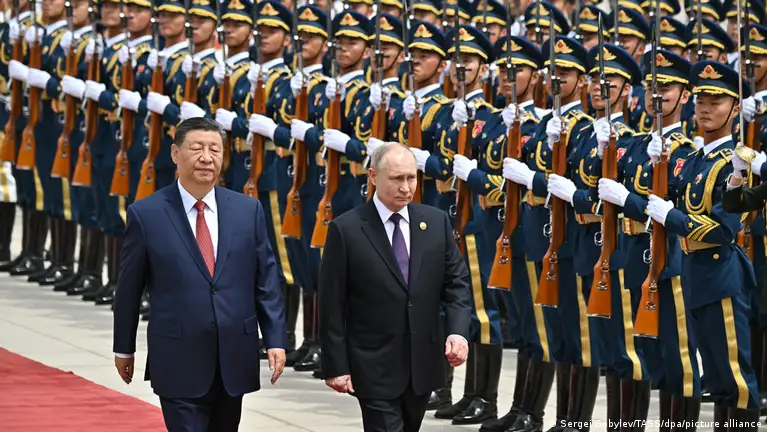
The choreography of the May 2026 meetings was designed to project parity, mutual respect, and strategic depth. Handshakes, joint walks through the Great Hall, and extended private sessions were televised to emphasise personal rapport and institutional continuity. Body language remained measured but relaxed, with both leaders employing historical references to the Silk Road, wartime alliances, and civilisational resilience to frame contemporary cooperation. Joint press statements avoided triumphalism, instead foregrounding technical implementation, mutual trust, and long-term vision. The visual messaging was deliberate: it countered Western narratives of dependency or friction, presenting instead a partnership of equals navigating structural global shifts.
Domestic Legitimacy and Global Signalling
Beyond the diplomatic stage, the visit served distinct domestic political functions. For President Putin, the Beijing summit reinforced the narrative that Russia’s geopolitical isolation is a Western construct, not an objective reality. By showcasing Chinese investment, technological partnerships, and diplomatic backing, the Kremlin projects economic resilience and strategic relevance to domestic audiences. For President Xi, the visit consolidates China’s image as a responsible global power capable of managing complex strategic relationships without compromising its core interests. Domestically, it validates the party’s foreign policy direction and reinforces economic security narratives. Internationally, the coordinated messaging signals to the Global South that alternative development models, financial architectures, and security frameworks are operational and accessible. The personal diplomacy thus functions as a dual-use instrument: reinforcing domestic political consolidation whilst projecting strategic confidence to external audiences.
Regional & Global Implications
Calculations in Asia and Eurasia
The deepening Russia–China axis has prompted recalibrations across neighbouring regions. India maintains a delicate balancing act, leveraging BRICS and SCO platforms for economic cooperation whilst strengthening security ties with the United States, Japan, and Australia through the Quad framework. New Delhi views the Russia–China partnership as a structural reality to be managed rather than an existential threat, focusing on border stability, energy imports, and multipolar diplomacy. Central Asian states, historically within Russia’s security orbit, are increasingly integrating with Chinese infrastructure finance and trade corridors. The SCO remains the primary institutional buffer, facilitating counter-terrorism coordination, water resource management, and border demarcation to prevent great-power friction. ASEAN nations continue to hedge, welcoming Chinese investment and Russian energy supplies whilst resisting alignment pressure and emphasising strategic autonomy. Japan perceives the axis as a compound security challenge, accelerating defence modernisation, deepening US alliance integration, and expanding diplomatic outreach to India and Australia to counterbalance northern and eastern maritime pressures. Smaller states generally view the partnership as an opportunity for diversification, though many remain cautious about over-reliance on a single economic or security pole.
Responses from NATO and Washington
Western strategic planning has adapted to the institutionalisation of the Russia–China partnership. NATO has strengthened its Indo-Pacific liaison frameworks, expanded defence industrial base investments, and enhanced intelligence-sharing protocols across allied nations. The alliance’s strategic concept now explicitly addresses cross-theatre coercion, hybrid warfare, and supply chain vulnerabilities linked to Eurasian cooperation. Washington has responded through intensified sanctions enforcement, technology export controls, diplomatic outreach to the Global South, and alliance consolidation in both Europe and Asia. The US strategy emphasises deterrence through capability, economic resilience, and coalition-building, whilst avoiding direct military confrontation. Both Western capitals acknowledge that the Russia–China axis cannot be dismantled through coercion alone; instead, they focus on managing its externalities, protecting critical infrastructure, and offering alternative partnership frameworks that compete on developmental and governance terms rather than ideological confrontation.
Conclusion
Consolidation of Existing Trajectories
The May 2026 state visit does not represent a rupture or a fundamental reorientation; rather, it marks the consolidation of a decade-long trajectory towards structured interdependence. The anniversary of the 2001 treaty provided a ceremonial milestone to institutionalise practices that have already become operational realities: yuan–ruble settlements, joint energy infrastructure, calibrated military exercises, and coordinated multilateral diplomacy. Both capitals have moved beyond ad hoc alignment towards systematic integration, creating redundant economic, financial, and security linkages that insulate the partnership from external shocks.
Assessing Durability, Limits, and Future Geopolitics
The durability of the Russia–China axis is anchored in mutual strategic necessity, systemic pressure from Western sanction regimes, and shared opposition to unipolar governance. Yet structural limits persist. The relationship is inherently asymmetrical, with China holding economic, technological, and demographic advantages that gradually reposition Russia as the junior strategic partner. Long-term divergences may emerge over Central Asian influence, Arctic resource governance, trade balance imbalances, and differing risk appetites regarding regional conflicts. Furthermore, neither capital seeks formal alliance entanglements that could compromise strategic autonomy or trigger unintended escalation. For global geopolitics in 2026 and beyond, the partnership functions as a central node in an increasingly multipolar system. It accelerates financial pluralism, complicates Western deterrence architectures, and provides an alternative governance model for emerging economies. Its endurance will depend on both capitals’ ability to manage asymmetry, navigate third-party pressures, and sustain institutional flexibility. The axis is unlikely to become a hegemonic bloc, but it will remain a defining structural feature of twenty-first-century international relations, shaping everything from energy markets and technology standards to security doctrines and diplomatic alignments.