(By Faraz Ahmed)
Introduction: When Satire Becomes Strategy
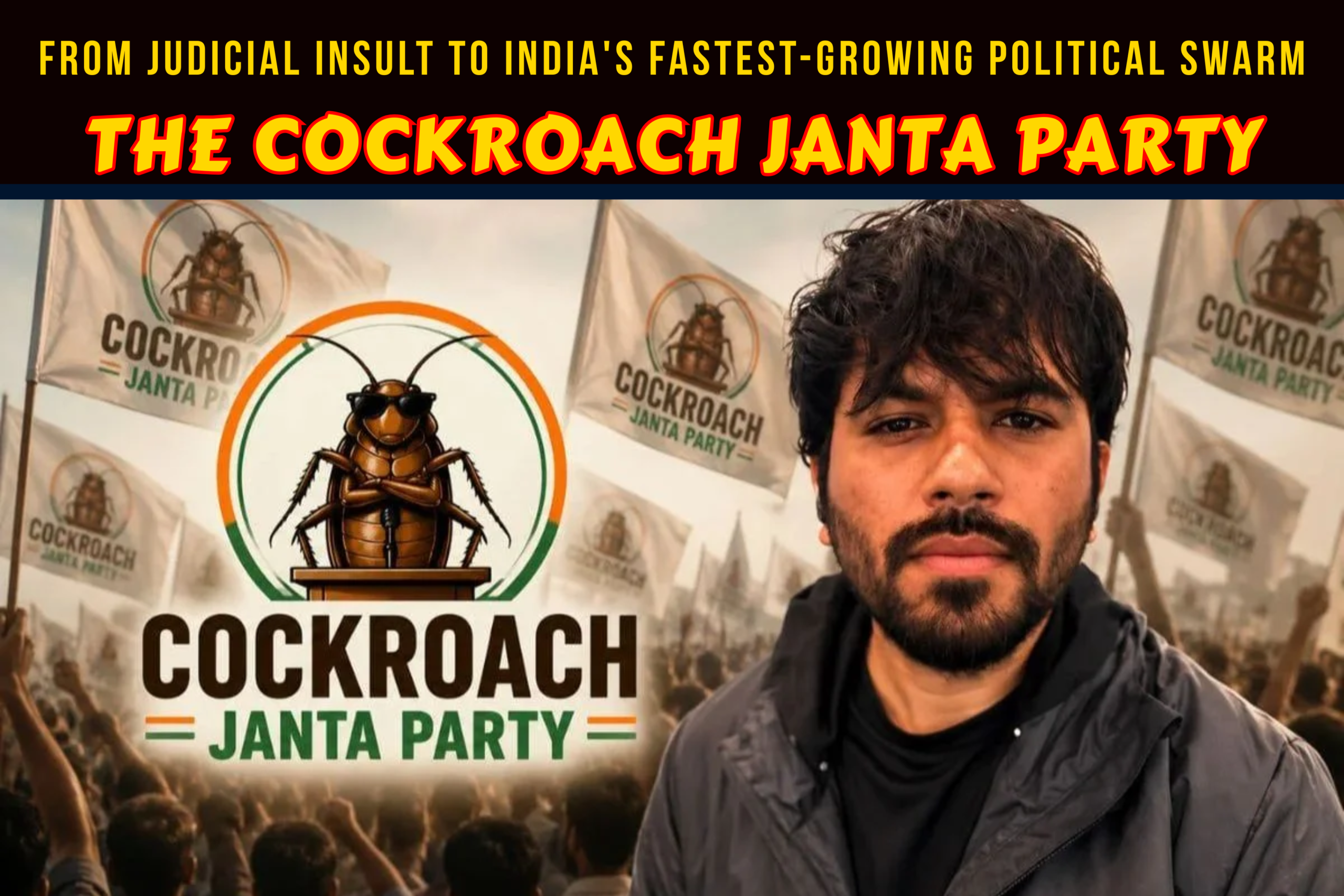
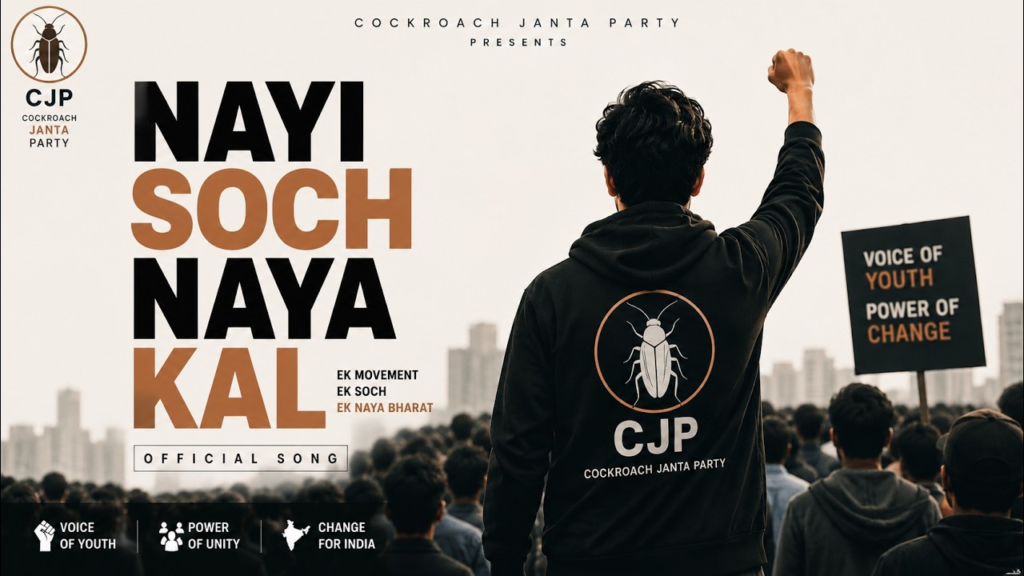
In the span of less than a week, a parody political movement born from a Supreme Court slur has become the most talked-about political force in India in particular and in the region in general. The Cockroach Janta Party (CJP) — named after an insect synonymous with survival — has amassed over 20 million Instagram followers, surpassing the ruling Bharatiya Janata Party’s 8.8 million on the same platform, and transformed a judicial insult into a nationwide symbol of youth resistance. What began as an absurdist online joke on May 16, 2026, has evolved into a structured political collective with a manifesto, membership criteria, and an increasingly visible offline presence.
The Spark: A Chief Justice’s Remark and a Generation’s Rage
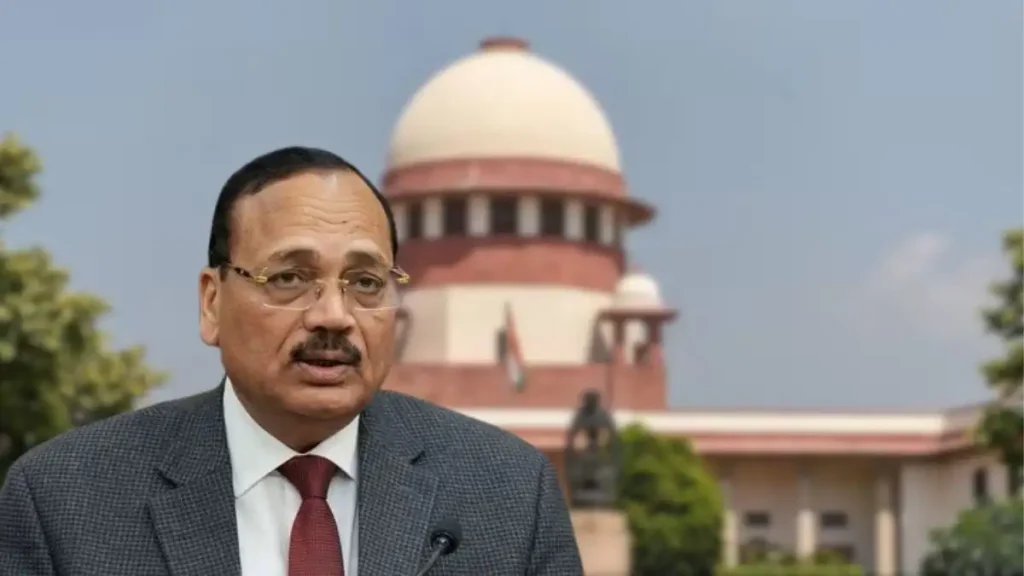
The CJP’s origin traces directly to comments made by Chief Justice of India Surya Kant during a court hearing in mid-May 2026. While discussing unemployed youth and activists, Kant stated: *”There are youngsters like cockroaches, who don’t get any employment or have any place in the profession… [they] become media… social media [activists] or Right to Information activists and start attacking everyone.”*
The remarks detonated across Indian social media. Though Kant later clarified that his comments targeted individuals with fraudulent degrees rather than India’s youth broadly, the damage was done. For a generation already battered by graduate unemployment rates nearing 40% among 15-25 year-olds, persistent exam paper leaks disrupting government recruitment, and a collapsing rupee, the “cockroach” label felt less like a legal observation and more like institutional contempt.
Rather than reject the insult, young Indians weaponized it.
The Architect: Abhijeet Dipke and the Accidental Revolution
The movement’s founder, Abhijeet Dipke, is a 30-year-old Boston University student and political communications strategist who previously worked with the Aam Aadmi Party (AAP), the anti-corruption movement-turned-political force that shook Indian politics in 2012. Dipke insists the CJP’s explosive growth was unintentional: “Nothing of this was intentional… It is the younger people who were actually very frustrated. They didn’t have any outlet. They were really angry at the government.”
Operating from “wherever the wifi works,” Dipke has positioned the CJP as a leaderless swarm rather than a traditional hierarchy. The party claims 160,000 registered “members” gathered through Google Forms, alongside tens of thousands of online volunteers. Its official X (Twitter) account, which had accumulated roughly 200,000 followers, was abruptly withheld in India on May 21 in response to a legal demand — only for Dipke to launch a replacement account within minutes, posting: “You thought you can get rid of us? Lol.”

The Manifesto: Satire With Substance
The CJP’s website leans heavily into self-mockery, declaring itself the “Voice of the Lazy & Unemployed” and listing tongue-in-cheek membership requirements: being unemployed (by force, choice, or principle), physically lazy (though mentally spiraling), chronically online for a minimum of 11 hours daily, and capable of professional ranting.
Beneath the humor, however, lies a pointed five-demand manifesto that directly targets institutional pillars of the Indian establishment:
- Judicial Accountability: No post-retirement Rajya Sabha (upper house) seats for Chief Justices — a practice critics call “judicial quid pro quo.”
- Electoral Integrity: Arrest of the Chief Election Commissioner under anti-terrorism laws (UAPA) if legitimate votes are deleted from rolls.
- Gender Parity: 50% reservation for women in Parliament (up from the proposed 33%) and 50% of all Cabinet positions reserved for women, without expanding Parliament’s strength.
- Media Independence: Cancellation of broadcast licenses for media houses owned by billionaires Mukesh Ambani and Gautam Adani, plus investigation of pro-government (“Godi media”) news anchors’ bank accounts.
- Anti-Defection: A 20-year ban on contesting elections or holding public office for any MLA or MP who defects from their party.
These demands reveal a sophisticated understanding of governance grievances that transcends mere meme culture.
Why It Resonated: The Perfect Storm of Youth Discontent
The CJP did not emerge in a vacuum. It surfed a wave of cascading crises hitting India’s Gen Z and millennial populations, who comprise more than a quarter of the country’s 1.4 billion people:
- Employment Collapse: The 2026 State of Working India Report by Azim Premji University found that only a small fraction of the 8 million annual graduates secure stable salaried jobs within a year. The IT services sector — historically India’s high-paying employment engine — is hemorrhaging jobs due to AI-driven automation.
- Examination Scandals: Repeated paper leaks in federally administered recruitment exams have blocked millions of young people from government jobs they spent years preparing for.
- Economic Squeeze: The Iran war has spiked fuel import costs, sending the rupee tumbling to nearly Rs 97 against the dollar (from 85 a year prior) and forcing the government to raise fuel prices. Prime Minister Narendra Modi recently urged citizens to embrace austerity by cutting gold purchases, foreign travel, and fuel usage — a stark reversal from his pre-2014 political attacks on similar economic conditions under previous governments.
- Institutional Distrust: The CJP channels widespread frustration with what its supporters view as captured institutions — from a judiciary perceived as seeking post-retirement political rewards to an election commission accused of voter roll manipulation to media conglomerates seen as extensions of corporate-political power.
As Dipke noted: “Five years ago nobody was ready to speak up against Modi or the government. The times are changing.”
From Digital Swarm to Street Presence
The CJP’s trajectory mirrors recent youth-driven political upheavals across South Asia, including anti-government movements in Sri Lanka, Bangladesh, and Nepal. While Modi and the BJP have maintained public silence on the CJP, the movement has already begun its offline migration. Young volunteers have appeared at protests dressed as cockroaches, and the symbol — once an insult — has been reclaimed as a badge of resilience: “They tried to step on us. We came back.“
Dipke has explicitly rejected comparisons to violent uprisings in neighboring countries, stating: “The youth of this country are far more mature, aware, and politically conscious than many give them credit for… They understand their constitutional rights and will express their dissent through peaceful and democratic means.”
Future Trajectory: Flash in the Pan or Political Paradigm Shift?
The Cockroach Janta Party stands at a critical inflection point. Several scenarios are plausible:
1. The Digital Ceiling
Critics, largely Modi supporters, dismiss the CJP as an opposition-aligned gimmick destined to fade. They point to Dipke’s AAP background as evidence of partisan orchestration and argue that Instagram followers do not translate into votes. India’s digital divide remains vast; 15 million online supporters represent a fraction of the electorate in a country where 900 million are eligible to vote.
2. The AAP Precedent
The most compelling historical parallel is the Aam Aadmi Party itself, which emerged from the 2011-12 anti-corruption protests as a decentralized citizen movement and now governs Delhi and Punjab. Dipke’s involvement with AAP’s early communications strategy suggests he understands this playbook. The CJP’s five-demand manifesto is already more detailed than many established regional parties.
3. Electoral Ambitions
While the CJP currently denies affiliation with any existing political organization, Dipke has signaled electoral intent: “This is the movement that has arrived in India… it will change the political discourse… if required it will also come on the ground.” The user notes interest in contesting upcoming state elections, primarily in capital cities — a strategically sound approach for testing organizational strength in urban, youth-heavy constituencies where digital mobilization can most efficiently convert to votes.
4. The Repression Variable
The withholding of CJP’s X account within days of its launch suggests the establishment is not ignoring the threat. If major social media platforms face sustained legal pressure to restrict CJP content, the movement’s decentralized, cockroach-like structure — leaderless, redundant, and capable of regenerating banned accounts — may prove to be either its greatest strength or its fatal fragmentation.
5. Mainstream Co-option or Collision
Opposition leaders have already offered endorsements. The CJP could either evolve into a formal political party with ballot symbols and ward-level committees, or be absorbed as a youth wing by established opposition forces seeking to harness its energy. Alternatively, if the BJP responds with policy concessions on employment and examination reform, the CJP’s specific grievances could be defused.
Conclusion: The Cockroach as Political Rorschach
The Cockroach Janta Party is simultaneously a joke and a judgment — a satirical mirror held up to a political establishment that underestimated the political sophistication of India’s unemployed graduates. Whether it endures as an electoral force, dissolves into digital folklore, or mutates into something unforeseen, it has already achieved something significant: it proved that in an age of institutional alienation, even an insult from the Chief Justice can become a campaign slogan.
In a political culture obsessed with strongmen and sacred cows, the cockroach — unkillable, unwanted, and everywhere — may be the most honest mascot Indian democracy has produced in decades.