(By Ayesha Mahnoor)
Introduction: The Seduction of Linear Thinking
“History rarely moves in straight lines, and global supremacy has never been awarded on a spreadsheet.”
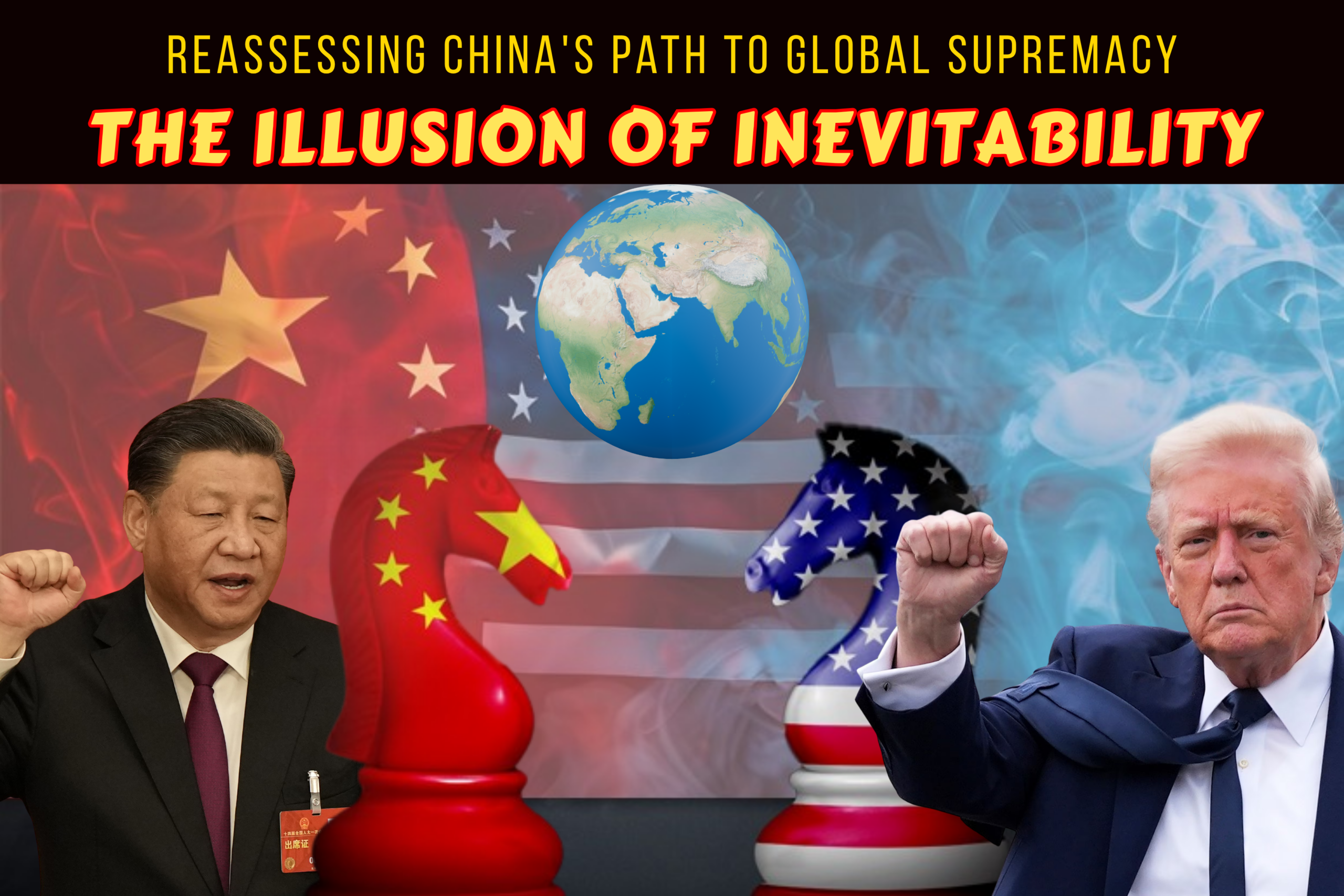
The narrative is familiar, almost ritualistic: China’s economy will surpass America’s, its technological edge will widen, and the 21st century will belong to Beijing. This projection is presented not as possibility, but as destiny. Yet if we strip away deterministic forecasting, a more complex reality emerges: economic might can build a superpower’s body, but only civilizational resonance can give it a voice the world willingly follows.
China’s ascent is undeniable. But output is not leadership. Production is not persuasion. And empires do not fall because they grow poor; they fall when they stop making sense to the world.
1. Redefining the Superpower: Beyond Guns and GDP
The classical understanding of superpower status was always multidimensional. Consider the historical template:
| Empire | Military Power | Economic Dominance | Civilizational Diffusion |
|---|---|---|---|
| Rome | Legions | Trade networks | Latin, Roman law, civic order |
| Britain | Royal Navy | Industrial might | English, common law, financial systems |
| USA | Global bases | Dollar hegemony | Universities, media, tech ecosystems, liberal norms |
“Hegemony is power that operates not through coercion, but through consent.”
— Antonio Gramsci
The United States maintains structural dominance not merely through military bases or dollar reserves, but through an ecosystem that shapes how the world defines progress, freedom, and modernity. This is what Gramsci called hegemony: the quiet architecture of global imagination, where even those who critique the system often do so using its vocabulary.
China’s model operates on a fundamentally different logic: state capacity, strategic autonomy, and developmental sovereignty. These are strengths domestically, but become constraints when projected globally. Superpower status requires organic adoption, not just transactional partnerships.
2. China’s Structural Strengths: The Impressive Reality
Let us be analytically honest about China’s achievements:
| Metric | China | United States | Implication |
|---|---|---|---|
| Manufacturing Output | 28% of global total | 16% | China is the world’s factory |
| Renewable Energy Capacity | 40% of global solar/wind | 12% | Dominance in green transition |
| EV Production | 60% of global output | 10% | Control of future mobility |
| Belt & Road Partners | 150+ countries | N/A | Extensive infrastructure diplomacy |
| STEM Graduates/Year | 4.7 million | 800,000 | Human capital pipeline |
| High-Speed Rail | 42,000 km | 0 km | Domestic connectivity advantage |
China has woven itself into the economic fabric of over 140 countries. Its state capacity to mobilize capital, coordinate long-term planning, and execute at scale remains unmatched. This is not a declining power; this is a formidable systemic challenger.
But here’s where the narrative requires nuance.
3. The Civilizational Gap: Where Numbers Don’t Translate
“Language does not just transmit thought; it structures it.”
— Noam Chomsky
When we move beyond production metrics into the realm of influence, structural gaps emerge:
| Dimension | China | United States | The Gap |
|---|---|---|---|
| Global Language Reach | Mandarin: 1.1B speakers (mostly native) | English: 1.5B speakers (1B+ as 2nd language) | English is the operating system of global science, finance, and tech |
| University Rankings (Top 100) | 6-8 institutions | 40-45 institutions | Academic gravity remains Western |
| Peer-Reviewed Publications | Growing rapidly, but mostly in Chinese journals | 70%+ of high-impact publications in English | Knowledge production still flows through English |
| Cultural Export Reach | Strong in Asia/Africa; limited in West | Hollywood, Netflix, music, gaming dominate globally | Entertainment ≠ normative influence |
| Media Trust (Global South) | Mixed; growing in BRI countries | Declining but still significant | Neither has monopoly on credibility |
| Diaspora Networks | 60M overseas Chinese (often assimilated) | Global Anglophone professional class | Informal influence networks favor English |
The critical insight: Mandarin lacks the second-language ecosystem, open academic pipelines, and cultural permeability that allow a language to become a global cognitive framework. China produces world-class content, but it remains largely contained within state-managed narratives or consumed as entertainment rather than as normative reference points.
4. The Consent Dilemma: Why Coercion ≠ Leadership
“Economies never operate in a vacuum; they are embedded in cultural and ethical frameworks.”
— Max Weber
Durable global leadership survives because others find it useful, familiar, or morally legible. Consider the embedded advantages:
The United States’ Structural Moats:
- Dollar dominance: 60% of global reserves, 88% of forex transactions
- Institutional path dependency: SWIFT, IMF, World Bank, WTO frameworks
- Academic gravity: 7 of top 10 universities; 40% of international students
- Tech ecosystems: Silicon Valley, open-source communities, venture capital networks
- Cultural socialization: Hollywood, journalism, streaming platforms normalize certain values
China’s Influence Model:
- Transactional partnerships: Infrastructure for resources/access
- State-led narratives: Controlled messaging, limited organic adoption
- Developmental authoritarianism: Admired for results, rarely adopted as system
- Financial statecraft: CIPS, digital yuan, bilateral swaps (growing but limited)
“Humans gravitate toward the familiar, not because it is perfect, but because it is intelligible.”
— Sigmund Freud (adapted)
The United States has made profound strategic missteps. Its domestic polarization and institutional gridlock are well documented. Yet embedded systems outlast flawed leadership. Path dependency is powerful. Civilizational diffusion creates gravitational pull that economic fluctuations cannot easily disrupt.
5. Alternative Futures: Beyond Binary Thinking
The 21st century is unlikely to produce a single hegemon in the 20th-century sense. Instead, we are moving toward layered multipolarity:
| Scenario | Description | Probability |
|---|---|---|
| US Resilience | America stabilizes economy, rebuilds institutions, leverages civilizational infrastructure | Moderate (35-40%) |
| Chinese Primacy | China closes civilizational gap, achieves normative consent, replaces US systems | Low-Moderate (20-25%) |
| Fragmented Multipolarity | Economic, technological, and cultural leadership decoupled; regional spheres of influence | High (40-50%) |
| Systemic Competition | Parallel systems (financial, tech, normative) coexist; selective decoupling | Very High (60-70%) |
China will undoubtedly reshape trade, technology, and development finance. But becoming the world’s defining superpower requires occupying the global imagination, not just the global supply chain.
Conclusion: The Unfinished Ascent
“Economies open doors, but civilizations decide who walks through them.”
This analysis is not meant to romanticize Western dominance or dismiss China’s achievements. It is to recognize that power, at its highest level, is as much about meaning as it is about mechanics.
If America stabilizes its economy, rebuilds institutional trust, and navigates its internal fractures, it retains a civilizational infrastructure that cannot be replicated overnight.
If China continues its current trajectory, it will reshape the global order. But unless it cultivates permeable cultural ecosystems, embraces linguistic and academic openness, and allows its narratives to be contested rather than curated, its influence will remain formidable but bounded.
The illusion of inevitability thrives on linear thinking. It assumes that because China has grown faster, it will automatically lead. But history’s most consistent lesson is quieter:
Supremacy is not inherited. It is internalized. And the world rarely internalizes what it does not understand, what it cannot critique freely, or what it does not dream in.
China’s path to global supremacy is not impossible. It is simply incomplete.