(By Khalid Masood)
Know the enemy and know yourself in a hundred battles you will never be in peril. When you are ignorant of the enemy but know yourself, your chances of winning or losing are equal. If ignorant both of your enemy and of yourself, you are certain in every battle to be in peril. – Sun Tzu
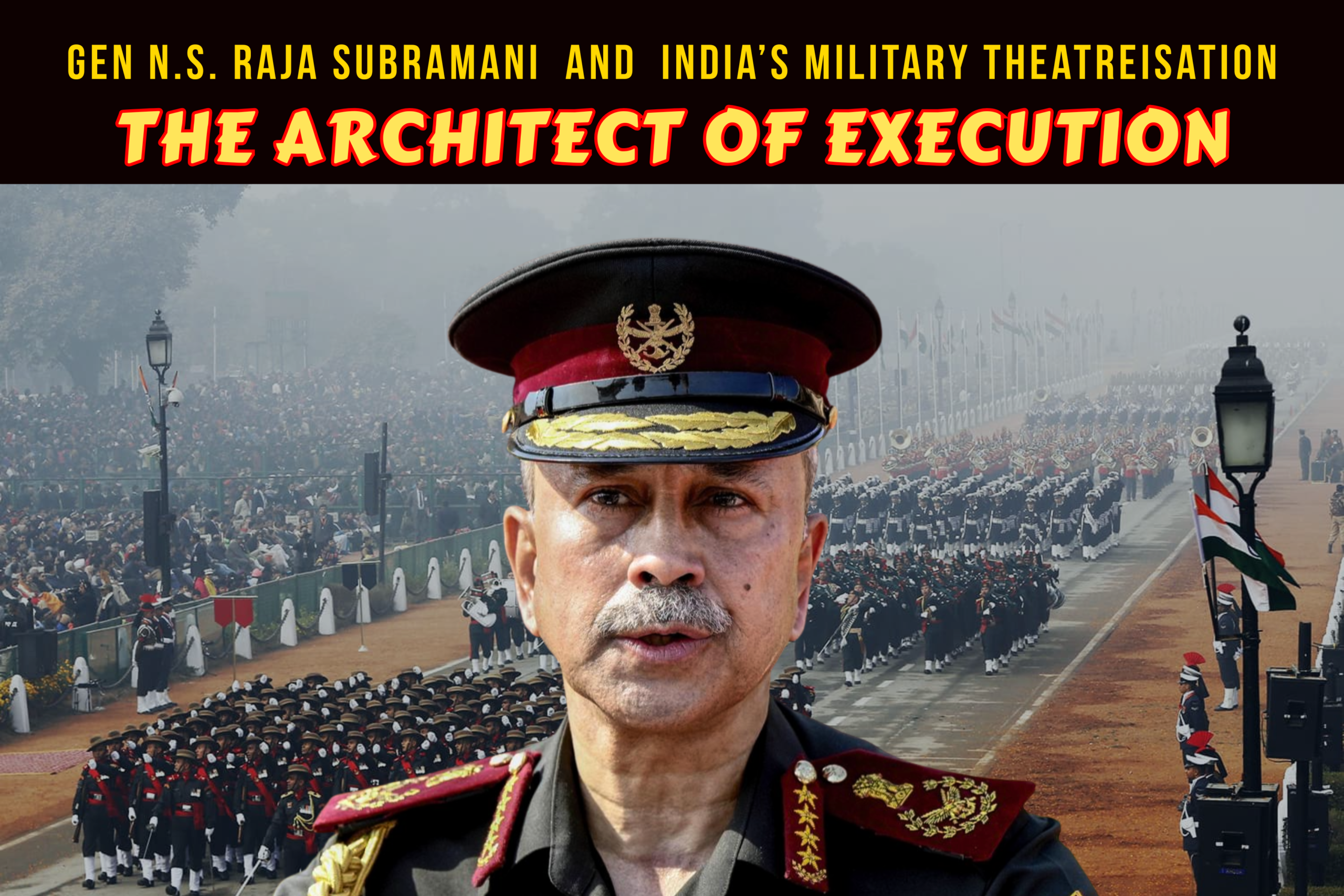
The transition of leadership at the apex of the Indian military establishment marks a critical juncture in New Delhi’s decades-long pursuit of joint warfare capabilities. On May 31, 2026, General N.S. Raja Subramani assumed office as India’s Chief of Defence Staff (CDS) and Secretary of the Department of Military Affairs (DMA), succeeding General Anil Chauhan. His appointment has sparked intense debate within India’s strategic community, as he is the second consecutive retired three-star officer to be recalled, promoted, and installed as CDS. For regional military analysts and strategic planners, particularly in Pakistan, this leadership change is highly significant not merely for its structural implications, but for its political-strategic signaling. General Subramani’s unique operational pedigree—spanning counter-insurgency, China-centric mountain warfare, and command of a premier strike corps on the western front—combined with his close strategic alignment with National Security Advisor Ajit Doval, positions him to aggressively dismantle inter-service silos. This article provides a detailed assessment of General Subramani’s professional background, the political doctrine of “Defensive Offence” that underpins his mandate, and the profound implications of these developments for the regional security calculus.
Part I: The Controversy of Recall and Strategic Alignment
General N.S. Raja Subramani’s appointment has ignited a vigorous debate within India’s defense circles. He is the second retired three-star officer, after General Anil Chauhan, to be brought back into service, promoted to four stars, and appointed as CDS. Many retired senior Indian officers have publicly questioned this precedent, arguing that capable serving officers are available and that recalling retirees undermines the morale and career progression of the active-duty cadre. They ask: Why bypass the serving hierarchy?
However, an objective analysis suggests that this decision is not an administrative anomaly but a deliberate strategic choice by the Modi government. The post of CDS was created by Prime Minister Narendra Modi’s administration with a specific intent: to ensure that the head of the military establishment shares the government’s strategic thinking and political vision. The selection of General Subramani is evidence of this alignment.
Before his appointment as CDS, General Subramani served as the Military Adviser at the National Security Council Secretariat (NSCS) from September 2025. In this role, he worked directly under National Security Advisor (NSA) Ajit Doval, heading the NSCS and engaging in regular, high-level strategic discussions. This nine-month tenure allowed for a deep convergence of thought between the military adviser and the NSA. It appears that NSA Doval concluded that General Subramani was the right individual to carry forward the government’s vision, prioritizing strategic trust and doctrinal alignment over traditional seniority norms. This pattern mirrors the appointment of General Anil Chauhan, who also had prior exposure to the NSCS system, indicating a clear preference for officers who have been vetted through the civilian national security apparatus.
Part II: Professional Pedigree and Operational DNA
To accurately forecast the trajectory of India’s military reforms, one must dissect the operational and strategic DNA of the officer leading the charge. General N.S. Raja Subramani’s career represents a deliberate and highly relevant blend of tactical, operational, and strategic experiences that directly align with India’s current threat perception.
Commissioned into the 8th Battalion of the Garhwal Rifles in 1985, General Subramani’s early career, as infantry officer, was forged in the crucible of counter-insurgency (CI) operations. His significant role in Operation Rhino in Assam provided him with foundational experience in intelligence-led operations, civil-military coordination, and the management of prolonged asymmetric conflicts. This background is critical, as modern warfare increasingly blurs the lines between conventional conflict and hybrid/asymmetric threats.
His operational command portfolio is particularly noteworthy for its direct relevance to India’s two primary strategic fronts. As the commander of the 168 Infantry Brigade in Jammu and Kashmir, and later as the General Officer Commanding (GOC) of the 17 Mountain Division, he gained extensive, hands-on experience in high-altitude warfare and infrastructure development along the Line of Actual Control (LAC) with China. The 17 Mountain Division, specifically raised and tailored for the eastern sector, is a cornerstone of India’s mountain strike capability.
Equally significant for regional analysts is his tenure commanding the prestigious 2 Corps on the western front. The 2 Corps, headquartered in Ambala, is a key offensive formation tasked with operations in the plains of Punjab and Rajasthan. Commanding this strike corps provided General Subramani with an intimate understanding of the operational dynamics, mobilization timelines, and logistical requirements of large-scale armored and mechanized warfare against Pakistan. Furthermore, his subsequent role as Chief of Staff (COS) of the Northern Command gave him a holistic, theatre-level perspective on managing a complex, multi-domain security grid.
Decorated with the Param Vishisht Seva Medal (PVSM), Ati Vishisht Seva Medal (AVSM), Sena Medal (SM), and Vishisht Seva Medal (VSM), General Subramani is widely regarded by peers as a pragmatic, data-driven leader. His educational background, including advanced degrees from King’s College London and Madras University, and training at the UK’s Joint Services Command and Staff College, indicates a strong grasp of Western military doctrine, which heavily influences India’s current push toward jointness.
Part III: The Doctrine of “Defensive Offence” and the Political-Military Nexus
Understanding General Subramani’s mandate requires unpacking the strategic doctrine that has guided the Modi government since 2014, often articulated by NSA Ajit Doval as “Defensive Offence.” This concept posits that while India has historically fought terrorism defensively within its own borders, particularly in Jammu and Kashmir, it should no longer remain passive. Instead, it must strike terrorist infrastructure in their sanctuaries, effectively shifting the cost of conflict onto the adversary.
This doctrine was first tested in practice during the tenure of General Bipin Rawat. In 2015, Indian forces crossed into Myanmar to neutralize militants of the NSCN-K group, an operation that received significant media coverage and was reportedly appreciated by NSA Doval. This success paved the way for more ambitious actions. Following the Uri terrorist attack in 2016, India conducted “surgical strikes” across the Line of Control (LoC), which were framed as counter-terrorism operations but carried immense political and psychological weight. The government institutionalized this narrative by celebrating it annually as “Parakram Parv.”
The doctrine evolved further with the use of air power. After the Pulwama attack in 2019, the Balakot airstrike marked a significant escalation, demonstrating India’s willingness to use air assets deep inside Pakistani territory. Proponents of this strategy argue that these operations enhanced the government’s domestic standing and demonstrated military superiority. However, critics, including some retired senior officers, warn that this approach risks miscalculation. While the government views recent operations (such as the reported “Operation Sindoor” during General Chauhan’s tenure) as successful examples of controlled escalation, there is a growing concern that any future India-Pakistan conflict could spiral into a full-scale war that neither side can easily control.
General Subramani’s appointment signals the government’s intent to institutionalize this “Defensive Offence” posture through structural reform. By placing an officer closely aligned with NSA Doval at the helm of the military, the government ensures that the armed forces are not just prepared for conventional defense, but are optimized for rapid, punitive cross-border operations that serve broader political objectives.
Part IV: The Mandate: Accelerating Theatreisation and Tri-Service Synergy
General Subramani’s primary operational mandate is to move the agenda of Integrated Theatre Commands (ITCs) from conceptualization to execution. While General Bipin Rawat championed the concept and General Anil Chauhan focused on long-term planning documents like “Defence Forces Vision 2047,” General Subramani is expected to prioritize immediate, tangible outcomes. Critics of the “Vision 2047” document argue that predicting military conditions 21 years into the future is speculative and that immediate security challenges demand urgent attention.
1. The Integrated Theatre Command (ITC) Architecture Under his stewardship, the finalization of the ITC blueprint is the top priority. The proposed structure includes:
- The Maritime Theatre Command (MTC): Integrating naval, coastal, and air assets to secure the Indian Ocean Region.
- The Air Defence Command (ADC): A pan-India, tri-service command to integrate radar networks and surface-to-air missile systems.
- Integrated Land Theatre Commands: Likely divided into a Western Theatre (facing Pakistan) and a Northern Theatre (facing China). The Western Theatre Command is of particular interest to regional analysts, as it would integrate the Army’s strike corps with tactical air power, significantly reducing the decision-making loop for cross-border operations.
2. Breaking the Asset-Pooling Deadlock The historical sticking point has been the Indian Air Force’s (IAF) resistance to permanently “pooling” its fighter squadrons under a land-centric theatre commander. General Subramani, having commanded both mountain divisions and strike corps, understands the IAF’s doctrinal concerns. However, his mandate requires a compromise. Analysts expect him to push a “functional integration” model, keeping aircraft administratively with the IAF but placing them under the operational control (OPCON) of the theatre commander during contingencies. This is essential for executing the “Defensive Offence” doctrine, which relies on rapid, coordinated air-land strikes.
Part V: Structural Reforms and Institutional Overhaul
Beyond theatre commands, General Subramani is leveraging his dual-hatted role as Secretary of the Department of Military Affairs (DMA) to drive systemic institutional reforms.
1. Optimization of the DMA and Joint Procurement The DMA is enforcing strict “jointness” criteria for all capital acquisitions. If a requirement can be met by a tri-service platform, single-service procurement requests are being rejected or merged. This forces the services to develop interoperable doctrines and eliminates redundant spending.
2. Operationalizing Tri-Service Agencies General Subramani is focused on making tri-service agencies combat-effective:
- Defence Cyber Agency (DCA): Transitioning to offensive cyber capabilities.
- Defence Space Agency (DSA): Ensuring resilient space-based C4ISR.
- Armed Forces Special Operations Division (AFSOD): Integrating special forces for deep-strike and strategic reconnaissance, functioning as a direct strategic tool for the CDS.
3. Indigenization with a Strategic Focus He is steering the Atmanirbhar Bharat policy toward critical capability gaps, such as artillery systems, advanced air defense, and loitering munitions, ensuring that indigenization does not come at the cost of operational readiness.
Part VI: Strategic Implications for the Region (The Pakistan and China Matrix)
For military planners and analysts in Pakistan, the structural reforms championed by General Subramani carry profound and direct strategic implications.
1. The Western Front: Reducing the OODA Loop General Subramani’s intimate knowledge of the western front, derived from his command of 2 Corps, heavily influences the design of the proposed Western Theatre Command. The primary objective is to drastically reduce the Observe-Orient-Decide-Act (OODA) loop. An integrated theatre command eliminates the friction between separate Army and Air Force headquarters, allowing for faster mobilization and higher-tempo offensive operations. For regional analysts, this implies that India is actively working to shorten its “warning time” and increase the speed of its initial strikes.
2. The Two-Front Dilemma and Resource Allocation The theatre command structure is designed to allow the political leadership and the CDS to dynamically shift “weight of effort” between the western and northern theatres without renegotiating command and control arrangements. This flexibility is crucial for managing a simultaneous two-front crisis.
3. Deterrence Stability and Escalation Risks The establishment of fully functional DCA, DSA, and AFSOD capabilities indicates India’s intent to dominate the “grey zone.” However, the reliance on “Defensive Offence” and limited cross-border operations carries inherent risks. While the Indian government may view these operations as controllable, the potential for miscalculation remains high. Any future conflict could escalate rapidly, especially if India’s integrated sensor-to-shooter networks are perceived as an existential threat. For Pakistan, this necessitates a continuous review of its own force integration efforts, C4ISR resilience, and asymmetric deterrence strategies to ensure that the strategic balance is not unduly skewed.
Part VII: Persistent Challenges and Institutional Friction
Despite General Subramani’s formidable pedigree and clear mandate, significant roadblocks remain.
1. Deep-Seated Inter-Service Rivalry The IAF’s institutional culture remains resistant to centralized control of air assets by land-centric commanders. Until a mutually acceptable doctrine is codified, full operationalization of land-based theatre commands will face internal resistance.
2. Bureaucratic Inertia Friction between the military establishment and the civilian bureaucracy in the Ministry of Defence continues to slow down procurement and decision-making. The CDS does not possess absolute financial authority, meaning major decisions still require civilian approval.
3. The Human Resource Conundrum Without a formal, institutionalized tri-service cadre for junior and middle-level officers, the ethos of jointness may struggle to take root. Officers may still prioritize their parent service’s interests for career advancement.
4. Budgetary Realities The cost of restructuring the military is enormous. With competing domestic economic priorities, there is a risk of “hollow” integration, where structures exist on paper but lack the necessary technological and logistical backing.
Conclusion
The appointment of General N.S. Raja Subramani as India’s Chief of Defence Staff is a decisive signal of the Modi government’s intent to align military leadership with its strategic vision of “Defensive Offence.” By recalling a retired officer with proven loyalty to the national security establishment and deep operational experience on both the western and northern fronts, New Delhi has prioritized strategic trust and execution over traditional seniority.
General Subramani is tasked with moving beyond long-term vision documents to deliver tangible results in theatreisation and tri-service integration. His success will depend on his ability to navigate inter-service rivalries, bureaucratic inertia, and budgetary constraints. For regional strategic planners, the key takeaway is that India is systematically optimizing its military for rapid, integrated, and potentially punitive cross-border operations. The coming 24 to 36 months will be a critical litmus test for his mandate, and his ability to institutionalize jointness will define the character of the Indian military—and the nature of deterrence in South Asia—for decades to come. The risk of escalation remains high, and the region must watch closely as India transitions from a defensive posture to one of proactive, integrated deterrence.