(By Quratulain Khalid)
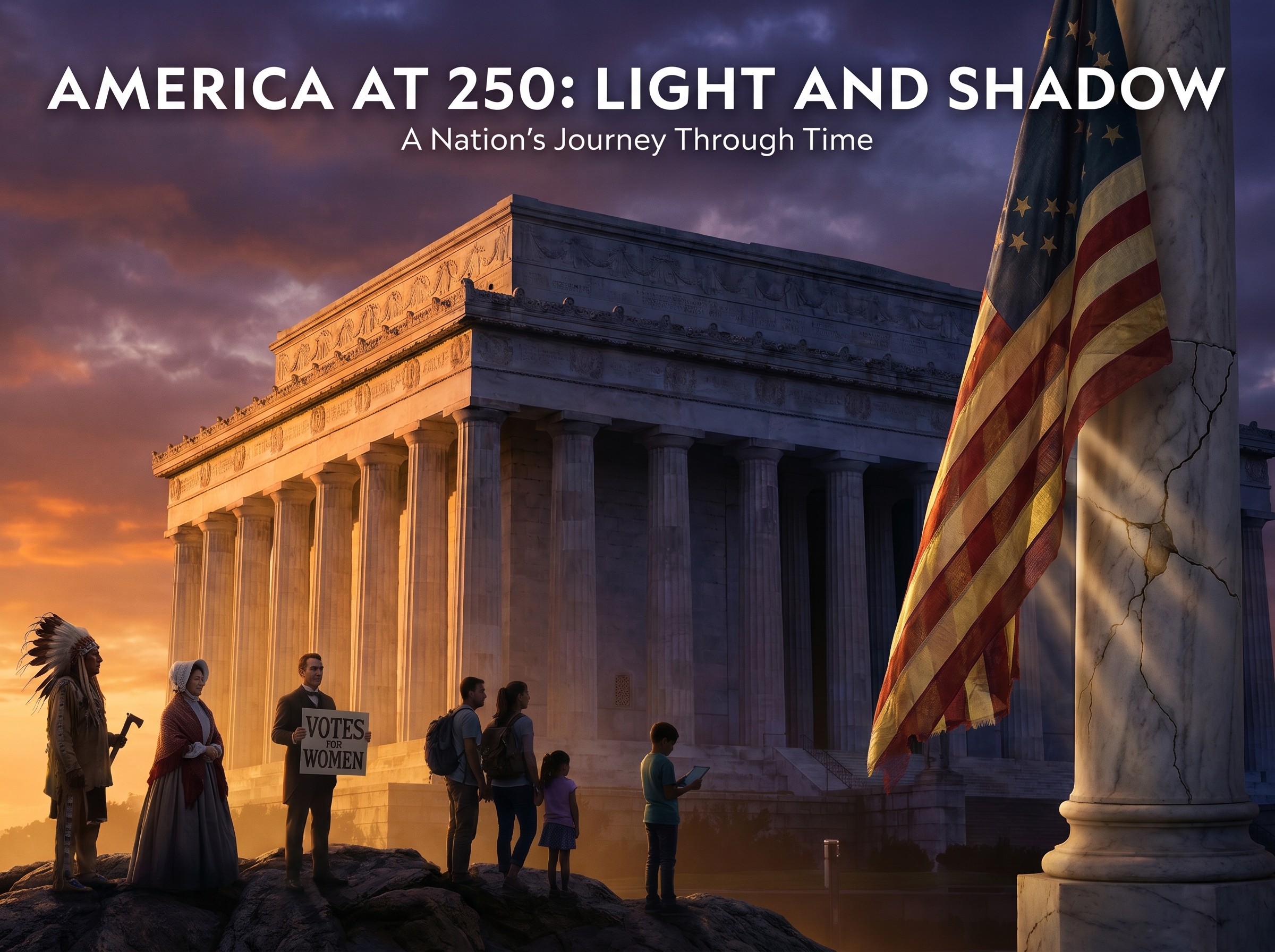
On the morning of July 4, 2026, the United States will wake to a milestone that no other modern nation has quite experienced: a 250th anniversary of its founding not as an ethnic homeland or a dynasty’s inheritance, but as an idea. There will be fireworks, certainly. There will be speeches. There will be hot dogs and brass bands and the inevitable retail sales. But beneath the pageantry, something more unsettling—and more honest—should occur. A quarter millennium is not merely a birthday. It is an audit.
The American story has always been two stories at once. It is the tale of a nation that proclaimed “all men are created equal” while holding one-fifth of its population in chains. It is the saga of a country that expanded across a continent through the systematic dispossession of Indigenous nations while opening its doors to immigrants who believed, often against all evidence, that this was a place where the future could be rewritten. It is the chronicle of a republic that has been, by turns, a beacon and a cautionary tale; more democratic than most empires in history, and less democratic than it has ever claimed to be.
At 250, the question is no longer whether America was great, or even whether it is great. The question is whether it can become what it has never been: a nation that fully practices what it has always preached.
I. The Founding Moment: The Audacity and the Fracture (1776–1789)
In 1776, the project was almost laughably radical. Most nations were built on blood, soil, or dynasty. America was built on a proposition. Thomas Jefferson, slaveholder and Enlightenment philosopher, drafted a sentence that would echo across centuries: “We hold these truths to be self-evident, that all men are created equal, that they are endowed by their Creator with certain unalienable Rights, that among these are Life, Liberty and the pursuit of Happiness.”
The radicalism of this claim in the eighteenth century cannot be overstated. It was a direct challenge to the divine right of kings, to the very notion that human beings were born into fixed stations. And yet, the fracture was baked in from the start. The same Congress that approved Jefferson’s words also preserved slavery. The Constitution that established a framework for self-governance also enshrined the three-fifths compromise, protected the slave trade for twenty years, and left suffrage to the states, where property requirements and racial exclusions flourished.
“I do not believe that the meaning of the Constitution was forever ‘fixed’ at the Philadelphia Convention. Nor do I find the wisdom, foresight, and sense of justice exhibited by the Framers particularly profound. To the contrary, the government they devised was defective from the start, requiring several amendments, a civil war, and momentous social transformation to attain the system of constitutional government, and its respect for the individual freedoms and human rights, that we hold as fundamental today.”— Justice Thurgood Marshall, 1987
For Indigenous nations, the founding was not a promise but a death sentence in elegant prose. The Declaration’s grievances against King George III included the accusation that the British had “endeavoured to bring on the inhabitants of our frontiers, the merciless Indian Savages.” The westward expansion that would follow was not an accident of history; it was encoded in the DNA of the project.
And for women, the promise was theoretical from the outset. Abigail Adams wrote to her husband John in March 1776, as he helped draft the new code of laws:
“Remember the ladies, and be more generous and favorable to them than your ancestors. Do not put such unlimited power into the hands of the Husbands. Remember all Men would be tyrants if they could.”
Her warning went unheeded.
The covenant theory helps us understand this paradox. The Declaration and the Constitution function not as static documents but as a social contract that each generation renegotiates. The Founders did not create a finished product; they created an argument. As Benjamin Franklin reportedly told a woman outside Independence Hall when she asked what kind of government the delegates had given the people:
“A republic, if you can keep it.”
The question has always been who gets to participate in it, and on what terms.
Frederick Douglass, speaking in Rochester on July 5, 1852, understood this better than most. “What, to the American slave, is your 4th of July?” he asked. “I answer: a day that reveals to him, more than all other days in the year, the gross injustice and cruelty to which he is the constant victim.” Douglass was not rejecting the American idea; he was holding it to account. He understood that the nation’s founding principles were simultaneously a lie and a promissory note. The question was whether future generations would cash it.
II. The Great Expansions and Contradictions: Testing the Covenant (1800–1945)
The nineteenth century was defined by expansion and contradiction. Manifest Destiny—the idea that it was America’s God-given right to stretch from sea to shining sea—drove the nation across a continent. But that expansion required the removal and extermination of Indigenous peoples, the annexation of half of Mexico, and the extension of slavery into new territories. The Civil War, which killed 750,000 Americans, was the first existential test of the Union. When Abraham Lincoln stood on the blood-soaked ground of Gettysburg in 1863, he understood that he was not merely preserving the old Union; he was transforming it, attempting to reconcile the nation’s founding ideals with its founding sins:
“Four score and seven years ago our fathers brought forth on this continent, a new nation, conceived in Liberty, and dedicated to the proposition that all men are created equal.”
Yet the reconciliation was incomplete. Reconstruction offered a brief, shining moment of multiracial democracy in the South before it was crushed by Jim Crow, lynch law, and the betrayal of 1877. The long arc of inclusion moved in fits and starts. The 19th Amendment brought women into the franchise in 1920, but Black women in the South remained effectively disenfranchised. Labor movements fought for the eight-hour day and workplace safety, but often excluded workers of color. The New Deal built the American middle class, but its benefits were distributed unevenly—domestic workers and agricultural laborers, disproportionately Black and Latino, were carved out of Social Security and labor protections by design.
For Indigenous nations, the expansion was catastrophic. In 1877, after a 1,700-mile fighting retreat, Chief Joseph of the Nez Perce surrendered to the U.S. Army in the Bear Paw Mountains of Montana. His words were not merely a military capitulation; they were the elegy of a vision of North America older than the republic itself:
“Hear me, my chiefs! I am tired. My heart is sick and sad. From where the sun now stands, I will fight no more forever.”
The world wars remade America’s self-image. In 1917, Woodrow Wilson sent troops to Europe to make the world “safe for democracy” while Black soldiers returned home to segregation and race massacres. In 1941, Franklin D. Roosevelt articulated the Four Freedoms—freedom of speech, freedom of worship, freedom from want, freedom from fear—even as Japanese Americans were rounded into internment camps and Black Americans served in segregated units.
By 1945, America had transformed from an isolated republic into a global superpower. Victory in World War II left the United States with half the world’s industrial capacity, an unmatched military, and a new sense of destiny. But power revealed contradictions as much as it resolved them. How could America lead the “free world” while maintaining apartheid in the South? The Cold War would force an answer.
III. The Transformation Era: The Postwar Social Contract and Its Limits (1945–2001)
The three decades after World War II are often remembered as a golden age of American consensus. The GI Bill sent millions of veterans to college and helped them buy homes. Suburbanization created a new geography of middle-class life. The interstate highway system stitched the continent together. Real wages rose. Union density peaked. For a significant portion of white America, the American Dream seemed not merely alive but thriving.
But the consensus was always partial. The same GI Bill that built white suburban wealth was administered locally in ways that largely excluded Black veterans. Redlining confined Black families to urban cores while federal highway construction bulldozed through their neighborhoods. The “expansion” of the middle class was, in many ways, an expansion of white privilege underwritten by federal policy.
The Cold War acted as a mirror. As the United States competed with the Soviet Union for the hearts and minds of the decolonizing world, its own racial caste system became a diplomatic liability. The civil rights movement was, in part, Cold War diplomacy by other means. When Eisenhower sent federal troops to Little Rock in 1957, he was not merely enforcing Brown v. Board of Education; he was protecting America’s image abroad.
When Martin Luther King Jr. stood on the steps of the Lincoln Memorial in 1963 and spoke of his dream, he was appealing to the promissory note that Douglass had identified a century earlier:
“I have a dream that one day this nation will rise up and live out the true meaning of its creed: ‘We hold these truths to be self-evident, that all men are created equal.'”
Five years later, President Lyndon B. Johnson addressed Congress after the violence at Selma, embracing the movement’s anthem and its moral claim:
“It is not just Negroes, but really it is all of us, who must overcome the crippling legacy of bigotry and injustice. And we shall overcome.”
The postwar era also saw the beginning of the end of consensus. Vietnam shattered the faith of a generation in American benevolence. Watergate shattered faith in institutions. The culture wars of the 1980s and 1990s—over religion, race, gender, and sexuality—revealed that Americans no longer shared a common narrative. By the time the Berlin Wall fell, the “two Americas” framework had taken hold: one cosmopolitan, multicultural, and coastal; the other traditionalist, religious, and heartland. Both claimed to be the real America.
As the century closed, Dwight D. Eisenhower’s farewell warning from 1961 seemed increasingly prophetic:
“In the councils of government, we must guard against the acquisition of unwarranted influence, whether sought or unsought, by the military-industrial complex. The potential for the disastrous rise of misplaced power exists and will persist.”
IV. The Present Moment: The Reckoning (2001–2026)
The twenty-first century opened with a trauma that would reshape the relationship between citizen and government. The terrorist attacks of September 11, 2001, united Americans in grief and rage, but the response—a sprawling security state, the Patriot Act, indefinite detention, torture, and two decades of war—divided them in ways that are still unfolding. The post-9/11 era normalized surveillance as a condition of citizenship. The balance between liberty and security, always tense, tilted decisively toward security. The question of who was being protected, and from whom, often broke along racial and religious lines.
There was an irony in this. Franklin D. Roosevelt had once told a nation paralyzed by economic terror:
“The only thing we have to fear is fear itself—nameless, unreasoning, unjustified terror which paralyzes needed efforts to convert retreat into advance.”
In the post-9/11 era, America seemed to forget the second half of that equation. Fear became the justification for exceptions to the rule of law, for the expansion of executive power, for the targeting of Muslim communities. The security state grew, and the republic held its breath.
Then came the Great Recession of 2008, which exposed the hollowness of the postwar social contract. The middle class, already buffeted by deindustrialization and stagnant wages, watched as Wall Street was bailed out and Main Street was foreclosed upon. The rise of the 1% and the gig economy created a new Gilded Age, where wealth concentrated at the top while precarity spread below. Student debt became a generational anchor. Geographic and social sorting accelerated—Americans increasingly lived among those who thought, voted, and worshipped like them.
The digital revolution fragmented reality itself. The internet, once hailed as a democratizing force, became an engine of division. Social media algorithms optimized for engagement amplified outrage and conspiracy. By the 2020s, Americans no longer merely disagreed about policy; they inhabited different epistemic universes. The question of what was true became partisan. Artificial intelligence, arriving in force by the mid-2020s, promised to either liberate or surveil on an unprecedented scale—perhaps both.
The identity reckoning of the 2010s and 2020s forced a confrontation with narratives that had long been marginalized. #MeToo challenged the impunity of powerful men. Black Lives Matter, sparked by the killing of Trayvon Martin and galvanized by the murder of George Floyd, demanded that America finally reckon with the persistence of state violence against Black bodies. The transgender rights movement asked the nation to expand its circle of “We the People” once more. These were not merely cultural moments; they were constitutional moments, struggles over who controls the American story.
Throughout this turbulence, the voice of James Baldwin offered a framework for the necessary patriotism—the love that demands honesty:
“I love America more than any other country in the world, and, exactly for this reason, I insist on the right to criticize her perpetually.”
The political realignment that followed was seismic. Institutional trust cratered. Populism surged on both the left and the right, though with different diagnoses and prescriptions. The stress test of January 6, 2021, when a mob stormed the U.S. Capitol to overturn a democratic election, revealed that the American experiment was not immune to the authoritarian tides sweeping the globe. It was a warning: the mechanisms of democracy are not self-executing. They require maintenance, faith, and participation.
Consider the lives caught in this vortex. Maria, a DREAMer brought to Phoenix at age three, has spent her adult life in legal limbo, contributing to a country that cannot decide whether to embrace her or deport her. James, a third-generation autoworker in Flint, Michigan, watched his factory close and his community hollow out, even as stock markets soared. Priya, a software engineer in Silicon Valley, builds AI systems that may automate millions of jobs while wondering if her own children will afford a home. Robert, a descendant of enslaved people in Georgia, votes in every election knowing that the same state that once required literacy tests now closes polling places in Black neighborhoods. Elena, a refugee from Venezuela who arrived in Houston in 2022, studies for her citizenship exam while wondering if the America she believed in still exists.
These are not abstractions. They are the human texture of the experiment.
V. The Future Trajectory: Toward 2076 (2026–2076)
What happens next? The next fifty years will be shaped by forces already in motion.
Demographic destiny is perhaps the most certain. The United States will become a majority-minority nation by 2045. This is not a prediction; it is arithmetic. The question is whether this transition will be a source of renewal or friction. Will a younger, more diverse America revitalize the nation’s institutions and economy? Or will demographic anxiety drive further polarization, voter suppression, and social balkanization? The answer depends on choices made in the next decade about immigration, education, and representation.
Climate and geography will redraw the American map. Climate migration is already shifting populations from the Southwest and Gulf Coast toward the Great Lakes and Pacific Northwest. Water scarcity in the Colorado River basin threatens agriculture and urban growth in the Southwest. Energy transformation—away from fossil fuels and toward renewables—will reshape the economy of Texas, Appalachia, and the Dakotas. The nation that expanded across a continent may find its geography becoming a constraint rather than an opportunity.
The AI and automation revolution poses an existential question about work and dignity. If mass technological unemployment arrives, can the American economy adapt without the social contract shattering? Universal Basic Income, once a fringe idea, has entered mainstream discourse. The alternative—a society where abundance coexists with widespread immiseration—may be politically untenable.
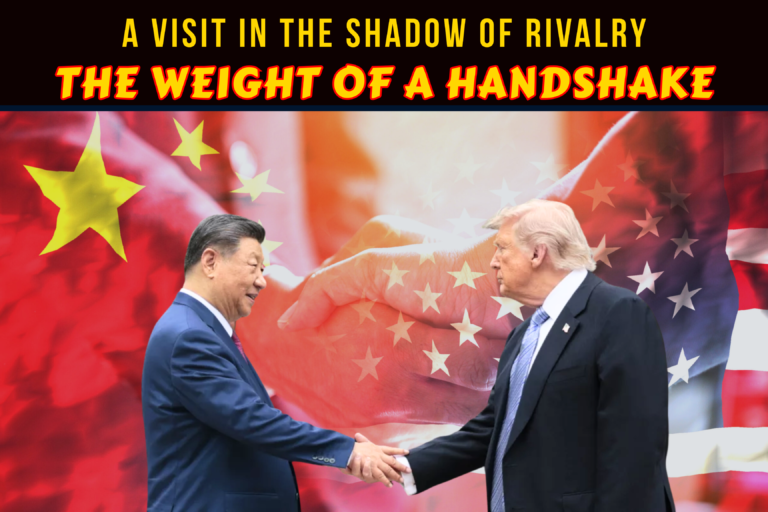
Great power competition with China will define the geopolitical landscape. The twenty-first century may be bipolar or multipolar. America’s alliances, its technological edge, and its ability to project soft power will be tested. But the greater challenge may be internal: can a divided democracy compete effectively with an authoritarian rival? The answer depends on whether Americans can restore a sense of shared purpose.
Constitutional stress is already visible. The Electoral College has produced presidents who lost the popular vote. The Supreme Court has become a focal point of partisan conflict. Gerrymandering has distorted representation. The filibuster has paralyzed legislation. The possibility of structural reform—expanding the Court, abolishing the Electoral College, admitting new states—collides with structural paralysis. By 2076, the Constitution will have lasted three centuries. Whether it remains a living framework or becomes a straitjacket depends on whether Americans can muster the political will to adapt it.
So: what would a healthy America look like in 2076? It would be a nation that has reconciled its founding ideals with its founding sins. It would have expanded the circle of “We the People” to include those who have long been outside it. It would have adapted its institutions to the realities of the twenty-first century without abandoning the principles of the eighteenth. It would have learned that security without liberty is tyranny, and that liberty without inclusion is hypocrisy.
The poet Langston Hughes, writing during the last great American reckoning, gave voice to the dream that has never quite died:
“Let America be America again. Let it be the dream it used to be. Let it be the pioneer on the plain Seeking a home where he himself is free. America never was America to me, And yet I swear this oath—America will be!”
The Continuous Argument
To understand the American experiment at 250, we must resist the urge to choose between celebration and mourning. It is neither. The “both/and” framework is essential. America is both the nation of Frederick Douglass and of Jim Crow; of the Four Freedoms and of Japanese internment; of the Civil Rights Act and of mass incarceration. It is both more democratic than most of history’s empires and less democratic than it claims.
Other nations offer lessons. India, the world’s largest democracy, struggles with religious nationalism and caste inequality while maintaining electoral pluralism. Brazil grapples with racial democracy and environmental destruction. The European Union attempts to forge unity from diversity, with mixed results. None of these models is directly transferable, but they remind us that multi-ethnic democracy is hard everywhere, and that America’s struggles are not unique even if its scale is.
The “unwritten” history—the voices of Indigenous nations, Latino communities, Asian Americans, LGBTQ Americans, and others—must be centered not as footnotes but as co-authors of the American story. Chief Joseph’s surrender was not merely a military defeat; it was the defeat of a vision of America that was older than the republic itself. To honor him is to acknowledge that the American experiment has always been, in part, an experiment in whose land this is.
At 250, the United States is not a finished product. It is a continuous argument. The Constitution is not a shrine but a workshop. The Declaration is not a trophy but a task.
Walt Whitman, who spent his life trying to capture the sprawling, contradictory essence of the nation in verse, understood this better than most:
“The United States themselves are essentially the greatest poem.”
A poem is not finished. It is revised, debated, misread, and reinterpreted across generations. It lives in the reading.
The fireworks will light up the sky on July 4, 2026. The brass bands will play. But the most patriotic act Americans can perform on that day is to ask the hard questions: Who have we been? Who are we now? Who are we willing to become?
The closing challenge is not a prediction. It is a provocation. Can America become what it has never been—a nation that fully practices what it has always preached? The answer is not in the archives. It is in the choices that will be made in the next fifty years, by the living, in the messy, glorious, painful present.
The experiment continues. It always has.