(By Khalid Masood)
I. Prologue: The Funeral as Historical Mirror
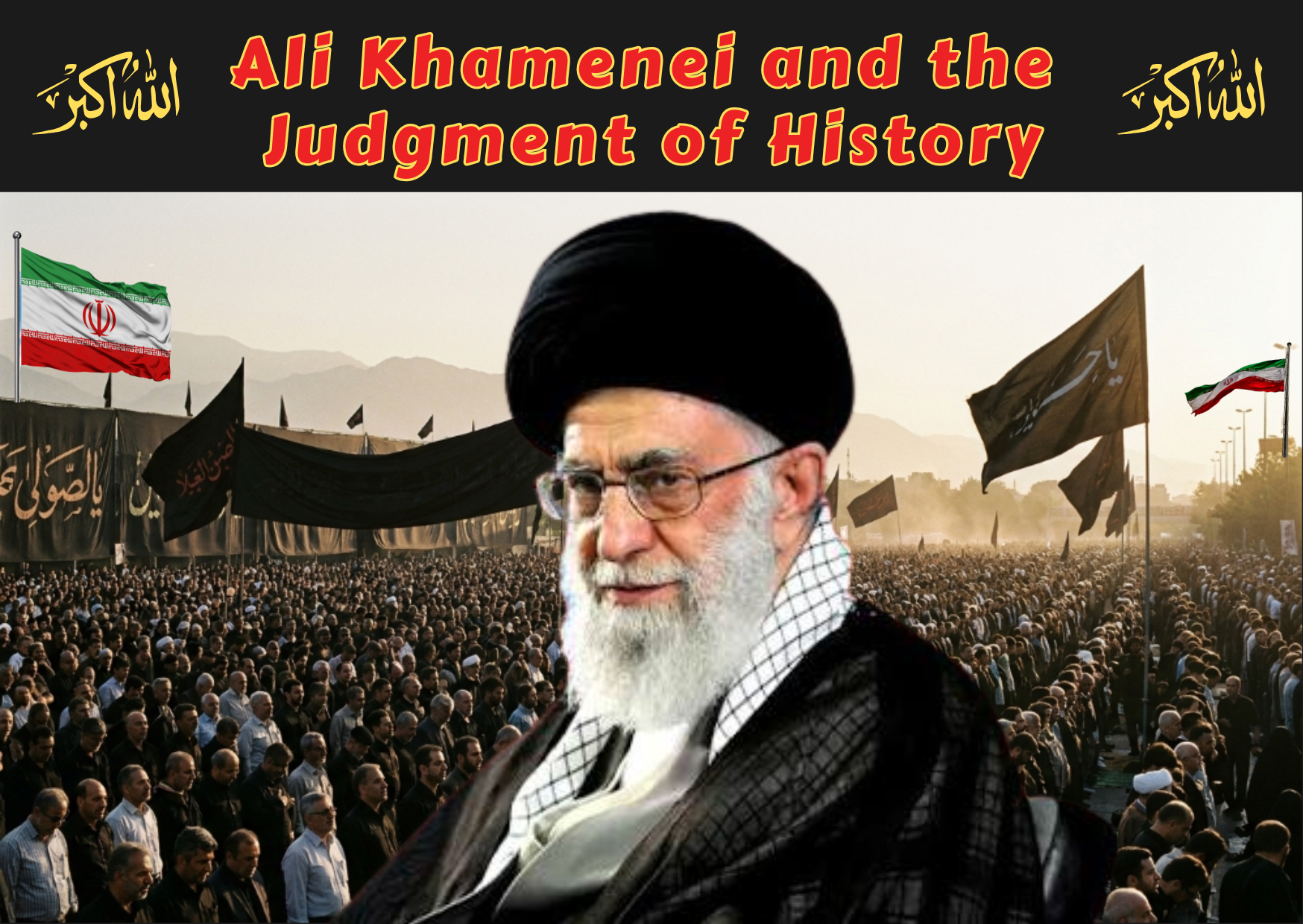
The heat rose from the asphalt in shimmering waves, but the millions did not move. They stood shoulder to shoulder across the breadth of Tehran, a human sea stretching from the Grand Mosalla to the horizon, where the Alborz mountains stood sentinel in the haze. It was the 5th of July, 2026. The Namaz-e-Janaza for Sayyid Ali Hosseini Khamenei had begun at dawn, and by the time the first takbir echoed across the loudspeakers, the crowd was already beyond counting. Iranian state media would later estimate the attendance at over ten million. Independent observers, struggling to find vantage points above the crush, stopped trying to verify the number. Some crowds are too large for arithmetic.
What they had come to bury was not merely a man. They had come to bury an era.
Watching with eyes full of tears this unprecedented, honourable send-off to a man who had chosen resistance over submission, some historical figures came to mind. History teaches a lesson that many powerful people ignored until it was too late. Genghis Khan, whose burial place remains one of the great secrets of the steppe, reportedly ordered that the gravesite be concealed by trampling horses and slaughtering witnesses—so fearful was the conqueror that his remains might one day be desecrated by those he had wronged. The Umayyad governor Al-Hajjaj ibn Yusuf, whose name became a byword for ruthlessness in the early Islamic centuries, was reportedly buried in an unmarked location to protect his bones from the hatred he had cultivated. The Abbasid Caliph Abu Ja’far al-Mansur, architect of Baghdad, is said to have arranged a concealed burial for similar reasons. Whether every detail of these stories is beyond dispute or not, they all point to the same enduring reality: those who rule through fear often understand, in their final hours, that fear cannot erase hatred.
Others were not so fortunate. Benito Mussolini’s body was hung upside down from a petrol station in Milan, abused by the same crowds who had once cheered him. Adolf Hitler, witnessing the approaching end, ordered that his remains be burned in the Chancellery garden so that nothing would remain for the victors to desecrate.
But here, in Tehran, something different was unfolding. There was no hidden grave. There was no burned body. There was no shame in the burial. The man being laid to rest was being sent off by millions in broad daylight, his bier carried through streets that could not contain the mourners. The question that hung over the city was not whether his memory would survive—memories always survive—but what kind of memory this was. A tyrant’s hidden grave speaks one language. A martyr’s open funeral speaks another.
The silence, when it came, was absolute. Ten million people standing in stillness. The only sound was the wind moving through the black banners, and the distant, rhythmic Takbir of the prayer leader: Allahu Akbar. In that silence, history was listening.
II. Early Life and Formation: The Making of a Revolutionary (1939–1979)
Ali Hosseini Khamenei was born in Mashhad on 19 April 1939, into a family of sayyids—descendants of the Prophet—whose roots in religious scholarship ran deep. His father, Seyed Javad Khamenei, was a respected cleric of modest means. The young Ali memorised the Qur’an early, and by his teenage years he had entered the seminary circles that would shape the rest of his life. But Mashhad in the 1950s was not a place of quiet scholarship alone. It was a city of growing political awareness, where the sermons of Ayatollah Abol-Ghasem Kashani and, later, the rising voice of Ruhollah Khomeini were circulating in samizdat form, copied by hand and passed from student to student.
The defining moment came in June 1963. Khomeini’s speech in Qom against the Shah’s White Revolution—and the subsequent brutal suppression of the seminaries—ignited a nationwide uprising. Khamenei, then twenty-four, was among the young clerics and students who took to the streets of Mashhad. The Shah’s security forces responded with characteristic violence. Khamenei was arrested, beaten, and held in solitary confinement. It was his first taste of prison, but not his last. Between 1963 and 1979, he would be arrested and exiled multiple times, moving between Mashhad, Tehran, and the remote town of Iranshahr in Baluchestan, where he was sent into internal exile.
These were not the sufferings of a passive scholar. Khamenei was actively organising, teaching, and building the networks of resistance that would prove indispensable when the revolution finally came. He translated the works of Ali Shariati—the revolutionary sociologist who sought to reconcile Marxist and Islamic liberation theology—bringing Shariati’s ideas to a wider clerical audience. He wrote poetry. He taught. He endured.
The assassination attempt of 27 June 1981 would leave his right hand permanently paralysed, a physical mark that he would carry for the rest of his life. The bomb, planted in a tape recorder at the Islamic Republican Party headquarters in Tehran, killed over seventy people, including the party’s secretary-general, Mohammad Beheshti. Khamenei survived, but the explosion severed tendons and nerves in his arm. For a man who would later be photographed holding a rifle with his left hand, or signing documents with a hand that trembled slightly, the paralysis was not merely a medical condition. It was a visible credential of revolutionary sacrifice.
By 1979, when the Shah finally fled and Khomeini returned from Paris, Khamenei was already a known quantity: a loyalist, an organiser, a survivor. He was appointed to the Revolutionary Council and then, in 1980, to the post of Tehran’s Friday Prayer Leader. The arc from student to revolutionary to institutional pillar was complete. But the greatest trial was still ahead.
III. The Presidency: The Warrior-Manager (1981–1989)
The Iran-Iraq War defined Khamenei’s presidency. Elected in October 1981 after the assassination of Mohammad-Ali Rajai, he inherited a nation under existential threat. Saddam Hussein’s Iraq had invaded in September 1980, occupying the oil-rich province of Khuzestan and pushing deep into Iranian territory. The revolution was barely two years old. Its army was in disarray, its economy crippled by capital flight, its international isolation nearly total.
Khamenei’s presidency was not that of a military commander—he left operational strategy to the generals—but of a manager of revolutionary survival. He understood, as few did, that the war was not merely being fought on the battlefields of Khorramshahr and Mehran. It was being fought in the factories that had to produce weapons, in the hospitals that had to treat the wounded, in the schools that had to continue teaching while fathers and brothers were fed into the meat grinder of the front lines.
The war years forged his worldview in fire. He saw Western powers—particularly the United States—arming Saddam with chemical weapons, satellite intelligence, and financial support. He saw the United Nations issue resolutions that seemed designed to pressure Iran into accepting a stalemate. He saw the world isolate his country while it bled. The lesson he drew was not one of diplomatic compromise but of self-reliance. A revolutionary state, he concluded, could not depend on the goodwill of great powers. It had to build its own capabilities, its own alliances, its own deterrent.
The war ended in August 1988 with UN Resolution 598, which Khomeini famously described as drinking “the poisoned chalice.” Over half a million Iranians had died. The economy was in ruins. But the revolution had survived. Khamenei, as president, had helped steward it through its darkest hour.
Then, in June 1989, Khomeini died. The transition that followed was not guaranteed. The constitution had to be amended to allow Khamenei’s elevation to Supreme Leader—he was not yet a marja, or source of emulation, in the traditional Twelver Shi’a hierarchy. But the Assembly of Experts, guided by Khomeini’s own recorded wishes and the political calculations of the moment, selected him. On 4 June 1989, Ali Khamenei became the second Supreme Leader of the Islamic Republic of Iran.
He was forty-nine years old. He would hold the position for thirty-seven years.
IV. The Supreme Leadership: Three Decades of Stewardship (1989–2026)
To understand Khamenei’s long tenure, one must abandon the temptation to read it as a single story. It was, instead, several overlapping narratives: the guardian of a revolutionary ideology, the architect of a regional strategy, the manager of a besieged economy, and the private man who read poetry and lived, by all accounts, with a simplicity that bordered on asceticism.
A. The Guardian of the Revolution
Khamenei’s authority rested on the constitutional principle of Wilayat-e-Faqih—the Guardianship of the Jurist—a concept developed by Khomeini that placed supreme political and religious authority in the hands of a senior Islamic jurist. For Khamenei, this was not merely a constitutional office. It was a sacred trust. He was the guardian of a revolution that he believed was under permanent siege by enemies foreign and domestic.
His relationship with the Islamic Revolutionary Guard Corps (IRGC) was central. Where Khomeini had used the Guard as a counterweight to the regular military, Khamenei integrated it into the core of the state. The IRGC became not merely a military force but an economic powerhouse, a media conglomerate, and the primary instrument of Iran’s regional policy. This fusion of military, economic, and ideological power under his office gave Khamenei a reach that no Iranian president could match. But it also meant that the failures of the system—corruption, economic mismanagement, political repression—would ultimately be laid at his feet.
B. The Regional Architect
If Khomeini’s foreign policy was defined by the export of revolution, Khamenei’s was defined by the construction of the “Axis of Resistance.” Beginning in the 1990s, Iran cultivated alliances with Hezbollah in Lebanon, Hamas and Islamic Jihad in Palestine, the Assad government in Syria, the Houthis in Yemen, and various Shi’a militias in Iraq. This was not imperialism in the classical sense—it was the creation of a network of asymmetric forces that could deter Israeli and American power while projecting Iranian influence.
The strategy had its victories. Hezbollah’s resistance to Israeli invasion in 2006, the survival of the Assad regime during the Syrian civil war, and the expansion of Iranian influence in post-Saddam Iraq all testified to the effectiveness of the model. But it also had its costs. Syria’s civil war alone drew Iran into a quagmire that cost billions of dollars and the lives of thousands of Iranian soldiers and proxy fighters. The regional Sunni powers—Saudi Arabia and the Gulf states—saw Iran’s expansion as an existential threat, leading to a cold war that destabilised the entire Middle East.
On the nuclear question, Khamenei presided over a long and tortuous negotiation. He issued a fatwa against the production of nuclear weapons, but he also authorised the development of a nuclear programme that brought Iran to the brink of war with Israel and the United States. The 2015 Joint Comprehensive Plan of Action (JCPOA) was, in many ways, an achievement of the Rouhani presidency, but Khamenei’s guarded support—and his subsequent disillusionment after the Trump administration’s withdrawal in 2018—shaped the trajectory. By the end of his life, Iran was a threshold nuclear state, its enrichment levels far beyond civilian needs, its economy strangled by sanctions, and its diplomacy frozen.
C. The Domestic Steward
At home, Khamenei faced the impossible task of keeping together a society that was changing faster than its political system. The population grew younger, more urban, more connected to the world through satellite television and, later, the internet. The revolutionary generation that had marched in 1979 was aging. Their children wanted jobs, travel, and freedoms that the Islamic Republic struggled to provide.
The economy was his Achilles’ heel. Despite possessing the world’s second-largest natural gas reserves and fourth-largest oil reserves, Iran’s economy was crippled by sanctions, corruption, and mismanagement. The rial lost value repeatedly. Inflation became a permanent feature of life. The middle class shrank. Brain drain accelerated. Khamenei spoke often of a “resistance economy”—self-reliant, domestically focused, impervious to sanctions—but the reality on the ground was one of chronic stagnation punctuated by crisis.
The 2009 Green Movement was the most serious domestic challenge of his tenure. Millions of Iranians took to the streets to protest what they believed was a rigged presidential election that returned Mahmoud Ahmadinejad to power. The regime’s response was forceful: mass arrests, show trials, reports of torture in Kahrizak detention centre, and the deaths of protesters including Neda Agha-Soltan, whose final moments were captured on a mobile phone and broadcast to the world.
Khamenei’s role in the crackdown was decisive. He endorsed the election results before the Guardian Council had completed its review, and he warned protesters that the regime would not tolerate continued dissent. The movement was crushed. But its memory persisted. For critics, 2009 was the moment when Khamenei chose regime survival over the democratic aspirations of his people. For defenders, it was the necessary defence of a revolutionary state against a “soft coup” orchestrated by foreign powers.
This is the analytical crossroads where honest history must pause. The 2009 protests were not a simple story of good versus evil. They were a collision between a population demanding accountability and a leadership convinced that any loosening of control would lead to the collapse of the entire system—and, given the fate of neighbouring Iraq and Syria, perhaps to national disintegration. Khamenei chose the path of preservation. History will long debate whether that choice was wisdom or cowardice.
D. The Man Behind the Office
Beneath the black turban and the public persona, there was a man who wrote poetry, who was known to prefer simple meals, who lived in a modest house rather than a palace. He translated works by Allama Iqbal (Lahori) and Ali Shariati into Persian, bringing the Islamic intellectual tradition to new audiences. His speeches, delivered often and at length, were not merely political communications. They were theological discourses, historical lectures, and moral exhortations rolled into one.
Those who met him in private described a man of quiet intensity, deeply read, with a memory that could recall hadith and poetry with equal fluency. He was not a charismatic speaker in the mould of Khomeini—his voice was softer, his gestures more restrained—but he possessed a quality that Khomeini had recognised early: absolute, unwavering loyalty to the revolutionary project.
Whether that loyalty was to the revolution’s ideals or to its survival as a political system is the question that divides his legacy.
V. The Death: Martyrdom, Sovereignty, and Symbolism
The circumstances of his death, as reported in the early months of 2026, remain contested in their details. What is clear is that he died in office, at the age of eighty-six, after a period of declining health that had fuelled speculation about succession for years. Some reports suggested he was killed in strikes on Tehran during the escalating regional conflict of early 2026. Iranian officials initially disputed these reports, but the subsequent funeral confirmed that the Supreme Leader was no more.
The forty days of mourning that followed followed the Shi’a tradition of Arba’in, but on a scale never before seen in Iran. The first Namaz-e-Janaza in Tehran on 5 July brought together not merely Iranians but delegations from across the Muslim world. Leaders from Pakistan, Iraq, Lebanon, Syria, Yemen, and the Palestinian territories were present. But more striking, perhaps, was the presence of delegations from African nations, from Central Asian republics, and from European countries that had spent decades in adversarial relations with Tehran.
What did their attendance signify?
For the Muslim world, Khamenei’s death represented the passing of the last major leader of the 1979 generation. He was the final living link to a revolution that had reshaped the Middle East. For Asian and African nations, his funeral was a statement of South-South solidarity—a recognition that Iran, despite decades of Western sanctions, had remained a significant power. For the European delegations, attendance was more complex: a mixture of diplomatic pragmatism, recognition that Iran was entering a new phase, and perhaps a quiet acknowledgment that a man who had defied the Western-led order for four decades deserved the respect of his adversaries in death if not in life.
The most significant geopolitical development in the immediate aftermath was the reported rapprochement between Iran and Pakistan. The two neighbours, divided by sectarian tensions, competing strategic interests, and the shadow of Saudi influence, moved to resolve long-standing disputes. Pipeline projects that had been stalled for years were revived. Border security cooperation was announced. The Iranian port of Chabahar and the Pakistani port of Gwadar were discussed as complementary rather than competing projects.
Whether this rapprochement would endure was uncertain. But it suggested that Khamenei’s death had created a diplomatic vacuum that new leaders on both sides were eager to fill. The rigidities of the old order, personified by a Supreme Leader who had seen Pakistan as unreliable and too close to Saudi Arabia and the United States, were giving way to a new pragmatism.
The funeral itself was a political text written in bodies and banners. When a leader is buried by millions in the open air, when his grave is not hidden but marked for pilgrimage, when his enemies send delegations rather than desecrators, something has been said about the relationship between power and legitimacy that transcends the individual. The hidden graves of Genghis Khan and Al-Hajjaj ibn Yusuf spoke of regimes built on fear. The open funeral of Ali Khamenei spoke, at the very least, of a regime that had convinced millions—perhaps billions—that its leader deserved honour.
Whether that conviction was justified is the question that history must now adjudicate.
VI. The Legacy: History’s Courtroom
Those who exercise power today—whether political leaders, military commanders, officials, corporate executives, or anyone with authority over others—should remember that every act of injustice leaves a mark beyond the present moment. Victims may be silenced, but their children remember. Communities remember. Nations remember. History remembers.
No amount of wealth, propaganda, or force can permanently rewrite the moral record. When power ends, only character remains. The question future generations will ask is not, “How powerful was this person?” but rather, “How did they treat those who were powerless?”
History is not merely a record of victories. It is also the court in which cruelty is judged long after the tyrant’s voice has fallen silent. Those who wield power today would do well to remember that while graves may be hidden, bodies may be burned, and monuments may be built or destroyed, the memory of justice—or cruelty—often outlives them all.
These words, written in reflection on the great send-off in Tehran, frame the only honest way to assess Khamenei’s legacy.
The Tyrant’s Fear vs. The Martyr’s Honour
The contrast is stark. The rulers who hide their graves do so because they understand, in their final hours, that they have governed by fear, and fear generates hatred that outlives the grave. Khamenei was not buried in secret. His body was not burned. His funeral was not a furtive affair conducted in the dead of night. Ten million people stood in the heat of a Tehran summer to pray for him.
What does this mean? It means, at minimum, that millions of Iranians and Muslims beyond Iran’s borders did not regard him as a tyrant. They regarded him as a guardian, a father figure, a symbol of resistance against a world order they perceived as unjust. The open grave is, in itself, a democratic verdict of sorts. It is the people saying: we are not ashamed of this man. We do not fear what history will say. We bury him in daylight.
But the open grave does not erase the record. It merely submits it to history with confidence rather than fear.
The Moral Record
How did Ali Khamenei treat the powerless?
For the rural poor, the religiously devout, the veterans of the Iran-Iraq War, and the millions who saw the Islamic Republic as a shield against Western domination, Khamenei was a protector. He maintained subsidies for basic goods. He spoke constantly of the mostazafin—the oppressed. He ensured that the revolutionary state’s welfare networks, however inefficient, continued to function. He kept Iran independent in an era when American military power toppled governments with apparent ease.
For the political prisoners held in Evin Prison, for the protesters shot in 2009 and in the demonstrations of 2019 and 2022, for the Baha’is systematically excluded from education and employment, for the women arrested for improper hijab, for the journalists and lawyers and activists who spent years in detention, Khamenei was the ultimate authority behind their suffering. He did not personally order every arrest. But he presided over a system in which such arrests were routine. He defended that system as necessary for revolutionary survival. He never apologised for it. He never reformed it in any fundamental way.
The moral record is therefore divided. It contains both the honour of resistance and the stain of repression. Future generations will not be able to separate the two, because they were inseparable in life. The same man who defied American hegemony also crushed domestic dissent. The same man who built an axis of resistance against Israeli expansion also presided over a system that executed juvenile offenders and persecuted religious minorities.
History’s courtroom does not accept plea bargains. It hears all the evidence.
The Umma’s Unification
Did his death unify the Muslim world?
The attendance at his funeral suggested a moment of rare solidarity. Sunni and Shi’a leaders stood together. Leaders from nations that had been at war sent delegations. The Palestinian cause, which Khamenei had championed with relentless consistency, provided a common thread.
But unity in grief is not the same as unity in politics. The sectarian divisions that Khamenei’s regional policy had both exploited and been exploited by did not disappear. The Saudi-Iranian rivalry did not end. The theological disagreements between Twelver Shi’ism and Sunni orthodoxy remained.
What his death may have unified was not the Umma in any institutional sense, but the Muslim world’s shared sense of grievance against a Western-led order that had bombed, sanctioned, and interfered across the Islamic world for decades. Khamenei had been the most consistent, most uncompromising voice of that grievance. In his absence, the grievance remained, but the voice was gone.
Iran-Pakistan Rapprochement
The most concrete geopolitical legacy may be the opening between Tehran and Islamabad. For decades, Pakistan had walked a tightrope: allied to Saudi Arabia, dependent on American aid, nervous of Iranian influence in Afghanistan and among Pakistan’s own Shi’a minority. Khamenei had viewed Pakistan with suspicion, seeing it as unreliable, too willing to serve American interests, and too quick to side with Saudi Arabia in regional disputes.
His death removed that personal animus. The new leadership in Tehran, facing a succession struggle and the need to consolidate, saw in Pakistan a necessary partner for economic survival and regional stability. The Pakistanis, for their part, saw an opportunity to reduce Saudi leverage and to finally build the energy and transport corridors that geography demanded.
Whether this rapprochement endures will depend on forces beyond Khamenei’s grave. But it suggests that his departure created space for pragmatism that his presence had foreclosed.
VII. Conclusion: The Question That Remains
When power ends, only character remains.
Ali Khamenei held supreme authority in Iran for thirty-seven years. He outlasted four American presidents, three wars, a revolution in neighbouring Iraq, the Arab Spring, the Syrian civil war, and the collapse of the Soviet Union. He built a regional alliance system that defied American and Israeli power. He kept Iran’s nuclear programme advancing despite the most comprehensive sanctions regime in modern history. He preserved the Islamic Republic when many predicted its collapse.
He also presided over a system that jailed its critics, executed its dissidents, and suffocated its civil society. He chose, again and again, the survival of the revolutionary state over the liberalisation of its politics. He never took the risk of opening the system, because he believed—sincerely, by all accounts—that opening the system would mean losing it.
Did he choose honour over slavery? He would certainly have said so. He saw the Western-led international order as a system of economic and cultural domination, and he refused to submit Iran to it. He accepted sanctions, isolation, and the threat of war rather than capitulation. For his supporters, this was the highest form of honour. For his critics, it was stubbornness that inflicted unnecessary suffering on ordinary Iranians.
Did his resistance to Western hegemony justify the domestic costs? That is the question that will divide historians for generations. The answer depends on whether one believes that Iran’s independence was worth the price of its internal repression. There is no mathematical formula for this. There is only the weighing of competing goods in the scales of historical judgment.
Did his stewardship preserve the Islamic Republic or calcify it? The Republic survived him. That is a fact. Whether it can thrive without him—whether the system he built is adaptable enough to meet the aspirations of a young, educated, globally connected population—is the great unknown of the post-Khamenei era.
The question future generations will ask is not, “How powerful was this person?” but rather, “How did they treat those who were powerless?”
On that final ledger, the accounts are still open. The victims of the system Khamenei led have not had their day in court. Their children remember. The prisoners remember. The exiles remember. But so too do the millions who stood in Tehran’s heat to pray for his soul, who saw in him not a tyrant but a shield, not an oppressor but a guardian.
History is not merely a record of victories. It is also the court in which cruelty is judged long after the tyrant’s voice has fallen silent. But it is also the place where sacrifice is honoured, where resistance is remembered, and where the complexity of human leadership is weighed rather than reduced to caricature.
Ali Khamenei was buried in an open grave, under an open sky, before an open multitude. He did not hide from history’s judgment. He submitted himself to it. The judgment will take decades, perhaps centuries, to render. But the funeral told us one thing with certainty: this was a man who was not afraid of what the grave would say.
The graves of feared rulers are hidden. The graves of honoured leaders are visited. The grave of Ali Khamenei, in the shrine of Imam Khomeini on the outskirts of Tehran, will be visited by millions in the years to come. Some will come to praise. Some will come to mourn. Some will come simply to understand.
And history, patient and inexorable, will keep its own counsel.