(By Khalid Masood)
I. The Speech That Revealed the Crack
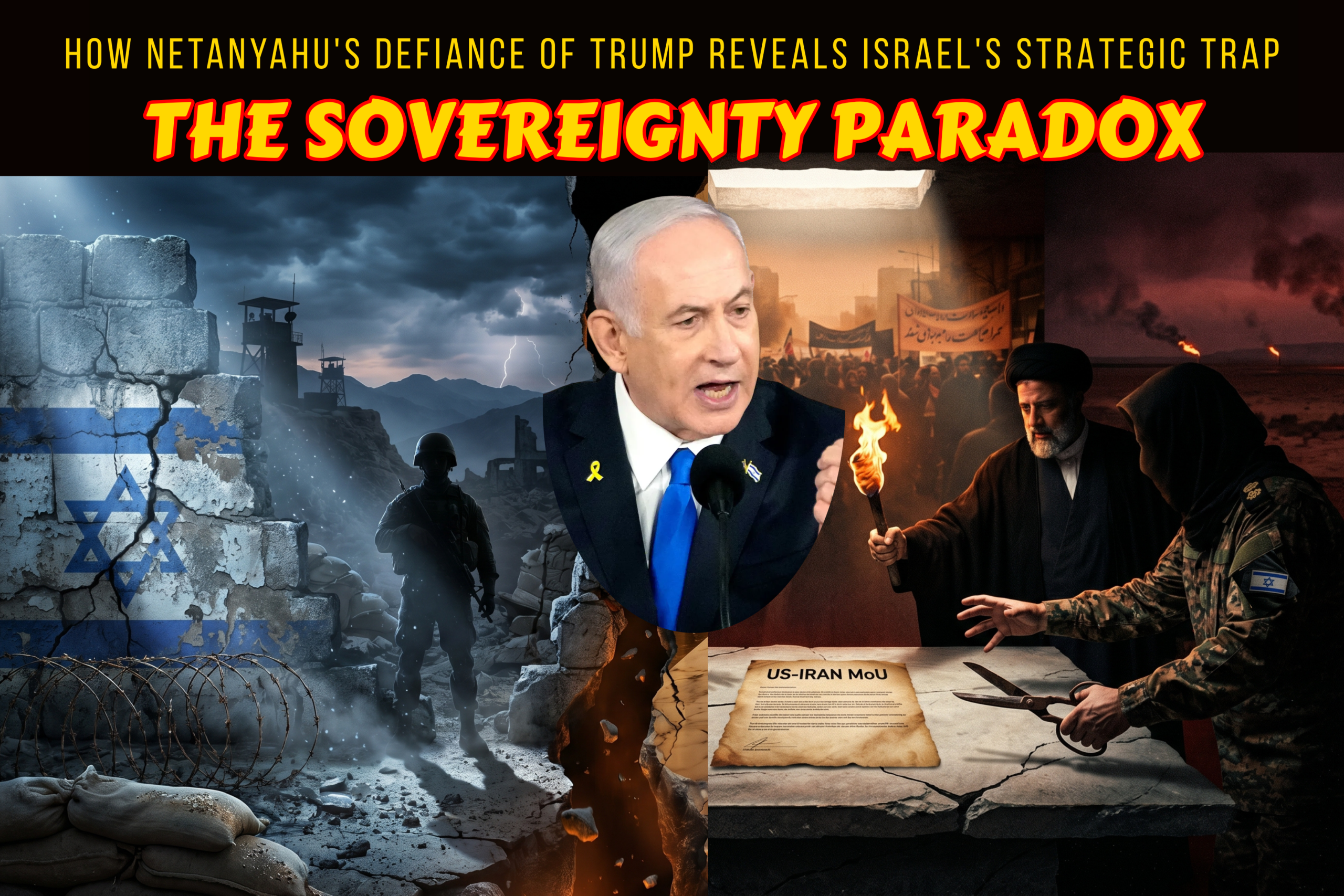
On the evening of June 21, 2026, Israeli Prime Minister Benjamin Netanyahu took the stage at the Jerusalem News Syndicate (JNS) Policy Summit and delivered a statement that sounded like a declaration of independence. “In the United States, they say that President Trump does everything that I ask him to do. And in Israel, they say that I do everything he wants me to do. Well, neither is true.” He paused for effect. “We’re leaders of independent and proud countries. We stand for our interests. I stand for the interests of Israel and for its security.“
The audience applauded. But in diplomatic circles, the applause was drowned out by a more uncomfortable sound: the creaking of a foundational alliance under strain.
Netanyahu’s denial was not delivered in a vacuum. It came precisely seven days after the United States and Iran signed the Islamabad Memorandum of Understanding—a provisional agreement brokered by Pakistan that calls for the “immediate and permanent cessation of military operations on all fronts, including in Lebanon,” and pledges to “guarantee Lebanon’s territorial integrity and sovereignty.”
It came three days after Netanyahu informed Israelis that their military would remain in southern Lebanon regardless of what Washington and Tehran had agreed to. And it came as reports circulated—subsequently confirmed by CNN—that Netanyahu was working behind the scenes, deploying right-wing media figures and friendly U.S. senators to pressure President Trump into toughening the final Iran deal.
The Prime Minister’s insistence that “we respect each other’s sovereignty and leadership” is, on its face, unremarkable. Allies say such things routinely. But when a leader must publicly assert that he is not his patron’s subordinate, the assertion itself becomes evidence of the very dependency it denies. Netanyahu was not reassuring Washington. He was performing sovereignty for a domestic Israeli audience that increasingly suspects he has mortgaged the country’s strategic autonomy to a mercurial American president.
This is the sovereignty paradox: the more forcefully Netanyahu declares Israel’s independence from Trump, the more he reveals how contingent that independence has become.
II. The Shadow Veto: Why Israel Cannot Accept Any U.S.-Iran Deal
To understand why Netanyahu’s defiance is both necessary and futile, one must look past the specific terms of the Islamabad Memorandum to the precedent it establishes. Israel’s opposition is not primarily about the deal’s provisions—though Jerusalem has concerns about whether Tehran will genuinely dismantle its enrichment infrastructure. The deeper objection is structural: any U.S.-brokered accommodation with Iran legitimizes Iranian regional status, and that legitimacy erodes Israel’s long-standing monopoly on American Middle East strategy.
This is what might be called the “shadow veto”—Israel’s unspoken but deeply held conviction that Washington must not normalize relations with Tehran at the expense of Jerusalem’s strategic preferences. The shadow veto is not exercised through formal diplomatic channels. It operates through influence networks in Congress, through media narratives that frame any Iran deal as appeasement, and through the implicit threat that Israel might act unilaterally against Iranian nuclear facilities if it deems the agreement insufficient.
Netanyahu’s reported use of right-wing pundits and pro-Israel senators to pressure Trump during the 60-day negotiation window is the shadow veto in its purest form. According to CNN, the Prime Minister believes Tehran will not fulfill its obligations under any final agreement and is mobilizing American political actors to ensure the deal collapses or is hardened beyond what Iran can accept.
This is not the behavior of a sovereign ally conducting independent diplomacy. It is the behavior of a dependent partner attempting to manipulate the patron’s domestic politics because it lacks the leverage to influence the patron’s foreign policy directly.
The historical parallel is instructive. In 2015, Netanyahu similarly opposed the Obama administration’s Joint Comprehensive Plan of Action (JCPOA). But then, he had a Republican Congress as a willing ally. In 2026, he faces a different landscape. Trump is simultaneously Israel’s closest ideological partner and its most unpredictable interlocutor. The President has reportedly called Netanyahu “crazy” in private conversations and complained that Israeli operations in Lebanon are undermining his efforts to end a war that has kept U.S. gasoline prices above $4 per gallon. “Why are you blowing up buildings?” Trump demanded in one call. “Stop blowing up buildings.”
The shadow veto worked against Obama because Netanyahu could count on partisan polarization in Washington. Against Trump, it is a far riskier proposition.
III. The Lebanon Exception: Territory as Sovereignty
Netanyahu’s defiance crystallizes around a single, concrete issue: the presence of Israeli troops in southern Lebanon. The Islamabad Memorandum explicitly calls for ending military operations in Lebanon and guaranteeing Lebanese sovereignty. Netanyahu’s response has been unequivocal: “We will remain in the security zones as long as required in order to defend our country.”
This is not merely a tactical disagreement. It is a fundamental divergence over what the U.S.-Iran deal means in practice. For Washington, the deal is a regional settlement that requires Israeli withdrawal as a condition of Iranian compliance. For Jerusalem, the deal is an American-Iranian bilateral arrangement that does not bind Israel, because Israel was not a party to the negotiations.
The military reality on the ground supports Netanyahu’s position—up to a point. Israel currently maintains five military outposts in southern Lebanon, some held for decades and others seized during the 2023–2024 war. Satellite imagery analyzed by AFP shows these positions have been fortified with earthen embankments and widened access roads. The easternmost base on Hamames Hill sits approximately 1.5 kilometers inside Lebanese territory. The westernmost outpost in Labbouneh is built roughly 150 meters from a United Nations peacekeepers base. These are not temporary forward positions. They are the infrastructure of permanent occupation.
Netanyahu’s vow to keep troops in Lebanon “as long as necessary” is therefore not an empty threat. It is a statement of existing military fact. But the question is whether Israel can sustain this position without American support. The IDF’s operations in Lebanon require U.S. diplomatic cover at the United Nations, intelligence sharing, and—critically—arms resupply. The $3.8 billion in annual American military aid is not merely a budget line. It is the structural foundation of Israel’s capacity to maintain operations on multiple fronts simultaneously.
If Washington decides that Israeli intransigence in Lebanon is jeopardizing the broader U.S.-Iran agreement, it has leverage. The Biden administration paused arms shipments in 2024 over disagreements about Rafah. A Trump administration facing economic pressure from a prolonged war might do the same. Netanyahu’s declaration that “we have our own interests” is rhetorically powerful. Strategically, it is a high-stakes gamble that Israel’s interests and America’s will remain aligned enough to prevent a rupture.
IV. The Convergence: Where Defiance Meets Dependence
The sovereignty paradox and the shadow veto are not separate phenomena. They are two sides of the same coin, and they converge in Netanyahu’s June 21 speech.
Consider the Israeli Prime Minister’s framing of the U.S.-Iran deal: “This agreement was made by the United States, by the president of the United States. That’s his decision.” The repetition for emphasis—”That’s his decision”—is telling. Netanyahu is not endorsing the deal. He is placing distance between himself and it, implicitly reserving Israel’s right to reject constraints it did not negotiate. But the distancing also reveals Israel’s structural weakness. If the deal is “his decision,” then Israel’s security architecture is, to some degree, subject to decisions made in Washington without Jerusalem’s participation.
This is the heart of the paradox. Netanyahu cannot openly defy Trump without risking the alliance that makes Israeli military operations possible. But he cannot accept the deal without appearing to subordinate Israeli interests to American diplomacy. His solution is performative sovereignty: enough public defiance to satisfy his domestic base, not enough actual defiance to trigger American retaliation.
The Lebanon troop presence is the physical manifestation of this balancing act. Maintaining five outposts is enough to assert Israeli autonomy. It is not enough to collapse the U.S.-Iran agreement or to fundamentally alter the regional balance. It is a holding action—a way to signal resistance without committing to the rupture that full resistance would require.
But holding actions have expiration dates. The 60-day negotiation window for the final Iran deal is ticking. Netanyahu’s behind-the-scenes pressure campaign may harden the agreement’s terms, or it may collapse the negotiations entirely. If the latter, Israel will have exercised its shadow veto—but at the cost of a regional war that Washington was trying to end, and that Israel may not be able to sustain without American support.
V. The Regional Chessboard: How Others Are Reading the Rift
The U.S.-Israel divergence is not occurring in a vacuum. Tehran, Hezbollah, and the Gulf states are all watching closely, and their calculations will shape whether this rift remains manageable or becomes structural.
For Iran, Netanyahu’s defiance is a gift. It allows Tehran to portray the Islamabad Memorandum as a reasonable American initiative thwarted by Israeli intransigence. If the deal collapses, Iran can blame Jerusalem rather than Washington, preserving its nascent diplomatic relationship with the Trump administration. If the deal holds, Iran can demand that the United States enforce Israeli withdrawal from Lebanon as a test of American credibility.
For Hezbollah, the situation is more complex. The group has suffered severe losses—internal sources acknowledge over 1,000 fighters killed, while Israel claims 2,500. Secretary-General Naim Qassem has acknowledged Hezbollah was severely weakened by Israel’s 2024 offensive.
Yet the group continues to fire rockets and drones at Israeli positions, and it has rejected direct talks with Israel that do not include its participation. Hezbollah’s strategy appears to be calibrated escalation: enough violence to make the Israeli occupation costly, not enough to trigger a full-scale war that would further deplete its ranks.
For the Gulf states—particularly Saudi Arabia and the UAE—the rift is an opportunity to deepen their own relationships with Washington at Israel’s expense. The Abraham Accords were premised on the idea that Israel was America’s indispensable regional partner. If that indispensability is now in question, the Gulf monarchies may recalculate whether their interests are better served by alignment with Washington directly rather than through Jerusalem.
VI. Conclusion: Managed Divergence or Structural Rift?
History suggests that U.S.-Israel disagreements are usually papered over. In 1956, Eisenhower forced Israel to withdraw from Sinai; the alliance survived. In 1981, Reagan condemned the Osirak strike; the alliance survived. In 2015, Netanyahu addressed Congress to oppose the JCPOA; the alliance survived. The pattern is clear: Israel pushes, America pushes back, both sides retreat to a tolerable middle ground.
But 2026 may be different for three reasons.
First, Trump is not a conventional president. His foreign policy is driven by transactional calculation and domestic political pressure, not by the institutional commitment to Israeli security that characterized previous administrations. If he concludes that Netanyahu is costing him politically—whether through high gas prices or through a global economic downturn—he may calculate that distancing from Israel serves his interests better than preserving the alliance.
Second, the regional context has changed. The 2026 Iran war was launched jointly by the U.S. and Israel, but its prosecution has diverged. Washington wants out; Jerusalem wants to press the advantage. This is not a disagreement over tactics. It is a disagreement over the fundamental purpose of the war—and over who gets to define when victory has been achieved.
Third, Netanyahu’s own political survival is at stake. Facing a potentially tough reelection campaign later this year, he cannot afford to be seen as Trump’s subordinate. His JNS Summit speech was as much a campaign address as a diplomatic statement. The more he performs sovereignty, the more he may be compelled to act on it—potentially crossing lines that the alliance cannot absorb.
Netanyahu’s declaration that “we stand for our own interests” is, in the end, both true and incomplete. Israel does stand for its own interests. But in a Middle East where American power remains the ultimate arbiter, those interests cannot be secured without American support. The Prime Minister’s defiance is not a statement of independence. It is a statement of trapped interdependence—a recognition that Israel’s autonomy is real within narrow margins, and that those margins are narrowing.
The shadow veto may yet prevent a U.S.-Iran deal that Israel finds unacceptable. But if it does, the cost will not be borne by Washington alone. It will be borne by an Israeli military stretched across Gaza, Lebanon, and Syria, dependent on American arms and diplomatic cover, and led by a Prime Minister who must perform sovereignty even as he knows its limits.
That is the sovereignty paradox. And it is not a problem that speeches can solve.