(By Faraz Ahmed)
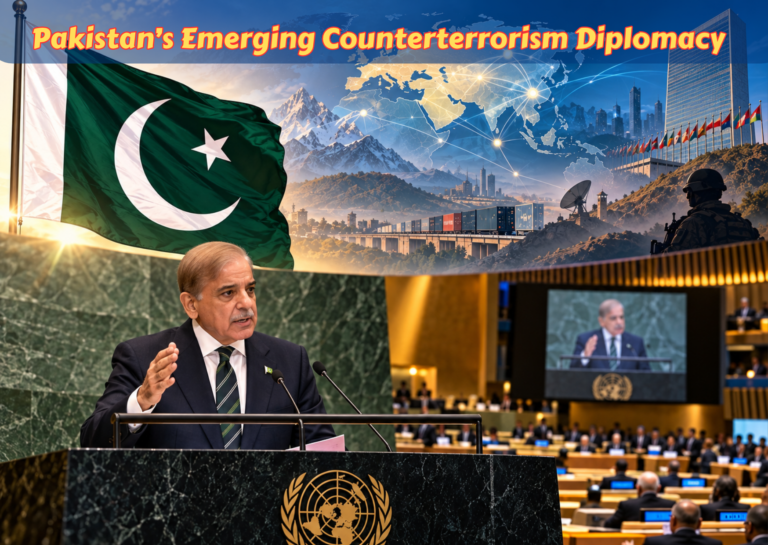
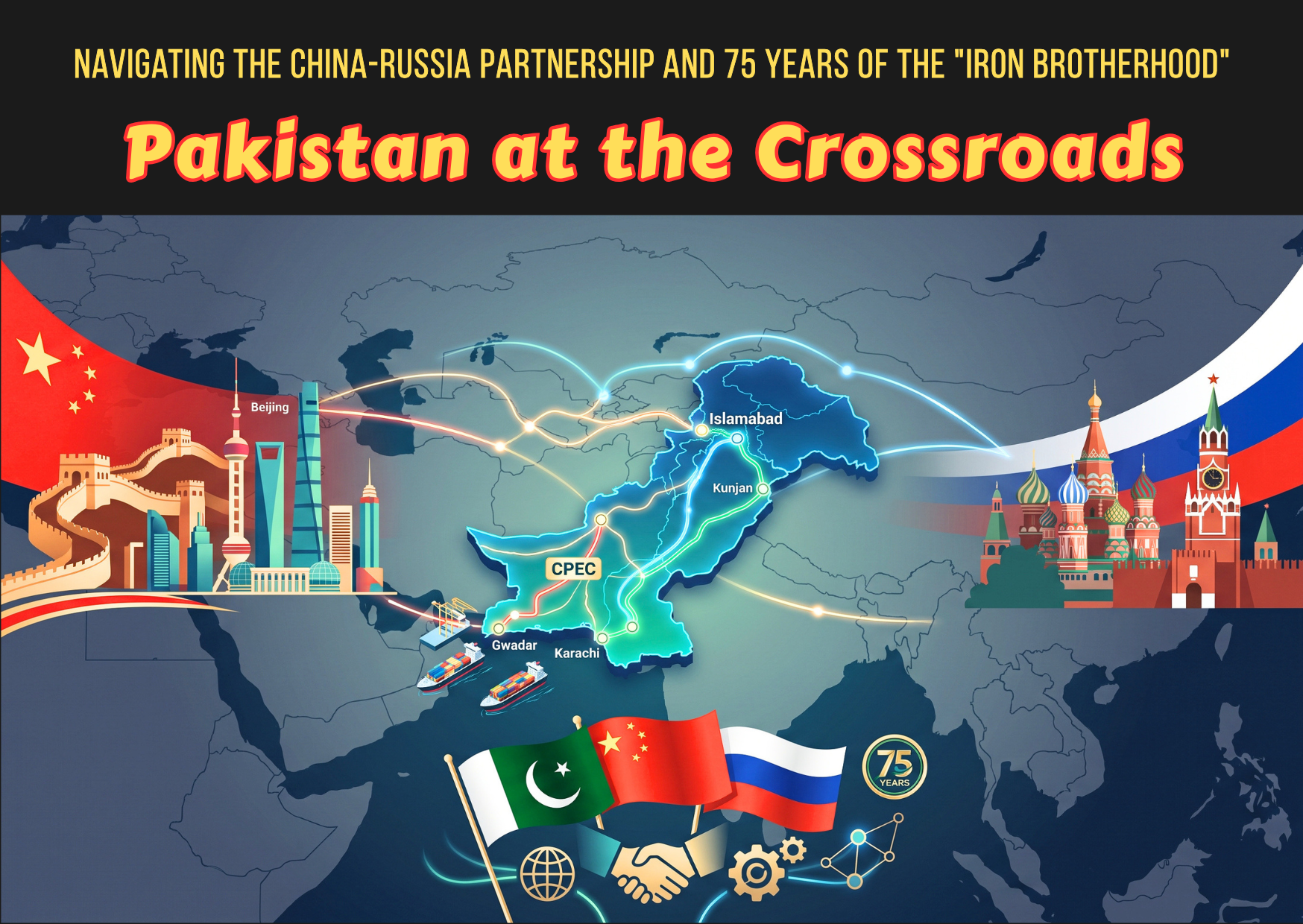
The year 2026 marks a watershed in Pakistan’s diplomatic history. As Islamabad celebrates the 75th anniversary of its ties with Beijing—cementing the “Iron Brotherhood’s” “all-weather” credentials—a deeper geopolitical shift is crystallizing. For decades, Pakistan’s strategic identity was defined largely through the prism of its bilateral relationship with China, a partnership forged in the crucible of the 1962 Sino-Indian War and hardened by decades of mutual reliance in defense, infrastructure, and nuclear cooperation. Yet that bilateral frame is now giving way to something more expansive.
In a rare joint op-ed, Chinese Ambassador H.E. Jiang Zaidong and Russian Ambassador H.E. Albert Khorev did more than commemorate the 25th anniversary of the Sino-Russian Treaty of Good-Neighborliness. They placed Pakistan at the center of a new Eurasian architecture, identifying it as an “essential node in the Eurasian connectivity network.” The symbolism was deliberate and unprecedented. Never before had the envoys of Beijing and Moscow in Islamabad spoken with a single voice on strategic matters, let alone used Pakistani soil to articulate a shared vision for continental integration.
The message was unmistakable: Pakistan is no longer merely China’s bilateral ally, but a pivotal hub in a multipolar, Sino-Russian strategic framework. What began as Gwadar’s integration into the China-Pakistan Economic Corridor has now acquired a trilateral dimension—one that links Islamabad not only to Beijing’s Belt and Road Initiative but also to Moscow’s broader Eurasian economic and security calculus. For a country long squeezed between regional rivalries and great-power competition, the joint article offered something rare: a seat at the table of architects, not merely a role as client or corridor.
The Historic Joint Statement: A New Strategic Calculus
The joint article by Ambassadors Jiang and Khorev was a diplomatic milestone in itself. Historically, major powers have managed their South Asian policies through distinct, often competing, bilateral channels. However, the unified messaging from Beijing and Moscow reflects the deepening strategic synchronization between the two powers.
In their piece, the ambassadors highlighted that the changing global order requires coordinated approaches to regional stability and economic integration. By singling out Pakistan, they underscored a shared realization in both capitals: the Eurasian landmass cannot be seamlessly integrated without unlocking the potential of the Pakistani landmass. This is not merely about trade; it is about creating an unbroken chain of infrastructure, energy, and security cooperation stretching from the Eurasian heartland to the warm waters of the Arabian Sea.
75 Years of the “Iron Brotherhood”: The Foundation
To understand Pakistan’s current strategic value, one must look at the foundation laid over the last 75 years. Since establishing diplomatic ties in 1951, Pakistan and China have navigated the Cold War, the war on terror, and the rise of Asia together.
The crown jewel of this 75-year journey is the China-Pakistan Economic Corridor (CPEC). Launched in 2015 as the flagship project of the Belt and Road Initiative (BRI), CPEC has fundamentally altered Pakistan’s infrastructure landscape. As the project transitions into its second phase—focusing on industrialization, agricultural modernization, science, and IT—the relationship is evolving from a purely strategic and infrastructure-based alliance to one of deep economic integration.
Yet, the 75th anniversary is not just a look backward; it is a pivot point. The security, diplomatic, and economic foundations built with China have provided Islamabad with the stability required to diversify its partnerships, most notably with Moscow.
Russia-Pakistan Relations: A Pragmatic New Chapter
While China has been Pakistan’s closest ally, relations with Russia have undergone a dramatic transformation. For decades during the Cold War, Moscow’s alignment with New Delhi kept Islamabad at arm’s length. Today, however, geopolitical tectonic shifts have forged a pragmatic, rapidly deepening partnership.
Russia’s “pivot to the East” and Pakistan’s need for energy security and multipolar diplomacy have created a natural convergence. The two nations have expanded cooperation in energy, trade, and defense, highlighted by regular military exercises and growing diplomatic consultations. For Russia, Pakistan offers a gateway to the Indian Ocean and a partner in managing the fallout of the Afghan withdrawal. For Pakistan, engaging Moscow provides crucial energy diversification and balances its foreign policy in an increasingly complex world.
Pakistan as the Ultimate Eurasian Connectivity Hub
The core thesis of the joint article by the Chinese and Russian ambassadors is Pakistan’s geographic imperative. Situated at the intersection of South Asia, Central Asia, and the Middle East, Pakistan is the missing link in several major regional integration projects.
- Access for Central Asia: The landlocked Central Asian Republics (CARs) and Afghanistan desperately require access to global maritime markets. Through the Gwadar Port and the broader CPEC network, Pakistan offers the shortest route to the Arabian Sea, aligning perfectly with Russia’s vision of the “International North-South Transport Corridor” and China’s BRI.
- Energy Corridors: Pakistan’s position makes it a viable transit route for energy resources, including potential pipelines from Central Asia and Turkmenistan (such as the TAPI project), which would benefit both regional producers and consumers.
- Integration of Frameworks: Pakistan is uniquely positioned to serve as the physical intersection where China’s BRI, Russia’s Greater Eurasian Partnership, and the Eurasian Economic Union (EAEU) can practically overlap and synergize.
Trilateral Cooperation: Converging Interests
While a formal “China-Russia-Pakistan” alliance is unlikely, trilateral cooperation on specific issues is already taking shape. The most pressing of these is Afghanistan. All three nations share a vested interest in a stable, peaceful Afghanistan that does not serve as a safe haven for terrorist organizations like the TTP or ETIM. Through platforms like the Shanghai Cooperation Organization (SCO) and various Moscow-led formats on Afghanistan, Beijing, Moscow, and Islamabad are increasingly coordinating their security and diplomatic approaches.
Furthermore, as the West imposes sanctions on Russia and seeks to contain China, the three nations are developing alternative financial mechanisms, local currency trade systems, and independent supply chains. Pakistan’s integration into these alternative economic architectures could provide a massive boost to its resilient economy.
Navigating the Challenges
Despite the immense potential, realizing this vision requires Pakistan to navigate significant hurdles.
- Internal Security and Stability: The Eurasian connectivity vision cannot be realized without robust internal security. Terrorist networks targeting Chinese nationals and state infrastructure in Balochistan and Khyber Pakhtunkhwa remain a severe threat to foreign direct investment.
- Economic Vulnerabilities: Pakistan’s ongoing macroeconomic challenges, including debt sustainability and reliance on IMF bailouts, limit its capacity to independently fund the infrastructure required to become a true transit hub.
- Geopolitical Balancing: As Pakistan deepens ties with the Sino-Russian bloc, it must carefully manage its relationships with the West (the US and Europe), which remain its largest export destinations. Furthermore, Pakistan must navigate the sensitivities of the India-Russia relationship, ensuring its growing ties with Moscow do not inadvertently complicate the broader South Asian security dynamics.
Conclusion: From Crossroads to Hub
As Pakistan celebrates 75 years of its time-tested friendship with China, the joint message from the Chinese and Russian ambassadors serves as a strategic roadmap for the future. The “Iron Brotherhood” provided the shield and the foundation; the new Sino-Russian consensus offers the blueprint for economic integration.
Pakistan is no longer just a geopolitical “crossroads” where empires historically clash; it has the potential to become the central “hub” where Eurasian connectivity converges. By capitalizing on its geographic destiny, ensuring internal stability, and leveraging the coordinated visions of Beijing and Moscow, Pakistan can transition from a regional security state to a prosperous, indispensable linchpin of the new Eurasian order. The next 75 years of Pakistan’s foreign policy will be defined not just by who its friends are, but by how effectively it connects them.