(By Khalid Masood)
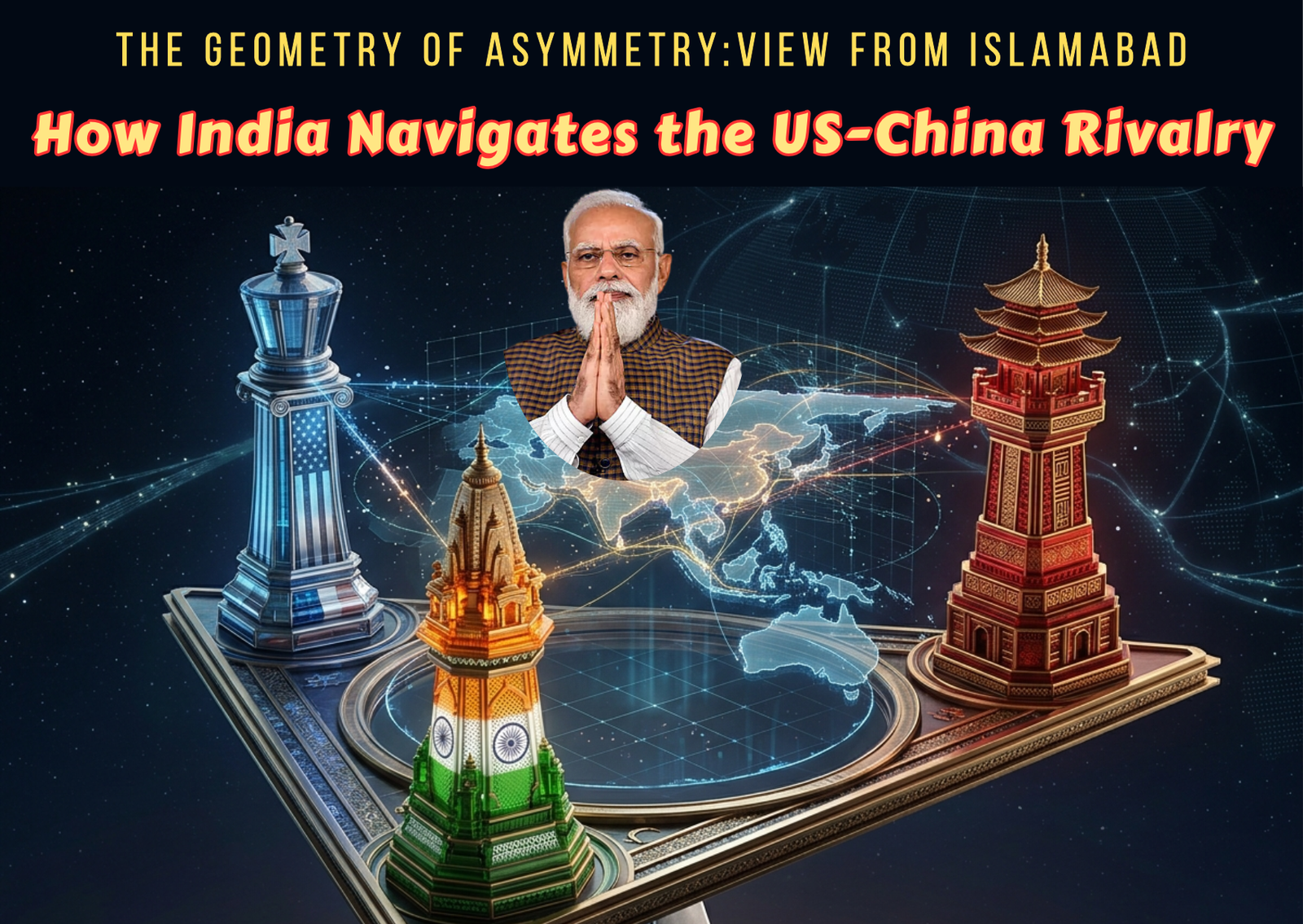
The 21st century’s defining geopolitical theater is the Indo-Pacific, and its central axis is the triangular relationship between the United States, China, and India. As the structural rivalry between Washington and Beijing deepens into a comprehensive contest for global primacy, New Delhi finds itself in a position of unprecedented strategic leverage. However, this leverage is accompanied by profound complexities. India is not merely a bystander to the US-China cold war; it is a pivotal swing state whose choices will heavily influence the balance of power in Asia.
Navigating this triangle requires a delicate synthesis of opportunism, caution, and a relentless pursuit of national interest. For India, the objective is not to choose a side in a bipolar Cold War, but to prevent the emergence of a unipolar Asian hegemony while maximizing its own trajectory toward great-power status. Yet, while New Delhi views its strategic maneuvering as a masterclass in multi-alignment, the view from Islamabad is markedly different, perceiving India’s diplomatic agility as a direct threat to Pakistan’s existential security.
The Architecture of Indian Strategic Autonomy
To understand India’s navigation of the US-China rivalry, one must first discard the outdated paradigm of “Non-Alignment.” Under Prime Minister Narendra Modi, India has transitioned from a posture of ideological equidistance to one of pragmatic, issue-based alignment. This is a transactional approach to statecraft where New Delhi partners with various powers based on converging interests in specific domains, without entering into formal, binding treaty alliances.
“India’s approach to the world is driven by national interest, not by ideological alignment. We are not in the business of getting into alliances; we are in the business of getting into partnerships.”
— Dr. S. Jaishankar, External Affairs Minister of India
From Non-Alignment to Multi-Alignment
India’s strategic calculus is anchored in the belief that the 21st century will be inherently multipolar. Therefore, tying its destiny exclusively to Washington would diminish its agency, while confronting Beijing outright would be economically and militarily ruinous. Instead, India practices strategic autonomy—keeping its options open, diversifying its partnerships, and refusing to be subordinated to the strategic priorities of any external power. As strategic analyst C. Raja Mohan notes, “India is no longer a balancing power; it is a leading power,” signaling a shift from reactive diplomacy to proactive statecraft.
The China Challenge: Deterrence, De-risking, and Coexistence
The primary driver of India’s foreign policy shift in the last decade is the rise of an assertive China. The 2020 Galwan Valley clash, which resulted in the first combat fatalities between the two nuclear-armed neighbors in decades, was a watershed moment. It shattered the Indian illusion that economic integration with China could insulate the relationship from border disputes.
The Galwan Watershed and Border Posture
In response to Chinese assertiveness, New Delhi has adopted a multi-pronged strategy to manage the threat. Militarily, India has accelerated the modernization of its armed forces, improved border infrastructure in the Himalayas, and pivoted its naval focus toward the Indian Ocean Region (IOR) to counter China’s “String of Pearls” strategy. Diplomatically, India joined the Quadrilateral Security Dialogue (the Quad) alongside the US, Japan, and Australia. However, New Delhi is careful to frame the Quad not as an “Asian NATO,” but as a benign grouping for public goods and maritime domain awareness.
Economic Decoupling and the Quad Calculus
Economically, New Delhi has systematically de-risked from Chinese dependence. This includes banning hundreds of Chinese applications, restricting Chinese foreign direct investment, and promoting the “Atmanirbhar Bharat” (Self-Reliant India) initiative. Crucially, while India balances China, it avoids the rhetoric of containment. New Delhi maintains diplomatic channels with Beijing, participates in the BRICS and Shanghai Cooperation Organization (SCO), and consistently asserts that the Asia-Pacific is large enough for both nations to prosper—a diplomatic nod to coexistence even amid fierce competition.
The American Embrace: Convergence Without Subordination
For the United States, India is the linchpin of its Indo-Pacific strategy. Washington views a strong, rising India as the only demographic and geographic counterweight to China in Asia. Consequently, the US has offered New Delhi unprecedented concessions, from foundational defense agreements (LEMOA, COMCASA, BECA) to the groundbreaking Initiative on Critical and Emerging Technology (iCET).
Technological Synergies and the Russia Stress Test
India eagerly accepts these American offerings, viewing them as essential for its military modernization and technological leapfrogging. However, New Delhi draws a firm red line at formal alliance. India refuses to be treated as a junior partner or a proxy in Washington’s containment strategy. This friction was starkly visible during the Russia-Ukraine war. While the US and its allies isolated Moscow, India maintained robust diplomatic and economic ties with Russia, continuing to purchase discounted Russian oil and Soviet-era military hardware. New Delhi’s message to Washington was clear: India will partner with the US to manage the China challenge, but it will not sacrifice its strategic autonomy to serve American geopolitical objectives.
The Pakistani Counterpoint: The View from Islamabad
While New Delhi and Washington celebrate the deepening of their strategic partnership, the view from Islamabad is steeped in deep strategic apprehension. To understand the Pakistan perspective on Indian foreign policy intentions, one must look through the lens of the enduring India-Pakistan security dilemma.
“For Pakistan, the India-US convergence is not merely a shift in the regional balance of power; it is the realization of its deepest strategic nightmare: a unified front of its two primary adversaries.”
— Consensus of the Pakistani Strategic Establishment
The Perception of Encirclement and the India-Centric Paradigm
From the Pakistani strategic establishment’s viewpoint, India’s “multi-alignment” is merely a tactical phrasing for a broader pursuit of regional hegemony. Islamabad interprets the US-India convergence as the formation of an anti-Pakistan axis. Pakistan perceives India’s alignment with the US as an attempt to legitimize New Delhi’s hardline stance on Kashmir and to secure a free hand in South Asia. By bringing the US into the Indian Ocean, India is attempting to militarily encircle Pakistan and secure its western borders, allowing it to focus entirely on its northern border with China.
The Sino-Pakistani Nexus as an Existential Imperative
Pakistan views India’s tilt toward Washington as an existential threat that leaves Islamabad with no choice but to deepen its “all-weather” strategic partnership with Beijing. The Pakistan-China nexus—cemented by the China-Pakistan Economic Corridor (CPEC) and extensive defense cooperation—is viewed in Islamabad as a necessary counterbalance to the India-US dynamic. Pakistani strategists are highly skeptical of India’s claims of strategic autonomy, arguing that as the US-China rivalry intensifies, India’s reliance on US technology will force New Delhi into a de facto alignment with Washington. Therefore, Pakistan views India’s current diplomatic maneuvering as a transitional phase toward becoming the primary US surrogate in South Asia.
Comparative Strategic Postures: A Triangular Matrix
The following table encapsulates the divergent strategic calculus of New Delhi and Islamabad within the broader context of the US-China rivalry:
| Strategic Dimension | India’s Posture (New Delhi) | Pakistan’s Counter-Posture (Islamabad) | US-China Context |
|---|---|---|---|
| Core Doctrine | Strategic Autonomy & Multi-Alignment | India-Centric Security Paradigm & Balancing | US seeks Indo-Pacific hegemony; China seeks regional primacy. |
| View of Washington | Essential partner for tech, defense, and balancing China; but not a treaty ally. | Unreliable ally prone to transactional shifts; a threat when aligned with India. | US views India as a net security provider; views Pakistan through a counter-terrorism/nuclear lens. |
| View of Beijing | Primary strategic competitor and border threat; requires deterrence and de-risking. | “All-weather” friend and indispensable balancer against Indian hegemony. | China views India as a secondary theater; views Pakistan as a vital strategic proxy. |
| Military/Naval Strategy | Forward posture in the Himalayas; naval expansion in the IOR to secure sea lines. | Development of tactical nuclear weapons; reliance on Chinese naval assets to counter Indian blockade. | US expanding naval presence via the Quad; China expanding via the “String of Pearls”. |
| Economic Statecraft | Decoupling from China; integrating with Western supply chains (iCET, I2U2). | Deep economic integration with China via CPEC; seeking relief from Western financial conditionalities. | US pursuing “friend-shoring”; China pushing the Belt and Road Initiative (BRI). |
Conclusion: The Fulcrum of the Indo-Pacific
The US-India-China triangle is not a static geometric shape, but a dynamic, asymmetrical relationship defined by shifting vectors of power. India’s navigation of this rivalry is a testament to its evolving statecraft. By leveraging American technology and strategic convergence to balance Chinese assertiveness—while fiercely guarding its decision-making independence—New Delhi is successfully engineering its rise as a “leading power” rather than a subordinate ally.
However, as the Pakistani strategic perspective highlights, India’s rise and its external alignments do not occur in a vacuum; they generate profound security externalities. Islamabad’s deepening integration with Beijing is the direct corollary of New Delhi’s embrace of Washington. Ultimately, India’s success in navigating the US-China rivalry will depend on its ability to manage the periphery. If New Delhi can prevent the US-China competition from boiling over into a kinetic conflict on its borders, and if it can manage the acute security anxieties of its immediate neighborhood—particularly Pakistan—it will secure its place not just as a swing state, but as an independent pole in the multipolar order of the 21st century. The triangle will remain the defining feature of Asian geopolitics, but India’s enduring goal is to ensure it is the fulcrum upon which the balance rests, rather than a mere piece on the board.