(By Khalid Masood)
For decades, Washington described its relationship with Islamabad as one of its “most complicated.” Today, it may be the fastest-warming relationship in American foreign policy. Within eighteen months, Pakistan’s Army Chief has been a guest at the White House three times in as many months, Islamabad has brokered direct talks between the United States and Iran, and a US firm has signed a $500 million critical minerals deal with a Pakistani military conglomerate
But how did the United States and Pakistan get here — from Cold War alliance to nuclear-era sanctions to the bitter estrangement of the 2010s, and now to what some analysts call a “new transactionalism”? This explainer covers the full arc: the history of US-Pakistan relations, the causes of their collapse, the mechanics of the 2025–26 reset, and what the thaw actually means for trade, security, India, and China.
The Historical Timeline of US-Pakistan Relations
1947–1958: Courtship and Early Alliances
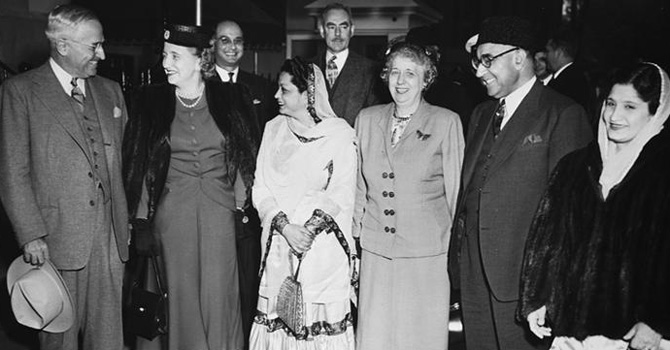
Pakistan was barely four years old when it began courting Washington. The courtship was deliberate: Pakistan’s first prime minister, Liaquat Ali Khan, declined an invitation to Moscow in 1950 and visited the United States instead — a symbolic choice that set the relationship’s direction for a generation. In 1951, Pakistan became one of the earliest recipients of US economic aid under the Mutual Security Act, and by 1954–55 it had joined the Southeast Asia Treaty Organization (SEATO) and the Baghdad Pact (later CENTO), anchoring itself firmly in the Western camp during the Cold War.
The payoff was substantial: military equipment and training, development loans, and — most consequentially — access to Pakistani airspace and bases. The Peshawar airfield became a launchpad for American U-2 reconnaissance flights over the Soviet Union, a secret arrangement that ended in spectacular fashion in May 1960 when Francis Gary Powers’ U-2 was shot down deep inside Soviet territory. The incident was an early demonstration of the relationship’s enduring paradox: Pakistan’s geography made it uniquely valuable to Washington, and uniquely dangerous for itself.
Yet even in this honeymoon era, the asymmetry was obvious. Pakistan wanted a formal security commitment against India — its actual threat perception — while the United States wanted a bulwark against communism. Those were never the same thing, and the gap between them would define every subsequent decade.
1960s–1971: War and Disappointment
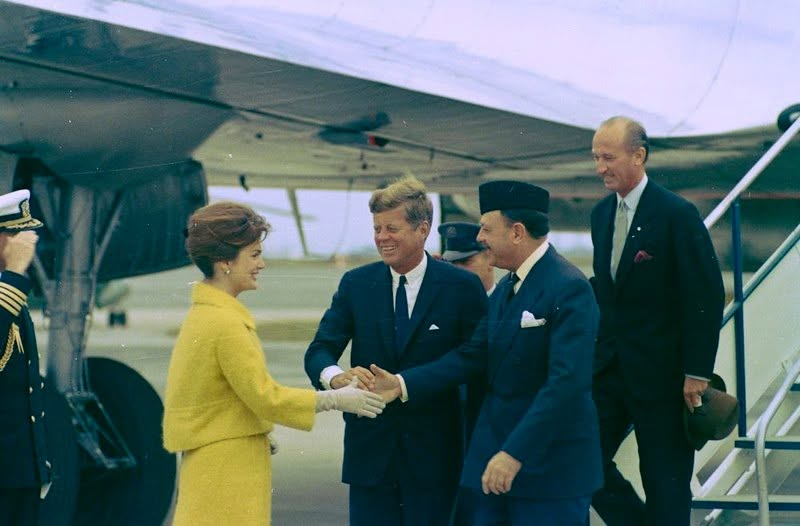
The relationship’s first great strain came in 1965, when India and Pakistan went to war over Kashmir. The Johnson administration applied an arms embargo to both sides — formally neutral, but experienced in Islamabad as abandonment, since Pakistan’s military was almost entirely American-equipped while India’s arsenal was diversified. Pakistani officers concluded that US equipment came with strings attached; American officials concluded that Pakistan was an impulsive client.
The rupture came in 1971. When East Pakistan rose in revolt and India intervened in December, the Nixon White House — guided by the opening to China, for which Pakistan was the essential secret conduit — “tilted” toward Islamabad, sending the aircraft carrier USS Enterprise toward the Bay of Bengal in a show of pressure. Yet the United States also renewed the arms embargo, and Pakistan lost half its territory regardless, becoming Bangladesh. For Pakistanis, 1971 taught a bitter dual lesson: Washington’s support was rhetorically warm but materially unreliable in a shooting war. For Americans, it confirmed Pakistan as a chronic crisis manager’s problem — a country whose wars, not whose potential, now defined the relationship.
The Bhutto years that followed (1971–77) saw Pakistan exit SEATO’s shadow, drift toward the Islamic world and China, and — fatefully — begin its covert nuclear program in response to India’s 1974 test. Each of these moves narrowed the space for US engagement, even before the decade’s sanctions arrived.
1979–1989: The Afghan Jihad Era
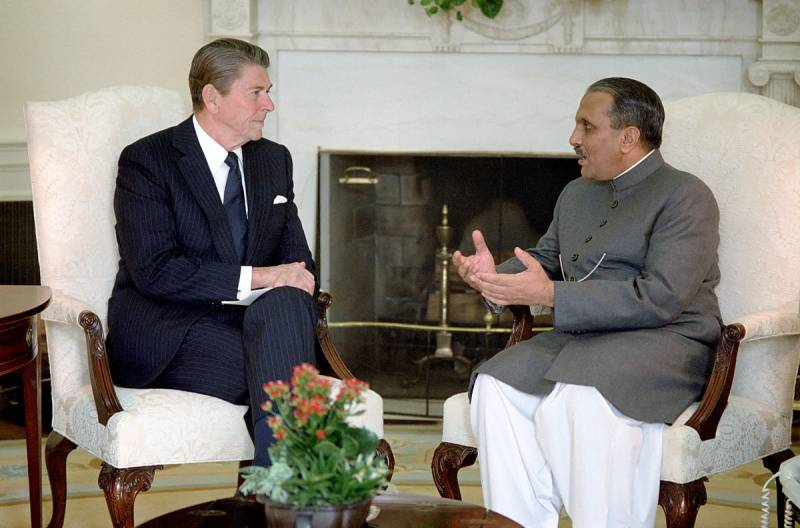
The Soviet invasion of Afghanistan in December 1979 transformed the relationship overnight — and is the foundational case study in what Pakistanis call the “on-again, off-again” cycle. Overnight, Pakistan went from nuclear pariah to frontline state. The 1981 Reagan administration won a six-year waiver of the Symington Amendment, unlocking roughly $3.2 billion in economic and military assistance, and the CIA began funneling billions through Pakistan’s Inter-Services Intelligence (ISI) to the Afghan mujahideen. By the mid-1980s, this was the largest covert operation in CIA history.
Pakistan’s strategic payoff was immense. The United States tolerated — and at times actively cooperated with — the ISI’s cultivation of Islamist militant networks, including factions that would later mutate into the Taliban and al-Qaeda. The doctrine of “strategic depth” in Afghanistan took shape in these years, with American acquiescence if not encouragement. This era also established the pattern that would define the entire relationship: Pakistan’s value to Washington was inversely proportional to regional calm. The more Afghanistan burned, the more Pakistan mattered.
The era’s abrupt end should have been a warning. Within months of the last Soviet troops leaving in February 1989, US attention evaporated. The 1990s were about to begin.
1990s: Sanctions and the Nuclear Decade
When the Cold War ended, so did Pakistan’s utility. In October 1990, President George H.W. Bush invoked the Pressler Amendment, cutting off all military and economic aid because Pakistan had crossed the nuclear threshold. Pakistanis remember this as the canonical betrayal: a decade of frontline service repaid with a single signature. The lesson seared into the Pakistani establishment — that American guarantees expire with American interests — remains the deepest residue of the entire relationship.
The decade that followed was defined by nuclear chess. Pakistan froze and unfroze its program under international pressure; the 1998 tests by both India and Pakistan triggered sweeping sanctions under the Glenn Amendment. When General Pervez Musharraf seized power in a 1999 coup, Washington added democracy-related sanctions to the nuclear ones. And yet even in this frozen period, quiet cooperation continued — most consequentially in the CIA–ISI channel tracking Osama bin Laden’s network, which had by then relocated from Sudan to Afghanistan.
The 1999 Kargil conflict with India, which Musharraf orchestrated while keeping his own civilian prime minister in the dark, demonstrated to the Clinton administration that Pakistan’s military was the real address in Islamabad — a lesson every subsequent US administration has applied, consciously or not.
2001–2011: The War on Terror Partnership
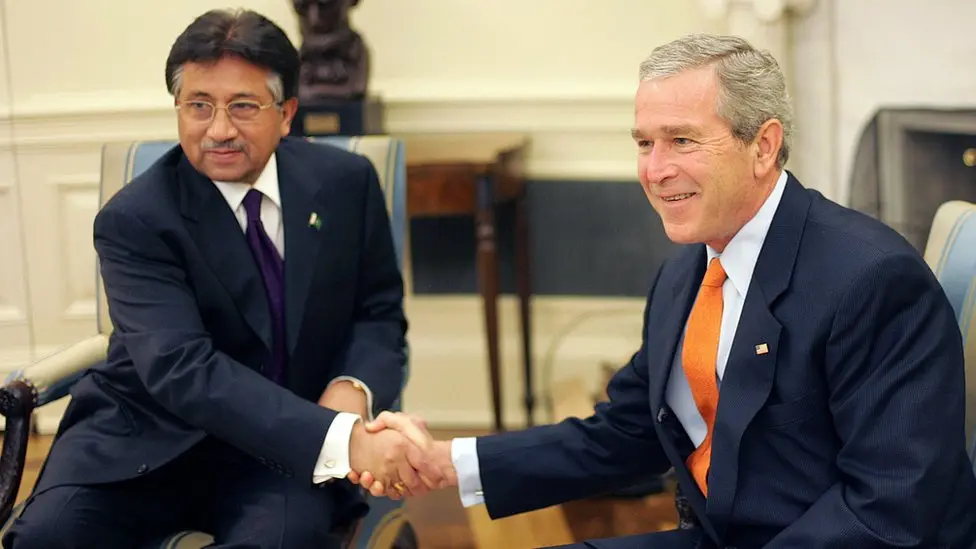
September 11 produced the second great re-engagement, faster and more total than the first. Musharraf’s famous “you are with us or against us” choice produced immediate and sweeping cooperation: Pakistani bases and airspace for the Afghan campaign, intelligence sharing, and the arrest of hundreds of al-Qaeda operatives on Pakistani soil. In return, Pakistan received over $33 billion in US aid over the following decade, the designation of “Major non-NATO ally” in 2004, and billions in Coalition Support Funds that effectively reimbursed the military’s operational costs.
But the decade’s defining feature was its internal contradiction. The United States was simultaneously fighting a war through Pakistan and against a Pakistani proxy — the Afghan Taliban’s leadership operated openly from Quetta and elsewhere, under ISI protection. Washington knew and mostly looked away, because the alternative was confronting the very state on which its war effort depended. Each revelation eroded the partnership from within: the A.Q. Khan nuclear proliferation network’s exposure (2004), the discovery that bin Laden’s courier networks ran through Pakistani cities, and finally the Abbottabad raid itself.
The raid of May 2, 2011, shattered what remained. For Washington, bin Laden’s discovery in a garrison town raised the darkest questions about Pakistani complicity or incompetence; for Pakistan, a unilateral SEAL operation on its soil was a humiliation no nuclear-armed state could digest. The partnership never recovered its momentum — the 2011 Salala border incident, in which NATO airstrikes killed 24 Pakistani soldiers, was almost an afterthought by comparison. The decade closed with both sides privately concluding the arrangement was finished, even if neither said so publicly.
2012–2024: Estrangement
The decade after Abbottabad was defined by drift, suspicion, and periodic punishment. The low points included:
- 2018: President Donald Trump’s famous tweet accusing Pakistan of taking “$33 billion” while giving “nothing but lies and deceit”
- 2021: The US withdrawal from Afghanistan, executed with minimal Pakistani input, followed by a near-total aid cutoff
- 2021–2024: The Biden years, marked by indifference — no presidential phone call to Pakistan’s prime minister for the first fifteen months of the administration — and Pakistan’s financial dependence shifting decisively toward China and Gulf states
By 2024, US-Pakistan relations were at their lowest point since 1971.
2025–Present: The Dramatic Thaw
The turnaround was startlingly fast:
- March 2025: Pakistan arrested an ISIS-K operative linked to the 2021 Abbey Gate bombing and handed him to US custody
- May 2025: Trump intervened during the India-Pakistan crisis and claimed credit for a ceasefire
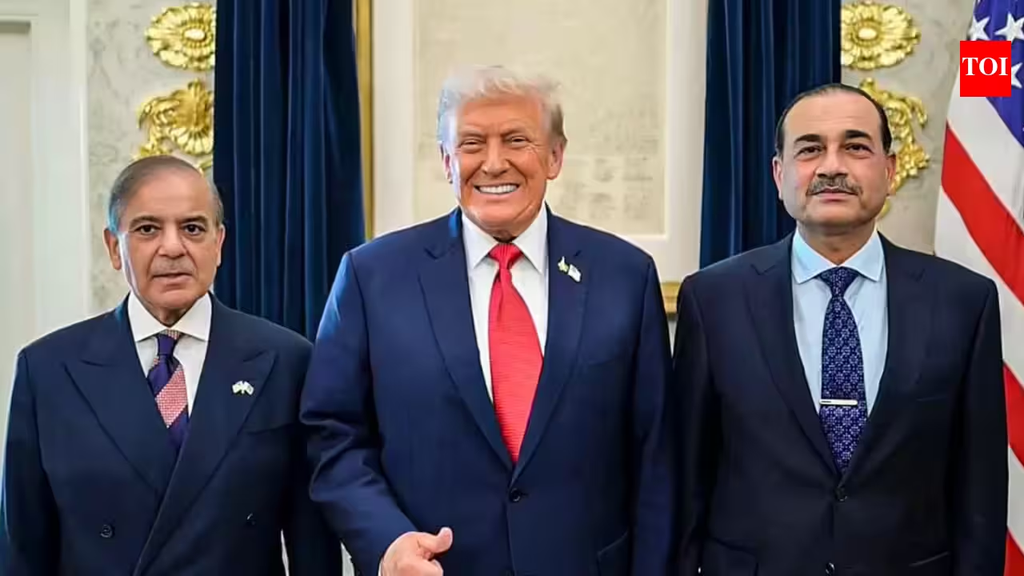
- June 2025: Army Chief Field Marshal Asim Munir dined at the White House — an unprecedented visit for a serving Pakistani army chief
- July 2025: A US-Pakistan trade agreement was announced
- September 2025: Munir returned to Washington with Prime Minister Shehbaz Sharif; a $500 million minerals deal was signed; Munir was back again a month later — three visits in three months
- April–June 2026: Islamabad hosted direct US–Iran engagement; a memorandum of understanding was signed on June 17
Why Did US-Pakistan Relations Collapse After 2011?
The Abbottabad Raid and Mutual Distrust
The bin Laden raid poisoned the well in ways that never fully drained. American officials questioned whether elements of the Pakistani state had sheltered the world’s most wanted man; Pakistani officials saw a violation of sovereignty that humiliated the military before its own public. Mutual trust never recovered, and every subsequent cooperation — drone strikes, supply routes, intelligence sharing — was transactional and resented.
Aid Cuts and the “Lies and Deceit” Era
Trump converted suspicion into policy. He suspended security assistance in January 2018, and his tweet framing Pakistan as a paid deceiver crystallized the relationship’s public narrative. By the time the Biden administration executed the Afghanistan withdrawal, Pakistan had been largely written out of Washington’s South Asia map — with the notable exception of a fleeting 2022 period when Imran Khan’s ouster briefly made Pakistan relevant again.
The Afghanistan Withdrawal and the End of “Do More”
With American troops gone, Washington no longer needed Pakistani supply routes or air corridors. The core transactional logic that had held the relationship together since 2001 — access for aid — simply expired.
The 2025–2026 Reset: How the Thaw Happened
The speed of the rapprochement has few precedents in modern diplomacy. Analysts attribute it to three converging factors.
1. The Abbey Gate Arrest: An Immediate Tactical Win
In March 2025, Pakistan arrested a senior ISIS-Khorasan operative tied to the Abbey Gate bombing that killed 13 American service members during the 2021 Kabul evacuation, and extradited him to US custody. For the Trump White House — which had made Abbey Gate a symbol of Biden-era failure — this was an immediately valuable deliverable, and it reset the tone at the top.
2. Operation Sindoor and Trump’s Ceasefire Claim
When India and Pakistan exchanged fire in May 2025, Trump inserted himself personally, claiming credit for brokering a ceasefire. Pakistan embraced the narrative enthusiastically — including talk, encouraged from Islamabad, of a Nobel Peace Prize nomination for Trump. Whatever the actual causality of the ceasefire, the episode gave both leaders a shared political win and a personal bond.
3. The Munir–Trump Relationship
The single most important factor is personal. Field Marshal Asim Munir has cultivated Trump with remarkable effectiveness, becoming a rare foreign military leader with standing access to the Oval Office. A structured analysis of Pakistan’s approach describes it as operating on three levels — “persona, priorities, policy — in that order”. Flattery, lobbyists, high-profile investments in Trump-affiliated ventures, and visible deference to Trump’s priorities all preceded any substantive policy concessions. Munir’s three White House visits in three months represent a level of access no Pakistani leader — civilian or military — has enjoyed in decades.
The New Economic Pillars
The US-Pakistan Trade Deal (July 2025)
The centerpiece of the economic reset is a trade agreement announced in July 2025, which reduced reciprocal tariffs on Pakistani exports to 19 percent. The deal’s framework extends well beyond tariffs into energy, mines and minerals, IT, and even cryptocurrency. For Pakistan’s export sector — textiles above all — tariff relief offered an immediate, tangible benefit.
The $500 Million Critical Minerals Deal
In September 2025, US Strategic Metals signed a memorandum of understanding with Pakistan’s Frontier Works Organisation — the commercial arm of the military — committing $500 million to develop rare earth elements, copper, and antimony deposits. The deal serves multiple purposes: it feeds into Washington’s strategic imperative of diversifying critical mineral supply chains away from China, and it gives the Trump administration a concrete deliverable to point to.
Crypto Diplomacy
Pakistan has positioned itself as an eager partner in the Trump administration’s digital asset agenda. The Pakistan Crypto Council signed a letter of intent with World Liberty Financial, a firm associated with the Trump family. Critics note that no stablecoin pilot project has actually begun six months after the MoU — an early example of the gap between announcement and delivery.
Hype vs. Reality
A dose of caution is warranted. Minerals remain roughly 3 percent of Pakistan’s GDP, many deposits sit in insurgency-affected Balochistan, and the $500 million figure is an MoU — not disbursed capital. The economic pillar of the reset is real but modest; its significance is political more than financial.
Security and Counterterrorism Cooperation
The Fourth Counterterrorism Dialogue (August 2026)
Security cooperation is quietly deepening alongside the public economic fanfare. At the fourth US-Pakistan Counterterrorism Dialogue held in August 2026, both sides reaffirmed cooperation against ISIS-Khorasan, al-Qaeda, the Tehrik-i-Taliban Pakistan (TTP), and the Balochistan Liberation Army. The dialogue format itself — institutionalized, working-level, and regular — is more durable than the headline diplomacy.
Intelligence Cooperation’s Durability
Behind the scenes, the CIA–ISI channel has functioned even through the worst periods of political estrangement. The Abbey Gate extradition demonstrated that this channel remains operational and mutually valued.
What’s Missing vs. the 2000s
Crucially, this is not a return to the War on Terror framework. There is no security treaty, no Coalition Support Funds, no large-scale weapons platform transfers, and no US bases or logistics footprint in Pakistan. The security relationship is narrower, cheaper, and more transactional than it was between 2001 and 2011 — which may paradoxically make it more sustainable.
The Iran Mediation: Pakistan as Honest Broker
The most striking demonstration of the relationship’s new value came in 2026, when Islamabad hosted direct engagement between the United States and Iran, culminating in a memorandum of understanding signed on June 17. Pakistan’s position is genuinely unique: it shares a border with Iran, hosts no US bases (insulating it from Iranian retaliation), and possesses an army chief with Trump’s personal confidence. Whether or not the Islamabad process produces a durable US–Iran framework, the mediation role itself elevates Pakistan from a problem to be managed to a partner with unique utility — the role Islamabad has coveted since 1947.
The China Question
Does the US rapprochement threaten Pakistan’s “all-weather” partnership with Beijing? The evidence so far says no. China supplied around 80 percent of Pakistan’s arms imports over the past decade, and the China–Pakistan Economic Corridor was relaunched as “CPEC II” in September 2025 — the same month as the minerals deal with Washington. Beijing has watched the US thaw without visible alarm, calculating correctly that its structural position — defence dependency, infrastructure lock-in, and financial lifelines — remains intact.
Analysts describe the emerging posture as “dual patronage”: Islamabad has achieved not a balancing act between rivals but a form of parallel extraction, deepening ties with Washington while its strategic dependence on Beijing remains untouched. Washington, for its part, appears willing to accept this — a marked departure from the Cold War logic that forced Pakistan to choose.
Implications for India and South Asia
The reset complicates India’s strategic comfort in ways that are still being absorbed in New Delhi. For two decades, the trajectory of US-India ties seemed linear: strategic convergence on China, defence cooperation, the Quad, and an implicit US de-hyphenation that treated India as the priority and Pakistan as legacy ballast. The 2025–26 thaw disrupts that linearity — not because Washington is choosing Islamabad over New Delhi, but because it is no longer organizing South Asia policy around New Delhi’s sensitivities at all.
De-hyphenation Under Strain
The Trump-era approach to South Asia is bilateral and transactional rather than regional and convergent. The May 2025 crisis illustrated the shift with unusual clarity. New Delhi’s position was that India’s actions during Operation Sindoor were a sovereign counterterrorism matter with no third-party role; Washington’s position, articulated by Trump personally, was that it had mediated and saved the day. Pakistan amplified the mediation narrative relentlessly — including the Nobel Peace Prize talk — precisely because it re-hyphenated India and Pakistan in Washington’s mind and, in the process, elevated Pakistan to peer status. India objected formally; the narrative persisted anyway. For New Delhi, this is the sharpest edge of the thaw: not what the US does for Pakistan, but what the US says about Pakistan.
The Tariff and Trade Dimension
Compounding the discomfort is the trade front. India simultaneously faced punishing US tariffs and a prolonged negotiation standoff in 2025–26, while Pakistan secured tariff relief and a minerals framework within months of re-engagement. Indian commentators have noted the inversion with some bitterness: the world’s largest democracy absorbed tariff pressure while a military-run state with an IMF program collected strategic investments. The Reko Diq copper-gold project in Balochistan — operated by a Canadian firm and among the largest undeveloped deposits on earth — adds a Western commercial stake in Pakistan’s mineral economy that runs in direct parallel to India’s own resource ambitions.
What to Watch Next
Three tests will determine whether the thaw genuinely reshapes South Asian geopolitics or merely decorates its surface:
- The next India-Pakistan crisis. Every previous US-Pakistan rapprochement has been stress-tested by Kashmir. The first serious flare-up on Trump’s watch will reveal whether Washington’s warmth toward Munir translates into diplomatic cover for Islamabad — and at what cost to the US-India relationship, whose own stock has fallen amid the tariff dispute.
- Defence cooperation depth. Any move toward renewed US military sales or joint exercises with Pakistan would cross an Indian red line far more serious than trade deals. So far, Washington has deliberately avoided it — there are no weapons platform transfers in the current framework — but the counterterrorism dialogue’s steady institutionalization is worth watching .
- China’s reaction. Beijing has absorbed the thaw with equanimity so far, having correctly calculated that its structural position — roughly 80 percent of Pakistan’s arms imports and the CPEC-II relaunch — is unthreatened . If that equanimity ever curdles into pressure on Islamabad to choose, the entire dual-patronage model collapses — and South Asia’s strategic geometry rearranges with it.
The most probable outcome is not a return to the pre-2016 US tilt toward India, nor a Cold War-style US-Pakistan alliance revival, but a messier equilibrium: Washington cultivating India for the China challenge and Pakistan for Iran, minerals, and counterterrorism simultaneously, while New Delhi recalibrates how much strategic autonomy it can afford to exercise. South Asia, in other words, is entering an era of competitive courtship — and both Delhi and Islamabad will be bidding for Washington’s attention for the foreseeable future.
Conclusion
The 2025–26 US-Pakistan reset is real, but it is not a restoration. The relationship that produced SEATO, the Afghan jihad, and the War on Terror — held together by grand strategic necessity — is gone. What has replaced it is something more modern and more fragile: a personality-driven, deal-driven, interest-driven partnership with genuine achievements (tariff relief, a minerals framework, an Iran mediation channel) and genuine limits (no defence treaty, no aid pipeline, no trust surplus).
For Pakistan, the thaw vindicates a classic strategic bet: geography and usefulness eventually bring Washington back. For the United States, it reflects a transactional era in which partners are valued for what they deliver now rather than what they represent. Whether the relationship outlasts the personalities currently sustaining it is the question that will define its next chapter — and the one this explainer will need updating to answer.