(By Khalid Masood)
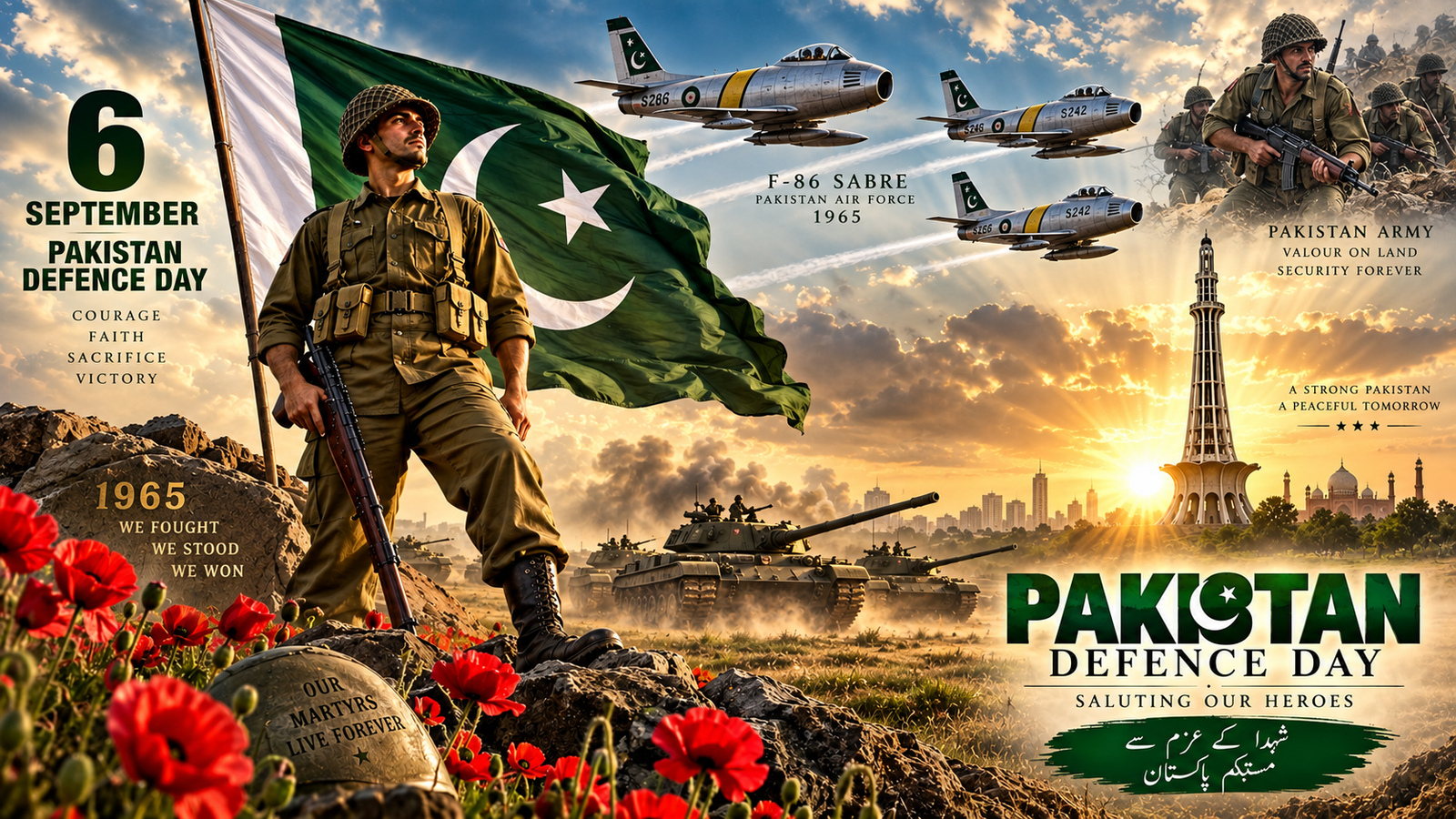
When the dawn of September 6, 1965, broke over the subcontinent, it did not bring the peace of a new morning; it brought the thunder of unprovoked aggression. As enemy armour rolled across the international border with the explicit objective of seizing Lahore, isolating Kashmir, and crushing the young nation’s spirit, they did not merely meet the resistance of a professional military. They collided with the unyielding, indivisible will of an entire nation.
Today, as Pakistan observes Defence Day (Youm-e-Difa), we do not merely mark a date on the calendar. We pause to bow our heads in profound reverence for the indomitable spirit of the Pakistani Armed Forces, the unmatched courage of our Ghazis, and the supreme, sacred sacrifices of our Shaheeds (martyrs), who turned the soil of Punjab into an impenetrable fortress and a graveyard for enemy ambitions.
The Crucible of 1965: A Masterclass in National Defence
The 1965 War was a defining crucible. Following the diplomatic and strategic maneuvers of Operation Gibraltar and the successful initial thrusts of Operation Grand Slam in the Chamb sector, India launched a massive, surprise offensive across the international border on September 6. The calculus of the adversary was fatally flawed: they mistook Pakistan’s desire for peace as a weakness, and its youth as inexperience.
What followed was a masterclass in defensive warfare. The battles of the BRB Canal, Chawinda, Phillora, and Dograi are now etched in gold in the annals of global military history. Outnumbered and outgunned in heavy armour, the Pakistan Armed Forces compensated with superior tactical brilliance, unparalleled infantry courage, and an absolute, non-negotiable refusal to yield a single inch of the motherland.
Legends of the Land: The Backbone of the Defence
The defence of Pakistan’s frontiers was anchored by leaders who embodied the principle of leading from the front, inspiring their troops through personal example and ultimate sacrifice.
We remember Major Raja Aziz Bhatti, the immortal defender of the BRB Canal. Facing relentless assaults, he famously declared, “I will not withdraw. I will die, but I will not leave my post.” He kept his sacred promise, embracing Shahadat while directing artillery fire, and was posthumously awarded the Nishan-e-Haider for his unparalleled devotion.
We honour Brigadier Ahsan Rashid Shami, who stood precariously close to the forward lines, monitoring and coordinating critical artillery support to break enemy momentum. Falling victim to intense ground fire, he embraced Shahadat, becoming the highest-ranking officer to make the ultimate sacrifice in the 1965 war, posthumously awarded the Hilal-e-Jurat.
We recall the indomitable spirit of Brigadier Hazur Hasnain, a giant among men in the Special Services Group (SSG). Dropped behind enemy lines during Operation Gibraltar, surrounded and heavily outnumbered, he fought his way out with sheer tactical genius and raw courage, earning the Sitara-e-Jurat and setting a gold standard for special operations.
In the fierce cauldron of the Battle of Chawinda, Major Ziauddin Abbasi of the Guides Cavalry emerged as a beacon of unshakeable resolve. Facing an overwhelming enemy armored assault, he boldly declared, “My squadron will advance.” Leading with his turret exposed to inspire his men, he pressed the attack until his tank was struck, embracing martyrdom but successfully halting the enemy’s advance. He was posthumously awarded the Sitara-e-Jurat.
Similarly, in the Khem Karan sector, Lieutenant Colonel Sahibzad Gul, Commanding Officer of the 6 Lancers, led his regiment to capture enemy territory. Standing tall on his tank’s turret to observe and direct the battle, he was mortally wounded by anti-tank fire, earning a posthumous Sitara-e-Jurat for his bold, front-line command.
Guardians of the Skies: The Eagles of Sargodha and Beyond
The Pakistan Air Force (PAF) wrote a saga of qualitative superiority, proving that the spirit of the pilot matters far more than the number of aircraft in the sky.
The skies over Sargodha witnessed the birth of a living legend: Squadron Leader M.M. Alam. On September 7, anticipating an enemy retaliatory strike, Alam was vectored toward incoming Indian Air Force Hunters. In a breathtaking display of airmanship, nerve, and lethal precision, he shot down multiple enemy jets in a matter of seconds, crippling the adversary’s aerial offensive and securing the skies over Pakistan’s most vital airbase.
We also bow to the supreme sacrifice of Squadron Leader Sarfraz Ahmed Rafiqui. Leading a daring strike on the Halwara airfield, his aircraft’s guns jammed mid-combat. Perfectly justified in retreating, he instead refused to abandon his men. He ordered his wingman to take over the attack while he flew defensive maneuvers in an unarmed aircraft to draw enemy fire and protect his formation. He embraced Shahadat, but his selfless action enabled his squadron to shoot down three more enemy aircraft. He was posthumously awarded the Hilal-e-Jurat.
Furthermore, the nation owes an immense debt to Squadron Leader (later Air Commodore) Sajad Haider. On the very morning of September 6, as news of the ground assault on Lahore broke, his squadron was diverted from its original mission. Flying through the haze, they unleashed devastating rocket and gun attacks on advancing enemy columns along the Amritsar-Wagah road. Staying over the target for 17 minutes until ammunition and fuel were critically low, they blunted the assault and, quite literally, saved Lahore.
The Silent Sentinels and the Nation in Arms
While the land and air battles raged, the Pakistan Navy secured the maritime frontiers. Through bold maneuvers like Operation Dwarka, the Navy neutralized coastal radar threats and ensured the absolute security of Karachi, the nation’s economic lifeline, proving the seamless tri-service synergy of Pakistan’s defence.
Yet, the true miracle of September 6, 1965, was the civilian uprising. The people of Lahore, Sialkot, and beyond did not flee; they mobilized. Women, students, and the elderly stood shoulder-to-shoulder with the soldiers, carrying water, food, and ammunition to the frontlines under heavy artillery fire. They transformed into a civilian militia, proving to the world that Pakistan is not merely a state on a map, but a deeply united nation in arms. This unbreakable civil-military bond remains our ultimate deterrent today.
The Legacy: A Pledge to the Roohani Fauj
The lessons of 1965 are not confined to history books; they are the guiding light for Pakistan’s modern security paradigm. Today, the nature of warfare has evolved into hybrid and fifth-generation domains. Yet, whether it is the Army clearing terrorist sanctuaries, the PAF maintaining absolute air supremacy, the Navy safeguarding the vital CPEC sea lanes, or the intelligence apparatus thwarting covert threats, the Armed Forces continue to embody the valour of their 1965 predecessors.
As we observe Defence Day, let us renew our covenant with our Armed Forces and the grieving, yet proud, families of our Shaheeds. Let us ensure that their sacrifices are honoured not just with floral tributes, but by building a strong, united, and economically resilient Pakistan—the very Pakistan they died to protect.
To the Ghazis who stand awake at our borders so that we may sleep in peace: We salute you.
To the Shaheeds whose blood waters the soil of this blessed land: You are immortal.
The adversaries of Pakistan may test our resolve, but they will never break our spirit. As long as the mountains stand and the rivers flow, the legacy of September 6 will echo through the corridors of time—a testament to a nation that knows exactly how to defend its honour.
Pak Fauj Zindabad!
Pakistan Paindabad!