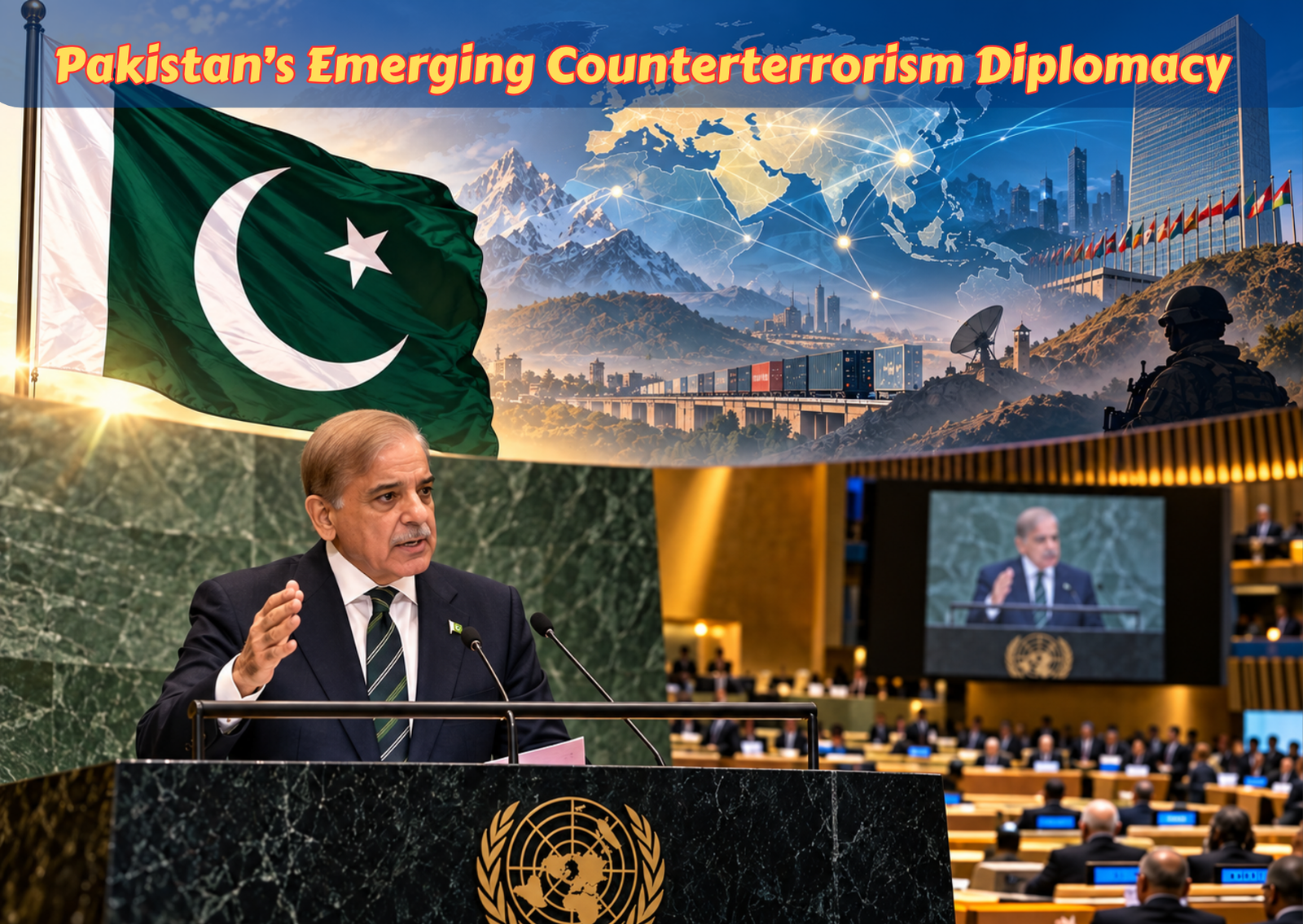
(By Khalid Masood)
Introduction: When Counterterrorism Becomes Statecraft
In the twenty-first century, the struggle against terrorism is no longer confined to battlefields, intelligence operations, border controls or law-enforcement agencies. It is also fought in conference rooms, diplomatic missions, international organizations and the increasingly contested arena of strategic narratives.
Counterterrorism has consequently become an important instrument of statecraft. States do not merely seek to defeat terrorist organizations physically; they also seek to shape the international understanding of terrorism—its causes, its perpetrators, the responsibilities of states, and the legitimacy of different security responses.
This evolution is particularly significant in South Asia, where India and Pakistan remain locked in a persistent dispute over terrorism, cross-border militancy, security and regional stability. Both governments have sought to place their respective narratives before international audiences. Yet the more consequential question is not simply which country makes the louder accusation. It is whether counterterrorism diplomacy can be transformed from an instrument of bilateral confrontation into a genuinely multilateral mechanism for reducing terrorism.
Pakistan’s diplomatic posture in 2026 is increasingly oriented towards that question.
Islamabad’s approach combines three elements: the presentation of Pakistan as a major victim of terrorism; the demand for a non-discriminatory standard against all terrorist organizations; and greater emphasis on multilateral institutions, particularly the United Nations and the Shanghai Cooperation Organisation (SCO).
The significance of this approach should not be exaggerated. Diplomatic rhetoric alone does not establish strategic success, and Pakistan continues to face serious terrorism-related challenges of its own. Nevertheless, the institutional developments of 2026 indicate an important evolution: Pakistan is seeking to move from explaining its security predicament to participating more actively in shaping the regional counterterrorism agenda.
As former UN Secretary-General Kofi Annan observed:
“Terrorism is a menace that requires a global response.”
That principle is particularly relevant to South Asia, where terrorism, militant networks, porous borders, political instability, Afghanistan’s security environment and great-power competition increasingly intersect.
1. From Defensive Diplomacy to Institutional Engagement
For much of the post-9/11 period, Pakistan’s international counterterrorism diplomacy was largely defensive.
Islamabad frequently found itself responding to allegations concerning militant organizations, explaining its military campaigns, defending its sacrifices and attempting to demonstrate compliance with international counterterrorism obligations.
That environment created a structural diplomatic disadvantage.
A state that spends most of its diplomatic energy rebutting accusations inevitably allows its adversary to establish the initial narrative.
The more significant development in 2026 is therefore not merely the language Pakistan is using. It is the increasing emphasis on institutional participation.
Pakistan has highlighted its engagement with:
- The United Nations counterterrorism system;
- The SCO Regional Anti-Terrorist Structure (SCO-RATS);
- Bilateral counterterrorism mechanisms;
- Cooperation with Russia and other SCO members;
- Counterterrorism financing and targeted financial sanctions;
- Intelligence and information-sharing mechanisms;
- Emerging challenges involving cyberspace and terrorist use of technology.
Pakistan’s Ministry of Foreign Affairs states that the country has strengthened its legal, institutional and policy framework for counterterrorism and terrorist financing and remains engaged in the UN, SCO-RATS and other international forums.
This matters because effective counterterrorism diplomacy is ultimately less about speeches than about institutions, information, legal cooperation and operational coordination.
2. The SCO-RATS Presidency: A Practical Test of Pakistan’s Diplomacy
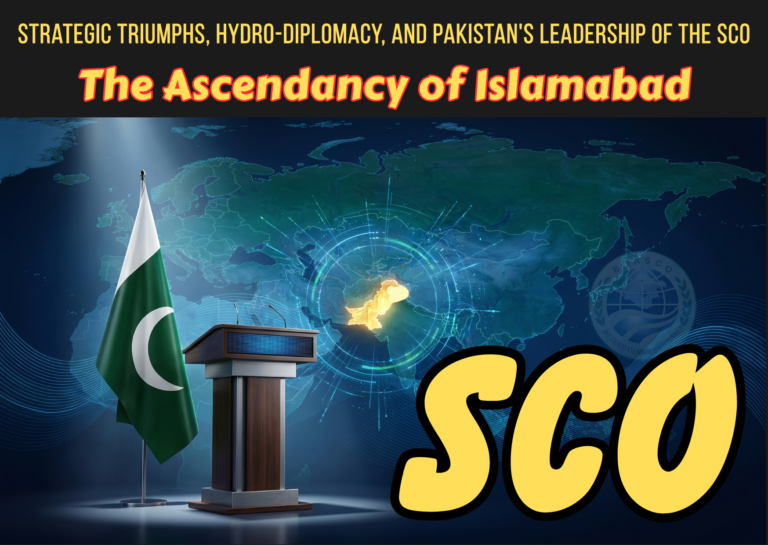
One of the most significant developments of 2026 was Pakistan’s chairmanship of the Council of the SCO Regional Anti-Terrorist Structure.
On 14 September 2026, Islamabad hosted the 46th meeting of the SCO-RATS Council. Delegations from Belarus, India, Iran, Kazakhstan, China, Kyrgyzstan, Pakistan, Russia, Tajikistan and Uzbekistan participated, alongside representatives of the SCO-RATS Executive Committee.
This is more important than a ceremonial diplomatic event.
SCO-RATS is designed to facilitate practical cooperation among member states against terrorism, separatism and extremism. During the Islamabad meeting, members reviewed the implementation of previous decisions, approved work plans for the Executive Committee and expert groups, and adopted decisions concerning information infrastructure and cooperation.
They also agreed on future activities, including a joint information operation and practical work concerning the misuse of the internet for terrorist, separatist and extremist purposes.
The significance is therefore institutional rather than theatrical.
Pakistan was not simply attending a counterterrorism conference. It was chairing a regional mechanism in which India, China, Russia, Iran and Central Asian states were participating simultaneously.
That creates a different diplomatic environment from a conventional Pakistan-India bilateral confrontation.
2.1 India’s participation is itself significant
The presence of India at the Islamabad SCO-RATS meeting is particularly noteworthy.
Pakistan’s Foreign Ministry confirmed that India’s Chargé d’Affaires participated in the meeting. Islamabad also expressed the expectation that participation would continue because the broader objective of the mechanism is peace, security and combating terrorism.
This demonstrates an important principle of multilateral diplomacy:
Institutions can continue functioning even when bilateral relations are deeply strained.
India and Pakistan may disagree sharply over the interpretation of terrorism and responsibility for cross-border violence. Yet within the SCO framework, they remain members of the same counterterrorism mechanism.
That institutional coexistence creates opportunities that bilateral diplomacy often cannot provide.
3. The Emerging Pakistani Doctrine: No Selective Counterterrorism
Pakistan’s central diplomatic argument in 2026 has increasingly revolved around the principle that terrorism should be opposed irrespective of the identity, nationality, ideology or geopolitical usefulness of the perpetrators.
This is not an exclusively Pakistani principle. It is deeply embedded in the wider international counterterrorism framework.
The United Nations has repeatedly emphasized that terrorism cannot be justified by political, religious or ideological considerations and that counterterrorism responses must operate within international law.
Pakistan is attempting to translate that principle into a regional diplomatic position.
Prime Minister Shehbaz Sharif stated at the 2026 SCO Plus meeting that terrorism in all its forms and manifestations—including what Pakistan describes as state terrorism—should be condemned clearly and unambiguously.
The wording is significant because it broadens Pakistan’s diplomatic argument.
Rather than focusing exclusively on particular organizations or incidents, Islamabad is attempting to establish a universal rule:
If terrorism is unacceptable, the standard must be applied consistently.
That is a more sophisticated diplomatic proposition than simply accusing an adversary of supporting terrorism.
It shifts the debate from:
“Who is responsible?”
to the broader question:
“What standard should govern the international response regardless of who is responsible?”
That distinction matters greatly in multilateral diplomacy.
4. The Problem of Politicization
Counterterrorism diplomacy inevitably encounters a difficult problem: the line between legitimate security concerns and political exploitation.
India and Pakistan routinely accuse one another of using terrorism-related narratives for political purposes. Each rejects important elements of the other’s allegations.
This makes it dangerous for any serious analysis to simply reproduce either side’s claims as established fact.
The more defensible position is that counterterrorism mechanisms lose credibility when their standards appear inconsistent.
The SCO itself recognized this concern in its 2026 diplomatic language, emphasizing that “double standards” in combating terrorism are unacceptable and calling for action against terrorism, including the cross-border movement of terrorists, with a central role for the United Nations.
This is an important development because it provides Pakistan with a diplomatic vocabulary that extends beyond the bilateral India-Pakistan dispute.
Pakistan can argue that it is not asking the international community to accept one country’s narrative over another’s. Rather, it can call for one standard, one legal framework and one institutional process.
Whether that argument ultimately persuades every international actor is another matter.
But as diplomatic strategy, it is considerably more durable than relying exclusively on bilateral accusations.
5. Pakistan’s Sacrifice: From Moral Argument to Diplomatic Capital
Pakistan’s enormous human and economic losses from terrorism remain one of the central pillars of its international narrative.
For years, Islamabad has emphasized that Pakistan has not merely been an observer of the global counterterrorism campaign; it has been one of its principal victims.
Pakistan’s Foreign Ministry now puts the cumulative human cost at more than 90,000 Pakistani lives, with economic losses exceeding US$150 billion over more than two decades.
Earlier Pakistani official statements used figures exceeding 80,000 fatalities. The variation reflects differences in the period covered and methodology used to calculate casualties.
The broader point, however, remains unchanged:
Terrorism has imposed an extraordinary cost on Pakistani society.
The diplomatic challenge is how to convert this sacrifice into something more substantial than a moral appeal.
Pakistan’s emerging approach attempts to do precisely that.
Instead of saying merely:
“We have suffered, therefore we should be believed,”
the stronger diplomatic proposition is:
“We have suffered, therefore we have a direct interest in developing mechanisms that prevent other states and societies from experiencing the same destruction.”
That is a far more constructive use of national sacrifice.
It converts victimhood into policy credibility.
6. From the Battlefield to the Information Battlefield
The character of terrorism itself is changing.
Terrorist organizations increasingly exploit:
- encrypted communications;
- social media;
- online propaganda;
- artificial intelligence;
- cryptocurrency and digital financial networks;
- cyber-enabled recruitment;
- transnational fundraising;
- online radicalization;
- disinformation and psychological operations.
The United Nations’ 2026 Counter-Terrorism Week specifically highlighted terrorist travel, terrorism financing, cyber-enabled threats and online radicalization as interconnected security challenges.
This creates a new dimension of counterterrorism diplomacy.
The state that controls territory but loses the information environment may still face strategic problems.
Consequently, Pakistan’s emphasis on information-sharing and the use of technology within SCO-RATS is strategically relevant. The September 2026 Islamabad meeting adopted decisions concerning information infrastructure and agreed on future joint activities addressing terrorist exploitation of the internet.
The counterterrorism battlefield is therefore becoming increasingly digital, financial and informational.
Military power remains indispensable, but it is no longer sufficient.
7. Afghanistan: The Difficult Test of Pakistan’s Regional Strategy
No assessment of Pakistan’s counterterrorism diplomacy can avoid Afghanistan.
Pakistan’s security environment is closely connected to developments across the western border, and Islamabad has repeatedly argued that terrorist groups operating from Afghan territory constitute a major security challenge.
At the SCO level, Pakistan has linked regional counterterrorism with the need for a peaceful and stable Afghanistan.
In September 2026, Prime Minister Shehbaz Sharif again argued that Pakistan seeks a peaceful and prosperous Afghanistan but warned that the continued use of Afghan territory for attacks against Pakistan undermines lasting regional stability.
Pakistan’s diplomatic challenge is substantial.
It must simultaneously:
- demand effective action against terrorist organizations;
- maintain channels of communication with Kabul;
- protect legitimate trade and connectivity;
- prevent further deterioration of bilateral relations;
- persuade China, Russia, Central Asian states and other partners that Afghan instability represents a regional—not merely Pakistani—problem.
This is where counterterrorism diplomacy intersects with economic statecraft.
A stable Afghanistan could become a bridge connecting Central Asia, Pakistan, China and the wider Eurasian economic system.
An unstable Afghanistan can instead become a corridor for militant networks, narcotics trafficking, illegal migration and transnational crime.
Security and connectivity are therefore not competing concepts. In the Afghan context, they are inseparable.
8. Pakistan’s Multi-Alignment and Strategic Autonomy
Another important characteristic of Pakistan’s 2026 diplomacy is its effort to avoid placing its counterterrorism policy exclusively inside one geopolitical camp.
Pakistan cooperates with Western countries while simultaneously maintaining extensive engagement with China, Russia, Iran and Central Asian states.
The June 2026 Pakistan-Russia Joint Working Group on Counter International Terrorism provides a useful example. The two sides discussed terrorism emanating from Afghanistan and examined ways of strengthening cooperation through both the United Nations and the SCO.
This is strategically significant.
The emerging international order is not neatly divided into two blocs. It is increasingly characterized by overlapping partnerships.
A country can cooperate with Washington on one security issue, Beijing on infrastructure, Moscow on regional security, Tehran on border concerns and Central Asian states on connectivity.
This is the logic of multi-alignment.
For Pakistan, such an approach offers diplomatic flexibility.
But it also carries risks.
Maintaining strategic autonomy requires careful calibration. If Islamabad appears to lean excessively toward one power centre, it could undermine the very diplomatic flexibility that gives multi-alignment its value.
The objective should therefore not be to replace one dependency with another.
It should be to maximize diplomatic options while protecting national interests.
9. The United Nations as the Ultimate Diplomatic Test
The SCO provides Pakistan with an important regional platform, but the United Nations remains the ultimate test of whether Pakistan’s counterterrorism diplomacy can transcend regional politics.
The UN’s counterterrorism architecture is built around universal principles, Security Council resolutions, sanctions regimes, international cooperation and the UN Global Counter-Terrorism Strategy.
The 2026 UN Counter-Terrorism Week itself emphasized cooperation between the UN, SCO-RATS and the Commonwealth of Independent States Anti-Terrorism Center. The objective was to strengthen practical cooperation against evolving threats in Central Asia while remaining consistent with international law, human rights and the rule of law.
This is precisely the institutional environment in which Pakistan’s argument for a non-discriminatory counterterrorism framework can gain relevance.
But there is an important caveat.
Pakistan cannot demand universal standards only when those standards benefit Pakistan.
For the argument to possess genuine diplomatic credibility, Islamabad must demonstrate that it applies the same principle consistently—to terrorist violence regardless of its target, ideology, nationality or political context.
That is the real test of diplomatic maturity.
10. The India-Pakistan Contest: Beyond the Accusation Cycle
India and Pakistan remain trapped in an extraordinarily persistent accusation cycle.
A terrorist attack occurs.
One side attributes responsibility.
The other rejects the allegation.
Diplomatic protests follow.
International partners are lobbied.
Media narratives intensify.
The cycle eventually produces another confrontation without necessarily resolving the underlying security problem.
This is precisely why multilateral institutions matter.
A functioning international counterterrorism system should not require the world to choose between competing national narratives.
It should instead establish mechanisms for:
- Evidence-based investigation;
- Intelligence cooperation;
- Extradition and mutual legal assistance;
- Financial tracking;
- Sanctions;
- Border management;
- Terrorist designation procedures;
- Information-sharing;
- Cyber monitoring;
- Prevention of terrorist recruitment;
- Prosecution under national and international law.
The more counterterrorism becomes institutionalized, the less room there is for purely rhetorical diplomacy.
That should ultimately benefit both South Asia and the wider international community.
11. A More Mature Pakistani Diplomatic Proposition
Pakistan’s emerging counterterrorism diplomacy can therefore be understood through five propositions:
| Diplomatic Principle | Practical Meaning |
|---|---|
| Universality | The same counterterrorism standard should apply to all terrorist organizations |
| Multilateralism | Terrorism should be addressed through institutions rather than bilateral political campaigns |
| Evidence | Allegations should be tested through credible evidence and established legal mechanisms |
| Institutional Cooperation | Intelligence, financial, legal and technological cooperation should complement military action |
| Strategic Autonomy | Pakistan should cooperate across geopolitical blocs without becoming dependent on any single one |
This framework is more defensible than simply presenting Pakistan as the victim and India as the aggressor.
It places Pakistan’s diplomatic argument on a universal foundation.
12. What Pakistan Must Do Next
If Pakistan wants to turn its 2026 diplomatic momentum into lasting influence, rhetoric will not be enough.
Islamabad will need to demonstrate measurable outcomes.
12.1 Strengthen evidence-based diplomacy
Counterterrorism diplomacy increasingly depends upon credible intelligence, forensic evidence, financial trails and legally usable information.
Diplomatic assertions unsupported by evidence will have diminishing value.
12.2 Deepen financial counterterrorism
Terrorist organizations require money.
Pakistan has already strengthened its institutional architecture for anti-money laundering, countering terrorist financing and targeted financial sanctions.
The next step is demonstrating effectiveness through measurable enforcement and international cooperation.
12.3 Make cyber-counterterrorism a diplomatic priority
Terrorist recruitment and propaganda increasingly take place online.
Pakistan should therefore promote regional mechanisms for:
- Digital intelligence-sharing;
- Monitoring terrorist propaganda;
- Disrupting online recruitment;
- Tracking terrorist financing;
- Countering extremist narratives;
- Preventing misuse of artificial intelligence.
12.4 Treat Afghanistan as a regional security problem
Pakistan should continue pressing for action against terrorist organizations while simultaneously supporting mechanisms for legitimate trade, connectivity and economic engagement.
Security without economic stability will remain fragile.
12.5 Preserve diplomatic credibility through consistency
The most powerful counterterrorism diplomacy is not the loudest.
It is the diplomacy that can withstand scrutiny.
If Pakistan advocates that terrorism must never be tolerated regardless of political circumstances, then that principle should be applied consistently.
That consistency would strengthen Islamabad’s diplomatic position far more effectively than increasingly aggressive rhetoric.
13. The Strategic Meaning of 2026
The real significance of Pakistan’s counterterrorism diplomacy in 2026 does not lie in whether Islamabad has “won” a diplomatic contest with New Delhi.
That would be too simplistic a measure.
The more consequential development is that Pakistan is attempting to change the level at which the contest is conducted.
Instead of allowing counterterrorism diplomacy to remain exclusively a bilateral argument between India and Pakistan, Islamabad is increasingly placing the issue within broader institutions:
UN → SCO → SCO-RATS → financial mechanisms → intelligence cooperation → cyber security → regional connectivity.
That is a more sophisticated form of statecraft.
It also reflects the changing nature of international security.
The terrorist threat of the future will not be defeated by military force alone. It will require intelligence cooperation, financial controls, border management, digital governance, law enforcement, diplomacy and economic development.
Conclusion: From Narrative Competition to Security Architecture
The counterterrorism diplomacy of 2026 marks an important stage in Pakistan’s continuing effort to redefine its international security identity.
For years, Pakistan’s diplomatic narrative was dominated by explanations of its own sacrifices, responses to accusations and attempts to defend itself against international criticism.
The emerging approach is different.
Islamabad is increasingly presenting itself as a participant in—and potentially a contributor to—the construction of regional counterterrorism mechanisms.
The September 2026 SCO-RATS meeting in Islamabad provided a concrete demonstration of this institutional role. Pakistan chaired a forum bringing together India, China, Russia, Iran and Central Asian states, while the organization adopted practical measures concerning information-sharing and future counterterrorism cooperation.
The broader international environment also supports this institutional approach. The United Nations itself is seeking closer cooperation with regional counterterrorism structures such as SCO-RATS in confronting terrorist travel, financing, cyber threats and online radicalization.
But Pakistan’s diplomatic opportunity should not be confused with diplomatic victory.
The credibility of Islamabad’s position will ultimately depend upon whether it can convert principles into measurable practice—whether through stronger financial controls, more effective intelligence cooperation, credible legal processes, improved border security, counter-radicalization measures or sustained engagement with regional partners.
The most persuasive diplomatic argument is ultimately not:
“Believe Pakistan.”
It is:
“Judge all states by the same standard.”
That is a proposition with considerably greater international resonance.
As Kofi Annan argued in his vision for a global counterterrorism strategy, effective counterterrorism requires states to dissuade, deny, deter, develop and defend—including the protection of human rights and adherence to international law.
Pakistan’s challenge in the years ahead is to demonstrate that its diplomacy can embody those principles consistently.
If it succeeds, the country’s role in regional counterterrorism could evolve beyond that of a state seeking recognition for the sacrifices it has made.
It could become that of a state helping to shape the rules, institutions and cooperative mechanisms through which South Asia and the wider Eurasian region confront terrorism collectively.
That would be a far more consequential form of strategic influence than winning any individual diplomatic argument.