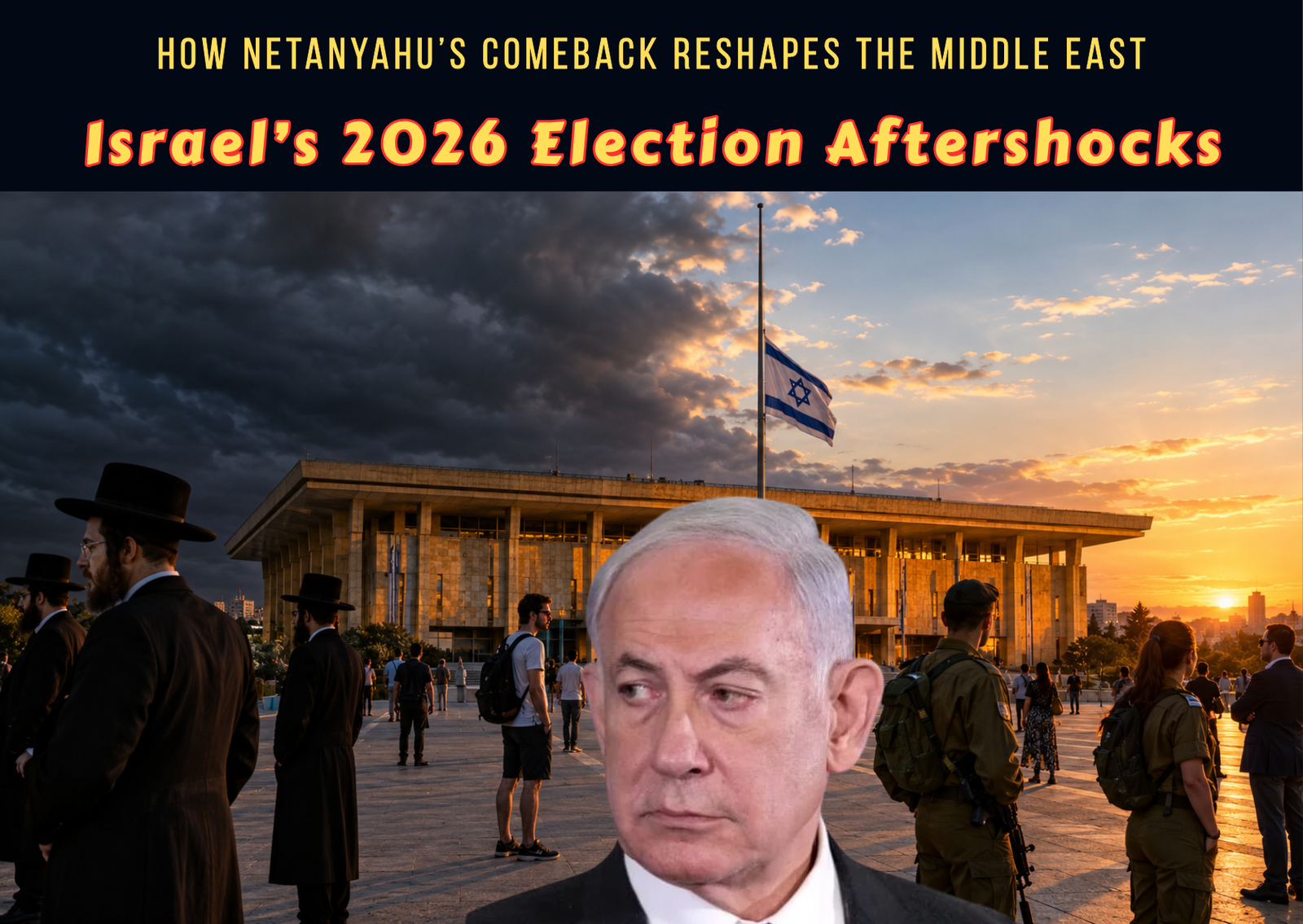
Analysis: The 2025 vote confirms a permanent rightward shift, but reveals a society traumatized, fragmented, and increasingly isolated from global democratic norms.
(By Khalid Masood)
I. Introduction: The Verdict of a War-Weary Nation
The polling stations had not yet closed when the first exit polls flickered across Israeli television screens, but the mood in Tel Aviv’s Rabin Square already told the story. A generation ago, this plaza hosted rallies for peace; on this balmy October evening in 2025, it held a fractured crowd—some waving Likud flags in vindication, others standing in stunned silence, holding photographs of hostages still held in Gaza tunnels.
Israel’s 2025 parliamentary election was never going to be a routine exercise in coalition arithmetic. It was a national trauma processing session disguised as a democratic ritual. Conducted while the embers of the Gaza conflict still smoldered and with northern communities evacuated under Hezbollah rocket fire, this vote represented something far more profound than a change in government. It was a referendum on whether a wounded society would choose the illusions of permanent war or the uncertainties of diplomatic compromise.
The results confirmed what demographers and political scientists had long predicted: Israel has undergone a seismic rightward realignment. Benjamin Netanyahu, the political phoenix who has dominated Israeli politics for a generation, secured yet another term—not through ideological persuasion, but through the politics of siege. Yet beneath the surface of this apparent continuity lies a dangerous fragmentation. The Israel that emerged from the 2025 election is more Jewish, more religious, more nationalist, and less democratic in the liberal sense than at any point in its history.
“We did not just win an election. We received a mandate to ensure that October 7th never happens again, whatever the cost, whatever the world says.”
— Benjamin Netanyahu, Victory Speech, Likud Headquarters, October 2025
II. The Road to the Polls: A Timeline of Turmoil
The October 7th Earthquake
To understand the 2025 vote, one must rewind to the cascading crises that preceded it. The October 7th Hamas attack—when militants breached the Gaza fence and slaughtered 1,200 Israelis—shattered the foundational myth of Netanyahu’s career: that he alone could guarantee security. For months, the so-called “Mr. Security” faced existential political peril. His approval ratings plummeted to 15% by early 2024, and the streets filled with protesters demanding his resignation.
The war cabinet formed in the attack’s aftermath—an uneasy alliance between Netanyahu, Defense Minister Yoav Gallant, and centrist Benny Gantz—was supposed to project unity. Instead, it became a pressure cooker. Gantz’s National Unity party demanded a post-war plan for Gaza that included Palestinian Authority involvement. Netanyahu, beholden to his far-right coalition partners, refused. When Gantz exited the government in late 2024, triggering the coalition’s collapse, Israel lurched toward snap elections.
The Constitutional Crisis
Compounding the security crisis was the unresolved constitutional crisis. The judicial overhaul attempted by Netanyahu’s government in 2023—aimed at curbing the Supreme Court’s power—had triggered the largest protest movement in Israeli history. Though paused for the war, the issue remained radioactive. The election thus became a proxy battle over the soul of the state.
“They are not just changing the government. They are changing the nature of the state. We are fighting for Israel’s soul.”
— Professor Yuval Noah Harari, speaking at a pre-election protest rally, September 2025
III. The Results: Numbers, Maps, and Margins
The final tally delivered a Knesset that mirrored Israel’s tribal divisions with mathematical precision. Netanyahu’s Likud party secured 32 seats—a remarkable recovery from the 24 seats it held in the previous Knesset. The broader right-wing religious bloc commanded 68 seats, a commanding majority in the 120-seat parliament.
Seat Distribution Overview
| Party | Leader | Seats (2025) | Seats (Previous) | Change | Bloc |
| Likud | Benjamin Netanyahu | 32 | 24 | +8 | Right |
| Yesh Atid | Yair Lapid | 18 | 24 | -6 | Center-Left |
| Religious Zionism | Bezalel Smotrich | 14 | 7 | +7 | Far-Right |
| National Unity | Benny Gantz | 12 | 12 | 0 | Center |
| Otzma Yehudit | Itamar Ben-Gvir | 10 | 6 | +4 | Far-Right |
| Shas | Aryeh Deri | 11 | 11 | 0 | Haredi |
| United Torah Judaism | Yitzhak Goldknopf | 7 | 7 | 0 | Haredi |
| Hadash-Ta’al | Ayman Odeh | 5 | 5 | 0 | Arab |
| Labor | Merav Michaeli | 0 | 4 | -4 | Left |
| Meretz | Zehava Galon | 0 | 0 | 0 | Left |
Demographic Divides
Geographically, the map revealed a stark divide. Tel Aviv and its affluent suburbs remained bastions of liberal opposition, while the periphery—the development towns of the Negev and Galilee, the settlement blocs of the West Bank, and the ultra-Orthodox neighborhoods of Jerusalem—painted the country in Likud blue and Haredi black.
| Region/Demographic | Turnout | Dominant Vote | Key Issue |
| Secular Tel Aviv | 78% | Yesh Atid / Labor | Judicial independence, Hostage deal |
| West Bank Settlements | 85% | Religious Zionism / Likud | Annexation, Security |
| Ultra-Orthodox (Haredi) | 92% | UTJ / Shas | Military exemption, Welfare funding |
| Arab-Israeli Communities | 44% (historic low) | Hadash-Ta’al / Boycott | Discrimination, Gaza war |
| Development Towns (Periphery) | 81% | Likud / Shas | Security, Cost of living |
Most significantly, the far-right Religious Zionism party doubled its representation to 14 seats, while Otzma Yehudit (Jewish Power) led by Itamar Ben-Gvir secured 10. Their combined 24 seats made them the third-largest force in Israeli politics, giving them veto power over any coalition formation.
IV. The Winners: Anatomy of the Right-Wing Resurgence
Netanyahu’s Survival
Netanyahu’s victory was not a triumph of policy but of psychology. He successfully framed the election as a choice between “strong Israel” and “weak Israel,” between those who would “finish the job” in Gaza and those who would “surrender to international pressure.” His campaign ads featured split screens: on one side, Hamas leaders celebrating; on the other, Netanyahu in a flight jacket, the commander-in-chief protecting the nation from existential threat.
The Extremist Enigma
The coalition’s composition, however, reveals the true nature of the mandate. Itamar Ben-Gvir, the extremist who was once considered too radioactive for mainstream politics, demanded and received the National Security Ministry, giving him control over police and prison services. Bezalel Smotrich, the settler leader who openly advocates for annexation of the West Bank, took the Finance Ministry with expanded authority over civilian affairs in the occupied territories.
“The people have spoken. They want a full Jewish sovereignty from the river to the sea. No more apologies, no more half-measures.”
— Itamar Ben-Gvir, Otzma Yehudit leader, upon receiving his ministerial appointment
The ultra-Orthodox parties—Shas and United Torah Judaism—extracted a heavy price for their support: legislation formalizing military exemptions for yeshiva students, billions in funding for religious institutions, and control over the Religious Affairs Ministry.
V. The Losers: Opposition in Disarray
The Collapse of the Zionist Left
If the right won the election, the center-left lost its reason for existence. The collapse of the Zionist left is not merely electoral; it is existential. Meretz, the dovish party that once championed Oslo, vanished from the Knesset entirely. Labor’s disappearance marks the end of the secular, social-democratic vision that built the state.
The opposition’s failure stems from a fundamental misreading of the Israeli public. They campaigned on governance, corruption, and judicial independence—issues that, while important to the Tel Aviv elite, paled in comparison to the visceral security concerns of a population that had experienced the worst massacre in its history.
The Hostage Families’ Movement
The “Bring Them Home” movement, which had mobilized hundreds of thousands in weekly demonstrations for the release of Gaza hostages, discovered that moral authority does not automatically translate into political power. Their tears and anguish, broadcast nightly on television, were ultimately no match for Netanyahu’s narrative that only military victory could prevent future October 7ths.
“We begged them to see our children, not as chess pieces, but as a reason to stop the madness. They chose victory over life.”
— Einav Zangauker, mother of hostage Matan Zangauker, election night interview
VI. The Geopolitical Ripple Effects
Washington’s Dilemma
The election results have sent shockwaves far beyond Israel’s borders. In Washington, the Biden administration—already strained by its support for Israel’s Gaza campaign—now faces a government that includes ministers who have been barred from entering the United States due to past incitement convictions. The progressive wing of the Democratic Party is pushing for conditions on military aid, particularly regarding weapons transfers to units involved in West Bank violence.
The Abraham Accords Freeze
In the Gulf, the Abraham Accords face their greatest test. Saudi Arabia, which had been negotiating normalization with Israel in exchange for a Palestinian pathway to statehood, has suspended talks indefinitely. The UAE and Morocco, already facing domestic criticism for their ties to Israel, are quietly recalibrating.
The Palestinian Question
For the Palestinians, the election confirms the death of the two-state solution as a viable diplomatic framework. With Smotrich controlling the Civil Administration in the West Bank, settlement expansion is accelerating at unprecedented rates. The de facto annexation that human rights groups have warned about for years is becoming de jure policy.
VII. Domestic Fault Lines: The Democracy Question
Judicial Independence Under Threat
The most profound consequence of the 2025 election may be the transformation of Israel’s democratic character. The new government has announced its intention to revive the judicial overhaul, this time with the numbers to pass it. The Supreme Court, which has served as the last check on executive power, faces neutering.
Military-Civil Tension
The military establishment, traditionally a bastion of national unity, is showing signs of strain. Thousands of reservists, including elite Air Force pilots, have signed letters refusing to serve in a government they view as illegitimate. While the IDF leadership has managed to contain this dissent so far, the precedent of conditional military service threatens the foundational ethos of the “people’s army.”
VIII. Conclusion: Israel’s New Normal
Israel’s 2025 election was not a deviation but a culmination. It confirmed the long-term demographic and ideological shift of the Israeli electorate toward religious nationalism and away from the secular liberalism of the state’s founders. Netanyahu, for all his legal troubles and tactical failures, has successfully redefined Zionism as a project of territorial maximalism and ethnic sovereignty.
Yet this victory is Pyrrhic. Israel emerges from this election more powerful domestically but more vulnerable internationally. It has a government that reflects the fears of its electorate but not the complexities of its reality. The “Start-Up Nation” is becoming the “Fortress Nation”—isolated, militarized, and increasingly illiberal.
The next eighteen months will determine whether this new configuration stabilizes or collapses under its own contradictions. Netanyahu faces a corruption trial that could resume with new evidence. The coalition’s ideological maximalism could trigger a constitutional crisis with the Supreme Court. And the unresolved Palestinian question, now buried under rubble and rhetoric, will not stay buried forever.
Israel has voted for continuity in wartime. But the demographic clock—Palestinian population growth, Haredi economic dependency, and the alienation of Arab citizens—ticks regardless of election results. The fortress may be impregnable, but it is also a prison. And in the Middle East, prisons have a habit of exploding.