(By Quratulain Khalid)
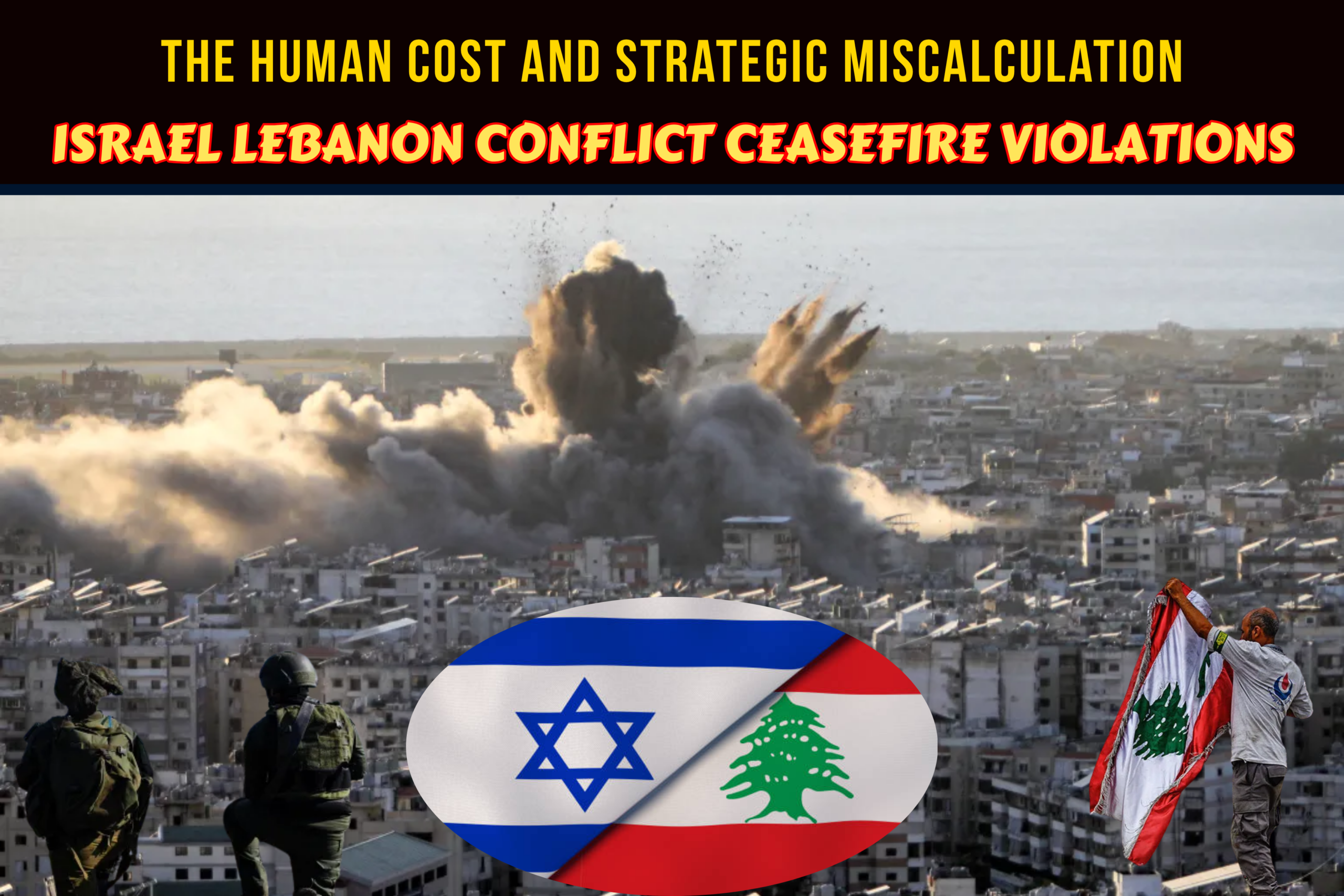
The illusion of restraint in southern Lebanon has long since dissolved. Over the past months, documented Israel Lebanon conflict ceasefire violations have transformed a fragile truce into a sustained campaign of aerial bombardment, artillery strikes, and ground incursions. Despite repeated international calls for de-escalation, Israeli military operations have consistently expanded beyond declared security parameters, striking residential neighbourhoods, agricultural zones, and UNIFIL-adjacent areas. The result is not enhanced security, but a deepening humanitarian emergency, a fractured diplomatic landscape, and a strategic paradigm that prioritises tactical force over verifiable conflict resolution.
This analysis examines how sustained Israeli military escalation has systematically undermined ceasefire frameworks, inflicted disproportionate civilian harm, and accelerated regional destabilisation. Grounded in UN monitoring data, international humanitarian law, and independent conflict documentation, the piece traces the operational trajectory, legal accountability gaps, and geopolitical consequences of a conflict that continues to exact a heavy toll on Lebanese civilians while offering no credible pathway to lasting stability.
From Border Skirmishes to Sustained Campaign
The Israel-Lebanon theatre was never truly quiet following the 2006 war. UN Security Council Resolution 1701 established a framework for mutual withdrawal, UNIFIL deployment, and the prohibition of unauthorised military activity along the Blue Line. For years, periodic cross-border exchanges were managed through informal understandings and calibrated deterrence. However, the operational tempo shifted dramatically between 2023 and 2026, as Israeli forces transitioned from containment to expanded aerial and artillery campaigns.
Israeli security establishments have frequently justified the escalation as pre-emptive deterrence against militant infrastructure. Yet field documentation and satellite imagery reveal a marked expansion of strike zones well beyond declared buffer areas. Residential compounds, civilian supply routes, and agricultural land have repeatedly been targeted under broad operational mandates. This shift from targeted strikes to area saturation reflects a strategic recalibration that prioritises military dominance over diplomatic de-escalation, fundamentally altering the conflict’s trajectory and civilian risk profile.
“What began as border management has become institutionalised escalation. When tactical operations routinely exceed declared security perimeters, the ceasefire ceases to be a framework and becomes a temporary pause.”
— UN Regional Security Analyst, Middle East Monitoring Desk, March 2026
Documented Ceasefire Breaches and Tactical Escalation
Independent monitoring platforms and UNIFIL incident logs record a consistent pattern of Israel Lebanon conflict ceasefire violations across southern governorates. Documented breaches include strikes on residential blocks in Nabatieh, Tyre, and Marjayoun; repeated artillery fire near UNIFIL observation posts; and the deployment of loitering munitions and heavy ordnance in densely populated zones. While Israeli statements frequently cite intelligence-led targeting, independent cross-referencing of strike coordinates, crater analysis, and civilian testimony consistently reveals a disproportionate impact on non-combatant populations.
The tactical reliance on wide-area bombardment and sustained aerial surveillance has systematically circumvented existing de-escalation mechanisms. Verification protocols, humanitarian corridors, and UN-monitored buffer zones have been repeatedly compromised by active strike patterns. Rather than neutralising security threats, this approach has entrenched a cycle of retaliation, displaced hundreds of thousands of civilians, and normalised the suspension of ceasefire commitments under the guise of operational necessity.
| Category | Documented Incidents (2024–2026) | Civilian Impact | Monitoring Source |
|---|---|---|---|
| Residential Zone Strikes | 140+ verified events | 890+ civilian fatalities, widespread structural damage | UNOCHA, Lebanese MoPH |
| UNIFIL-Adjacent Fire | 60+ recorded breaches | 3 peacekeepers injured, observation posts compromised | UNIFIL Incident Logs |
| Agricultural & Infrastructure Targeting | 95+ documented cases | 42% reduction in seasonal harvests, water grid disruption | FAO, ICRC Field Reports |
| Loitering Munition Deployment | 70+ confirmed uses | High fragmentation radius, civilian casualties in open areas | OSINT Conflict Trackers, HRW |
Data compiled from publicly verified UN, NGO, and open-source monitoring reports as of April 2026. Figures reflect cross-referenced incident logs and humanitarian impact assessments.
The Humanitarian Toll: Civilian Suffering and Institutional Collapse
The human cost of sustained military operations in Lebanon is both quantifiable and profound. Verified casualty figures compiled by the Lebanese Ministry of Public Health, UNOCHA, and the International Committee of the Red Cross indicate a sharp rise in civilian deaths and injuries, with women and children comprising a significant proportion of those killed. Displacement has reached historic levels, with entire villages emptied and temporary shelters operating far beyond capacity. Schools, healthcare facilities, and water treatment plants have sustained repeated damage, crippling essential services and triggering secondary public health crises.
Aid delivery has been systematically obstructed by active strike zones, bureaucratic delays, and restricted access corridors. UN agencies and local humanitarian organisations report that even when convoys are authorised, operational pauses are routinely violated, leaving medical supplies, food, and shelter materials stranded.
“When humanitarian corridors are suspended under operational pretexts, the distinction between combatant and civilian ceases to hold. We are witnessing the systematic dismantling of civilian survival infrastructure.”
— ICRC Regional Head of Operations, Lebanon/Syria Desk, February 2026
The long-term socio-economic scarring is equally severe: livelihoods destroyed, agricultural land contaminated, and a generation of students deprived of consistent education. The humanitarian architecture in southern Lebanon is not merely strained; it is being actively dismantled by sustained military pressure.
International Law and the Accountability Deficit
Under international humanitarian law, the principles of distinction, proportionality, and precaution in attack are non-negotiable. Yet documented strike patterns in Lebanon consistently raise serious questions regarding compliance. The repeated targeting of civilian-adjacent infrastructure, the use of wide-area munitions in populated zones, and the obstruction of humanitarian access collectively suggest a systemic disregard for IHL obligations. UN Commission of Inquiry statements, HRW field documentation, and Amnesty International investigations have repeatedly highlighted these discrepancies, yet tangible accountability remains elusive.
| IHL Principle | Documented Operational Pattern | Compliance Status | Legal Implications |
|---|---|---|---|
| Distinction | Civilian infrastructure struck in proximity to alleged militant sites | Consistently compromised | Potential breach of GCIV Art. 33, AP I Art. 48 |
| Proportionality | Wide-area ordnance deployed in densely populated zones | Repeatedly exceeded | Violates AP I Art. 51(5)(b) |
| Precaution in Attack | Minimal advance warning, limited civilian evacuation windows | Inadequate | Contravenes AP I Art. 57 |
| Humanitarian Access | Aid corridors suspended during active operations | Systematically restricted | Breaches GCIV Art. 23, UNSCR 1701 para. 8 |
Legal mapping based on Geneva Conventions Additional Protocol I, UN Commission of Inquiry guidelines, and IHL advisory opinions.
The international response has been characterised by rhetorical condemnation without substantive enforcement. Western diplomatic shielding, coupled with Security Council veto dynamics, has repeatedly blocked binding resolutions, independent investigations, and targeted accountability mechanisms.
“Accountability cannot be negotiated away. Repeated breaches of distinction and proportionality demand independent investigation, not diplomatic deferral. Impunity is a policy choice, not a legal inevitability.”
— Director of International Justice Programme, Human Rights Watch, January 2026
The International Criminal Court’s preliminary examinations into alleged war crimes in the region proceed at a glacial pace, constrained by jurisdictional complexities and political reluctance. This accountability deficit normalises impunity, undermines the credibility of international legal frameworks, and signals to state actors that military escalation carries minimal diplomatic consequence.
Geo-Strategic Repercussions: Regional Destabilisation and Power Dynamics
The strategic paradox of Israel’s Lebanon operations is increasingly evident. Rather than securing long-term stability, sustained military escalation has accelerated Lebanon’s institutional fragility, deepened economic paralysis, and eroded state sovereignty. Politically, the vacuum created by prolonged conflict strengthens non-state narratives, fuels recruitment cycles, and legitimises armed resistance frameworks. Regionally, the conflict intersects with broader power dynamics involving Syria, Iran, and Gulf state diplomacy, complicating maritime security, energy transit routes, and EU migration management.
From a geo-strategic standpoint, reliance on military escalation as a substitute for diplomatic architecture has proven counterproductive. Over-militarisation has not yielded secure borders; instead, it has strained Israel’s regional standing, intensified transnational security anxieties, and exposed the limitations of deterrence-driven policy. The Mediterranean basin now faces compounded risks: destabilised supply chains, heightened naval posturing, and a refugee landscape that continues to pressure European border agencies. Strategic miscalculation, not security assurance, defines the current trajectory.
Diplomatic Realities and the Path Forward
Current mediation frameworks have repeatedly failed to produce enforceable outcomes. US and EU-led initiatives, backchannel negotiations, and UN diplomatic tracks lack verification mechanisms, mutual accountability provisions, and binding withdrawal timelines. Sustainable de-escalation requires verifiable monitoring protocols, independent ceasefire observation teams, and prioritised humanitarian corridors insulated from military activity. Diplomatic engagement must shift from reactive crisis management to structured conflict resolution, with regional security architecture that addresses root grievances rather than symptom suppression.
The international community must move beyond rhetorical diplomacy towards enforceable accountability. Targeted sanctions mechanisms, arms transfer reviews, and UN mandate reforms could restore leverage to ceasefire compliance frameworks. Comparative models from Cyprus, Kosovo, and the Balkans demonstrate that sustained stability is achievable only when military pressure is replaced by law-based monitoring, transparent verification, and inclusive diplomatic tracks. Lebanon’s devastation should serve as a catalyst for recalibrating Middle Eastern conflict policy, not a footnote in an endless cycle of retaliation.
Conclusion: Beyond the Cycle of Retaliation
The Israel Lebanon conflict ceasefire violations examined in this analysis reveal a clear pattern: sustained military escalation has not produced security, but has deepened civilian suffering, fractured diplomatic frameworks, and accelerated regional destabilisation. Lebanon’s southern governorates stand as a testament to the cost of unaccountable force and the failure of deterrence-driven policy. Independent investigations, enforceable monitoring protocols, and humanitarian prioritisation are no longer optional; they are prerequisites for any credible path to stability.
Sustainable peace requires the abandonment of militarised exceptionalism in favour of verifiable, law-based frameworks. Until international actors commit to enforceable accountability and structural diplomatic engagement, the region will remain trapped in a cycle of retaliation, civilian displacement, and strategic miscalculation. Lebanon’s crisis is not isolated; it is a mirror reflecting broader geopolitical failures. Addressing it demands not more force, but more accountability.