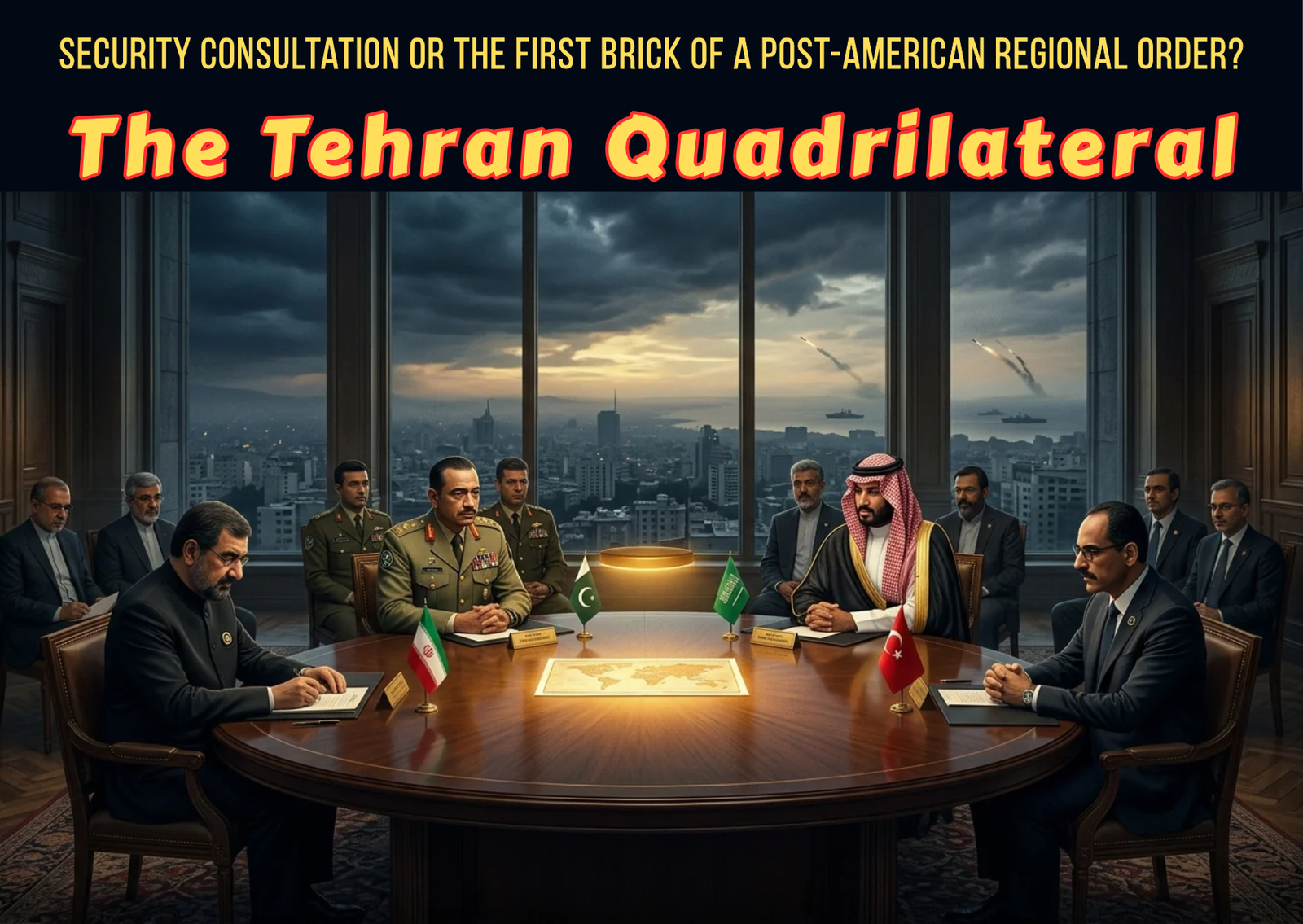
Pakistan, Iran, Türkiye and Saudi Arabia in Tehran — 26 October 2026
(By Khalid Masood)
PART I — EXECUTIVE SUMMARY
On 26 October 2026, Tehran hosted the first quadrilateral security meeting of Iran, Pakistan, Türkiye and Saudi Arabia, hosted by Major General Mohsen Rezaei, Secretary of Iran’s Supreme National Security Council, and attended by Saudi Defence Minister Prince Khalid bin Salman, Pakistan’s Chief of the Army Staff and Chief of Defence Forces Field Marshal Asim Munir, and Türkiye’s MİT Director Ibrahim Kalın. Iranian President Masoud Pezeshkian and Foreign Minister Abbas Araghchi also participated.
The four countries assembled because the region stands on the edge of a wider war. The June 2026 interim agreement — brokered by Pakistan and Qatar — that was to reopen the Strait of Hormuz, end the US blockade of Iranian ports and launch nuclear negotiations, unravelled within weeks as both sides returned to attacks.
With American and Israeli elections approaching and rhetoric hardening, and with Houthi missile and drone attacks striking Saudi airports and killing civilians, the four states shared an urgent interest in stopping the slide back to full-scale war.
The meeting appears to have been initiated primarily by Pakistan, whose army chief has emerged as the region’s most active diplomatic-military figure since the June mediation. Islamabad’s motivation is threefold: to preserve the credibility of its June mediation, to protect the Mecca Joint Defence Agreement (7 August 2026) from being tested in a war it cannot afford, and to position itself as an indispensable bridge between the Gulf, Iran and the West.
Saudi Arabia’s participation reflects its exposure to Houthi attacks and its desire to de-escalate on two fronts. Türkiye’s dispatch of its intelligence chief signals an operational, back-channel character. Iran’s hosting of a meeting including the defence minister of a state it has been indirectly at war with via the Houthis is itself a significant diplomatic concession to de-escalation.
The official outcome was deliberately modest. The joint statement — four sentences — confirmed the meeting occurred, named the participants, and stated the four sides “agreed to continue the dialogue to strengthen cooperation amongst the four regional countries, including for peace and security in the region.” No date or venue for a follow-up was announced; no mechanisms or documents were disclosed.
The immediate strategic significance lies less in what was agreed than in who was in the room. The defence minister of Saudi Arabia sat across from the secretary of Iran’s Supreme National Security Council while Iran-backed Houthis were attacking Saudi territory. The Pakistani army chief — whose country belongs to a NATO-style defence pact with Saudi Arabia and Türkiye — acted as diplomatic interlocutor for Iran. This is crisis-management diplomacy with an unusually senior cast, not yet a new security architecture.
For Pakistan, the meeting offers real opportunities — enhanced diplomatic capital, a potential economic dividend, and a facilitator role — but also real risks: exposure to a conflict it cannot control, contradiction between its American relationship and its Iranian engagement, and the danger that its nuclear status becomes a subject of regional bargaining.
Three most important strategic takeaways:
- The meeting institutionalised a four-power consultative channel at the highest level, but produced no mechanism. The gap between the seniority of the participants and the thinness of the outcome is the single most revealing fact about the meeting.
- Pakistan has become the region’s default facilitator, but its facilitation is only as valuable as its ability to hold Washington’s and Tehran’s confidence simultaneously. The June agreement’s collapse shows how fragile that position is.
- The Mecca Defence Alliance and the Tehran quadrilateral are now the two poles of a possible post-American regional order — but they are not yet connected, and Iran is not a member of the former. Whether the quadrilateral evolves into a genuine security framework or remains a diplomatic fire-brigade will be determined in the next three to six months.
PART II — HISTORICAL AND GEOPOLITICAL BACKGROUND, 2023–OCTOBER 2026
The quadrilateral meeting is the product of three converging trajectories: the Saudi-Iranian rapprochement brokered by Beijing in March 2023 and its subsequent erosion; the transformation of Pakistan’s security relationships with Riyadh and Ankara; and the February 2026 outbreak of open US-Israeli war against Iran, which shattered the existing regional order.
Saudi Arabia and Iran. The March 2023 China-brokered restoration of diplomatic relations raised hopes of durable de-escalation. Those hopes were progressively dashed as the Gaza war widened, Iran’s proxy network — above all the Houthis — attacked Saudi energy and civilian infrastructure, and the shadow war between Israel and Iran became open war in 2026. By October 2026, Saudi Arabia faced a direct Houthi missile and drone campaign, including attacks on airports that killed civilians, while seeking to avoid being drawn into a US-Israeli war against Iran.
Pakistan’s repositioning. The Strategic Mutual Defence Agreement with Saudi Arabia (17 September 2025) formalised six decades of military cooperation; the Mecca Joint Defence Agreement (7 August 2026) brought Türkiye into a NATO-style collective defence arrangement committing that “any armed attack against any one of the three States shall be regarded as an attack against them all.”
Simultaneously, Pakistan maintained its working relationship with Iran and in June 2026, together with Qatar, brokered the interim agreement on the Strait of Hormuz.
The 2026 Iran war and its aftermath. The February 2026 US-Israeli war against Iran, and the subsequent Houthi escalation against Saudi Arabia, created the conditions in which the Mecca pact was signed. The pact’s credibility was immediately tested: when Houthi attacks struck Saudi Arabia in September, Pakistan initially declined a military response, stating its reaction would remain diplomatic, and Saudi Arabia had to request direct US assistance despite the pact — revealing the gap between treaty language and operational capability.
The pact was formally invoked on 5 October, with Pakistan and Türkiye offering limited defensive and technical support rather than combat operations.
The unravelling of the June agreement. The June 2026 interim deal collapsed quickly. By October, Israeli and American leaders were sharpening threats ahead of elections, Iran remained defiant, and the region braced for renewed hostilities. It was against this backdrop that the four powers assembled in Tehran.
Chronological timeline: the 15 most consequential developments
| Date | Development |
|---|
| March 2023 | China brokers Saudi-Iranian restoration of diplomatic relations |
| 17 September 2025 | Pakistan and Saudi Arabia sign Strategic Mutual Defence Agreement in Riyadh |
| February 2026 | Outbreak of US-Israeli war against Iran |
| March 2026 | Riyadh Summit of Arab and Islamic nations; Egypt, Pakistan, Saudi, Turkish foreign ministers hold “R4” talks on the sidelines |
| June 2026 | Pakistan-Qatar brokered interim agreement: Hormuz reopened, US blockade ended, nuclear talks to open; unravels within weeks |
| 7 August 2026 | Mecca Joint Defence Agreement signed by Saudi Arabia, Türkiye and Pakistan |
| 17 August 2026 | AP reports Saudis sought allies’ help as missile defences ran low; Türkiye and Pakistan say no formal request made |
| 10 September 2026 | Pakistan declines immediate military response to Houthi attacks; response to remain diplomatic |
| 5 October 2026 | Mecca pact invoked; Pakistan and Türkiye provide limited defensive/technical support |
| Early October 2026 | Saudi-Syrian contacts on possible Syrian involvement in Yemen; US informed and does not object |
| Mid-October 2026 | Egypt’s parliament approves military support to Saudi Arabia against Houthis |
| 20 October 2026 | Full text of Mecca pact published by Middle East Eye after Turkish parliamentary submission |
| 25 October 2026 | Qatari mediators travel to Tehran in coordination with the US |
| 26 October 2026 | Quadrilateral meeting in Tehran; joint statement issued |
| 27 October 2026 | Regional and international reactions; analysis phase begins |
PART III — THE MECCA JOINT DEFENCE AGREEMENT
Signed on 7 August 2026 at Al-Safa Palace in Makkah by Crown Prince Mohammed bin Salman, President Erdoğan and Prime Minister Shehbaz Sharif, the agreement converted the bilateral September 2025 Saudi-Pakistani pact into a trilateral collective defence arrangement.
The full text, obtained by Middle East Eye on 20 October 2026 after submission to the Turkish parliament, comprises 16 articles. Core provisions include:
- Article 1: Parties shall use “all necessary means” to eliminate threats to territorial integrity, sovereignty or borders.
- Article 2: An externally originating armed attack on one party “shall be considered an attack against all,” with immediate assistance “within the limits of their available resources, including military means and capabilities.”
- Articles 3–7: Defence-industrial cooperation, joint production, R&D, training, exercises and interoperability.
- Article 8: A Strategic Political and Defence Committee (foreign ministers, defence ministers, chiefs of general staff) meeting twice yearly; a secretariat in Riyadh headed by a Pakistani secretary-general for the first three years; accession by consensus.
- Article 9: Intelligence sharing through secure channels.
- Article 16: Indefinite duration; withdrawal only after ten years with three months’ notice.
Assessment. The agreement is modelled explicitly on NATO’s Article 5, but with two critical differences. First, the response is deliberately elastic — assistance “within the limits of available resources” after an “objective assessment,” language preserving each state’s freedom of action. Second, the agreement names no adversary and contains no automatic trigger, no joint command and no standing forces. As the Arab Center Washington DC observes, its real value is “political and industrial” rather than military — a framework for defence-industrial localisation, Saudi access to Turkish drone and fighter technology, and Pakistani access to Saudi capital.
Ratification status: Submitted to the Turkish parliament; Pakistani and Saudi processes not publicly detailed. The first SPDC meeting took place in Istanbul on 31 August 2026, indicating provisional implementation pending full ratification.
Does it extend to threats from Iran or Israel? The text identifies no threat. In practice, the September–October Houthi crisis demonstrated that members interpret it as covering attacks on Saudi territory — including by Iran-backed actors — but with responses calibrated to avoid direct confrontation with Tehran. The Tehran meeting should therefore be read not as an extension of the Mecca pact to Iran, but as an attempt by its members to ensure the pact is never tested against Iran.
Iran is not a member. No credible source reports Iranian accession or an accepted invitation. Iranian officials publicly welcomed the pact in August 2026 with calls for “Muslim unity” — a rhetorical embrace carefully avoiding endorsement of its provisions.
PART IV — MEETING DETAILS AND PARTICIPANTS
The meeting took place in Tehran on Monday, 26 October 2026, hosted by Rezaei in his capacity as SNSC Secretary. Iranian state media (IRIB) broadcast footage of the opening session, and both Pezeshkian and Araghchi attended, indicating full presidential backing rather than a merely technical exchange.
The delegation composition is analytically significant:
- Pakistan: Field Marshal Asim Munir, COAS and Chief of Defence Forces. Pakistan was represented by its senior military leadership rather than civilian diplomats, reflecting both the security-centred agenda and the reality that Pakistan’s Iran and Saudi relationships are currently managed substantially through military channels. The Tribune confirmed the visit as an official COAS/CDF visit to Tehran.
- Saudi Arabia: Prince Khalid bin Salman, Defence Minister and brother of the Crown Prince. Sending the defence minister signals that Riyadh’s core concern is the Houthi military threat and the risk of wider war, not symbolism.
- Türkiye: Ibrahim Kalın, MİT Director. Ankara’s choice of its intelligence chief rather than a minister suggests back-channel, operational diplomacy — consistent with Türkiye’s preference for intelligence-led engagement with Iran and Kalın’s role as a trusted Erdoğan envoy.
- Iran: Rezaei as host, with Pezeshkian and Araghchi attending.
No heads of government attended. There is no confirmed public record of separate bilateral meetings beyond the plenary, though the presence of Pezeshkian and Araghchi at a meeting hosted by the SNSC secretary strongly suggests at least a ceremonial presidential interaction. Anonymous regional officials told AP that the war in Yemen and Houthi strikes on Saudi Arabia were discussed; this is credible reporting, not official confirmation.
PART V — AGENDA AND ISSUES DISCUSSED
The publicly documented agenda, per Anadolu’s pre-meeting reporting and the joint statement, centred on regional security and stability, Israel’s activities in the region, and developments in Palestine and Lebanon.
Credible anonymous-source reporting adds the Yemen war and Houthi attacks.
A. Regional security and de-escalation — confirmed
The joint statement frames the meeting as being about “peace and security in the region.” AP characterised the objective as “preventing renewed fighting in the Iran war.” Erdogan’s same-day televised warning that renewed attacks on Iran would destabilise the region corroborates the de-escalation focus.
B. Iran-US negotiations — reported context, not confirmed agenda
Qatari mediators travelled to Tehran on 25 October “working in coordination with the United States,” according to a regional official speaking anonymously. The quadrilateral therefore ran in parallel with an active US-coordinated mediation track. Whether specific nuclear or sanctions formulas were discussed is not publicly confirmed; the June agreement’s collapse and the Qatari presence make it highly probable the state of the US-Iran track was reviewed.
C. Saudi Arabia and Yemen — reported by anonymous officials
Two regional officials confirmed to AP that the war in Yemen and Houthi strikes against Saudi Arabia were discussed. Given the Saudi defence minister’s personal attendance, the Houthi threat was almost certainly the kingdom’s central agenda item. No ceasefire or de-escalation arrangement was announced.
D. Israel, Palestine and Lebanon — confirmed in pre-meeting agenda reporting
Anadolu reported these as agenda items. No statement on Gaza, the Palestinian territories or Lebanon emerged, suggesting either that discussion produced no consensus or that the participants deliberately kept the most divisive items off the public record.
E. Maritime and economic security — analytical inference
No official statement mentions the Strait of Hormuz, shipping insurance or energy markets. However, the June agreement’s core subject was Hormuz shipping and the US blockade; any serious discussion of preventing renewed war necessarily implicated maritime security. This remains inference, not confirmed agenda.
Agenda-versus-outcomes table
| Agenda item | Confirmed discussed? | Public outcome |
|---|
| Regional security, de-escalation | Yes (joint statement) | Agreement to “continue the dialogue” |
| Israel’s regional activities | Yes (Anadolu pre-meeting) | None stated |
| Palestine and Lebanon | Yes (Anadolu pre-meeting) | None stated |
| Yemen war / Houthi attacks | Reported (AP, anonymous officials) | None stated |
| US-Iran nuclear track | Not confirmed | None stated |
| Strait of Hormuz / maritime security | Not confirmed | None stated |
| Follow-up mechanism | No | No date or venue announced |
PART VI — OFFICIAL PRESS RELEASES AND MEDIA BRIEFINGS
The joint statement: full analysis
The complete joint statement, as published by IRNA, reads in its operative part:
“The first meeting of the four regional countries was held today, 26 October 2026, in Tehran. His Excellency General Mohsen Rezaei, the Secretary of Iran’s Supreme National Security Council, hosted the meeting. His Royal Highness Prince Khalid bin Salman, the Defense Minister of Saudi Arabia, His Excellency Field Marshal Asim Munir, the Chief of the Army Staff and the Chief of the Defense Forces of Pakistan, and His Excellency Ibrahim Kalin, the head of the Turkish Intelligence Service, participated in the meeting. The participants agreed to continue the dialogue to strengthen cooperation amongst the four regional countries, including for peace and security in the region.”
What the statement does not say — and why that matters:
- No mention of the United States, Israel or any specific conflict. The statement is threat-agnostic, mirroring the Mecca pact’s refusal to name adversaries. This is deliberate ambiguity: it allows Iran to claim the meeting resisted American pressure, Saudi Arabia to claim it addressed Houthi aggression, and Pakistan to claim it served all parties.
- No mechanism. No working groups, hotlines, secretariat or scheduled follow-up. “Continue the dialogue” is the weakest form of diplomatic continuity.
- No reference to the Mecca Defence Alliance. The three non-Iranian participants are all Mecca pact members, yet the statement does not mention it — confirming that the quadrilateral is a separate, parallel track and that Iran is not being brought into the pact.
- No condemnation of any party. Notably absent is any language on Houthi attacks, Israeli operations or American policy. This silence is itself the outcome: the four parties could not agree on a common characterisation of the threats they individually face.
National presentations
- Iranian media (IRNA, IRIB, Tehran Times): Framed the meeting as Iran-centric diplomacy — Pezeshkian stating Iran “supports any agreement that would deepen regional cooperation, resolve differences and make greater use of the shared resources and capabilities of Islamic countries.”
- Saudi statement: Described the delegations as hoping to find “ways to de-escalate tensions, enhance regional security and promote its stability.”
- Pakistan: No detailed ISPR release on the substance had been published by the cut-off; the visit was confirmed as an official COAS/CDF visit.
- Türkiye: Erdogan’s televised address the same day warned against renewed attacks on Iran — the most forward-leaning public statement by any participant.
No binding commitments were announced. No agreements were signed.
PART VII — COUNTRY-BY-COUNTRY STRATEGIC ANALYSIS
Pakistan
Pakistan’s initiative reflects a coherent, if risky, strategy. The June mediation gave Islamabad a diplomatic identity it has lacked for two decades: a state that can talk simultaneously to Washington, Riyadh and Tehran. The Mecca pact gave it a defence-industrial and financial dividend — including a reported $3 billion Saudi cash infusion in April 2026.
The Tehran meeting extends this logic: Pakistan positions itself as the only state with working military-to-military relationships with all three other participants. The risks are equally clear: an economy that cannot sustain war, a military stretched on the Indian border, and a nuclear status that makes deep security alignment with Iran a red flag for Washington. The September experience — when Pakistan declined a military response under the Mecca pact — showed the limits of its commitments. Islamabad’s diplomacy is valuable precisely because it is not backed by a willingness to fight.
Iran
Tehran’s objectives were defensive and diplomatic: to demonstrate it is not isolated, to cultivate regional interlocutors who can restrain Washington and Riyadh, and to keep the door open to sanctions relief through non-American channels. Hosting at the SNSC with presidential attendance signalled seriousness. Iran’s leverage is real — its ability to activate or restrain the Houthis is the most important variable in Saudi security — but its economy is under severe strain and its leadership faces domestic pressure over the June agreement’s collapse.
Saudi Arabia
Riyadh’s participation is the meeting’s most striking feature. The kingdom is simultaneously under Houthi attack, party to a defence pact with Pakistan and Türkiye, and dependent on American military protection it no longer fully trusts after the pact’s September failure. Engaging Iran directly pressures Washington to take Saudi security seriously, explores whether Tehran can deliver Houthi restraint, and diversifies the kingdom’s security relationships in line with Vision 2030’s strategic autonomy logic. Prince Khalid’s personal attendance signals a Crown Prince-level priority.
Türkiye
Ankara’s dispatch of Kalın reflects both the operational character of Türkiye’s Iran engagement and Erdoğan’s personal control of the file. Türkiye’s interests are commercial and strategic: defence-industrial exports to Saudi Arabia, energy relationships with Iran, and a broader ambition to be the indispensable Eurasian power. Erdogan’s public warning against renewed attacks on Iran — made while his intelligence chief sat in Tehran — illustrates Türkiye’s dual-track approach: rhetorical solidarity with Iran, practical alignment with the Mecca pact.
Comparative matrix
| Dimension | Pakistan | Iran | Saudi Arabia | Türkiye |
|---|
| Primary objective | Regional facilitator role; protect June mediation gains | Break isolation; restrain US/Israel; sanctions relief | Houthi restraint; avoid war on two fronts | Defence exports; strategic autonomy; Iran channel |
| Key leverage | Only state with working ties to all three; US relationship; nuclear status | Houthi control; Hormuz geography; missile/drone capability | Oil wealth; Mecca pact membership; US dependence | NATO membership; defence industry; Erdogan’s personal diplomacy |
| Principal constraint | Economic fragility; India on eastern border; US pressure | Sanctions; war damage; domestic instability | Houthi attacks; dependence on US for missile defence | Economic volatility; NATO obligations vs regional autonomy |
| Potential gains | Diplomatic capital; Saudi investment; Iranian trade | Regional legitimacy; de-escalation on its terms | Security from Houthi attacks; diversified partnerships | Defence contracts; energy deals; mediator status |
| Strategic risks | Overextension; contradiction between US and Iran tracks | Perceived weakness; failure to deliver Houthi restraint | Abandonment by Mecca pact partners; US unreliability | Alienating Washington; entanglement in Gulf conflicts |
PART VIII — INTERNATIONAL REACTIONS
United States: No official White House or State Department response had been published by the cut-off. The parallel Qatari mediation track — explicitly “in coordination with the United States” — suggests Washington is at minimum tolerating, and likely quietly supporting, the quadrilateral as a complementary de-escalation channel. The Trump administration’s earlier non-objection to Saudi-Syrian contacts on Yemen indicates a pattern of allowing regional states to manage de-escalation so long as US interests are protected.
Israel: No official Israeli response was published by the cut-off. The meeting’s inclusion of Israel’s activities as an agenda item, and Erdogan’s warning against attacks on Iran, will be read in Tel Aviv as an attempt to constrain Israeli freedom of action.
China: No official reaction published. Beijing’s 2023 Saudi-Iran mediation gives it a natural interest in the quadrilateral’s success, and it will likely present the meeting as vindication of its “regional states solving regional problems” narrative.
Russia: No official reaction published. Moscow benefits from any process that reduces American freedom of action in the Gulf, but also from continued US-Iran tension that keeps Washington distracted. Its posture will likely be cautiously supportive.
India: New Delhi has previously stated it is “closely following” the Mecca pact’s development and its external affairs minister downplayed it — a posture likely to extend to the quadrilateral, with particular attention to any Pakistan-Iran security convergence.
Qatar: Actively engaged — its mediators were in Tehran the day before the quadrilateral, working with the US. Doha is a de facto fifth participant in the de-escalation effort.
UAE, Egypt, other Gulf states, EU, UN: No official responses published by the cut-off. Egypt’s parliament approved military support to Saudi Arabia against the Houthis on the day of the meeting, indicating Cairo is aligning with Riyadh’s security needs even as it stays outside the Mecca pact.
PART IX — MILITARY AND STRATEGIC IMPLICATIONS
The quadrilateral meeting does not create a military alliance, and should not be analysed as one. Its military significance lies in what it prevents and what it prepares:
- Crisis prevention: The most immediate military effect is the creation of a four-power channel that can transmit warnings and clarifications between capitals whose armed forces operate in close proximity — the US Navy and Iran’s IRGC in the Gulf, Saudi and Houthi forces in Yemen, Israeli and Iranian assets across the region.
- The Mecca pact’s untested character: The September–October experience demonstrated that the pact has no automatic trigger and no standing forces. The Tehran meeting reduces the probability that the pact will be tested against Iran in the near term, which serves all three members.
- Intelligence coordination: Kalın’s presence and Article 9 of the Mecca pact suggest that intelligence sharing — particularly on Houthi operations and Iranian intentions — is the most plausible near-term form of practical cooperation among the four.
- Pakistan’s nuclear status: Any deepening of Pakistan-Iran security cooperation will inevitably raise questions about nuclear technology transfer. There is no evidence of such transfer, and Pakistan’s non-proliferation record since 2004 makes it unlikely; but the perception risk is real and will be monitored closely in Washington and New Delhi.
- Limits: The four states have radically different force structures, strategic doctrines and threat perceptions. Iran’s military is built for asymmetric deterrence; Saudi Arabia’s for territorial defence with American support; Pakistan’s for full-spectrum war with India; Türkiye’s for expeditionary operations and NATO interoperability. Joint exercises among all four are implausible in the near term.
PART X — GEOECONOMIC IMPLICATIONS
Near-term effects (already visible):
- Oil and LNG markets: The meeting’s occurrence reduced the immediate risk premium on Gulf crude, as it signalled that major regional producers and consumers are actively working to prevent a Hormuz closure. Markets will treat the follow-up process as a leading indicator of conflict risk.
- Shipping insurance: War-risk premiums for Gulf transits remain elevated; a credible quadrilateral de-escalation process would gradually compress them.
- Saudi investment in Pakistan: The April 2026 $3 billion infusion set a precedent; sustained Pakistani facilitation is likely to be rewarded with further Saudi deposits and investment commitments.
- Türkiye’s defence exports: The Mecca pact’s industrial provisions — co-production of the Akıncı UCAV, potential Saudi participation in the Kaan fighter programme — give Ankara a structural commercial interest in the pact’s survival, which the Tehran meeting supports.
Hypothetical long-term benefits (contingent on de-escalation):
- A Pakistan-Iran trade corridor connecting to CPEC’s western alignment.
- Reduced sanctions pressure on Iran if the nuclear track revives, opening Iranian energy and consumer markets to Turkish and Pakistani firms.
- A Gulf-wide security dividend freeing Saudi and Emirati capital for domestic transformation rather than defence procurement.
Risks: If the quadrilateral fails and war resumes, Pakistan faces the worst of both worlds — a collapsed facilitation role, a tested and found-wanting Mecca pact, and potential secondary sanctions exposure if its Iran engagement deepens.
PART XI — PAKISTAN’S STRATEGIC OPPORTUNITIES AND RISKS
Opportunities
- Diplomatic credibility: Pakistan is the only state that can credibly claim relationships with Washington, Riyadh, Tehran and Ankara simultaneously. The Tehran meeting converts this structural advantage into recognised diplomatic capital.
- Military-to-military relationships: Munir’s presence consolidates the pattern — visible since the SMDA — in which Pakistan’s military leadership conducts high diplomacy, giving the institution an international role that partly compensates for domestic political turbulence.
- Economic dividends: Saudi financial support, potential Iranian trade, and Turkish defence-industrial cooperation all flow from the facilitator role.
- Border security: A de-escalated Iran is a quieter western border, freeing Pakistani security forces for the eastern and internal fronts.
Risks
- Exposure to a conflict it cannot control: If the US or Israel strikes Iran despite the quadrilateral, Pakistan’s facilitation will be seen to have failed, damaging the credibility on which its entire strategy rests.
- Contradictory commitments: The Mecca pact obliges Pakistan towards Saudi Arabia; its US relationship constrains its Iran engagement; its China relationship adds another layer. These are manageable today but could become irreconcilable in a crisis.
- Balochistan dimension: Any perception that Pakistan is facilitating Iranian security operations in Balochistan — or vice versa — carries domestic political costs and risks alienating local populations.
- India factor: A Pakistan-Iran-Türkiye-Saudi convergence will accelerate Indian efforts to build countervailing relationships with the UAE, Israel and the US, raising the strategic temperature on Pakistan’s eastern front.
- Sanctions exposure: Deeper Pakistan-Iran economic cooperation risks running afoul of US secondary sanctions, particularly in banking and energy.
- Institutional overreach: The military’s dominance of foreign policy leaves Pakistan’s diplomacy vulnerable to the preferences and tenure of individual officers; a change in COAS could reset the entire approach.
Policy recommendations
- Institutionalise the facilitation role. Create a permanent, civilian-manned office for regional mediation within the Foreign Office, so the role survives personnel changes.
- Keep the quadrilateral and the Mecca pact formally separate. Do not allow Tehran to believe it is being managed by a pact it is not part of, or Riyadh to believe Pakistan is diluting its commitments.
- Prioritise the Houthi file. Pakistan’s most valuable contribution is pressing for Houthi restraint; it should coordinate with Qatar to make this the quadrilateral’s first concrete deliverable.
- Protect the US channel. Islamabad should brief Washington fully and frequently, converting its Iran access into a strategic asset in American eyes rather than a source of suspicion.
- Sequence economic engagement with Iran behind the sanctions environment, prioritising trade that does not trigger secondary sanctions.
- Avoid nuclear signalling. No Pakistani official should reference Pakistan’s nuclear capability in any regional security context; the perception cost vastly exceeds any deterrent benefit.
PART XII — SCENARIO ANALYSIS
Scenario A — Diplomatic breakthrough (probability: LOW-MEDIUM)
A sustainable de-escalation framework emerges: Houthi attacks on Saudi Arabia taper, the US-Iran nuclear track revives with quadrilateral and Qatari guarantees, and a second quadrilateral meeting produces a mechanism. Preconditions: Iranian leadership concludes restraint serves its interests; Washington engages rather than strikes; the Houthis comply. Beneficiaries: Pakistan (credibility consolidated), Iran (sanctions relief), Saudi Arabia (security), global energy markets. Pakistan implications: Facilitator role institutionalised; economic dividends flow. Early-warning indicators: Houthi attack tempo falls; a date is set for a second meeting; US-Iran indirect talks resume publicly. Constraints: Israeli and American electoral timelines push against restraint; Iranian hardliners may see de-escalation as surrender.
Scenario B — Limited cooperation (probability: HIGH)
The four countries continue consultations without binding agreement — periodic meetings, intelligence exchanges, no mechanism, no deliverables. This is the default trajectory given the joint statement’s thinness. Beneficiaries: All four, marginally — the channel itself has value. Pakistan implications: Facilitator role persists but yields diminishing returns; economic dividends remain potential rather than actual. Early-warning indicators: A second meeting is announced within three months but produces similarly vague language; the Qatari track continues in parallel.
Scenario C — Renewed regional conflict (probability: MEDIUM)
US or Israeli strikes on Iran resume, Houthi attacks intensify, the quadrilateral collapses into mutual recrimination. Triggers: An Israeli or American decision that diplomacy has failed; a major Houthi attack causing mass Saudi casualties; an Iranian nuclear breakout move. Pakistan implications: Worst case — Mecca pact tested and found wanting, facilitation discredited, economy hit by oil shock, forced to choose between Riyadh and Tehran. Early-warning indicators: Israeli strike rhetoric intensifies after the US election; Houthi attacks on Saudi oil infrastructure resume; Iran reduces IAEA cooperation.
Scenario D — Broader regional architecture (probability: LOW)
The consultations gradually institutionalise into a standing security mechanism involving additional states (Egypt, Qatar, possibly Iraq). Preconditions: Scenario A’s success plus Egyptian accession to the Mecca pact or a parallel quadrilateral charter. Constraints: Egypt’s hesitation; the impossibility of Iran joining a pact whose other members are aligned with the US; the absence of a common threat definition. Pakistan implications: Pakistan becomes a founding pillar of a genuinely post-American regional order — the strategic prize, but also the strategic burden. Early-warning indicators: Egypt joins the Mecca pact; a quadrilateral secretariat is proposed; joint maritime security exercises are floated.
PART XIII — CRITICAL QUESTIONS
1. Was Pakistan the principal initiator? The evidence is suggestive but not conclusive. Pakistan’s COAS made an official visit to Tehran for the meeting, Pakistan co-brokered the June agreement whose collapse created the urgency, and Islamabad has the strongest structural interest in a four-power channel. However, no official source confirms initiation. Iran, as host, also had strong reasons to convene. Assessment: Pakistan was most likely a principal co-initiator with Iran, with Saudi and Turkish participation secured through Pakistani and Iranian persuasion respectively.
2. Did Pakistan act as an intermediary between Washington and Tehran? Not formally at this meeting — the US was not a participant. But Pakistan’s facilitation is only meaningful because of its American relationship, and the parallel Qatari-US track suggests the quadrilateral and the Washington track are coordinated at least at the level of shared objectives. Assessment: Pakistan is an indirect intermediary, with Qatar performing the direct US liaison role.
3. Why did Saudi Arabia engage directly with Iran despite continuing tensions? Because the alternative is worse. The Houthis are attacking Saudi territory; the Mecca pact failed to produce a military response in September; and the US is unreliable and distracted. Direct engagement costs Riyadh little and buys potential Houthi restraint, leverage over Washington, and insurance against a wider war.
4. Why was Türkiye represented by its intelligence chief? Because Türkiye’s Iran relationship is managed through MİT and the presidential office, not the Foreign Ministry. Kalın is Erdoğan’s most trusted envoy; his presence signals seriousness without the protocol weight of a ministerial visit, preserving Ankara’s flexibility.
5. Was Israel an explicit or implicit focus? Implicitly central. Israel’s activities were on the agenda per Anadolu; the meeting’s purpose — preventing renewed war — is defined by Israeli (and American) intentions. But no statement mentions Israel, reflecting the participants’ inability or unwillingness to adopt a common position.
6. Could this initiative reduce reliance on external security guarantors? Only in the very long term. The September experience proved that the Mecca pact cannot yet substitute for American protection. The quadrilateral adds a diplomatic layer, not a military one. A genuine reduction in US dependence requires the defence-industrial provisions of the Mecca pact to mature over a decade.
7. Is a four-country Islamic military alliance emerging? No. Iran is not part of the Mecca pact, no new alliance was announced in Tehran, and the four states’ military doctrines are incompatible. What is emerging is a four-country diplomatic consultative mechanism alongside a three-country defence pact — not a quadrilateral military bloc.
8. Could the arrangement undermine existing US alliances? Not yet. The Mecca pact’s Article 12 explicitly preserves prior treaty obligations, and none of the three members has abrogated its American relationships. The longer-term risk to US regional primacy is real but gradual — a function of defence-industrial autonomy, not of the Tehran meeting.
9. What are the major obstacles to sustained cooperation? The absence of a common threat definition; Saudi-Iranian structural rivalry; the US-Iran confrontation’s gravitational pull; the Israeli factor; and the domestic political constraints in each capital.
10. Turning point or temporary response? Both. The meeting is a temporary response to the immediate threat of renewed war — but the fact that it happened at all, at this level, with this composition, makes it a potential turning point if the channel survives the next six months. The answer will be written by events, not by the joint statement.
PART XIV — FINAL STRATEGIC ASSESSMENT
What the meeting achieved: It created a four-power, leader-level channel for regional de-escalation at the moment of maximum danger. It brought the Saudi defence minister and the Iranian SNSC secretary into the same room during an active Iranian proxy war against Saudi Arabia. It gave Pakistan a platform that consolidates its facilitator role. And it demonstrated to Washington and Tel Aviv that the region’s major powers are actively organising to prevent a war they did not choose.
What it failed to achieve: Everything substantive. No mechanism, no deliverables, no common threat assessment, no date for a follow-up, no position on the Houthi attacks that were reportedly discussed, no reference to the nuclear file, no mention of the Mecca pact. The joint statement is a commitment to talk about talking.
What remains uncertain: Whether Iran can or will deliver Houthi restraint; whether Washington will engage with or bypass the quadrilateral; whether the channel survives a serious provocation; and whether Pakistan can sustain a role that depends on the personal diplomacy of its military leadership.
Do the four countries share a durable strategic vision? No. They share an immediate interest in avoiding a wider war, and nothing more. Iran wants sanctions relief and regime security; Saudi Arabia wants security from Iranian proxies; Türkiye wants commercial and strategic autonomy; Pakistan wants relevance and investment. These interests converge today and may diverge tomorrow.
Could the meeting reshape the regional balance of power? Only incrementally and only if it institutionalises. The deeper structural shift — the Mecca pact and the gradual erosion of the American security guarantee — predates and transcends this meeting. The quadrilateral is a symptom of that shift, not its cause.
Pakistan’s likely role: Pakistan will remain the channel’s most active member, its value deriving from its unique position. The role is real but fragile, and Pakistan’s leadership should resist the temptation to overclaim what the channel can deliver.
Realistic prospects for regional peace: Modest. The quadrilateral reduces the probability of accidental or unmanaged escalation; it does not address the underlying conflicts — the US-Iran confrontation, the Yemeni war, the Israeli-Palestinian question — that drive the region’s instability. It is a firebreak, not a peace process.
The Tehran Quadrilateral: The Beginning of a New Regional Order or Diplomacy Under the Shadow of War?
The honest answer is that it is too early to tell, and the question itself contains the answer. The Tehran meeting is diplomacy conducted under the shadow of war — convened precisely because war is possible, structured to prevent it, and limited by the same fear that created it. Whether it becomes the beginning of a new regional order depends on whether the four powers can convert a shared fear into a shared project. That conversion requires what this meeting did not produce: a mechanism, a deliverable, and a common definition of the threats they face. Pakistan, which has the most to gain from the channel and the least to lose from its failure, will be the measure of whether the shadow of war gives way to the architecture of peace — or whether, as so often in this region’s history, the diplomacy of fear merely postpones the next war rather than preventing it.