An In-Depth Analysis of the 30–31 August Escalation and Its Global, Regional, and Gulf Implications
(By Khalid Masood)
I. Executive Summary
The overnight exchange of 30–31 August 2026 — a US precision strike on Iranian launchers at Larak Island followed by Iran’s first-ever ballistic missile attacks on American air bases in Jordan — represents the most significant escalation in the six-month-old US-Iran war since Operation Epic Fury opened the conflict on 27 February 2026. What began as a joint US-Israeli aerial campaign against Iran’s nuclear and military infrastructure has metastasized into a direct, state-on-state military confrontation with global energy security, regional stability, and great-power competition hanging in the balance.
This article examines the strategic drivers behind the Larak strike, the unprecedented nature of Iran’s retaliation against US bases in Jordan, and the cascading consequences this escalation is likely to produce across the Gulf region, the broader Middle East, and the global economy. It also presents three plausible future scenarios — ranging from controlled de-escalation to full-scale regional war — and assesses the policy choices facing Washington, Tehran, and the Gulf monarchies in the days and weeks ahead.
II. The Road to Larak: Context of the August Escalation
To understand why 30 August mattered, one must trace the arc of the preceding month. By mid-August, the war had settled into a grim pattern: US naval forces maintained a blockade of Iranian ports and conducted periodic strikes against IRGC assets, while Iran responded asymmetrically through mine-laying in the Strait of Hormuz, attacks on commercial shipping, and aggressive rhetoric. The Islamabad Memorandum of 17 June — a ceasefire brokered with Pakistani mediation — had collapsed by early July when Iran resumed vessel interdictions in Hormuz.
Several developments in August intensified the pressure:
- 14 August: Iran shot down a US UAV over Hormozgan province and attacked two vessels in the Strait, demonstrating continued operational capacity despite five months of US strikes.
- 16 August: Iran’s Army Chief issued a provocative $30,000 bounty for killing or capturing US soldiers, explicitly doubling the reward if the act was carried out by a female Iranian citizen — a clear signal of mobilization and populist defiance.
- 18 August: The UAE accused Iran of firing two missiles into its territorial waters, prompting Abu Dhabi to sever all trade ties with Tehran. Iran dismissed the incident as a “false flag,” but the accusation deepened Gulf anxieties.
- 20 August: President Trump declared “economic d-day,” announcing that any nation trading with Iran would face US sanctions. This marked a strategic pivot toward economic strangulation, even as kinetic operations continued.
- 24–27 August: Iran blacklisted 45 tankers for violating Hormuz transit rules; the US launched Operation Economic Outcast; and a British-flagged tanker was struck by an unidentified projectile in the Strait.
By 30 August, the operational tempo had reached a point where both sides were primed for a more direct confrontation. The US strike on Larak Island — targeting two IRGC launchers where Iranian forces were reportedly preparing to lay sea mines — was, in Washington’s view, a preemptive defensive action to protect commercial shipping lanes. In Tehran’s view, it was an unprovoked act of aggression on sovereign Iranian territory that produced military and civilian casualties.
III. The Larak Island Strike: Tactical Operation, Strategic Miscalculation?
What Happened
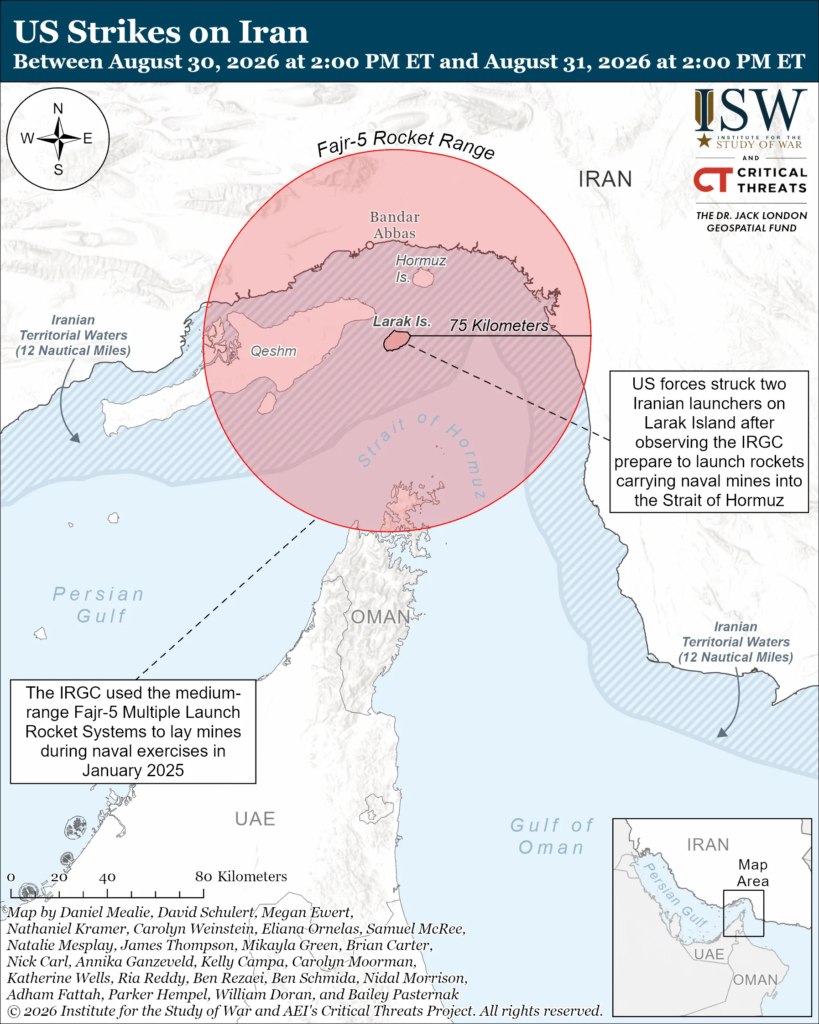
On the evening of 30 August, US forces conducted precision strikes against two IRGC missile launchers on Larak Island, a strategically positioned outpost in the Strait of Hormuz. The island sits at the mouth of the Persian Gulf, controlling access to the world’s most critical oil chokepoint. According to US Central Command, Iranian forces were observed preparing to emplace sea mines in the strait — a tactic Iran has employed repeatedly since February to disrupt commercial traffic and exert leverage over global energy markets.
The strike was tactically successful: both launchers were destroyed, and the mine-laying operation was disrupted. However, the operation produced casualties among both IRGC personnel and civilians on the island — a fact Tehran quickly seized upon for propaganda and legal purposes.
Why It Escalated
The Larak strike crossed an implicit threshold that had governed the conflict since June. Following the collapse of the Islamabad ceasefire, US operations had generally targeted remote military installations, nuclear facilities, and IRGC bases with limited civilian presence. Larak was different: it was a populated island, the strike produced civilian casualties, and it occurred at a moment when Iran’s leadership was under intense domestic pressure to demonstrate resolve.
Moreover, the timing was politically explosive in Tehran. The Iranian regime had spent August framing the conflict as one of national survival against American economic warfare and military encirclement. The bounty on US soldiers, the Hormuz blacklists, and the increasingly belligerent rhetoric from the IRGC all signaled a leadership that could not afford to absorb another humiliating strike without responding. Larak provided the pretext — and the domestic political necessity — for a direct retaliation against US forces.
IV. The Overnight Retaliation: Iran’s Ballistic Missile Gambit
The Attacks
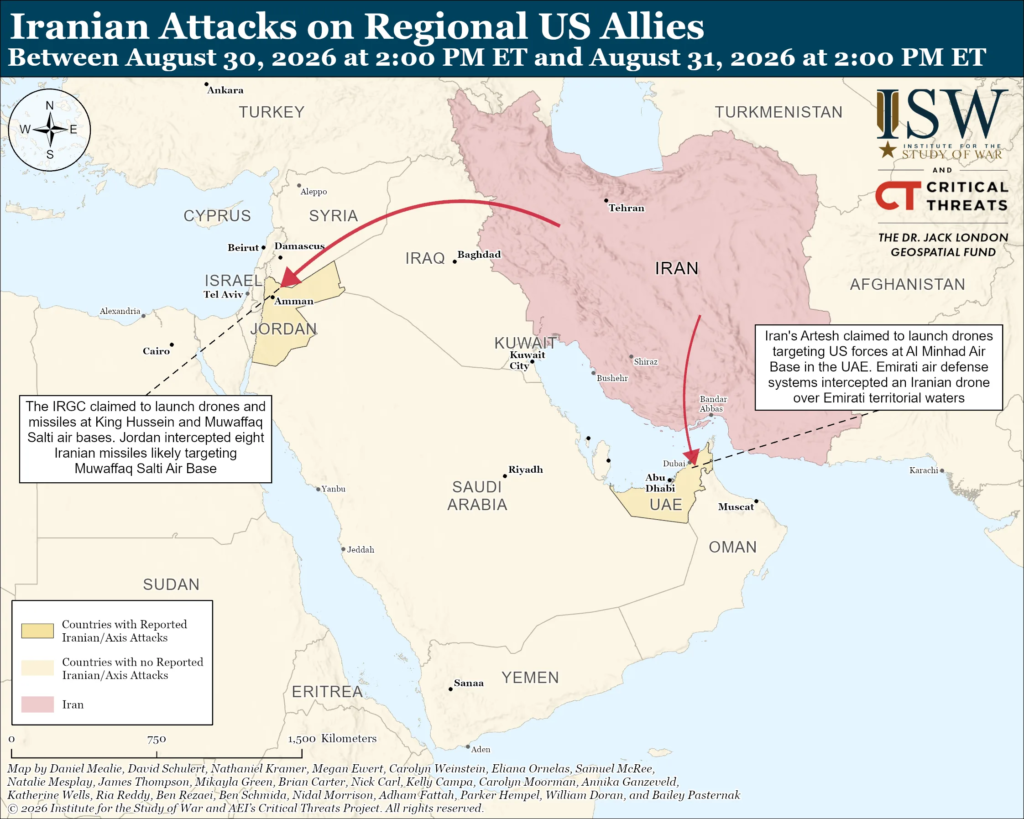
In the early hours of 31 August, the IRGC launched ballistic missiles at two US air bases in Jordan:
- King Hussein Air Base (also known as Al H-4 or Ruwayshid Air Base), located in eastern Jordan near the Iraqi border.
- Al Azraq Air Base (Muwaffaq Salti Air Base), a major Royal Jordanian Air Force facility that also hosts US and coalition forces.
Simultaneously, Iran claimed to have targeted Al Minhad Air Base in the United Arab Emirates with dozens of drones, striking locations where US forces and helicopters were stationed. The UAE separately confirmed intercepting a drone originating from Iranian airspace over its territorial waters.
Why This Is Unprecedented
Since the war began on 27 February 2026, Iran had never directly attacked fixed US military installations with ballistic missiles. Its previous responses had been asymmetric and indirect: mine-laying, vessel attacks, cyber operations, and proxy actions through allied militias. The 31 August strikes represent a fundamental shift in Iran’s risk calculus.
Several factors likely drove this decision:
- Domestic Legitimacy: The Iranian regime needed to demonstrate that it could strike back directly at the “Great Satan” rather than merely harassing commercial shipping. Ballistic missiles are a symbol of national technological prowess and military independence — precisely the narrative the regime needs to sell to a war-weary population.
- Deterrence Signaling: By demonstrating the capability and willingness to hit US bases, Iran is attempting to raise the cost of future US strikes. The message is clear: if you hit us on our soil, we will hit you on yours — even if “yours” means facilities in allied countries.
- Exploiting Jordanian Geography: Jordan is a vulnerable target. It hosts significant US military infrastructure but lacks the layered air defense of the GCC monarchies. The choice of Jordanian bases rather than facilities in Saudi Arabia, Qatar, or Bahrain may reflect a calculated effort to test US resolve without immediately triggering a massive Gulf-wide defensive response.
- The UAE Drones: The claimed drone strike on Al Minhad and the confirmed drone interception over UAE waters serve a dual purpose: they pressure the UAE for its 18 August trade cutoff and its increasingly close security cooperation with the US, while also testing Emirati air defenses.
V. Regional Impact: The Gulf Monarchies Face a Reckoning
The overnight escalation has plunged the Gulf Cooperation Council (GCC) states into their most precarious security environment since the 1990–91 Gulf War. Each monarchy now faces a distinct set of challenges:
United Arab Emirates
The UAE is arguably the most exposed. The drone interception on 31 August confirms that Iranian aerial assets are now penetrating Emirati airspace — a development that will trigger massive air defense alerts across Abu Dhabi and Dubai. The Emirates had already severed trade with Iran on 18 August; now it faces the prospect of direct military retaliation for that decision.
The UAE’s strategic dilemma is acute. It has built its foreign policy on economic openness and strategic hedging — maintaining functional relations with all major powers while hosting US military facilities. That hedge is now collapsing. If Iran continues targeting Al Minhad or other UAE-based US assets, Abu Dhabi may face domestic pressure to reduce the American military footprint, even as it desperately needs US protection.
Saudi Arabia
Riyadh has maintained a cautious distance from the kinetic phase of the war, focusing instead on economic diversification and regional diplomacy. However, the Larak strike and Jordan retaliation have shattered the illusion that Saudi Arabia can remain on the sidelines. Iranian missiles or drones could easily target US facilities at Prince Sultan Air Base or other installations in the Kingdom.
The Saudi leadership must now calculate whether its recent rapprochement with Iran — painstakingly built through Chinese mediation in 2023–2024 — can survive a direct US-Iran shooting war on its doorstep. If Iran expands its targeting to Saudi-based US assets, Riyadh may be forced into an explicit alignment with Washington that it has sought to avoid.
Qatar
Qatar hosts the largest US military installation in the Middle East — Al Udeid Air Base, the forward headquarters of US Central Command. Any Iranian strike on Al Udeid would be an order of magnitude more significant than the Jordan attacks and would almost certainly trigger a massive US retaliation. Doha is likely engaged in frantic back-channel diplomacy to prevent such an outcome, but its leverage over Tehran is limited.
Oman
Oman has played the role of neutral intermediary throughout the conflict, and on 26 August, the IRGC claimed that Oman and Iran had reached agreements on Hormuz control and revenue-sharing. However, Oman’s neutrality is becoming untenable. If the war expands, Muscat will face intense pressure from both Washington and its GCC allies to abandon its traditional hedging strategy.
Kuwait and Bahrain
Both host significant US naval and air assets. Bahrain, as the headquarters of the US Fifth Fleet, is a particularly high-value target. Kuwait’s Ali Al Salem Air Base and Ahmad al-Jaber Air Base are critical to US air operations over Iraq and Iran. Any expansion of Iranian targeting to these facilities would represent a full-scale regionalization of the conflict.
The Jordanian Crisis
Jordan is the immediate crisis point. As a non-GCC state with a fragile economy and a large Palestinian refugee population, Jordan lacks the financial reserves and military depth of the Gulf monarchies. The missile strikes on King Hussein and Al Azraq bases have demonstrated that Jordanian territory is not a sanctuary from the US-Iran war.
King Abdullah II faces an existential political challenge. Jordan’s population is deeply hostile to any perception that the Kingdom is serving as a platform for American military operations against a Muslim country. The IRGC strikes, whether they caused significant damage or not, have shattered the illusion of Jordanian insulation. If the US uses Jordanian bases to launch retaliatory strikes against Iran, Amman may face internal unrest and demands to expel US forces — a move that would cripple US operational flexibility in the northern theater.
VI. Global Impact: Energy, Markets, and Great Powers
The Oil Shock
The most immediate global consequence of the 30–31 August escalation was the surge in oil prices. Brent crude rose above $90 per barrel on 31 August, a 2% spike driven by fears that the Strait of Hormuz could face a comprehensive closure.
The Strait of Hormuz handles approximately 21% of global petroleum consumption and one-third of the world’s liquefied natural gas (LNG) trade. Even a partial disruption — whether through Iranian mine-laying, US naval interdiction, or mutual attacks on tankers — would send energy markets into turmoil.
If Iran follows through on its repeated threats to close Hormuz entirely, or if the US and Iran engage in sustained naval combat in the strait, oil prices could spike to $120–150 per barrel within days. Such a shock would:
- Europe: Reignite inflationary pressures just as the Eurozone was stabilizing after years of post-pandemic recovery. Germany’s industrial sector, heavily dependent on imported energy, would face renewed cost pressures.
- Asia: China, Japan, South Korea, and India — all major Hormuz-dependent importers — would face severe balance-of-payments pressures. China’s strategic petroleum reserve would be tapped, but it is not sufficient to offset a prolonged closure.
- United States: While the US is now a net energy exporter, domestic gasoline prices are politically sensitive. A sustained spike above $100/barrel would hit American consumers weeks before the November midterm elections — precisely the political timing Secretary Rubio had sought to avoid.
The Dollar and Sanctions
Trump’s “economic d-day” declaration of 20 August — threatening sanctions against any nation trading with Iran — has already begun to fracture the global trading system. Countries like China, India, and Turkey, which maintain significant energy and commercial ties with Iran, are now caught between US pressure and their own economic interests.
The 31 August escalation strengthens the hand of those in Washington who argue for maximum economic pressure. However, it also risks accelerating the trend toward de-dollarization and the creation of alternative payment mechanisms outside US financial control. If major economies conclude that US sanctions policy is inseparable from active military conflict, the long-term damage to the dollar’s role as the global reserve currency could be substantial.
Russia and China
Moscow and Beijing have both condemned the US strikes while maintaining formal neutrality. However, the escalation serves their strategic interests in important ways:
- Russia: A prolonged US-Iran war diverts American military and diplomatic attention from Ukraine and the European theater. Higher oil prices also benefit Russian export revenues, partially offsetting the impact of Western sanctions.
- China: Beijing is Iran’s largest trading partner and the primary buyer of sanctioned Iranian oil. A closed Hormuz would devastate Chinese energy imports, but it would also create leverage for Beijing to demand US restraint in exchange for cooperation on other issues. China has positioned itself as a potential mediator — a role it played successfully in the Saudi-Iran rapprochement — and may seek to exploit the crisis to expand its diplomatic influence in the Gulf.
India and Pakistan
Both South Asian powers are heavily dependent on Hormuz energy flows. Pakistan, which brokered the failed June ceasefire, may attempt to reinsert itself as a mediator. India, which has maintained careful neutrality while deepening defense ties with the US, faces a difficult choice: continue buying discounted Iranian oil through back channels (and risk US sanctions), or align fully with Washington and accept higher energy costs.
VII. Military Assessment: Capabilities and Vulnerabilities
US Position
The US maintains overwhelming conventional superiority in the Gulf. The USS George Washington carrier strike group, supplemented by land-based airpower from Qatar, Kuwait, Bahrain, and the UAE, can deliver precision strikes across Iran with relative impunity. US missile defense systems — Patriot batteries and Aegis-equipped destroyers — provide layered protection for key bases.
However, the 31 August attacks exposed vulnerabilities:
- Fixed bases are targets: The era of assuming that US bases in friendly countries are sanctuaries is over. Iran’s ballistic missile arsenal — estimated at thousands of missiles with ranges up to 2,000 km — can reach any US installation in the region.
- Overextension: The US is simultaneously managing operations in the Gulf, supporting Ukraine, and maintaining commitments in the Indo-Pacific. The pivot of the USS George Washington from the Pacific to the Gulf has left a carrier gap in Asia at a moment of heightened US-China tensions over Taiwan.
- Mine warfare: Iran’s mine-laying capacity remains potent. The US Navy has cleared over 100 mines in recent weeks, but the Strait of Hormuz is narrow enough that even a handful of undetected mines can halt commercial traffic.
Iranian Position
Iran’s military has been battered by six months of US-Israeli strikes. Its air defenses have been degraded, its nuclear facilities damaged, and its conventional forces attrited. However, Iran retains significant asymmetric capabilities:
- Ballistic missiles: The 31 August strikes demonstrated that Iran can still launch coordinated missile attacks despite US suppression efforts.
- Naval asymmetry: IRGC fast-attack craft, submarines, and mine-laying vessels can harass US naval forces and commercial shipping in the confined waters of the Gulf.
- Proxy networks: Iranian-backed militias in Iraq, Syria, Lebanon, and Yemen remain active and could be activated for a wider regional campaign.
Iran’s strategic vulnerability is economic. The US blockade and sanctions have crippled Iranian oil exports, devastated its currency, and created severe shortages of food and medicine. The regime’s willingness to escalate despite these pressures suggests either desperation or confidence that it can outlast American political will.
VIII. Future Prospects: Three Scenarios
Scenario A: Controlled De-escalation (Probability: 25%)
In this scenario, both Washington and Tehran recognize that further escalation serves neither side’s interests. The US refrains from retaliating for the Jordan strikes beyond limited, symbolic strikes on remote Iranian military targets. Iran, having demonstrated its capacity to hit US bases, declares “satisfaction” and returns to asymmetric harassment of shipping rather than direct attacks on American installations.
Requirements: Back-channel diplomacy through Oman, Qatar, or Pakistan; a US commitment to ease some sanctions in exchange for Iranian restraint in Hormuz; and Gulf state pressure on both sides to avoid a wider war.
Obstacles: Trump’s inflammatory rhetoric and AI-generated Kharg Island post suggest he is not in a conciliatory mood. Iran’s hardliners, emboldened by the Jordan strikes, may push for further action.
Scenario B: Sustained Limited War (Probability: 50%)
This is the most likely trajectory. The US responds to the Jordan strikes with intensified air and naval operations against Iranian military targets — particularly missile sites, radar installations, and IRGC bases. Iran continues periodic missile and drone attacks on US bases in Jordan, Iraq, and possibly the Gulf states, while maintaining pressure on Hormuz shipping.
Characteristics:
- Oil prices fluctuate between $90–$120/barrel
- The Strait of Hormuz remains partially open but with significantly reduced traffic
- GCC states adopt defensive postures, increasing air defense cooperation with the US
- No major ground invasion, but sustained aerial and naval combat
Risks: The “limited” nature of this war is inherently unstable. Any major Iranian strike causing significant US casualties, or any US strike producing mass Iranian civilian casualties, could push the conflict toward Scenario C.
Scenario C: Regional Conflagration (Probability: 25%)
In this worst-case scenario, the US launches a massive retaliatory campaign against Iranian military, economic, and leadership targets following the Jordan strikes. Iran responds by:
- Closing the Strait of Hormuz through comprehensive mine-laying and missile attacks on shipping
- Activating proxy militias in Iraq, Syria, Lebanon, and Yemen to attack US and Israeli targets
- Striking Saudi oil facilities (as it did with Abqaiq in 2019, but with greater intensity)
- Potentially targeting Israeli cities with long-range missiles
Global Consequences:
- Oil prices exceed $150/barrel
- Global recession becomes probable
- Massive refugee flows from Iran, Iraq, and potentially the Gulf states
- Direct Israeli involvement, raising the risk of nuclear escalation if Iran’s nuclear facilities are targeted
- Chinese and Russian intervention — diplomatically, economically, and potentially militarily — to protect their interests
Trigger Points:
- US casualties at Jordanian bases exceeding single digits
- Iranian missile strikes on Saudi or UAE oil infrastructure
- An Israeli strike on Iranian nuclear facilities
- A major tanker disaster in Hormuz (e.g., a burning supertanker blocking the strait)
IX. The Gulf’s Existential Dilemma
The 30–31 August escalation has exposed a fundamental strategic reality that the Gulf monarchies have spent two decades trying to avoid: it is impossible to simultaneously host US military forces and maintain workable relations with Iran during an active US-Iran war.
The UAE’s experience is illustrative. Its decision to cut trade with Iran on 18 August was likely intended to demonstrate loyalty to Washington and distance itself from Tehran. Instead, it made the Emirates a target. The drone interception on 31 August is only the beginning; if the war continues, Al Minhad, Jebel Ali, and even downtown Dubai could find themselves in Iran’s crosshairs.
Saudi Arabia faces a similar calculus. The Vision 2030 economic transformation depends on stability, foreign investment, and predictable oil revenues. A regional war threatens all three. Yet Riyadh cannot abandon its security relationship with Washington without leaving itself defenseless against Iranian aggression.
The smaller Gulf states — Qatar, Kuwait, Bahrain — are even more vulnerable. None can survive a sustained conflict without US protection, yet all suffer from the instability that US military operations in their territory produce.
The Gulf’s strategic nightmare is this: The US and Iran are fighting a war in which the Gulf states are the prize, the battlefield, and the collateral damage — but neither Washington nor Tehran is primarily accountable to them.
X. Conclusion: A War Without Exit
The US-Iran war of 2026 has now entered a phase that neither side anticipated when Operation Epic Fury was launched in February. What was conceived as a limited aerial campaign to degrade Iran’s nuclear program and military capabilities has evolved into a direct, state-on-state conflict with no clear military or political endpoint.
The Larak Island strike and the Jordan base retaliation have destroyed the remaining illusions of restraint. Iran has demonstrated that it can and will strike American forces directly. The US has demonstrated that it will not tolerate Iranian control of Hormuz, regardless of the civilian cost. The Gulf states have demonstrated that neutrality is not an option.
In the coming days, the critical decisions will be made in Washington and Tehran. Will Trump authorize a major retaliatory strike that risks a wider war weeks before midterm elections? Will Iran’s leadership, having tasted the propaganda victory of hitting US bases, push for further escalation to rally a restive population? Will the Gulf monarchies collectively demand a ceasefire, and if so, will either superpower listen?
The Strait of Hormuz remains open — for now. But the margin for error has vanished. The next missile, the next mine, the next drone could be the spark that turns a regional war into a global crisis.
The world is watching. The Gulf is holding its breath. And the missiles are already in the air.