(Quratulain Khalid)
The Dichotomy of August 15
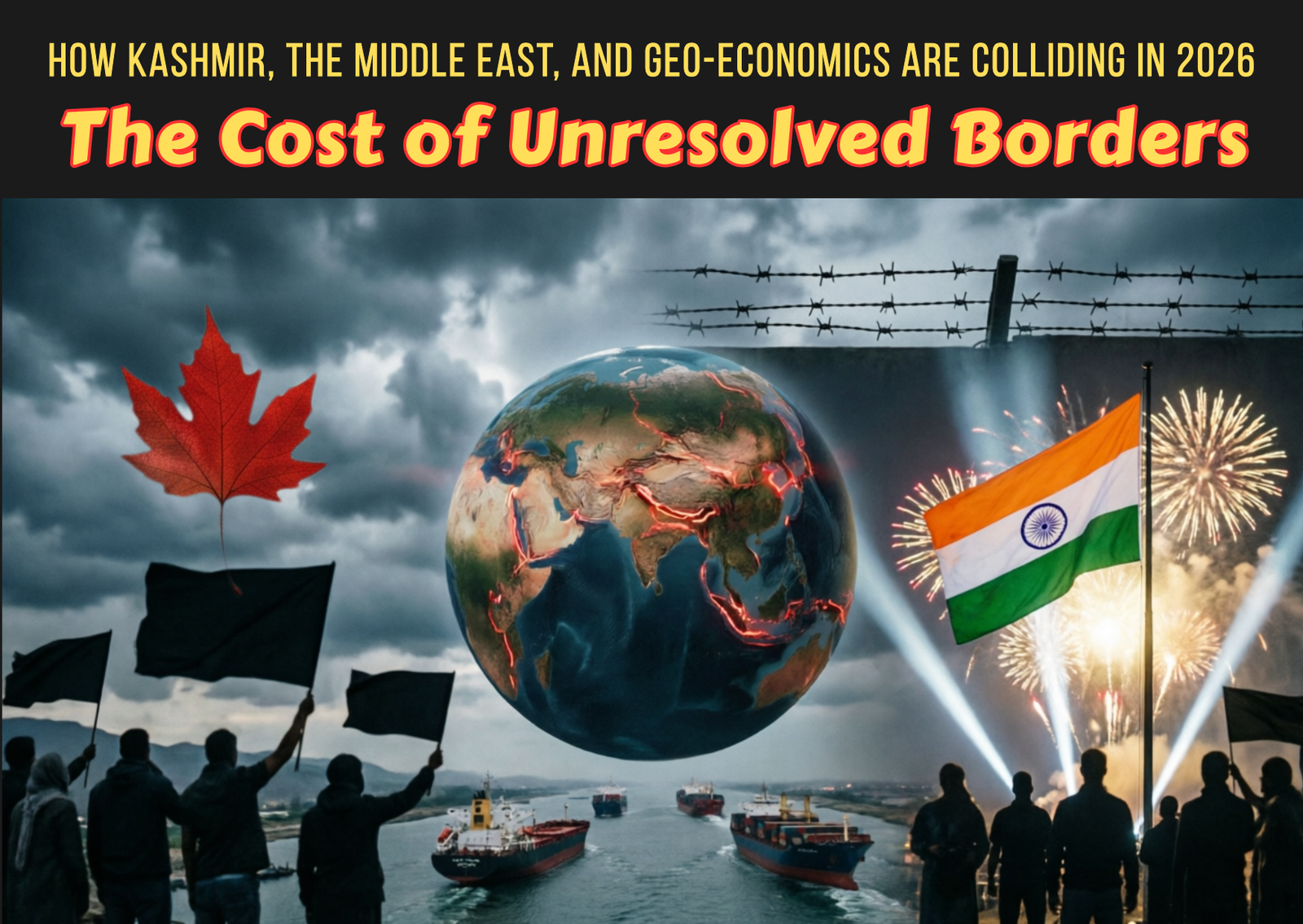
Today, as India marks its 79th Independence Day with elaborate military parades, flag-hoisting ceremonies, and sweeping declarations of its rise as a global power, a radically different narrative unfolds just a few hundred kilometers away in the disputed territory of Jammu and Kashmir. There, August 15 is not a day of celebration. It is observed as a “Black Day“—a day of strikes, black flags, and defiance against what Kashmiri leaders describe as the illegal and forcible occupation of their homeland.
This stark dichotomy—one nation’s triumph, another people’s mourning—is not an anomaly confined to South Asia. Across the globe in August 2026, unresolved borders, contested sovereignties, and frozen conflicts are erupting with renewed ferocity. From the Strait of Hormuz, where the United States has vowed to impose territorial control over one of the world’s most critical energy chokepoints, to the scorched plains of Sudan and the contested corridors of East Africa, the international system is buckling under the weight of its unfinished 20th-century business.
The question confronting policymakers, strategists, and economists in 2026 is no longer whether these unresolved conflicts matter. The question is how long the global economy can absorb their escalating costs.
The South Asian Flashpoint: Kashmir’s Black Day in a Multipolar World
Every year on August 15, the Kashmir Valley and Azad Jammu and Kashmir go dark. Shops shutter. Streets fill with protesters hoisting black flags. Social media erupts with hashtags demanding self-determination. And security forces lock down the region to prevent any organized demonstration.
The reasons remain unchanged since 1947. Kashmiris reject the partition outcome that placed the Muslim-majority state in a contested limbo. They point to UN Security Council resolutions that promised a plebiscite—a promise never fulfilled. For the Kashmiri political and resistance leadership, observing August 15 as a Black Day is a deliberate act of geopolitical signaling: a reminder to the international community that New Delhi’s claim over the territory is contested, incomplete, and maintained through force.
Yet in 2026, the Kashmir question cannot be understood in isolation. It sits at the intersection of the world’s most consequential strategic rivalry. India’s western border with Pakistan remains militarized, while its northern frontier with China—particularly in Aksai Chin and along the Line of Actual Control—remains a live flashpoint. The China-Pakistan Economic Corridor (CPEC), a flagship project of Beijing’s Belt and Road Initiative, cuts directly through Pakistani-administered Kashmir, making the territory an indispensable node in China’s geo-economic architecture.
For India, Kashmir represents a sovereignty imperative. For Pakistan, it remains an unfinished agenda of Partition. For China, it is a strategic corridor. And for the eight million people caught in the crossfire, it is a daily reality of curfews, surveillance, and the denial of political agency.
The geo-strategic cost is immense. India diverts significant military and intelligence resources to maintain internal security in the Valley, resources that could otherwise be deployed to counter China’s maritime expansion in the Indian Ocean. Pakistan’s foreign policy remains largely oriented around the Kashmir issue, limiting its diplomatic bandwidth in a rapidly realigning world. And the broader South Asian region—home to nearly two billion people—remains the least economically integrated bloc on the planet, with intra-regional trade stagnating below five percent of total commerce.
The Middle East Cauldron: Hormuz, Gaza, and the Weaponization of Geography
If Kashmir represents the cost of an unresolved border in South Asia, the Middle East in August 2026 represents the cost of an entire region in perpetual conflict.
Today, the world watches as tensions between the United States and Iran reach a boiling point over the Strait of Hormuz. With President Donald Trump publicly vowing to make the strait “US territory pretty soon,” the language of diplomacy has been replaced by the vocabulary of annexation. The Strait of Hormuz, through which approximately twenty percent of the world’s oil supply transits daily, has become the single most dangerous flashpoint on the planet. Any miscalculation here would not merely be a regional crisis—it would be an immediate global economic shock.
Simultaneously, Israeli forces continue operations in the occupied Palestinian territories, with reports of tear gas deployments near Ramallah and settler expansions deepening the fragmentation of Palestinian land. The 2026 Middle East conflict has also cast a long shadow over the upcoming FIFA World Cup, forcing the international community to confront the uncomfortable intersection of global sports diplomacy and unresolved territorial occupation.
In Sudan, the civil war has intensified dramatically. Reports of border camps being attacked and Tigrayans fleeing fighting with Ethiopian forces underscore a broader pattern: the Horn of Africa and the Sahel are becoming interconnected theaters of instability, where state collapse, ethnic conflict, and great-power competition converge.
What connects Kashmir, Palestine, and Sudan is not merely the presence of violence. It is the fundamental failure of the international system to enforce its own resolutions. In each case, UN mandates, plebiscite promises, and ceasefire agreements have been rendered meaningless by the absence of political will among the permanent members of the Security Council.
Geo-Economics: The Price of Fragmentation
The World Economic Forum’s annual report for 2026 identified geoeconomic confrontation as the top global risk. This is not a theoretical warning. It is a present reality.
Geopolitical fragmentation is accelerating. U.S.-China technology competition has evolved from tariffs into full-spectrum decoupling—semiconductor export controls, rare-earth mineral stockpiling, and the bifurcation of artificial intelligence ecosystems into competing Western and Chinese spheres. Western multinational enterprises, caught in the crossfire, are undertaking costly divestment strategies from Russia and reassessing their exposure to contested markets from South Asia to the Middle East.
The energy markets feel the pressure most acutely. With oil prices spiking in response to the Hormuz standoff and the broader Middle East conflict, the knock-on effects are devastating labor markets in the West. US employment figures have declined as energy costs squeeze corporate margins. The geopolitical premium on oil is no longer a temporary risk factor—it is a structural feature of the 2026 global economy.
For nations like India and Pakistan, these dynamics present both peril and opportunity. India positions itself as an alternative manufacturing hub to China, courting Western capital while simultaneously managing its border disputes. Pakistan, anchored to CPEC and its relationship with Beijing, navigates the increasingly complex U.S.-China rivalry while its economy struggles under the weight of debt and inflation.
The upcoming G20 finance ministers’ meeting in Bangkok, scheduled alongside the IMF and World Bank Annual Meetings later this month, will be forced to confront these intersections. How does the global financial architecture function when its major stakeholders are locked in geoeconomic confrontation? How do developing nations secure investment when the corridors of trade pass through active conflict zones?
These are the questions that will define the remainder of 2026.
Conclusion: The Enduring Cost of Frozen Conflicts
The lesson of August 15, 2026, is stark and unambiguous. In an era of artificial intelligence, quantum computing, and interplanetary ambition, the fundamental grammar of international relations remains the grammar of territory. Borders drawn by colonial administrators in 1947, ceasefire lines frozen in 1949, and occupation boundaries hardened over decades continue to dictate the security calculations of nuclear-armed states and the daily lives of hundreds of millions of people.
The Kashmiri family observing a Black Day in Srinagar. The Palestinian farmer watching settlers raise a flag on contested land. The Sudanese family fleeing cross-border shelling. The Iranian tanker captain navigating a strait under threat of annexation. These are not isolated stories. They are the human cost of a world that chose to manage conflicts rather than resolve them.
True geo-economic integration—whether in South Asia, the Middle East, or Africa—is impossible atop the fault lines of unresolved sovereignty. Until the international community moves beyond conflict management and toward genuine political resolution, the cost of these unresolved borders will continue to compound. And in a world already fractured by great-power competition, that cost may soon become one that no economy can bear.