(By Quratulain Khalid)
The Warm-Water Obsession
For over a century, the Kremlin has harboured a singular, unyielding geopolitical ambition: to reach the warm waters of the Arabian Sea. It is a dream that has shaped empires, triggered wars, and redrawn the map of Eurasia. In December 1979, that dream drove the Soviet Union to send its 40th Army thundering across the Amu Darya into Afghanistan, a catastrophic gamble that would ultimately bleed the superpower dry and hasten its collapse.
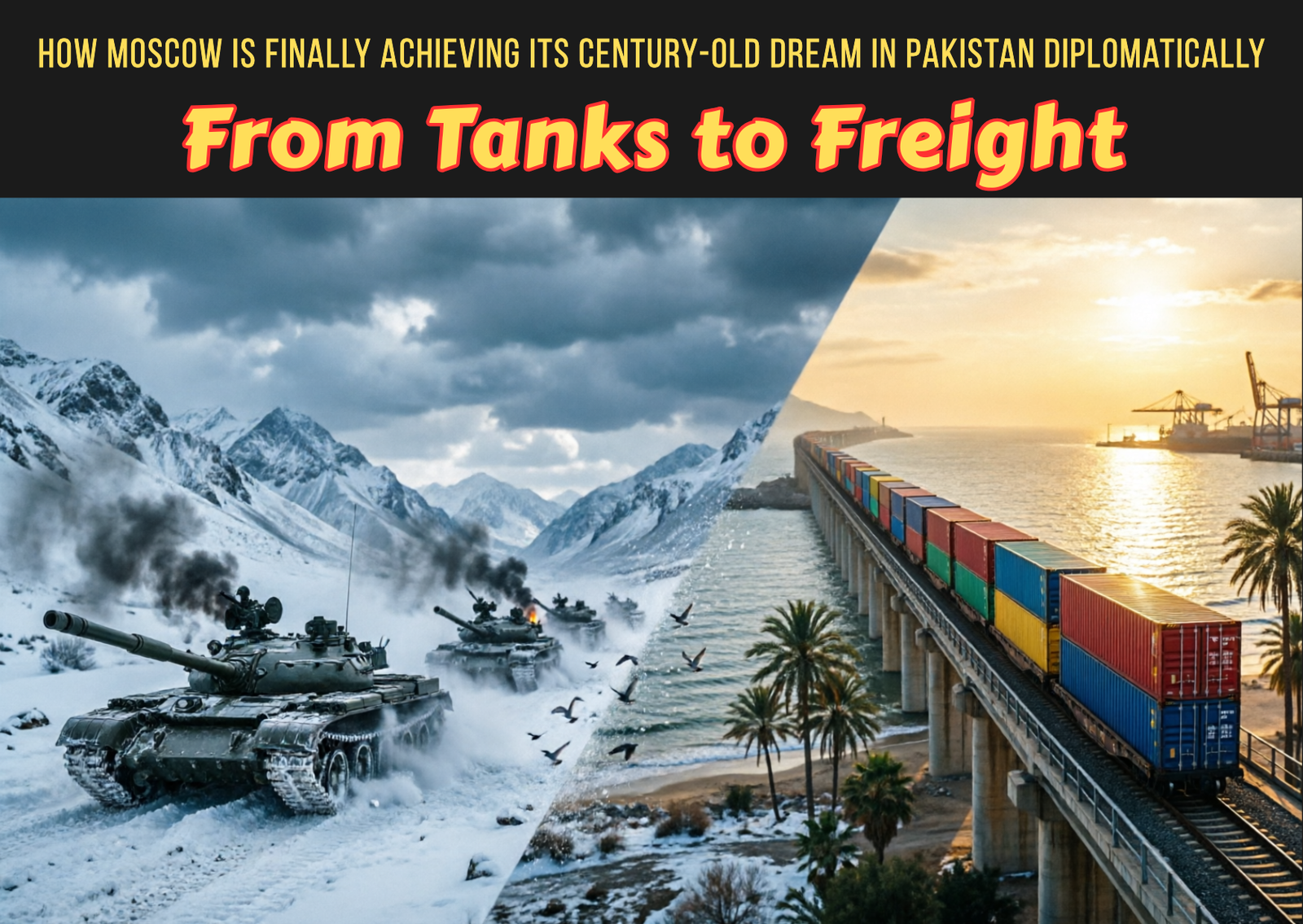
Today, in August 2026, Moscow is pursuing the exact same objective. But the instruments of statecraft have changed. The T-62 tanks and Mi-24 Hind gunships have been replaced by freight wagons, shipping manifests, and bilateral trade agreements. Russia is no longer seeking to conquer its way to Karachi; it is negotiating its way there.
And Pakistan — the very nation that stood as the bulwark against Soviet expansionism four decades ago — has now become Moscow’s willing partner in this new chapter of Eurasian connectivity.
The Historical Wound: How Pakistan Turned the Tables
The Soviet invasion of Afghanistan was never merely about Kabul. It was about the Khyber Pass, the Bolan Pass, and the road to the Arabian Sea. Soviet strategists envisioned a corridor through Afghanistan and Balochistan that would grant the USSR direct access to the Indian Ocean, outflanking NATO’s southern flank and threatening the West’s energy lifelines.
Pakistan saw through the design immediately. Under the resolute leadership of President General Zia-ul-Haq, Islamabad made the fateful decision to resist. Pakistan’s Inter-Services Intelligence (ISI) became the operational backbone of the Afghan resistance, training, arming, and directing the Mujahideen from the tribal belt of Waziristan to the Panjshir Valley.
It was Pakistan that fought first. It was Pakistan that turned the tables. The Mujahideen, and later the broader coalition of the United States, China, and Saudi Arabia, joined the cause — but it was Pakistan’s initial strategic resolve that shattered the myth of Soviet invincibility.
By February 1989, the last Soviet soldier crossed the Friendship Bridge at Termez in retreat. The Soviet Union itself dissolved two years later. The warm-water dream was buried beneath the rubble of empire.
As the late Pakistani strategist Air Marshal (Retd) Nur Khan once observed: “Pakistan did not merely fight a proxy war; it defended the very geography of South Asia against a superpower’s appetite for the sea.”
The New Corridor: Diplomacy Where Artillery Failed
Fast-forward to 2026, and the geopolitical landscape has been fundamentally transformed. Russia, strangled by Western sanctions since 2022 and facing a US-imposed naval blockade in the Strait of Hormuz, is desperately seeking land-based trade arteries that are immune to Anglo-American maritime dominance.
Enter Pakistan.
In recent months, Moscow and Islamabad have moved decisively to establish their first-ever direct freight railway service, linking the Russian capital with Pakistan’s commercial hub and deep-water ports. The Russian Ambassador to Pakistan confirmed publicly that freight trains would operate between Moscow and Karachi, with Faisalabad also designated as a key node in the network. Belarus, Russia’s closest political ally, has expressed interest in joining the corridor.
This is not a speculative pipe dream. Pakistan Railways has confirmed trial operations, and the corridor is being formally integrated into the International North-South Transport Corridor (INSTC) — the 7,200-kilometre multimodal network originally conceived by India, Iran, and Russia in 2000 to connect the Indian Ocean to Northern Europe via Iran and the Caucasus.
The strategic logic is unmistakable. What Moscow failed to achieve with the Red Army in 1979, it is now achieving with the Russian Railways Directorate in 2026. The destination is identical: the warm waters of the Arabian Sea. The method has simply evolved from coercion to commerce.
The Route: Two Paths to the Sea
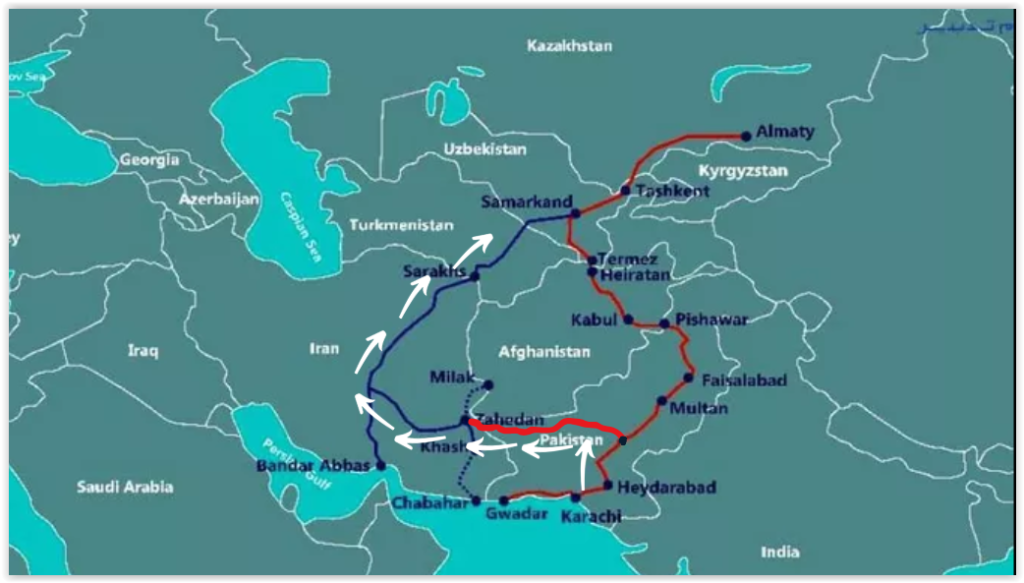
Russia is pursuing two complementary corridors to reach Pakistan, each with distinct advantages and formidable challenges:
| Parameter | Western Route (Via Iran) | Eastern Route (Via Afghanistan) |
|---|---|---|
| Path | Russia → Central Asia → Iran (Zahedan/Mirjaveh) → Pakistan (Taftan → Quetta → Karachi) | Russia → Uzbekistan → Afghanistan → Pakistan |
| Approximate Distance | ~8,000 km | ~4,500 km |
| Estimated Transit Time | ~20 days | ~15 days (projected) |
| Key Infrastructure | Zahedan-Mirjaveh railway (Iran); Quetta-Taftan line (Pakistan) | Trans-Afghan Railway (Uzbekistan–Afghanistan–Pakistan) |
| Status | Partially operational; test runs conducted | Under construction/planning; $7+ billion estimated cost |
| Primary Risk | US sanctions on Iran; gauge breaks | Taliban governance; security; financing |
| Key Stakeholders | Russia, Iran, Pakistan, Turkmenistan | Russia, Uzbekistan, Afghanistan, Pakistan |
Russia’s dual-track strategy ensures redundancy. Should the Iranian corridor be disrupted by military escalation — a realistic prospect given the current US naval blockade of the Strait of Hormuz and the broader Iran-US confrontation — the Trans-Afghan route could absorb the traffic. Conversely, if Afghan instability renders the eastern corridor unreliable, the western route via Iran remains the fallback.
The Technical Reality: Why “Uninterrupted” Remains a Dream
Political communiqués speak of “uninterrupted” and “seamless” connectivity. The engineering reality tells a different story. The Moscow-to-Karachi corridor is plagued by one of the most persistent problems in Eurasian logistics: the gauge break.
| Region | Track Gauge | Implication |
|---|---|---|
| Russia / Central Asia | 1,520 mm (Russian broad gauge) | Incompatible with Iran |
| Iran | 1,435 mm (Standard European gauge) | Incompatible with both Russia and Pakistan |
| Pakistan | 1,676 mm (broad gauge) | Incompatible with Iran |
A freight container travelling from Moscow to Karachi must be physically unloaded and reloaded — or the train’s bogies must be swapped — at every gauge transition point. This process, known as transshipment, adds hours or even days at each border crossing. For a corridor intended to rival maritime shipping in cost-efficiency, these delays are commercially devastating.
As Dr. Jonathan Hillman, a senior fellow at the Center for Strategic and International Studies, has noted: “The gauge problem is the great unspoken tax on Eurasian land trade. Every break of gauge is a point of friction, delay, and potential corruption.”
The proposed solutions — dual-gauge tracks, variable-gauge axle systems, and dedicated transshipment terminals — require billions of dollars in capital expenditure. For a Pakistan already navigating severe fiscal constraints and IMF conditionality, the financing challenge is immense.
Furthermore, critical infrastructure gaps persist. The Quetta-Taftan railway line in Balochistan, which would serve as the primary artery connecting the Iranian border to Karachi, is ageing, single-track, and operating well below capacity. Iran has repeatedly urged Pakistan to complete a standard-gauge link from the Mirjaveh border crossing to Taftan to ensure seamless operations. Until that gap is closed, the corridor remains functionally fractured.
The Security Equation: Corridors Through Conflict Zones
No analysis of this corridor would be complete without confronting the security landscape through which it must pass.
Balochistan: The western route terminates in Karachi and Gwadar, traversing the entirety of Balochistan — a province where separatist insurgencies have persisted for decades. Groups such as the Balochistan Liberation Army (BLA) have repeatedly targeted infrastructure projects, railways, and foreign nationals. Securing hundreds of kilometres of exposed rail line against sabotage will require a substantial and sustained military commitment from the Pakistani state.
Afghanistan: The eastern route transits Taliban-controlled Afghanistan, where the absence of functioning state institutions, international recognition, and a formal legal framework for commercial transit makes insurance and liability virtually impossible. The Trans-Afghan Railway remains, at present, more aspiration than reality.
Iran: With the United States maintaining a naval blockade and the broader Iran-US confrontation showing no signs of de-escalation, any corridor transiting Iranian territory carries inherent military risk. A single escalation in the Persian Gulf could sever the western route overnight.
India-Pakistan Rivalry: Any trade corridor terminating in Pakistan is, by definition, vulnerable to the perennial tensions between New Delhi and Islamabad. A single military escalation along the Line of Control could freeze commercial operations indefinitely.
The Geopolitical Triangle: India’s Dilemma
Perhaps the most consequential dimension of this development is its impact on the India-Russia-Pakistan strategic triangle.
India has invested heavily in Iran’s Chabahar Port precisely to create an alternative route to Russia and Central Asia that bypasses Pakistan entirely. The Chabahar route, linked to the INSTC, was designed to give New Delhi privileged access to Russian energy and Central Asian markets without dependence on Islamabad’s goodwill.
Moscow’s simultaneous courtship of Pakistan fundamentally complicates India’s strategic calculus. Russia is no longer content to rely on a single southern gateway. By developing Karachi and Gwadar as parallel nodes, Moscow is hedging its bets, ensuring that no single partner — India included — holds a monopoly over its access to the Indian Ocean.
For Pakistan, the opportunity is transformative. Islamabad gains transit revenue, infrastructure modernisation, deeper integration into Eurasian trade networks, and — perhaps most critically — a strategic counterweight to India’s regional dominance. The Russia-Pakistan rail link, if realised, would mark Pakistan’s definitive emergence as a Eurasian transit state rather than a mere South Asian periphery.
The Geo-Economic Stakes
The commercial potential of the corridor is substantial. Russian exports to South and Southeast Asia — crude oil, natural gas, wheat, timber, fertilisers, and metals — currently rely on lengthy and vulnerable maritime routes. A functioning rail corridor would slash transit times from over 40 days by sea to approximately 20 days by rail, while offering a sanctions-resistant alternative.
For Pakistan, the benefits extend beyond transit fees. The corridor would anchor Pakistan within a broader Eurasian economic architecture, linking it to the China-Pakistan Economic Corridor (CPEC), the INSTC, and the Belt and Road Initiative simultaneously. Islamabad would become a nexus where Chinese, Russian, Iranian, and Central Asian trade flows converge.
For the landlocked Central Asian Republics — Kazakhstan, Uzbekistan, Turkmenistan, Kyrgyzstan, and Tajikistan — the corridor represents something historically unprecedented: direct access to warm-water ports and, through them, to global markets.
Conclusion: The Dream Realised, the Road Ahead
In 1979, Moscow sent armoured divisions through the Hindu Kush to seize what it believed was its geopolitical destiny. Pakistan stood firm. The Soviet Union bled, retreated, and ultimately ceased to exist.
In 2026, Moscow is sending trade delegations, railway engineers, and freight manifests through the same geography. And Pakistan is opening its doors.
The Moscow-Karachi freight train is not yet a commercial reality. The gauge breaks are unresolved. The infrastructure is incomplete. The security environment remains perilous. The financing is uncertain. Western sanctions cast a long shadow over every transaction.
But the direction of travel is unmistakable. The century-old dream of the Kremlin — warm-water access to the Arabian Sea — is no longer a military objective pursued through invasion. It is a commercial objective pursued through negotiation. And Pakistan, which once stood as the barrier to that dream, has become its gateway.
As the Russian Foreign Ministry stated in a recent briefing: “The era of confrontation has given way to the era of connectivity. Russia seeks partners, not adversaries, on the road to the Indian Ocean.”
Whether that road will be truly “uninterrupted” remains to be seen. But one thing is certain: the tanks have been replaced by freight wagons, and the battlefield has become the marketplace. The Great Game continues — but the rules have changed.