(By Khalid Masood)
Introduction: From Estrangement to Entente
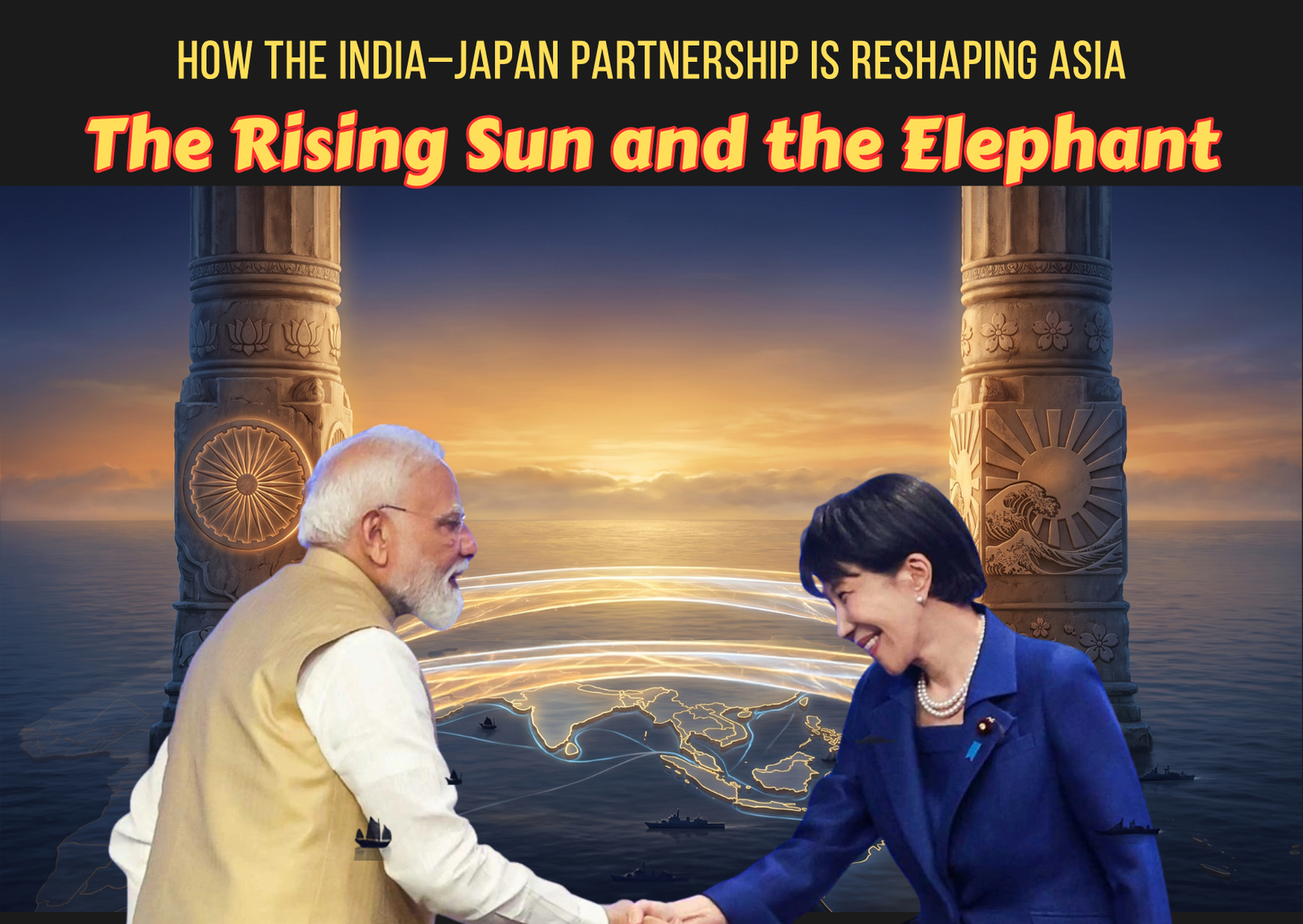
In the shifting architecture of twenty-first-century geopolitics, few bilateral relationships have undergone a more consequential transformation than that between India and Japan. For much of the post-war era, the two nations remained polite but distant—separated by geography, divergent strategic cultures, and India’s steadfast non-alignment. Today, however, New Delhi and Tokyo have constructed what they term a “Special Strategic and Global Partnership,” an arrangement that has evolved from diplomatic aspiration into a structural pillar of the regional order. Anchored in the “Free and Open Indo-Pacific” (FOIP) vision, this axis is no longer a matter of ceremonial goodwill; it is a deliberate recalibration of power in a continent where the contours of hegemony are being actively contested.
The velocity of this transformation has been striking. In August 2025, Prime Minister Narendra Modi travelled to Tokyo to unveil the India–Japan Joint Vision for the Next Decade with then-Prime Minister Shigeru Ishiba, laying down a ten-year strategic roadmap. Six months later, in January 2026, Japan’s Foreign Minister Toshimitsu Motegi arrived in New Delhi for wide-ranging consultations. And on 1–3 July 2026, Prime Minister Sanae Takaichi undertook her first official visit to India for the Sixteenth Annual Summit—a visit that produced $12.5 billion in fresh investment pledges, 129 memoranda of understanding, and a raft of defence and technology agreements that signal a partnership moving from promise to practice.
For policymakers in Beijing, Islamabad, and across Southeast Asia, the deepening India–Japan entente is not an abstract development. It is a tangible shift in the distribution of economic weight, military capability, and diplomatic influence—one that demands rigorous, unsentimental analysis.
The Architecture of Convergence
The partnership rests upon three mutually reinforcing pillars, each of which would be formidable in isolation but acquires strategic density only in combination.
Geopolitical Balancing
Both India and Japan share an abiding interest in preventing the emergence of a unipolar Asia dominated by a single continental hegemon. Their conception of regional order is not one of containment in the Cold War sense, but of competitive equilibrium—a multipolar system in which power is sufficiently dispersed to ensure that no single actor can unilaterally dictate the rules of maritime commerce, territorial sovereignty, or technological standards. This is not alliance politics in the Atlantic mould; it is a pragmatic alignment of sovereign interests.
Economic De-risking
Tokyo’s pioneering embrace of the “China Plus One” strategy has positioned India as the principal beneficiary of Japanese industrial diversification. With a domestic market of 1.4 billion consumers, a burgeoning digital economy, and a manufacturing base gradually ascending the value chain, India offers Japanese capital what China once did: scale, growth, and strategic depth. Initiatives such as the Asia–Africa Growth Corridor (AAGC) illustrate the ambition of this synergy—not merely bilateral trade, but the joint construction of alternative economic arteries across the developing world.
The July 2026 summit gave concrete form to this ambition. Japanese industry committed approximately $12.5 billion in new investments and signed 129 MoUs at the India–Japan Joint Economic Forum. The two leaders also unveiled a Joint Roadmap for Economic Security, institutionalising cooperation in semiconductors, critical minerals, quantum computing, and artificial intelligence. Prime Minister Modi announced a dedicated “Japan Business Week” to be hosted by his own office, underscoring the premium New Delhi places on removing friction for Japanese investors. The message was unambiguous: India is not merely an alternative to China; it is becoming the preferred destination for Japanese capital in the Indo-Pacific.
The Trade Ledger: Volume, Deficit, and Trajectory
The economic narrative is best read in the numbers. Bilateral trade has expanded robustly—from roughly $14 billion in 2020 to $27.47 billion in FY 2025–26, an 81% surge in six years. Yet the ledger reveals a structural asymmetry:
| Metric | FY 2024–25 (Actual) | FY 2025–26 (Actual) | FY 2026–27 (Projected)* |
|---|---|---|---|
| Total Bilateral Trade | $25.15 billion | $27.47 billion | ~$30.0 billion |
| Indian Exports to Japan | $6.25 billion | $6.04 billion | ~$6.6 billion |
| Indian Imports from Japan | $18.90 billion | $21.43 billion | ~$23.4 billion |
| Trade Balance | −$12.65 billion | −$15.39 billion | −$16.8 billion (est.) |
| Year-on-Year Growth | +10.1% | +9.2% | ~+9.0% |
*Projection based on the 9.2% compound growth rate observed between FY 2024–25 and FY 2025–26.
The widening deficit is not a diplomatic failure but a reflection of structural complementarity: Japan exports high-value capital goods—nuclear reactors, precision machinery, electrical equipment, and specialty steel—that India requires for its industrialisation, while India exports commodities and intermediate goods where value-addition is comparatively lower. The Comprehensive Economic Partnership Agreement (CEPA) of 2011 eliminated tariffs on 94% of product lines over a decade, yet preference utilisation has remained low on the Indian side due to rigid rules of origin, Japanese non-tariff barriers, and information asymmetries. The July 2026 roadmap therefore places renewed emphasis on regulatory harmonisation and mutual recognition agreements—attempting to unlock latent potential that tariff schedules alone have failed to capture.
From Pledges to Projects: The MoU Record
Japan’s investment commitments to India have a distinguished record of materialisation. Unlike the aspirational targets that often characterise summit diplomacy, Tokyo’s pledges have tended to convert into concrete capital:
| Year / Summit | Commitment Announced | Materialisation / Status | Key Sectors |
|---|---|---|---|
| Dec 2015 (Modi–Abe) | JPY 3.5 trillion investment and financing target | Achieved ahead of schedule by 2018. Suzuki, Toshiba, and Hitachi were major beneficiaries. Laid groundwork for the Delhi–Mumbai Industrial Corridor. | Infrastructure, manufacturing, bullet train |
| Mar 2022 (Kishida–Modi) | JPY 5 trillion over 5 years; 57 MoUs signed | Achieved in 3 years (by 2025). Cumulative FDI reached ~$45 billion. 1,434 Japanese firms now operate in India. | Automobile, electronics, chemicals, digital |
| Aug 2025 (Modi–Ishiba) | JPY 10 trillion private investment for next decade | Under implementation. Focus: semiconductors, critical minerals, green hydrogen, defence technology. | Semiconductors, AI, quantum, green tech |
| Jul 2026 (Takaichi–Modi) | $12.5 billion fresh pledges; 129 MoUs; UNICORN defence co-development | Fresh commitments; timeline 2026–2031. Implementation pending. | Defence co-development, shipbuilding, rare-earth stockpiling |
Japan Bank for International Cooperation (JBIC) and JETRO surveys suggest that 60–70% of Japanese FDI pledges in India convert into actual investment within the announced timeframe—a conversion rate that compares favourably with other emerging markets. The remainder is typically delayed by regulatory friction, land acquisition hurdles, or shifting market conditions rather than abandoned outright. This track record lends credibility to the July 2026 commitments that might otherwise be dismissed as summit theatre.
Defence and Technology
The military dimension of the relationship has matured from symbolic port visits to substantive capability-building. The annual Dharma Guardian joint exercises, the ongoing negotiations for the transfer of Japan’s US-2 amphibious aircraft technology, and deepening intelligence-sharing arrangements signal a level of strategic trust that would have been inconceivable a generation ago.
The July 2026 summit accelerated this trajectory. The two prime ministers announced an agreement in principle on the UNICORN (Unified Complex Radio Antenna) project—an unprecedented joint venture in naval stealth technology that marks the first-ever India–Japan co-development of military hardware. They also welcomed the conduct of the naval exercise JAIMEX 25 and directed their ministers to convene the fourth 2+2 Foreign and Defence Ministerial Meeting in Tokyo before the year’s end. For a nation whose post-war constitution has long constrained defence exports, Japan’s willingness to co-develop sensitive military technology with India represents a fundamental revision of strategic posture.
The China Calculus: A Two-Theatre Dilemma
For Beijing, the India–Japan axis represents something more sophisticated—and more troubling—than a conventional military alliance. It is a geopolitical force multiplier that compounds China’s strategic challenges across two maritime theatres simultaneously.
The Maritime Encirclement Perception
Chinese strategic planners have long been sensitive to the prospect of a “soft containment” architecture linking the Indian Ocean with the East China Sea. India’s growing naval presence in the waters between the Strait of Malacca and the Horn of Africa, combined with Japan’s maritime dominance in the Western Pacific, creates a pincer-like operational environment that complicates Beijing’s freedom of manoeuvre. While neither New Delhi nor Tokyo seeks outright confrontation, the cumulative effect of their coordinated maritime posture is to raise the costs of Chinese assertiveness in both theatres.
The Quad Multiplier
Japan is, by most measures, the most technologically advanced and financially capable Asian member of the Quadrilateral Security Dialogue (Quad). Its contribution—satellite surveillance, undersea cable security, development finance, and naval logistics—empowers India to assume a more assertive role as a maritime security provider in the Indian Ocean Region (IOR). This, in turn, complicates China’s Belt and Road Initiative (BRI), particularly its port investments and naval logistics arrangements along the Indian Ocean rim. The Quad is not an Asian NATO, but it is increasingly a functional mechanism for burden-sharing among like-minded democracies—and that functionality is what alarms Beijing.
The July 2026 summit reinforced this message. Prime Minister Takaichi explicitly linked her visit to Quad cooperation, stating that India and Japan share responsibility for maintaining peace and stability in the Indo-Pacific. Prime Minister Modi, for his part, welcomed Japan’s updated FOIP as fully aligned with India’s own MAHASAGAR initiative, which seeks to help Indian Ocean states safeguard their sovereignty through capacity-building rather than dependency. The convergence is deliberate, and Beijing knows it.
Pakistan’s Conundrum: Between Alignment and Autonomy
For Islamabad, the India–Japan partnership presents a nuanced challenge that defies zero-sum logic. Pakistan’s strategic doctrine has long rested upon the “all-weather” friendship with China as its principal counterweight to Indian power. As Tokyo deepens its defence and high-technology cooperation with New Delhi, Islamabad must confront an uncomfortable asymmetry: its primary adversary is acquiring advanced capabilities from a partner that Pakistan cannot afford to antagonise.
The Economic Imperative
Despite these strategic divergences, Japan remains one of Pakistan’s most significant bilateral donors and a critical source of concessional financing and quality infrastructure. From the Karachi Nuclear Power Plant initiatives to water management and transport projects, Japanese development assistance has been a consistent feature of Pakistan’s economic landscape. This creates a strategic paradox: Pakistan’s security alignment is with China, but its economic stability depends, in part, on Japanese capital.
The Pragmatic Path
Islamabad’s optimal response lies not in attempting to counter the India–Japan axis militarily—a proposition that is neither feasible nor rational—but in decoupling its economic diplomacy from its security alignments. By cultivating a stable, transparent, and investment-friendly domestic environment, Pakistan can preserve its access to Japanese infrastructure finance and quality technology, thereby preventing its marginalisation from the emerging economic corridors of Asia. The challenge is not to oppose the partnership, but to ensure that Pakistan remains an indispensable node in the broader Asian economic ecosystem.
Southeast Asia: The Hedging Dividend
For the nations of ASEAN, the India–Japan partnership is less a threat than an opportunity—a welcome diversification of regional power that enhances their strategic autonomy.
An Alternative to Debt Diplomacy
ASEAN capitals have observed with growing unease the debt-sustainability risks associated with certain infrastructure financing models. Japan’s emphasis on “quality infrastructure”—transparent procurement, environmental safeguards, and fiscal sustainability—offers a credible alternative. The India–Japan axis, in this respect, functions as a market-correcting mechanism, introducing competitive discipline into regional development finance.
Strategic Options, Not Strategic Choices
Countries such as Vietnam, Indonesia, and the Philippines benefit from a stronger India–Japan alignment not because they wish to join an anti-China coalition, but because it expands their diplomatic leverage. A multipolar regional order grants ASEAN nations the luxury of hedging—extracting economic benefits from all major powers while committing to none. The India–Japan partnership, by adding depth to the non-Chinese pole of Asian power, makes this hedging strategy more viable.
Global Implications: The Middle-Power Moment
Beyond the confines of Asia, the India–Japan alliance carries significance for the architecture of the global order itself.
Supply-Chain Resilience
In an era of weaponised interdependence, the two nations are at the forefront of efforts to secure critical mineral supply chains, semiconductor fabrication ecosystems, and green-technology value chains. Their collaboration is not merely about bilateral trade; it is about reducing systemic vulnerability to single-point failures in the global economy. The July 2026 summit’s focus on joint stockpiling of rare-earth elements and co-investment in resilient chip supply chains reflects a shared recognition that economic security is now indistinguishable from national security.
Institutionalising the Indo-Pacific
Perhaps most importantly, the partnership is transforming the “Indo-Pacific” from a geographical abstraction into an operational framework. Through coordinated investments in maritime domain awareness, cybersecurity standards, and disaster-response logistics, India and Japan are constructing the institutional sinews of a regional order that is rules-based, transparent, and inclusive. This is statecraft of a high order: not the imposition of hegemony, but the cultivation of order through capacity and example.
Conclusion: The Art of Managed Complexity
The deepening friendship between India and Japan is not a romantic alliance born of cultural affinity; it is a hard-headed partnership forged in the crucible of strategic necessity and economic opportunity. The diplomatic calendar of the past year—Modi’s Tokyo visit in August 2025, Motegi’s New Delhi mission in January 2026, and Takaichi’s landmark summit in July 2026—has demonstrated that this is a relationship with momentum, institutional depth, and shared intent.
For China, it is a complication that demands tactical recalibration; for ASEAN, a stabilising force that enlarges the room for diplomatic manoeuvre; and for Pakistan, a complex reality that rewards pragmatic statecraft over ideological rigidity.
The future of Asia will not be determined by any single bilateral relationship, however consequential. It will be shaped by how effectively the region’s major actors—Beijing, New Delhi, Tokyo, and Islamabad among them—manage their rivalries, protect their core interests, and sustain the economic interdependencies that make conflict prohibitively costly. In this calculus, the India–Japan partnership is not the final answer; it is, rather, a critical variable—one that has shifted the equilibrium of the continent and, in doing so, redrawn the map of possibilities for all who inhabit it.