(By Khalid Masood)
A Comprehensive Analysis of the Diplomatic Breakthrough, the Strait of Hormuz Reopening, and Pakistan’s Emergence as a Critical Mediator
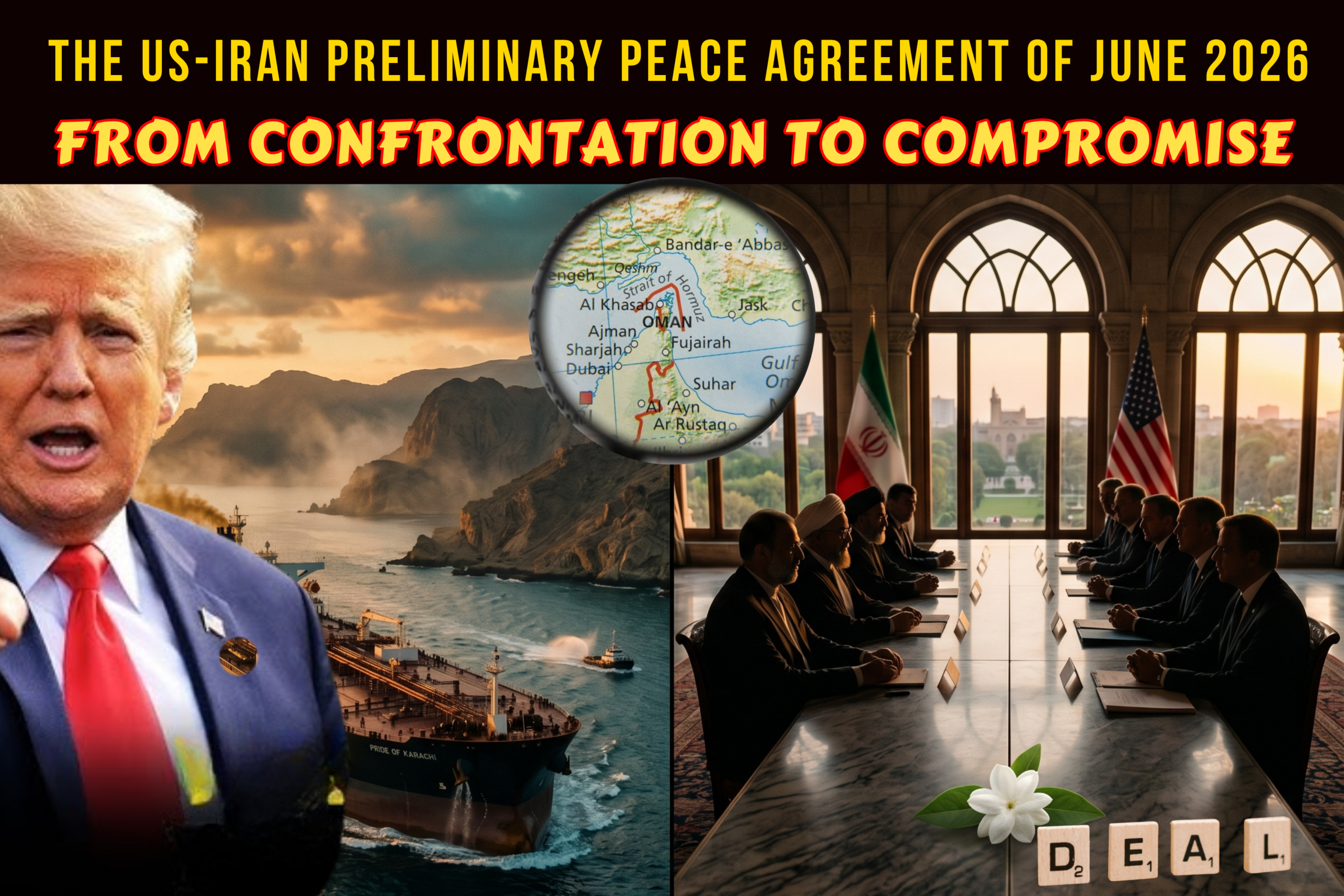
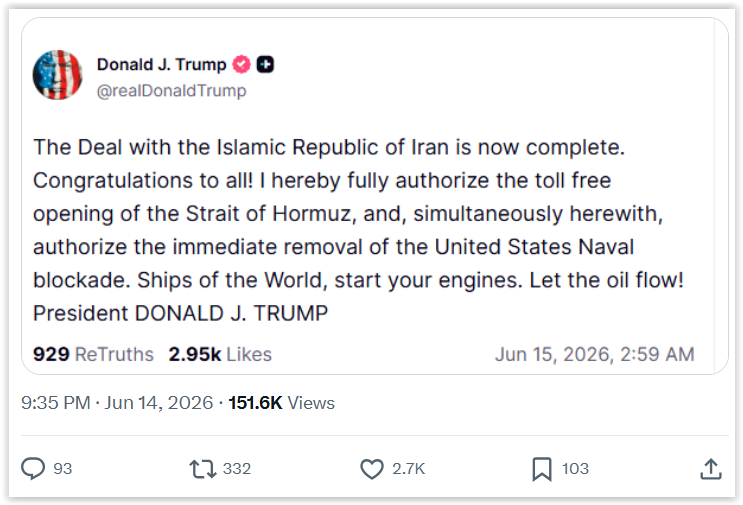
On 15 June 2026, after nearly four months of devastating conflict that reshaped the geopolitical landscape of the Middle East, the United States and Iran announced a preliminary peace agreement that promises to end the most serious military confrontation between the two nations since the 1979 revolution. US President Donald Trump confirmed that Washington and Tehran had reached a framework deal, with Iranian officials simultaneously indicating that the text had been finalized and a formal signing ceremony scheduled for 19 June 2026 in Europe. The agreement centers on the reopening of the Strait of Hormuz—through which approximately one-fifth of global oil shipments pass—the removal of the US naval blockade on Iranian ports, and the suspension of major military operations. Yet beneath the headlines of diplomatic triumph lies a more complex reality: the agreement’s most difficult provisions, particularly those concerning Iran’s nuclear program, remain unresolved, casting a long shadow over whether this represents a genuine path to lasting peace or merely a pause in a decades-long enmity.
The Anatomy of the Agreement: What Has Been Agreed
The Ceasefire Framework
The preliminary agreement establishes a permanent ceasefire framework that supersedes the fragile two-week truce brokered in early April 2026. That initial ceasefire, announced on 7 April after a down-to-the-wire plea from Pakistani Prime Minister Shehbaz Sharif, had quickly unraveled when Israel launched massive airstrikes on Lebanon on the same day—strikes that Iran and Pakistan insisted violated the ceasefire’s terms, while Israel and the US maintained Lebanon was never included.
The June framework goes further. It mandates the suspension of major military operations by both sides, effectively halting the air campaign that had pounded Iranian military installations, nuclear facilities, and infrastructure since the war’s outbreak in February 2026. For Iran, this means an end to the missile and drone strikes against US bases and naval assets in the Persian Gulf, as well as attacks on commercial shipping. For the United States, it means standing down the strategic bombing campaign that had targeted Iran’s power plants, oil infrastructure, and suspected nuclear weapons sites.
Reopening the Strait of Hormuz
The most consequential immediate provision is the reopening of the Strait of Hormuz. When Iran closed the strait in early 2026—citing security concerns and asserting sovereignty over the waterway—it triggered a global energy crisis. Oil prices spiked, shipping insurance rates soared, and alternative routes through pipelines and around the Cape of Good Hope proved insufficient to compensate for the loss of the world’s most critical oil chokepoint.
The agreement establishes a protocol for the strait’s reopening, including the removal of naval mines laid by Iranian forces and the creation of a maritime security framework to ensure safe passage for commercial vessels. US Central Command had already begun limited mine-clearing operations in April, but the formal reopening represents a strategic reversal for Tehran, which had previously declared the strait would “not be opened to the enemies of this nation.”
Lifting the Naval Blockade
In response to the failed Islamabad Talks of 11–12 April 2026—where US Vice President J.D. Vance departed after 21 hours of negotiations yielded no agreement—President Trump had imposed a full naval blockade on Iranian ports. The blockade, enforced by US Navy destroyers, prevented any vessels from originating or destined for Iranian ports from transiting, effectively strangling Iran’s already sanctions-battered economy.
The June agreement commits to removing this blockade, though the sequencing remains a point of delicate negotiation. Iranian officials have insisted that the blockade must be lifted concurrently with the strait’s reopening, while US negotiators have reportedly sought to tie its removal to verifiable Iranian compliance with other provisions.
The Nuclear Question: The Elephant in the Room
For all the agreement’s significance, its most glaring limitation is the nuclear issue. The 2026 war was triggered, in large part, by the collapse of diplomatic efforts to constrain Iran’s nuclear program. When negotiations that began in April 2025—mediated initially by Oman, then by Pakistan—failed to produce a breakthrough by Trump’s self-imposed deadlines, Israel launched preemptive strikes against Iranian nuclear facilities in June 2025, igniting a conflict that would escalate dramatically when the United States entered the war directly in early 2026.
What Remains Unresolved
The preliminary agreement deliberately postpones the most contentious questions to future negotiations. These include:
Uranium Enrichment: Iran has enriched uranium to levels far beyond the 3.67% limit set by the 2015 Joint Comprehensive Plan of Action (JCPOA), with stockpiles of highly enriched uranium that could, in theory, be weaponized. The US has demanded the complete dismantlement of Iran’s enrichment infrastructure and the removal of all existing stockpiles. Iran, for its part, has proposed building additional civilian reactors with international oversight—a proposal the US has rejected.
International Inspections: The agreement calls for the restoration of IAEA inspections, including the Additional Protocol that allows for surprise inspections at undeclared sites. However, Iran had expelled IAEA inspectors in early 2025 amid rising tensions, and Tehran’s willingness to grant unfettered access remains deeply uncertain.
Missile Programs: The US has sought limits on Iran’s ballistic missile program, which poses a threat to regional allies including Israel and the Gulf states. Iran has consistently rejected any constraints on its missile capabilities, viewing them as essential to its deterrence posture.
Sanctions Relief: Perhaps the most politically charged issue in Washington is the question of sanctions. Iran has demanded the lifting of both primary and secondary US sanctions, the unfreezing of approximately $6 billion in frozen assets, and congressional approval of any agreement. The Trump administration, facing pressure from a Congress where 229 legislators wrote in May 2025 demanding no deal that allows enrichment, has insisted that sanctions relief will be conditional and phased.
The Terms on the Table
According to reports, the draft agreement submitted by Iran on 11 June 2026 includes provisions for the strait to remain open, all nuclear material stockpiles to be removed from Iran, the complete dismantlement of Iran’s nuclear program, and no funds released until Iran carries out every term. Iran would also commit to not funding “terrorist groups.”
Whether these terms are acceptable to Tehran’s leadership—particularly Supreme Leader Ali Khamenei, who has historically viewed nuclear capability as a strategic imperative—remains the central question hanging over the agreement.
Timeline of the 2026 Conflict: From Escalation to Negotiation
Understanding the significance of the June agreement requires tracing the arc of the conflict that preceded it.
February–March 2026: The War Begins
The year opened with indirect US-Iran talks in Muscat, Oman, on 6 February 2026. The American delegation included Special Envoy Steve Witkoff, Jared Kushner, and CENTCOM commander Admiral Brad Cooper; the Iranian side was led by Foreign Minister Abbas Araghchi. Secretary of State Marco Rubio expressed skepticism, stating, “I’m not sure you can reach a deal with these guys.” The talks ended without agreement but with a commitment to continue engagement.
By March, the diplomatic window was closing. On 6 March, Trump declared on social media: “There will be no deal with Iran except UNCONDITIONAL SURRENDER!” On 23 March, he postponed an ultimatum on reopening the Strait of Hormuz, claiming “very good and productive conversations” with Iranian officials—claims that IRGC-affiliated media outlets denied.
On 25 March, Pakistani officials delivered a 15-point US proposal to Iran. The proposal demanded an end to Iran’s nuclear program, missile limits, strait reopening, restrictions on support for armed groups, and sanctions relief. Iran rejected it outright, issuing a five-point counter-proposal that included an end to US-Israeli attacks, security guarantees, war reparations, and international recognition of Iranian sovereignty over the Strait of Hormuz.
Early April: The Ceasefire and Its Collapse
The turning point came on 7 April, when Trump announced a two-week ceasefire to begin the following day, brokered by Pakistan. Iranian officials agreed, with national security adviser Mahdi Mohammadi warning: “Without fully restraining America’s rabid dog in Lebanon, there will be no ceasefire or negotiations, and the missiles are ready to launch.”
The ceasefire collapsed almost immediately. On the same day it was announced, Israel launched its strongest wave of attacks on Lebanon since the war began. Iran paused Hormuz traffic in response. The Lebanese government denounced the strikes as war crimes.
The Islamabad Talks and Their Failure
On 11 April, Vance, Witkoff, and Kushner arrived in Islamabad for what were billed as make-or-break peace talks. The Iranian delegation included Araghchi and Parliament Speaker Mohammad Bagher Ghalibaf. After 21 hours of negotiations at the Serena Hotel, Vance departed on 12 April, announcing: “The bad news is that we have not reached an agreement.”
The sticking point, Vance explained, was Iran’s refusal to make “an affirmative commitment that they will not seek a nuclear weapon, and they will not seek the tools that would enable them to quickly achieve a nuclear weapon.” He left what he called a “final and best offer” on the table.
Trump’s response was characteristically theatrical. While the talks were ongoing, he told reporters he did not care about the outcome and attended a UFC fight in Miami with Secretary Rubio. Following the talks’ failure, he announced a full naval blockade of Iranian ports, to begin on 13 April.
April–May 2026: Blockade and Stalemate
The naval blockade intensified the economic pressure on Iran while US Navy destroyers entered the Strait of Hormuz for mine-clearing operations. Iran threatened to attack the ships, accusing the US of ceasefire violations. Trump, meanwhile, oscillated between threats—warning on 7 April that “a whole civilization will die tonight, never to be brought back”—and claims that a deal was imminent. CNN later determined that between 23 March and 9 June, Trump had claimed at least 38 times that a deal was imminent.
On 25 April, Trump cancelled a planned envoy trip to Islamabad, alleging divisions within Iranian leadership. Through it all, Pakistan remained the primary channel of communication, with Islamabad and Beijing jointly proposing a five-point peace initiative on 31 March and continuing to shuttle messages between the capitals.
June 2026: The Breakthrough
The breakthrough came on 11 June, when Iran submitted a draft agreement to the United States. Trump announced that a time and place in Europe would be announced for the deal’s signing. By 15 June, both sides had confirmed the preliminary framework, with the formal signing set for 19 June.
Pakistan’s Diplomatic Renaissance: The Islamabad Opening
No analysis of the 2026 peace process is complete without acknowledging Pakistan’s extraordinary emergence as the conflict’s indispensable mediator. This represents one of the most remarkable diplomatic turnarounds in recent history—a country that Trump had accused of “lies and deceit” during his first term in 2018 now hosting the most significant US-Iran negotiations since 1979.
How Pakistan Became the Go-Between
Pakistan’s mediation role evolved organically from its unique position: it maintains diplomatic relations with both Washington and Tehran, shares a long border with Iran, and has a substantial Shiite population that gives it cultural credibility with the Islamic Republic. When Qatar declined to lead negotiations and Oman—having hosted the 2025 talks—proved unable to bridge the growing divide, Pakistan stepped into the vacuum.
Prime Minister Shehbaz Sharif and Army Chief Asim Munir became the faces of Pakistan’s diplomacy. When the two-week ceasefire was announced on 7 April, both Trump and Iran’s foreign ministry named Sharif and Munir in their announcements—a rare concurrence that, as Rasheed Wali Janjua of the Islamabad Policy Research Institute noted, “no other country enjoyed.”
Building a Coalition
Pakistan did not act alone. Islamabad engaged in sustained consultations with Saudi Arabia, Turkey, Qatar, and Egypt, while coordinating closely with China. This demonstrated a sophisticated understanding that any durable peace required consolidated regional and international support. The Al Jazeera Centre for Studies described this as “The Islamabad Opening”—a deliberate effort to position Pakistan as a global middle power.
The Domestic Reaction
The transformation caught many Pakistanis by surprise. As 19-year-old Khizra Zaheer told NPR during the April talks: “When did Pakistan get so influential?” The question reflected a broader national astonishment at seeing Islamabad’s normally sleepy capital thrust into the center of global geopolitics.
For Pakistan’s leadership, the motivation was both diplomatic and existential. A wider Middle East war risked spilling into South Asia, disrupting oil supplies, and destabilizing remittance flows from the millions of Pakistanis working in Gulf countries. By facilitating peace, Pakistan was protecting its own interests while gaining international prestige it had not enjoyed since facilitating Henry Kissinger’s secret visit to China in 1971.
International Reactions: Cautious Welcome, Deep Concerns
The United Nations and Global Powers
The United Nations has welcomed the agreement as a major step toward regional stability. UN human rights officials have urged restraint from all parties during the implementation phase. The European Union, while not directly involved in the negotiations, has expressed support for any framework that reduces the risk of nuclear proliferation in the Middle East.
Israel and the Lebanon Question
Israel remains the most significant potential spoiler. Throughout the negotiations, Israeli Prime Minister Benjamin Netanyahu consistently rejected any ceasefire that included Lebanon, insisting that operations against Hezbollah would continue regardless of any US-Iran agreement. The Israeli strikes on Lebanon on 7 April—hours after the ceasefire was announced—demonstrated this resolve.
The preliminary agreement does not explicitly address the Lebanon conflict, creating a dangerous ambiguity. Iranian officials have warned that continued Israeli attacks on Hezbollah could derail the broader peace process. With Hezbollah having announced a pause in attacks during the April ceasefire only to see Israel escalate, trust between the parties is fragile at best.
Regional Armed Groups
Beyond Hezbollah, Iran’s network of regional proxies—including the Houthis in Yemen, Shiite militias in Iraq, and Palestinian Islamic Jihad—complicates implementation. The US has demanded that Iran cease funding these groups, but Iran views them as legitimate resistance movements and instruments of regional influence. Whether Tehran can or will rein them in remains deeply uncertain.
The Iranian Domestic Context
Within Iran, the agreement has produced mixed reactions. The Iranian rial has shown signs of recovery, and the Tehran Stock Exchange rose on news of potential sanctions relief. However, hardline elements—including the IRGC and its media affiliates—have criticized any concessions as surrender. The pro-government newspaper Kayhan has been particularly vocal, at one point calling for the assassination of Trump.
Among the Iranian opposition, figures like Reza Pahlavi have urged the US to avoid negotiations with the current regime and instead support “a nationwide struggle for freedom and democracy.” The agreement’s domestic political sustainability in Iran is thus far from guaranteed.
Why This Matters for Pakistan: Stakes and Opportunities
For Pakistan, the US-Iran agreement is not merely a diplomatic triumph—it is a matter of national survival and strategic repositioning.
Energy Security
Pakistan is heavily dependent on imported energy. A prolonged closure of the Strait of Hormuz would have devastated Pakistan’s economy, already strained by inflation and debt. The reopening of the strait and the stabilization of oil prices represent an immediate economic relief.
Remittance Flows
Millions of Pakistanis work in Saudi Arabia, the UAE, Qatar, and other Gulf states. These remittances constitute a critical pillar of Pakistan’s foreign exchange reserves. A wider regional war would have disrupted these flows, potentially triggering a balance-of-payments crisis. The agreement reduces this risk significantly.
Strategic Positioning
By successfully mediating between two adversarial great powers, Pakistan has demonstrated a capacity for diplomatic leadership that few observers thought possible. This “Islamabad Opening” could attract foreign investment, strengthen ties with both the US and China, and elevate Pakistan’s standing in international forums.
The Balancing Act
Pakistan must now navigate a delicate path. It must maintain its credibility with Iran while preserving its strategic partnership with the United States. It must balance its relationships with Saudi Arabia and Turkey, both of which have their own interests in the outcome. And it must manage domestic expectations that may exceed what the agreement can realistically deliver.
The Bottom Line: Peace or Pause?
The preliminary US-Iran agreement of June 2026 represents a genuine diplomatic achievement. It has halted a war that threatened to engulf the Middle East, reopened the world’s most critical oil chokepoint, and created a framework for addressing the nuclear issue through negotiation rather than force. Pakistan’s role as mediator has been indispensable, marking a historic moment in South Asian diplomacy.
Yet the agreement’s limitations are equally real. The nuclear question—the issue that started the crisis—remains unresolved. Israel’s operations in Lebanon continue to threaten the ceasefire’s integrity. Iran’s regional proxies remain active. And the domestic politics in both Washington and Tehran could easily unravel what has been built.
The formal signing on 19 June 2026 will be a moment of celebration. But the hard work of implementation, verification, and compromise lies ahead. Whether this agreement proves to be the foundation of a new regional order or merely a pause before the next round of conflict will depend on the political will of leaders in both capitals—and on the continued steady hand of the mediators who brought them to the table.
For now, the world watches with cautious hope. The missiles have, for the moment, stopped flying. The strait is reopening. And diplomacy, against long odds, has prevailed over destruction. Whether that victory can be sustained is the question that will define the Middle East for years to come.