How a single attack on a Cyprus-flagged vessel on 12 July 2026 reignited the most dangerous confrontation in the Middle East — and why the world may not escape a wider war this time.
(By Khalid Masood)
I. The Incident
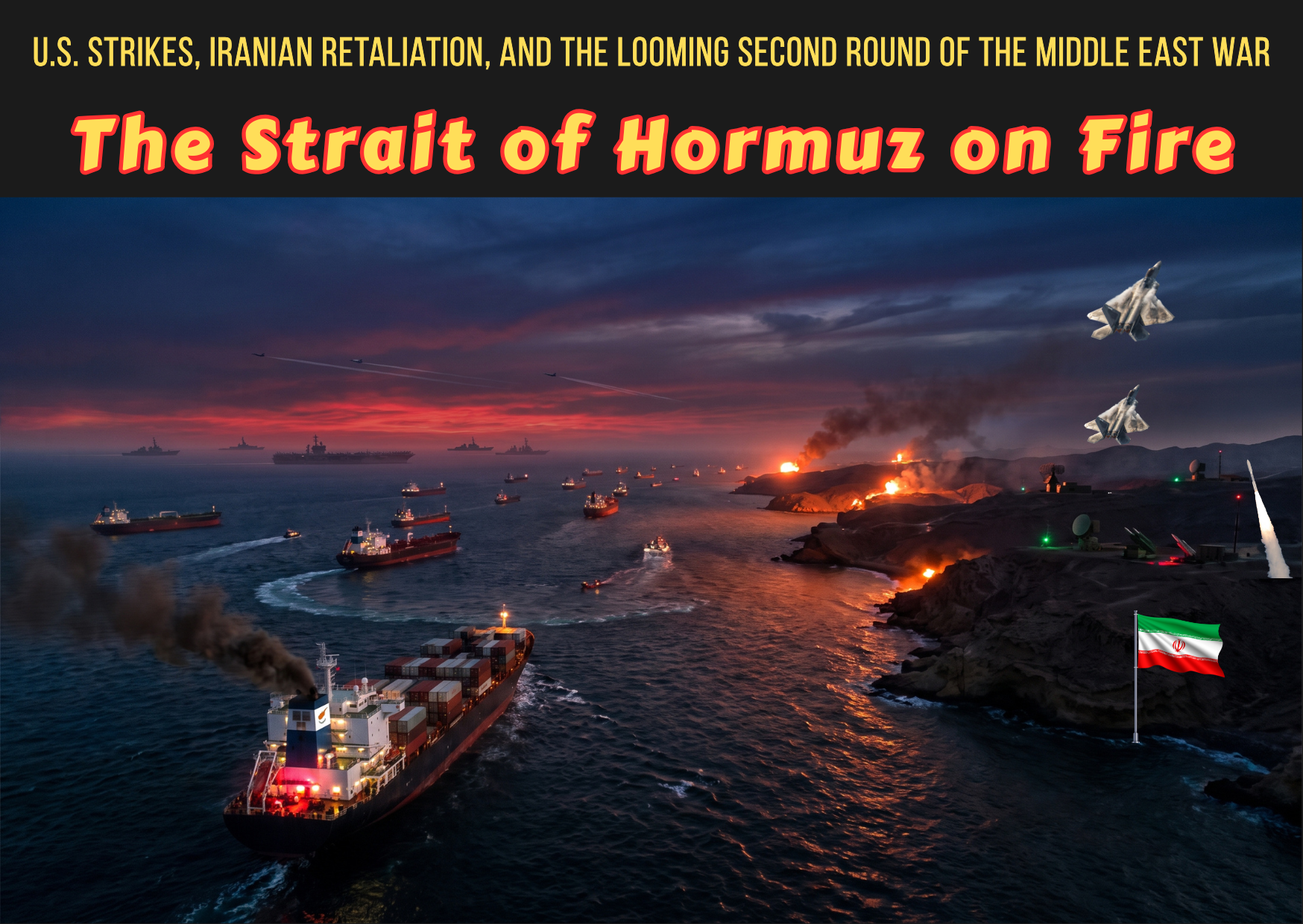
The first reports came in the early hours of Saturday, 12 July 2026. In the narrow waters of the Strait of Hormuz — that dagger-thin chokepoint through which roughly one-fifth of the world’s petroleum shipments pass — a Cyprus-flagged container ship came under fire. Iran’s Islamic Revolutionary Guard Corps (IRGC) Navy claimed the vessel had “jeopardized maritime security by switching off its systems” and was sailing an “unauthorised route.” Warning shots, Tehran insisted. But the United States Central Command (CENTCOM) saw it differently: “Tehran blatantly attacked” a civilian vessel transiting international waters. A crew member went missing. The ship’s engine room caught fire. The vessel was disabled, dead in the water.
Within hours, the crisis metastasized. Iran announced the Strait of Hormuz was closed “until further notice” — a unilateral blockade of the world’s most critical energy artery. “Until the end of American interventions in this region and no vessels will be allowed to pass through,” the IRGC declared. The United States responded with a third consecutive night of strikes, hitting approximately 140 Iranian missile, drone, and radar installations near the strait. Defense Secretary Pete Hegseth put it bluntly: “Iran made a poor choice. Now they pay.”
This was not piracy. This was not an accident. This was state-on-state maritime warfare in the world’s most strategically congested waterway — and it is the direct, inevitable continuation of a war that began in late February 2026, flared through twelve days of devastating direct combat in June, and never truly ended.
II. The Immediate Event: Anatomy of the 12 July Crisis
The vessel at the center of the storm was a Cyprus-flagged container ship — a detail that matters more than it might appear. Cyprus is an European Union member state. Its flag is a common choice for international shipping due to favorable maritime law and insurance frameworks. By targeting a Cyprus-flagged vessel, Iran was not merely harassing random commercial traffic; it was probing the boundaries of international tolerance, testing whether the European Union would be drawn into the confrontation, and signaling that no flag state was immune from its new doctrine of controlled passage through Hormuz.
According to CENTCOM, the ship suffered “significant engineroom damage” and an onboard fire that left it unable to continue its journey. One civilian crew member remained missing. The IRGC’s narrative — that the vessel had disregarded repeated warnings and shut down its transponder — fit a pattern Tehran had established since the war’s outset: Iran would regulate Hormuz traffic, demand compliance with its routing instructions, and punish defiance. But the United States had drawn its own red line. Unrestricted freedom of navigation through Hormuz was non-negotiable.
The U.S. response came at 7:15 p.m. Eastern Time on Saturday — 11:15 p.m. GMT — and constituted the third round of American strikes in a single week. CENTCOM stated the strikes were carried out “at the direction of President Donald Trump” and aimed to “degrade Iran’s ability to attack civilian mariners and commercial ships freely transiting the strait.” The target set reportedly included IRGC naval facilities, missile batteries, drone launch sites, and coastal radar installations along the Iranian side of the strait.
Iran’s counter-response was both immediate and ominous. The IRGC Navy warned that “acts of aggression against Iran will be met with a severe response, and new enemy bases in the region will be targeted.” Simultaneously, Iran’s new Supreme Leader Mojtaba Khamenei — son of Ali Khamenei, who was killed in the U.S.-Israeli opening strikes of February 2026 — issued his first public message since his father’s funeral. “Vengeance is the will of our nation and must inevitably be carried out,” he wrote. “This matter depends neither on my personal existence nor on that of other officials. Whether we are present or not, it will come to pass.” He added that Iran had compiled “a list of individuals to be targeted.”
The assassination threat was not abstract. Hours before the Hormuz incident, Trump had posted on Truth Social that any attempt on his life would lead the United States to “completely decimate” Iran. “1000 Missiles are Locked and Loaded and aimed at the Islamic Republic of Iran,” he wrote, “with thousands of more to immediately follow.” The personalization of a geopolitical crisis — leader versus leader, threat against threat — has shrunk the space for diplomatic maneuver to nearly nothing.
Meanwhile, the economic shockwaves were immediate. Oil markets, already jittery from months of Hormuz uncertainty, spiked sharply. Brent crude and West Texas Intermediate both surged on the news. Shipping insurance rates for Gulf transits — already elevated since the war’s outbreak — jumped further. Vessel operators began rerouting around the Cape of Good Hope, adding weeks and millions of dollars to voyages that normally pass through Hormuz in a matter of hours. The global economy, still recovering from the February-June war’s disruptions, faced a renewed energy price shock.
III. The Unfinished War: From February to June and Back Again
To understand why 12 July 2026 is so dangerous, one must understand what came before. The 2026 Iran war did not begin in July. It began on 28 February 2026, when the United States and Israel launched surprise airstrikes against Iran — targeting military and government sites, and assassinating Supreme Leader Ali Khamenei and other senior officials. Iran retaliated with ballistic missile barrages against Israel, strikes on U.S. bases across the Middle East, and the immediate closure of the Strait of Hormuz. The conflict expanded rapidly: Israeli strikes deep inside Iran, U.S. operations against Iranian nuclear facilities, proxy warfare across Lebanon, Syria, Iraq, and Yemen.
By the time a shaky ceasefire took hold in June, the toll was staggering. Approximately 700 Iranians had been killed — including Khamenei, parliamentary speaker Ali Larijani, and numerous IRGC commanders. Some 25 Israelis had died. Iranian ballistic missiles had struck targets as far afield as Cyprus, Saudi Arabia, Kuwait, Qatar, Bahrain, and the UAE. The United States had conducted sustained air and naval campaigns, including a full naval blockade of Iranian ports that began on 13 April 2026 and was only lifted after a deal was signed on 17 June 2026.
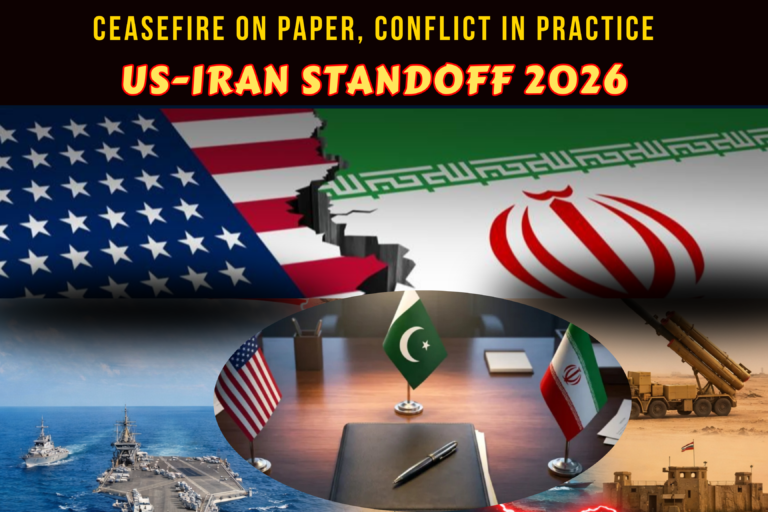
But the June deal was not a peace treaty. It was an interim memorandum — the Islamabad Memorandum — that paused active combat without resolving the underlying conflicts. And one critical issue remained terrifyingly unresolved: the fate of Iran’s nuclear material. Approximately 400 kilograms of highly enriched uranium — enough for multiple nuclear weapons — was unaccounted for in the war’s chaos. Had Iran dispersed it to hidden facilities before the strikes? Had Israel or the United States seized portions of it? Was it still in underground complexes that survived the bombing? Nobody knew for certain. And in nuclear strategy, uncertainty is the most dangerous variable of all.
The ceasefire, never robust, began fraying almost immediately. Iran continued to restrict Hormuz passage, demanding tolls of up to $2 million per ship and granting exemptions only to friendly nations — China, Russia, India, Pakistan, Malaysia, Thailand, the Philippines. The United States insisted on unrestricted, toll-free navigation for all vessels. The two positions were irreconcilable. By early July, the “ceasefire” had become a fiction maintained by diplomats while military forces on both sides prepared for the inevitable resumption of hostilities.
Then came the reports that Israeli Prime Minister Benjamin Netanyahu had briefed the White House on plans for fresh strikes against Iran’s reconstituting ballistic missile program. Israeli intelligence had detected Iranian efforts to rebuild missile factories, develop new solid-fuel propulsion systems, and expand underground tunnel networks for missile storage and launch. Tehran, bloodied but unbowed by the June war, was racing to restore the strategic deterrent that the U.S.-Israeli campaign had degraded but not destroyed. Israel’s strategic doctrine — preemption against existential threats — demanded action. The clock was ticking.
The 12 July Hormuz incident must be understood in this context. It was not an isolated maritime provocation. It was Iran’s answer to Netanyahu’s threats — a demonstration that Tehran could still choke the global economy, that the strait remained its leverage, and that any Israeli or American escalation would carry a price measured in oil markets, shipping lanes, and global stability.
IV. Trump’s Contradictory Doctrine: The Stick and the Carrot
The Trump administration’s Iran policy has always been a study in deliberate contradiction. On one hand, maximum pressure: sanctions, naval blockades, military strikes, assassination of senior leaders, threats to bomb Iran “back to the Stone Ages.” On the other hand, persistent diplomatic outreach: offers of a new nuclear deal broader than the JCPOA, backchannel feelers through Oman and Qatar, public expressions of interest in a “beautiful” agreement that would address not just nuclear enrichment but ballistic missiles and regional proxy networks.
This contradiction is not accidental. It is Trump’s strategic signature — the belief that unpredictability is strength, that keeping adversaries off-balance forces concessions no predictable diplomacy could achieve. The approach has produced moments of tactical success: the Islamabad talks in April, the June deal that paused the war. But it has also produced repeated crises of miscalculation, where military escalation outpaces diplomatic control.
The Hormuz crisis of 12 July exposes the limits of this approach. Iran’s new leadership — Mojtaba Khamenei, wounded in the strikes that killed his father and reportedly unseen in public since before the war — is not a pragmatic negotiator in the mold of some earlier Iranian officials. He is a man who has publicly sworn vengeance, who has compiled assassination lists, and who leads a revolutionary regime humiliated by the killing of its supreme leader and the destruction of its military infrastructure. For such a leadership, Trump’s simultaneous offer of talks and threat of “1000 Missiles” reads not as sophisticated statecraft but as provocation demanding response.
The internal dynamics of the Trump administration add further uncertainty. Defense Secretary Hegseth’s blunt “Iran made a poor choice. Now they pay” suggests a military-first posture. But reports indicate that Qatari mediators were in Tehran as recently as Friday, 11 July — the day before the Hormuz incident — attempting to “reinforce Qatar’s role as a mediator.” Iranian Foreign Minister Abbas Araghchi met with his Omani counterpart in Muscat to discuss “appropriate mechanisms for the safe passage of ships through the Strait of Hormuz.” Omani and Iranian negotiators agreed to continue talks “at the technical and political levels.” The diplomatic track, in other words, was still alive even as the missiles flew.
Trump himself has added to the confusion. On Friday, 10 July, he declared the ceasefire over while simultaneously saying the United States and Iran had “agreed to continue talks.” This is not coherent strategy. It is strategic incoherence by design — and in a nuclear-armed or near-nuclear context, incoherence is a recipe for catastrophe.
The parallel with Trump’s other major military adventure — the naval deployment to the Caribbean and threats against Venezuelan President Nicolás Maduro — suggests a broader pattern. Military assertiveness as global diplomatic leverage. “Boat strikes” against alleged drug traffickers in one hemisphere, missile strikes against Iranian naval installations in another. The message to adversaries everywhere: defiance carries a military cost. But the message to allies is equally clear: the United States is an unpredictable partner, capable of shifting from negotiation to bombardment without warning.
V. The Houthi Wildcard and the Proxy Dimension
No analysis of the Hormuz crisis is complete without accounting for Iran’s asymmetric doctrine — the use of proxy forces to extend Tehran’s reach while maintaining a veneer of deniability. And no proxy is more dangerous in the current context than the Houthis of Yemen.
Since the Gaza war of 2023-2024, the Iran-backed Houthis have demonstrated a sustained capability to attack commercial shipping in the Red Sea and Gulf of Aden — using anti-ship missiles, naval mines, and drone swarms. Their operations have disrupted global trade routes, forced vessel rerouting around Africa, and proven that even a non-state actor can impose significant costs on the global economy when armed with Iranian technology and guided by Iranian strategic objectives.
The critical question now is whether the Houthis will expand operations to the Strait of Hormuz proper — or whether they are already coordinating with IRGC naval forces in the current crisis. Iranian doctrine has long envisioned layered defense of Hormuz: regular naval forces, IRGC fast-attack boats, coastal missile batteries, and proxy forces operating from Yemeni territory across the Gulf of Aden and Bab al-Mandeb. A simultaneous closure of both Hormuz and the Red Sea would cut off virtually all maritime energy flos from the Middle East to Europe and Asia. The economic consequences would be catastrophic.
Iran’s broader proxy network — Kata’ib Hezbollah in Iraq, Liwa Fatemiyoun in Syria, Hezbollah in Lebanon (degraded but not destroyed) — adds further escalation potential. Each of these groups has the capability to strike U.S. bases, Israeli targets, or Gulf state infrastructure. In the June war, Iranian proxies conducted attacks across the region. In a renewed conflict, they would likely do so again — and with greater coordination, having learned from the first round’s failures.
The Gulf Arab states find themselves in an excruciating position. Saudi Arabia, the UAE, Qatar, Kuwait, and Bahrain all depend on Hormuz for their economic survival. All fear Iranian retaliation against their oil infrastructure — the memory of the 2019 Abqaiq attack, which temporarily halved Saudi oil production, remains seared into their strategic consciousness. Yet none can afford to be seen as openly siding with the United States against a fellow Muslim nation, particularly one that commands significant popular sympathy across the Arab street. Their posture is likely to be one of public neutrality and private support for U.S. action — a dangerous tightrope that could collapse if the conflict widens.
Oman, traditionally the Gulf’s mediator between Washington and Tehran, faces a particularly delicate test. Omani Foreign Minister Sayyid Badr Albusaidi has been actively engaged with his Iranian counterpart, and Muscat has offered to host technical talks on safe passage. But can Oman mediate while U.S. missiles are striking Iranian targets and Iranian leaders are vowing vengeance? The mediator’s role requires trust from both sides — and trust is in desperately short supply.
VI. Global Stakes: Oil, Economics, and Great Power Rivalry
The Strait of Hormuz is not merely a Middle East flashpoint. It is a global economic chokepoint — and its closure or even severe disruption sends shockwaves through every major economy on Earth.
China, the world’s largest importer of Gulf oil, has the most immediate stake. Beijing has condemned the U.S. naval blockade as “irresponsible and dangerous” and warned that it “would go against the international community’s interests.” Chinese Foreign Ministry spokesman Guo Jiakun urged “relevant parties to honor the ceasefire agreement.” But China’s interests are complex: it wants stable oil flows, but it also benefits from U.S. strategic overextension in the Middle East, which distracts Washington from the Indo-Pacific competition. The recent Japan-India summit, tightening security cooperation “farther from Trump’s America,” and China’s own Pacific missile launch — described by analysts as a “declaration, not a test” — suggest Beijing is actively exploiting the U.S. preoccupation with Iran to advance its regional agenda.
Russia’s position is equally nuanced. The Kremlin has condemned the U.S. blockade and warned of an “economic earthquake.” Putin, who met with Trump in Anchorage in August 2025, benefits from higher oil prices — every barrel of Iranian crude kept off the market is a barrel of Russian crude sold at a premium. But Moscow does not want a wider Middle East war that could draw U.S. resources back to a theater Russia would prefer to see Washington bogged down in indefinitely. The Iran-Russia axis, strengthened by shared hostility to the U.S.-led order, has limits. Moscow will support Tehran diplomatically and economically, but it is unlikely to risk direct military entanglement.
Europe faces a perfect storm. The EU is already engaged in tense trade war talks with China. A Hormuz crisis deepens European energy insecurity at the very moment the continent is attempting to wean itself off Russian gas. The choice becomes stark: accelerate the green transition — requiring massive investment and years of lead time — or renew fossil fuel dependence on less reliable suppliers. Spain’s defense minister Margarita Robles captured the European mood with bleak candor: “Since this war started, nothing makes sense.” The UK and France have promoted a “multinational mission” to secure Hormuz, but without U.S. leadership, such efforts lack the military heft to be credible.
India, granted passage through Hormuz by Iran during the war, walks its own tightrope. Dependent on Gulf oil but cultivating strategic partnerships with both the United States and Iran, New Delhi has pursued a policy of studied neutrality. But neutrality becomes untenable when the strait is on fire and the global economy is convulsing.
VII. Three Scenarios: What Happens Now?
The next 48 to 72 hours will determine whether the 12 July crisis is contained or becomes the spark for a wider, more devastating conflict. Three scenarios present themselves:
Scenario One: Contained Escalation (Probability: 40%)
The United States and Iran exchange limited blows — the current strikes and any immediate Iranian retaliation — but both sides pull back from the brink. The Cyprus-flagged vessel incident is resolved through backchannel negotiation. Oman and Qatar succeed in restarting talks. Oil prices spike, then stabilize. The Islamabad Memorandum framework is patched back together. This is the June war pattern: intense but brief, followed by mutual exhaustion and a return to uneasy coexistence. The danger is that both sides have already demonstrated that this pattern satisfies nobody — and that the next crisis will be worse.
Scenario Two: Wider Regional War (Probability: 35%)
Israel, alarmed by Iranian missile reconstruction and emboldened by U.S. military action, launches the fresh strikes Netanyahu has reportedly planned. Iran responds with mass ballistic missile barrages — not just against Israel, but against U.S. bases in Iraq, Syria, Jordan, and the Gulf states. The Houthis close the Red Sea. The United States is drawn into a sustained air campaign against Iranian military, nuclear, and leadership targets. Gulf state infrastructure suffers collateral damage. The war that began in February resumes with renewed ferocity, and this time there is no off-ramp in sight. The missing 400 kilograms of uranium becomes the elephant in the room — if Iran has weaponized it, or if Israel believes it has, the conflict could cross into nuclear territory.
Scenario Three: Strategic Breakthrough (Probability: 25%)
The crisis shocks all parties into genuine negotiation. Trump, who craves a “deal” legacy to rival or exceed any predecessor’s, leverages the military pressure to extract a comprehensive agreement: Iranian acceptance of intrusive nuclear inspections, limits on ballistic missiles, normalization of Hormuz navigation, and regional security guarantees. In exchange, the United States offers sanctions relief, recognition of Iran’s regional role, and security assurances. This is the least likely scenario — it requires trust that does not exist, leadership on both sides willing to take political risks for peace, and a diplomatic architecture that has barely survived the last five months. But it is not impossible. Desperation sometimes produces breakthroughs that calculation cannot.
VIII. Conclusion
The Strait of Hormuz on 12 July 2026 is a microcosm of everything that has gone wrong with Middle East geopolitics — and with the broader international order. It is a place where unresolved wars fester, where nuclear ambiguity breeds existential fear, where proxy entanglements blur the line between state and non-state violence, and where great power competition intersects with revolutionary ideology and raw realpolitik to produce a toxic compound.
The Trump administration’s central gamble — that military force can compel diplomatic concession, that unpredictability is a form of strength, that America can intimidate its way to a better deal — is being tested in real time, in the most dangerous theater on Earth. The results so far are not encouraging. Iran has not been intimidated into submission. It has been provoked into defiance. The strait is closed. The missiles are flying. The vengeance is sworn.
And beneath it all, the uranium is still missing. The missiles are being rebuilt. The proxies are mobilizing. The summer heat in the Gulf is oppressive, and it is only July.
The world is watching not for the next drone or the next missile — those will come, regardless. The world is watching for whether any actor in this drama still believes in an off-ramp. Or whether, in the logic of escalation that has consumed the Middle East for generations, the only way out is through — through more fire, more destruction, and perhaps, this time, through a darkness from which there is no return.