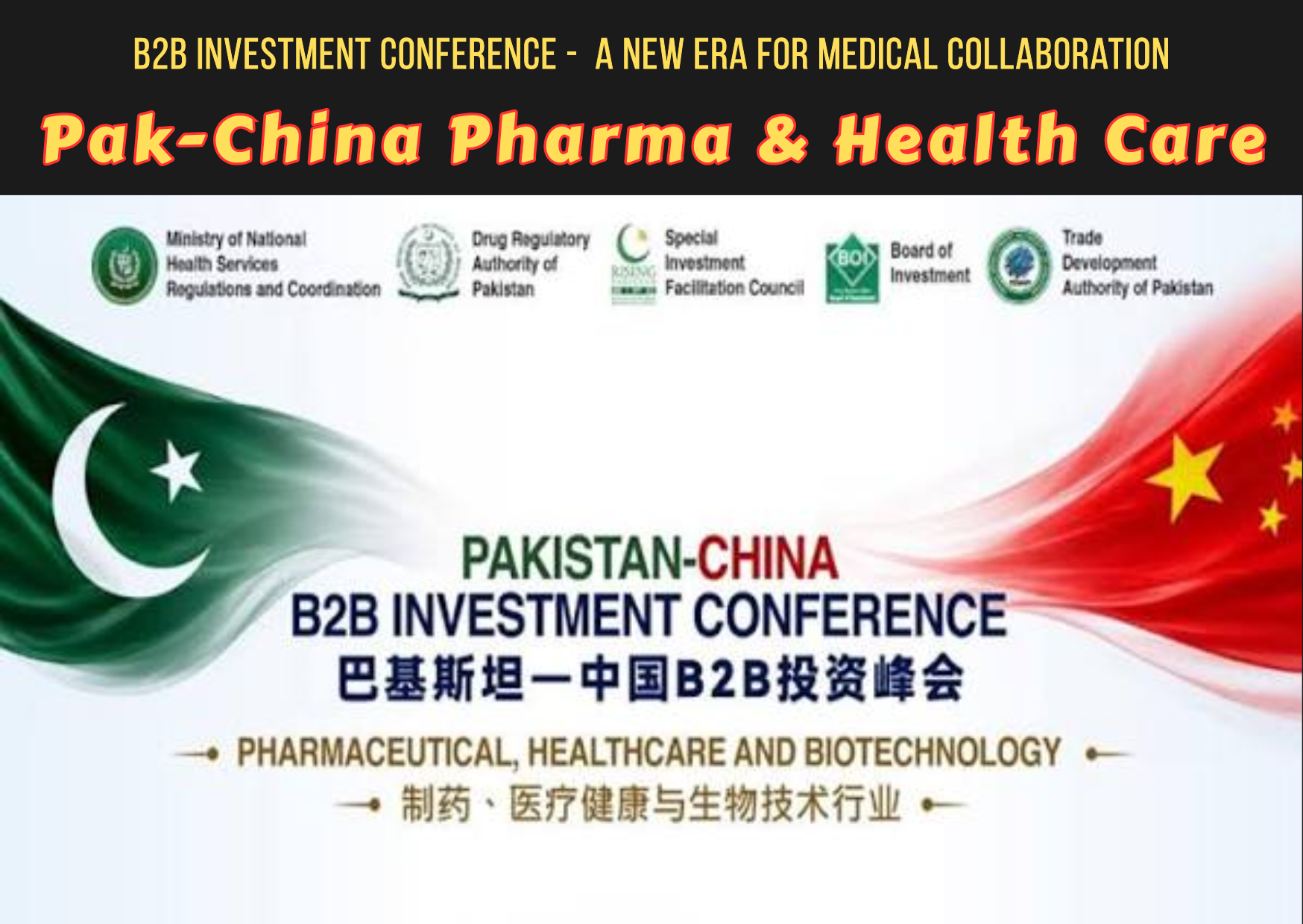
kistan-China Pharmaceutical and Health Care B2B Investment Conference
Historic $850 million in deals signals Pakistan’s bold bid for pharmaceutical self-reliance
(By Quratulain Khalid)
In the sprawling landscape of global pharmaceuticals, one fact stands above all others: China is the world’s largest manufacturer. But what fewer people realise is that China is rapidly becoming the world’s pharmacy as well. That same nation whose traditional herbal remedies were once dismissed as mere household folklore has transformed Traditional Chinese Medicine into a global industry worth $50–60 billion—a figure expected to double within the next decade.
Against this backdrop, a landmark event unfolded in Islamabad on July 17–18, 2026: the Pakistan-China Pharmaceutical and Health Care B2B Investment Conference. Organised through the joint efforts of the Special Investment Facilitation Council (SIFC), the Ministry of National Health Services, and the Drug Regulatory Authority of Pakistan (DRAP), the conference brought together 146 leading Chinese companies with approximately 220 delegates and more than 200 Pakistani companies. By its conclusion, participants had signed agreements valued at approximately $850 million—$600 million in binding deals and $250 million in memorandums of understanding—marking one of the largest business engagements between the two nations in the pharmaceutical and healthcare sectors.
The Conference at a Glance
The two-day event was nothing short of historic in scale. Federal Health Minister Syed Mustafa Kamal, addressing a press conference ahead of the event, described it as a potential “game changer” for Pakistan’s pharmaceutical and healthcare industry. The conference focused on six strategic sectors: active pharmaceutical ingredients (APIs), biotechnology and vaccines, medical devices, generic formulations and injectables, clinical trials and research, and herbal and traditional Chinese medicines.
Special Assistant to the Prime Minister on Industries and Production, Haroon Akhtar Khan, noted that the initiative was fully aligned with Prime Minister Shehbaz Sharif’s vision to accelerate industrial development, increase foreign direct investment, localise manufacturing, and create employment opportunities. The conference featured structured business-to-business meetings, networking sessions, and investment discussions aimed at fostering joint ventures, technology transfer, contract manufacturing, research collaboration, and local production partnerships.
Among the key outcomes, 18 agreements were specifically related to herbal and traditional medicine, reflecting the growing synergy between Pakistan’s rich herbal traditions and China’s advanced capabilities in this domain.
China’s Pharmaceutical Revolution – The Global Context
To understand the significance of this conference, one must first appreciate the extraordinary trajectory of China’s pharmaceutical industry. In 2025, China’s medicine exports reached approximately $100.1 billion, with the product structure continuously optimising. Traditional strong-performing products such as chemical APIs and medical devices have maintained a large share in the global market, while their export scales have steadily increased.
Even more remarkable is China’s surge in pharmaceutical innovation. In 2025, Chinese drugmakers signed a record **$135.7 billion** through **157 cross-border out-licensing deals**—a sharp rise from $51.9 billion across 94 deals in 2024. This remarkable growth signals that the global market is increasingly recognising China’s homegrown innovation. The momentum has continued into 2026, with the total value of out-licensing deals in the first quarter alone approaching $60 billion.
This transformation did not happen by accident. China has invested heavily in research and development, establishing various platforms to dismantle information barriers and supply chain obstacles in cross-border medical trade. The country’s clinical trial infrastructure has expanded dramatically, and China has emerged as a global biotech hub capable of competing with the world’s largest pharmaceutical companies in cancer research, immunotherapy, biologics, and advanced medicines.
Perhaps no single event symbolises this transformation more than the 2015 Nobel Prize awarded to Chinese scientist Tu Youyou for her development of a traditional Chinese herbal remedy for malaria treatment. This breakthrough has since saved millions of lives worldwide and stands as powerful evidence that traditional knowledge can be transformed into globally standard medicines through modern science.
Pakistan’s Pharmaceutical Reality – A Sector in Need
While China has soared, Pakistan’s pharmaceutical sector has struggled with structural challenges that have left it dangerously dependent on foreign suppliers. Currently, Pakistan imports approximately 90 percent of the raw materials required by its pharmaceutical industry—primarily Active Pharmaceutical Ingredients (APIs) from China and India. The country meets only about 15 percent of its API requirements through local production.
This dependency exposes manufacturers to exchange rate fluctuations, global price volatility, and supply chain disruptions, keeping production costs unstable. The situation has been compounded by rising input costs over the past five years: industrial gas prices have increased by 280 percent, electricity by 100 percent, and minimum wage by 60 percent. These pressures have resulted in over 80 percent depreciation on essential medicines, which constitute 40 percent of the market.
The vaccine situation is equally concerning. Pakistan currently imports 13 different types of vaccines. With global vaccine assistance expected to end by 2030, the country’s annual vaccine expenditure is projected to rise from approximately $400 million to **$1.2 billion**. Health Minister Mustafa Kamal has warned that “to remove Pakistan from import dependence, the production of local vaccine is imperative”.
Past failures serve as cautionary tales. Multinational corporations such as MAC have left Pakistan due to regulatory and profitability challenges—a reminder that without investor-friendly policies and a consistent enabling environment, even the most promising opportunities can evaporate.
Key Outcomes and Commitments
The Islamabad conference produced concrete outcomes that could fundamentally reshape Pakistan’s pharmaceutical landscape:
API Manufacturing
The agreements signed will help establish local production of pharmaceutical raw materials, potentially reducing production costs and making medicines more affordable for consumers. This addresses the critical 90 percent import dependency that has long constrained the sector.
Vaccine Production
Pakistan and China signed agreements to begin local vaccine production. The government has already introduced Pakistan’s first National Vaccine Policy, approved by the federal cabinet, aimed at reducing dependence on imported vaccines. The conference saw approximately $350 million in agreements specifically in vaccines and biotechnology.
Technology Transfer
Chinese companies have committed to transferring advanced manufacturing technologies to Pakistan, covering medical devices, clinical trials, and vocational training. These initiatives will strengthen workforce skills and expand the pharmaceutical industry’s capabilities.
Regulatory Reform
Health Minister Mustafa Kamal highlighted significant progress in regulatory reforms. DRAP has digitised more than 80 percent of its services, with applicants now able to apply online for drug licenses and receive them by email within 20 days of registration. Pakistan currently exports medicines to 52 countries under WHO Maturity Level 2 standards, and expects a WHO Level 3 inspection in April 2027 that could grant access to approximately 100 additional export markets.
The Herbal Medicine Dimension
Traditional medicine represents a particularly promising area of collaboration. Traditional Chinese Medicine constitutes approximately 25 to 30 percent of China’s domestic pharmaceutical market, reflecting the deep cultural and economic significance of herbal remedies. The conference’s 18 herbal and traditional medicine agreements signal a mutual recognition of the potential in this sector.
Pakistan has its own rich herbal traditions, and the similarities between Chinese, Pakistani, and Indian herbal practices create a natural foundation for collaboration. While formulation methods and specific ingredients may differ, the underlying philosophy of using natural remedies for health and wellness is shared across these cultures.
The potential extends beyond domestic consumption. With China’s expertise in standardising and commercialising traditional medicine, Pakistan could position itself as a regional hub for herbal medicine production and export. This aligns with the broader vision of leveraging Pakistan’s agricultural resources and traditional knowledge to create value-added pharmaceutical products.
The Policy Imperative
Throughout the conference, one message was repeated with remarkable consistency: policy matters. The success of these agreements depends not on the signatures themselves but on the enabling environment that follows.
Kamran Nasir, Group Managing Director of OBS and CEO of AGP Limited, welcomed the conference and praised the Ministry of Health, SIFC, and DRAP for organising the event, adding that SIFC’s key role in supporting deregulation of Pakistan’s growing pharmaceutical sector has further strengthened investor confidence.
However, as Nasir noted in his interview, the pending policy announcement on biotechnology and vaccines remains critical. “Until the policy comes out, we won’t know what guaranteed offtake the government is committing,” he said. “At the end of the day, if money isn’t being made in any business, that development can never reach that point.”
Deregulation has already played a role in attracting investment. But as Nasir pointed out, consistency is key. Pakistan has always struggled with policy inconsistency, and there is a great need to bring in a consistent, long-term policy framework. The government has announced plans to establish a Special Industrial Zone at Port Qasim, where land will be offered at concessional rates to investors, particularly those planning to export 50 to 70 percent of their production. Such initiatives, if implemented effectively, could transform the investment landscape.
Expert Perspective – Kamran Nasir, CEO AGP Pharma
Kamran Nasir, a veteran of Pakistan’s pharmaceutical industry, offered valuable insights into both the opportunities and challenges facing the sector.
On China’s rise, Nasir observed that “China is becoming a global superpower and a power to reckon with.” He noted that while China started slowly in pharmaceuticals, its policy-level continuity and focus on research have enabled remarkable progress. “In API manufacturing, no one stands equal to China,” he said. “All the raw material feed in the world goes through China.”
On Pakistan’s current position, Nasir acknowledged that the country produces only 15 percent of its own API requirements. “85 percent of our API is imported. This number is still very large, and you know foreign currency is very important for us. For self-reliance, it is crucial that we grow rapidly in API manufacturing.”
On the path forward, Nasir emphasised the importance of exports. “These involve huge volumes, so margins are low. That means naturally you don’t just serve Pakistan; you also have to export.” He highlighted the need for competitive energy costs, investor-friendly policies, and tax incentives to enable Pakistani companies to compete globally.
On deregulation, Nasir was unequivocal: “If the industry doesn’t make money, foreign investment will never come.” He cited the example of MAC, which left Pakistan because regulations and policies made it impossible to generate profits.
Despite these challenges, Nasir’s vision for the future is ambitious: “Our dream is that pharma is the next rising star. Inshallah, by 2032–33, we can export $10 billion in pharmaceuticals. Because we have the skill set, technology, and knowledge.”
Challenges and Risks
For all its promise, the path to pharmaceutical self-reliance is fraught with challenges:
Policy Inconsistency: Pakistan’s history of shifting policies and delayed implementation has deterred long-term investment. The pending policy announcement on biotechnology and vaccines must be followed by consistent execution.
High Energy Costs: With industrial gas prices up 280 percent and electricity up 100 percent over five years, Pakistani manufacturers face a significant cost disadvantage compared to regional competitors.
Infrastructure and Skills: Building modern pharmaceutical production facilities requires substantial investment in infrastructure and workforce development. The conference’s accompanying TVET Forum on Skills Development reflects recognition of this challenge.
Regional Competition: India has long dominated the South Asian pharmaceutical market, and other regional players are also advancing. Pakistan must differentiate itself through quality, cost competitiveness, and strategic partnerships.
Execution Risk: The risk of agreements remaining just MOUs without concrete implementation is real. The transition from signing to execution requires sustained effort from both governments and the private sector.
Quality Control: As Pakistan expands its pharmaceutical production and export capabilities, maintaining rigorous quality standards will be essential for accessing international markets.
The Road Ahead – Recommendations
The Islamabad conference has laid a foundation. What happens next will determine whether this foundation supports a new edifice of pharmaceutical self-reliance or remains an unfulfilled promise. The following recommendations emerge from the conference’s discussions:
1. Move from Assembly to Manufacturing
Pakistan must transition from merely assembling imported components to conducting research, developing formulations, and manufacturing APIs, vaccines, and medical devices locally. This requires investment in R&D infrastructure and human capital.
2. Leverage CPEC and Strategic Ties
The China-Pakistan Economic Corridor (CPEC) provides a framework for technology transfer and industrial cooperation. As one official noted, these partnerships would open new avenues for the promotion of industrial cooperation, health economy, and advanced medical technology under CPEC Phase II.
3. Create a Dedicated Pharma Export Zone
The proposed Special Industrial Zone at Port Qasim, with concessional land rates for exporters, should be prioritised and expanded. Export-oriented policies will enable Pakistani manufacturers to achieve the scale needed for profitability.
4. Build Local R&D Capacity
Pakistan must invest in research institutions, academia-industry linkages, and clinical trial infrastructure. The conference’s focus on clinical trials and research as a strategic sector reflects recognition of this need.
5. Ensure Policy Consistency
The government must demonstrate long-term commitment to pharmaceutical sector development through consistent policies, predictable regulations, and transparent governance. The National Vaccine Policy is a positive step; its implementation will be closely watched.
6. Accelerate Regulatory Reform
DRAP’s digitisation of services is commendable. Further reforms should focus on reducing regulatory bottlenecks, streamlining approvals, and aligning with international standards to facilitate exports.
Timeline for Action
| Timeframe | Priority Actions |
|---|---|
| 1 Year | Finalise and implement pending policies on vaccines and biotechnology; establish Special Industrial Zone incentives; begin technology transfer projects |
| 3 Years | Achieve significant reduction in API import dependency; commence local vaccine production; expand exports to new markets |
| 5 Years | Approach $10 billion pharmaceutical export target; achieve WHO Level 3 certification; establish Pakistan as regional pharmaceutical hub |
Conclusion
The Pakistan-China Pharmaceutical and Health Care B2B Investment Conference of 2026 represents a pivotal moment in Pakistan’s journey toward pharmaceutical self-reliance. With $850 million in agreements, the participation of 146 Chinese companies and over 200 Pakistani firms, and a focus on everything from APIs to vaccines to herbal medicine, the conference has laid the groundwork for a transformation of Pakistan’s healthcare and pharmaceutical sectors.
But as Kamran Nasir aptly noted, “If the industry doesn’t make money, foreign investment will never come.” The success of these agreements depends on policy consistency, regulatory reform, and a genuine commitment to creating an enabling environment for investment and innovation.
The opportunity is historic. China has demonstrated that traditional knowledge can be transformed into globally competitive pharmaceutical products through research, investment, and consistent policy. Pakistan, with its own rich traditions, strategic location, and deep ties with China, has the potential to follow a similar path.
The agreements signed in Islamabad are not an end but a beginning. If Pakistan can move from assembly to research, from import dependence to self-reliance, and from domestic supplier to regional exporter, the coming decade could see the emergence of a pharmaceutical sector that not only meets Pakistan’s healthcare needs but also contributes significantly to its economic prosperity.
The vision is ambitious: $10 billion in pharmaceutical exports by 2032–33. The path is challenging. But for the first time in decades, the pieces are falling into place. The question now is whether Pakistan has the will to seize this moment.