Policy Failure, Food Security, or Vested Interests?
(By Khalid Masood)
1. Introduction
Wheat is not merely a crop in Pakistan. It is the thread that stitches together the nation’s food security, rural economy, political stability, and social fabric. For a country of 240 million people where wheat contributes approximately 72 percent of daily caloric intake and per capita consumption hovers around 124 kilograms per year—among the highest in the world—wheat is nothing less than a strategic asset.
When wheat prices rise, governments fall. When harvests fail, national security trembles.
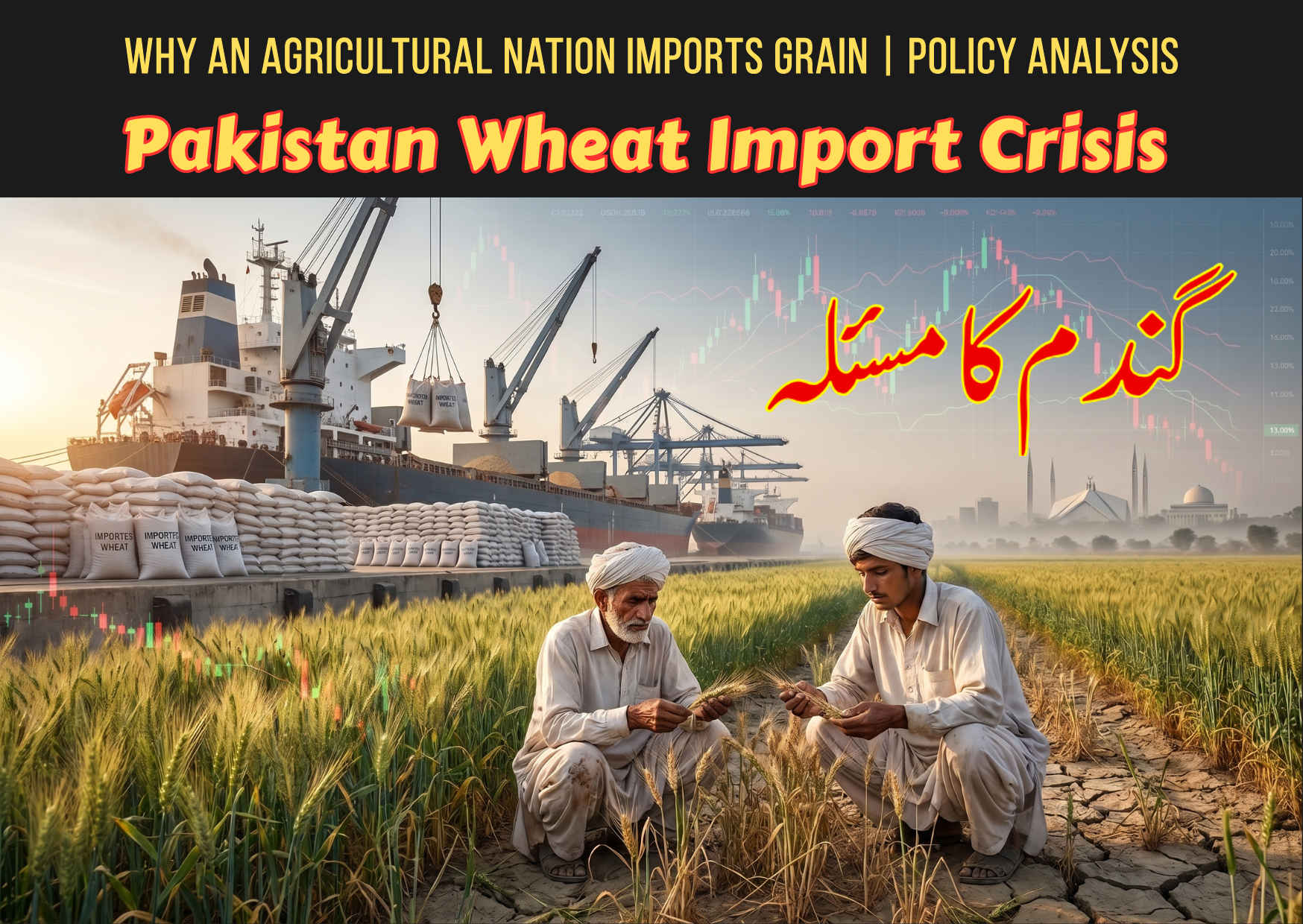
And yet, Pakistan finds itself in a bewildering paradox. In fiscal year 2023-24, the country imported approximately 3.59 million metric tons of wheat, valued at over $1 billion, despite having ample domestic stocks.
The Auditor General of Pakistan later revealed that this import caused a staggering loss exceeding Rs 300 billion, with 4.12 million metric tons of locally produced wheat already sitting in public sector storage when the imports arrived.
In 2024-25, the government abruptly abandoned procurement altogether, leaving farmers without a support price and triggering a 6.8 percent collapse in planted area.
Now, for 2025-26, the USDA forecasts that Pakistan will need to import at least 1.7 million metric tons—perhaps as much as 2 million—while domestic production plunges to 27.5 million metric tons from a record 31.6 million just one year earlier.
This is not a story of inevitable agricultural decline. Pakistan possesses the Indus River system, one of the world’s largest contiguous irrigation networks. It has fertile alluvial soils, a farming population with generations of wheat cultivation experience, and a climate that can support two crop cycles in many regions. The question, therefore, is not whether Pakistan can produce enough wheat. It is why, year after year, it chooses not to—and who benefits from that choice.
This article examines the anatomy of Pakistan’s wheat import dependency through an evidence-based, analytically rigorous lens. It distinguishes between verified facts, documented institutional failures, reasonable inferences from available data, and allegations that remain unproven. The objective is not to indict individuals without evidence, but to illuminate a system that has repeatedly failed its farmers, its consumers, and its treasury.
2. Pakistan’s Wheat Economy
2.1 Scale and Significance
Pakistan is the world’s eighth-largest wheat producer, with average annual output oscillating between 25 and 32 million metric tons over the past decade.
The 2024 harvest delivered a record 31.4 to 31.8 million metric tons, reflecting expanded sowings and favorable weather.
Yet this triumph proved fleeting. By FY2025, production had fallen to approximately 28.98 million metric tons—an 8.9 percent decline.
For 2025-26, the USDA forecasts a further drop to 27.5 million metric tons, driven by a 7 percent reduction in planted area and severe dry weather.
Table 1: Pakistan Wheat Production, Area, and Yield (Selected Years)
| Year | Area (Million Hector Acer) | Production (Million Tons) | Yield (MT/Hector Acre) |
|---|---|---|---|
| 2020-21 | ~8.9 | 27.5 | 3.09 |
| 2021-22 | ~9.2 | 26.4 | 2.87 |
| 2022-23 | ~9.0 | 28.2 | 3.13 |
| 2023-24 | 9.73 | 31.6 | 3.24 |
| 2024-25 | 9.08 | 29.0 | 3.19 |
| 2025-26 (est.) | 9.08 | 27.5 | 3.03 |
Hector Acer = 10,000 square meters ≈ 2.47 Acres
Sources: USDA FAS, Pakistan Bureau of Statistics, Provincial Crop Reporting Services
2.2 Provincial Distribution
The geography of Pakistan’s wheat production is highly concentrated. Punjab province accounts for approximately 77 percent of national output, followed by Sindh at roughly 15 percent.
Khyber Pakhtunkhwa and Balochistan contribute the remainder, largely from rainfed (barani) areas where yields are significantly lower and more vulnerable to climatic variability. This concentration creates systemic risk: when Punjab underperforms, the entire national food security architecture wobbles.
2.3 The Yield Gap
Pakistan’s wheat yields, while improving gradually, remain substantially below those of comparable and competing nations. The country’s average yield of approximately 3.0-3.2 metric tons per hectare compares unfavorably with India’s ~3.5 MT/ha, China’s ~5.8 MT/ha, and the 4.4-7.9 MT/ha achieved by farms in developed countries such as Germany, Poland, and the United States.
Even Australia, with its predominantly rainfed wheat systems, averages around 1.9-2.5 MT/ha—but with vastly lower production costs and superior marketing infrastructure.
This yield gap is not primarily a function of inferior soils or climate. It reflects decades of underinvestment in agricultural research, poor seed quality, inadequate extension services, inefficient water use, and the persistence of suboptimal farming practices across millions of smallholder plots.
2.4 Consumption and the Supply-Demand Balance
Domestic wheat consumption in Pakistan is driven by population growth, dietary habits, and increasing feed use in the poultry sector. Total consumption for 2025-26 is forecast at 31.9 million metric tons, with food, seed, and industrial use accounting for 92.5 percent of demand.
The widening gap between production (~27.5 MT) and consumption (~31.9 MT) leaves a deficit of approximately 4.4 million metric tons, partially covered by carryover stocks but increasingly requiring imports.
3. Why Is Pakistan Importing Wheat?
The question itself has become contested. In mid-2025, the USDA’s Foreign Agricultural Service reported that Pakistan was “unlikely to import wheat” during the current marketing year, citing strong planting progress, restored government procurement of 6.2 million metric tons at a minimum support price of $312 per tonne, and the persistence of subsistence farming even when state procurement was suspended. Pakistan had not imported wheat so far in the marketing year, and the agency expected the trend to hold.
Yet this optimism sits uneasily against the arithmetic of stocks and prices. Ending stocks are projected to collapse from 4.7 million metric tons to just 1.5 million metric tons — barely enough for two to three weeks of national consumption. Wholesale wheat prices in Karachi have climbed to approximately Rs 120-125 per kilogram, well above the levels that prevailed when private imports last stabilized the market. The Cereal Association of Pakistan (CAP), representing the country’s organized wheat traders and flour millers, has formally demanded permission to import 4 million metric tons through the private sector, arguing that state-managed procurement has “repeatedly led to severe financial loss to the national exchequer” and that unrestricted commercial imports would bring prices down to Rs 95-100 per kilogram.
Whether imports materialize or not, the conditions that make them a live policy option are the result of multiple converging pressures.
3.1 Lower Production: The Immediate Trigger
The proximate cause of the 2025-26 supply tightness is straightforward: production has fallen while consumption has risen. The USDA attributes the decline to a 7 percent reduction in planted area and “extremely dry weather” throughout the growing season. Rainfall between September and December 2024 was approximately 40 percent below normal, triggering near-drought conditions. For a crop that depends on irrigation for 85 percent of its area, the absence of supplemental rainfall proved costly.
3.2 Climate Change and Water Scarcity
Pakistan’s wheat crop is increasingly exposed to climate volatility. The 2022 catastrophic floods, which caused over $30 billion in damages and destroyed four million acres of crops, demonstrated the fragility of the agricultural system. But the more insidious threat is chronic water stress.
Canal water availability from April to September 2024 dropped by 3.4 percent compared to 2023, from 61.85 million acre-feet to 59.75 MAF. Many canal systems now deliver 20-40 percent less water than required during peak seasons, forcing farmers to rely on tube wells that consume expensive diesel or electricity. The electricity tariff for agricultural tube wells rose approximately 20 percent above 2023 levels in July 2024, further constraining irrigation capacity.
The irrigation infrastructure itself is deteriorating. The Tarbela and Mangla reservoirs, completed in the 1970s, have lost approximately one-third of their storage capacity to siltation. No new large water reservoirs have been built for decades. Meanwhile, inter-provincial water disputes — particularly between Punjab and Sindh — continue to undermine equitable distribution, with Punjab accused of over-withdrawing its allocated share while Sindh’s canals run dry.
3.3 Input Cost Inflation
The economics of wheat farming in Pakistan have become increasingly unfavorable. A special study by the Auditor General of Pakistan documented the dramatic escalation in production costs between 2017-18 and 2023-24:
| Input | Cost per Acre (2017-18) | Cost per Acre (2023-24) | Increase |
|---|---|---|---|
| DAP Fertilizer | Rs 12,690 | Rs 11,766 | Variable |
| Urea (2 bags) | Rs 4,661 | Rs 7,600 | +63% |
| Tube Well Irrigation | Rs 1,900 | Rs 3,000 | +58% |
| Land Rent (6 months) | Rs 22,500 | Rs 35,000 | +56% |
| Harvesting | Rs 5,500 | Rs 10,000 | +82% |
| Threshing | Rs 4,950 | Rs 9,000 | +82% |
Source: Wheat Policy Analysis for 2023-24 Crop, Government of Pakistan
When these soaring costs collided with collapsing farm-gate prices in 2024 — falling from Rs 4,000 per 40 kg to as low as Rs 2,200-3,000 — farmers faced a margin squeeze that made wheat cultivation economically irrational.
3.4 Seed Quality and Research Deficits
Pakistan’s seed system is fundamentally broken. Certified wheat seed production is insufficient to meet national requirements, and logistic constraints limit distribution. The seed industry — both public and private — produces only a small fraction of required seed, leading to extensive use of farm-saved seeds that are genetically degraded and produce lower yields. Major varieties such as Akbar, Dilkash, and Urooj in Punjab, and Amber and Sunehria in Sindh, were developed in government research institutes decades ago. While they offer rust resistance, their yield potential has not kept pace with international benchmarks.
3.5 Mechanization Gaps
Pakistan’s agricultural mechanization remains primitive by regional standards. Per hectare use of horsepower stands at 1.50, compared to India’s 2.50, China’s 3.88, and Japan’s 7.0. While seedbed preparation is 85 percent mechanized, sowing and planting operations are only 25 percent mechanized, and harvesting stands at just 40 percent. The number of combine harvesters remains inadequate, and most threshing is performed by machines that produce poor grain quality. This selective mechanization creates bottlenecks at critical stages, delaying operations and increasing losses.
3.6 Policy Discontinuity: The Decisive Factor
While climate and costs created headwinds, the decisive factor in the 2024-25 production collapse was policy discontinuity. For the first time in decades, the federal government failed to announce a support price before the autumn 2024 planting season. The USDA’s Foreign Agricultural Service noted: “The sudden change in policy occurred without any prior announcement nor consultation with farmers. Government procurement has always been a major part of wheat marketing in Pakistan. The lack of clarity regarding a guaranteed price for the 2025-26 crop has created uncertainty among farmers regarding how they will market their crop.”
The message to farmers was unmistakable: the government would not guarantee a floor price. Many responded by shifting to alternative crops — canola, pulses, vegetables — or simply reducing wheat acreage. The result was a 6.8 percent decline in planted area, from 9.73 million hectares to 9.08 million hectares.
3.7 The Stock Paradox
The current debate over imports is complicated by a paradox of stocks. On one hand, ending stocks are projected at a dangerously low 1.5 million metric tons. On the other hand, approximately 450,000 metric tons of three-year-old wheat remains in the country, much of it held by PASSCO in deteriorating condition. The traders argue that this aging stock represents the waste of state-managed procurement, while the government insists that restored procurement and a strong planting pace have stabilized supply. The truth is that neither narrative fully captures the reality: stocks are simultaneously too low for comfort and too old to be useful — a dual failure of quantity forecasting and quality management.
3.8 Institutional Coordination Failures
The fragmentation of wheat governance between federal and provincial authorities has created persistent coordination failures. The Ministry of National Food Security and Research, PASSCO, provincial food departments, and the Pakistan Bureau of Statistics operate with limited data sharing and conflicting mandates. The Auditor General’s special study found that the Ministry presented inflated national wheat requirements to the Economic Coordination Committee by including Afghanistan’s demand in Pakistan’s consumption figures — without providing supporting documentation. The Wheat Board, constituted in 2021 to evaluate costs of production and recommend support prices, failed to meet for over 18 months between June 2022 and December 2023. When it did convene, it extended import deadlines without statutory authority and ignored provincial objections to excessive imports.
4. Did Government Policies Discourage Farmers?
4.1 The Support Price Rollercoaster
Pakistan’s wheat support price history reads like a case study in policy volatility. In 2022-23, when international prices surged to $440 per ton, the government raised the support price from Rs 2,200 to Rs 3,900 per 40 kg in a single year—a 56 percent increase that the Auditor General later found exceeded the actual cost of production.
This abrupt hike fueled inflation and imposed massive fiscal costs. Then, in 2024-25, the government eliminated procurement entirely, leaving farmers to face market prices that had collapsed to Rs 2,200-3,000 per 40 kg—below production cost for many.
4.2 The 2024 Procurement Collapse
The consequences of non-procurement were devastating. Punjab, which typically procures around 4 million metric tons, purchased zero wheat from the 2024 harvest.
Sindh procured only 892,000 metric tons against a target of 1 million. PASSCO procured 1.78 million metric tons against a target of 1.4 million—exceeding its target but insufficient to stabilize the market. Overall, public procurement reached only 2.885 million metric tons against a target of 4.75 million—a 40 percent shortfall.
Farmers, unable to sell to the government and facing depressed private market prices, suffered acute financial distress. Many sold below production cost. The Kissan Ittehad Pakistan organized nationwide protests beginning May 10, 2024, demanding government intervention.
4.3 Market Distortions and the Private Sector
The government’s flip-flop between heavy intervention and abrupt withdrawal created market distortions that benefited neither farmers nor consumers. When the government procured aggressively at above-market prices, it crowded out private traders and created artificial shortages. When it withdrew completely, private traders and flour mills exploited farmer desperation with below-cost purchasing. The lack of a stable, predictable policy framework prevented the emergence of efficient private sector marketing channels.
4.4 The Acreage Response
Farmers are rational economic actors. When wheat becomes unprofitable, they shift to alternative crops. The 6.8 percent decline in wheat area in 2024-25 was a direct market response to policy uncertainty and price collapse.
This acreage shift is not easily reversible. Once farmers invest in canola, pulses, or vegetable infrastructure, returning to wheat requires renewed confidence in government commitments—a commodity currently in short supply.
5. The Economics of Wheat Imports
5.1 State-Managed Imports: A Fiscal Hemorrhage
When the government imports wheat directly, the costs extend far beyond the purchase price. In FY2023-24, Pakistan imported 3.59 million metric tons of wheat, spending approximately $1.03 billion in scarce foreign exchange. The Auditor General estimated the total financial impact — including storage, subsidies, and market distortions — at over Rs 310 billion. The government then subsidized the release of this imported wheat to flour mills, creating a fiscal drain at both ends: expensive acquisition and discounted distribution.
The economics are punishing. For 2025-26, with potential import requirements estimated at 1.7-2.0 million metric tons and international FOB prices ranging from $233 (Argentina) to $272 (Canada) per ton, the direct import bill would exceed $400-500 million. Add ocean freight, insurance, port handling, inland transportation, storage, and financing costs, and the total economic burden approaches $600-700 million. When state-managed, these imports also carry the hidden costs of storage losses (3.5 percent in godowns, 8.5-10.5 percent in open storage), bureaucratic delays, and the political economy of subsidized release to favored millers.
5.2 Private Sector Imports: A Different Calculus
The Cereal Association of Pakistan presents an alternative model. In FY2023-24, the private sector imported 2.7 million metric tons of wheat “without using a single penny of public money or subsidies.” According to CAP, these imports stabilized domestic wheat prices from Rs 123 per kilogram down to Rs 95 per kilogram, improved supply chains, and imposed no financial burden on the national exchequer.
This argument has merit in theory. Private importers bear their own financing costs, storage risks, and market losses. They do not require government warehouses, subsidized electricity for storage, or bureaucratic procurement committees. If international prices are favorable — and CAP notes that the Black Sea and South American harvest seasons during July-August 2025 offer “highly competitive international prices” — private imports could indeed cool domestic markets without draining public finances.
However, the private sector model is not without risks. Unregulated private imports can lead to speculative hoarding, price manipulation by large traders, and quality control failures. The same traders who stabilized prices in 2023-24 could just as easily create artificial shortages if import licenses are concentrated in too few hands. CAP’s demand for “open, transparent, and non-discriminatory” import policy is therefore a necessary condition, but not a sufficient guarantee, of consumer benefit.
5.3 The Opportunity Cost
Regardless of who imports, the deeper question is whether Pakistan should be importing at all. Consider what the same resources could achieve if directed toward domestic production:
- Fertilizer subsidies: At Rs 55,838 per acre in traded input costs, the import bill could subsidize improved fertilizer access for millions of acres.
- Certified seed distribution: The seed gap is a primary yield constraint. Investment in certified seed production and distribution could raise yields by 15-20 percent.
- Water efficiency: Drip and sprinkler irrigation systems, laser land leveling, and canal lining could reduce water waste by 30-50 percent.
- Research and extension: Pakistan’s agricultural research institutions are chronically underfunded. A fraction of import costs could revitalize wheat breeding programs.
- Mechanization: Subsidized access to precision planters, combine harvesters, and modern threshers could close the yield gap with India and China.
The arithmetic is compelling. Every dollar spent on imports is a dollar not spent on building domestic productive capacity. Over a five-year cycle, sustained investment in yield-enhancing interventions could add 5-8 million metric tons to domestic production — eliminating import dependency permanently.
5.4 Balance of Payments Impact
Pakistan’s external account remains fragile. The State Bank of Pakistan holds limited foreign exchange reserves, and every dollar spent on wheat imports — whether by government or private sector — is a dollar unavailable for energy, machinery, or debt service. Private imports may spare the treasury, but they still drain the country’s foreign exchange. The macroeconomic vulnerability is identical.
6. The Vicious Cycle
Pakistan’s wheat economy is trapped in a recurring cycle that can be diagrammed as follows:
Government discourages farmers → Production falls → Prices rise → Government imports wheat → Imports depress future farmer confidence → Farmers reduce cultivation → Government imports again
This cycle has repeated at roughly 7-10 year intervals. Production declined by 6 percent between 2017-18, 7 percent between 2011-12, and 9.8 percent between 2000-01. Each decline was followed by imports, price spikes, and political crises.
6.1 Policy Inconsistency as Root Cause
The cycle’s engine is policy inconsistency, not agricultural inevitability. When international prices are high, the government raises support prices aggressively, encouraging overproduction. When international prices collapse, the government abandons farmers to “market forces,” destroying planting incentives. The result is a boom-bust pattern that serves no stakeholder well.
6.2 Can Private Imports Break the Cycle?
The Cereal Association of Pakistan argues that removing the state from procurement and import decisions altogether would break this cycle. Their logic is straightforward: if the government stops distorting prices through erratic procurement, farmers will respond to genuine market signals; if the private sector handles imports transparently, supply will stabilize without fiscal drain; and if the state focuses on research, extension, and infrastructure rather than grain trading, long-term productivity will improve.
This argument deserves serious consideration, but it is not conclusive. India’s experience demonstrates that stable public procurement can provide planting certainty without the volatility Pakistan has experienced. Australia’s model shows that market-driven systems work — but only with world-class infrastructure and low production costs that Pakistan does not possess. The risk of a purely private import model in Pakistan’s context is that traders, not farmers, would capture the benefits of international price arbitrage, while farmers remain exposed to domestic price swings without a support price floor.
A more likely path is a hybrid: the government guarantees a minimum support price and maintains a modest strategic reserve, while allowing private sector imports under transparent, competitive, and non-discriminatory rules when stock-to-use ratios fall below defined thresholds. This would provide farmers with planting certainty while preventing the fiscal catastrophes of state-managed bulk imports.
6.3 Institutional Weakness
The institutions charged with managing wheat policy lack the capacity for strategic planning. The Ministry of National Food Security failed to accurately forecast stocks in 2023-24. PASSCO, with a covered storage capacity of only 572,482 metric tons against strategic reserve requirements of 2 million metric tons or more, could not absorb market surpluses. Provincial food departments operate with outdated data and limited coordination.
6.4 Rent-Seeking and Regulatory Capture
While no court has convicted specific individuals of corruption in wheat imports, the structure of the wheat trade creates inherent rent-seeking opportunities. Import licenses, port allocations, storage contracts, and subsidized flour distribution all concentrate economic power in the hands of a small number of traders, millers, and transporters. The World Bank has noted that when public procurement crowds out private traders at above-market prices, it limits market activity and denies farmers essential market services.
7. Is Corruption a Possibility?
This section requires exceptional care. The distinction between evidence, reasonable suspicion, inference, and conspiracy theory must be maintained rigorously.
7.1 What the Evidence Shows
The Auditor General of Pakistan’s Special Study on Wheat Procurement/Import, published in 2024-25, documented multiple governance failures:
- Excessive import: 3.59 million metric tons were imported despite 4.643 million metric tons of closing stocks in April 2024.
- Inflated requirements: Afghanistan’s wheat demand was included in Pakistan’s national requirement calculations without justification.
- Delayed MSP announcement: The minimum support price for 2022-23 was determined on March 1, 2023—after harvesting had already begun—denying farmers planting-season certainty.
- Wheat Board dysfunction: The Board failed to meet for 18 months, extended import deadlines without authority, and ignored provincial objections.
- Procurement shortfalls: Punjab procured zero wheat in 2024-25 against a 2 million metric ton target.
These findings constitute documented institutional failure. They do not, by themselves, prove criminal corruption.
7.2 The 2024 Scandal and Investigations
In response to the 2024 crisis, Prime Minister Shehbaz Sharif established an inquiry committee and suspended PASSCO’s Managing Director and General Manager of Procurement for “negligence and non-compliance.”
The Secretary of Food Security was also suspended. Media reports suggested that from August 2023 to March 2024, wheat worth Rs 330 billion was imported by the caretaker government, of which 1.3 million metric tons was allegedly found unfit for human consumption due to fungus—though the Information Minister denied this claim.
7.3 Why Import Contracts Attract Scrutiny
Food import contracts are inherently vulnerable to corruption globally. The combination of urgent need, limited suppliers, opaque pricing, and emergency procurement procedures creates conditions favorable to rent extraction. International examples abound—from India’s rice import scandals to Egypt’s wheat procurement corruption cases. In Pakistan’s context, the repeated pattern of unnecessary imports, followed by investigations, followed by limited accountability, naturally generates public suspicion.
7.4 A Balanced Assessment
No public evidence has established that specific individuals profited illegally from wheat imports. However, the Auditor General’s findings demonstrate systemic governance failures that created conditions where corruption could occur. The burden of proof lies with investigators and courts—not with journalists. What can be stated with confidence is that repeated opaque procurement processes, institutional dysfunction, and the absence of transparent competitive bidding justify demands for radical transparency. The government’s failure to publish comprehensive import justifications, procurement criteria, and contractor selection methodologies has itself become a policy failure.
8. International Comparisons
How do other major wheat-producing and consuming nations manage their grain economies?
8.1 India
India, with comparable climatic conditions and a smallholder-dominated farm structure, maintains a robust Minimum Support Price (MSP) system announced before each planting season. The Food Corporation of India procures 25-30 percent of domestic production, maintaining strategic reserves of 20-30 million metric tons.
While this system has fiscal costs and market distortions, it provides farmers with planting certainty and consumers with price stability. India’s wheat yields, at approximately 3.5 MT/ha, exceed Pakistan’s by 10-15 percent.
8.2 Australia
Australia’s wheat sector is almost entirely market-driven, with minimal government intervention. The GrainCorp and CBH Group operate efficient bulk handling and storage networks. Average yields are lower than Pakistan’s (1.9-2.5 MT/ha), but production costs are among the world’s lowest, and quality premiums are captured through sophisticated marketing. Australia’s success lies in infrastructure, not subsidies.
8.3 China
China maintains rigid government procurement at floor prices, combined with massive strategic reserves estimated at 40-50 percent of annual consumption.
The government invests heavily in agricultural research, achieving yields of 5.8 MT/ha. While China’s system is fiscally expensive and creates market distortions, it has ensured that the world’s most populous nation has not faced wheat import dependency for decades.
8.4 Canada and the United States
Both countries rely on crop insurance, revenue protection programs, and futures markets to stabilize farmer incomes rather than direct price intervention. The Canadian Wheat Board’s privatization demonstrated that efficient grain marketing can function without government procurement. Yields in these countries range from 3.1 to 3.5 MT/ha, with highly efficient logistics keeping costs competitive.
8.5 Lessons for Pakistan
Pakistan’s challenge is unique: it cannot afford China’s fiscal burden, lacks Australia’s infrastructure, and cannot replicate Canada’s market institutions overnight. The most relevant model may be a hybrid approach: guaranteed minimum prices announced before planting (as India does), combined with investment in storage infrastructure (as Australia has), and gradual private sector development supported by transparent public procurement.
9. Institutional Failures
9.1 PASSCO: A Corporation in Crisis
The Pakistan Agricultural Storage and Services Corporation, established in 1973, has become a symbol of institutional decay. Its covered storage capacity of 572,482 metric tons is grossly inadequate for a country requiring strategic reserves of 2-6 million metric tons.
Its liabilities total approximately Rs 528 billion, and the Economic Coordination Committee approved its winding-up in late 2024—though the process was later put on hold.
PASSCO’s storage losses, estimated at 3.5 percent over five months in godowns and 8.5-10.5 percent in open storage, represent massive waste.
9.2 Ministry of National Food Security and Research
The Ministry’s failures are extensively documented in audit reports. It presented inflated consumption figures to justify imports. It failed to coordinate with provincial departments. It did not ensure that the Wheat Board met regularly. And it ignored provincial warnings that stocks were adequate before authorizing massive imports.
9.3 Provincial Food Departments
Punjab’s decision to procure zero wheat in 2024-25—while other provinces made limited purchases—created a vacuum that private traders exploited. The provincial food departments operate with outdated stock management systems, limited digital integration, and political interference in release decisions.
9.4 Agricultural Research and Extension
Pakistan’s wheat varieties are aging. Extension services reach a fraction of farmers. The gap between research station yields and farm-level yields exceeds 50 percent in many districts. Without revitalized research and effective extension, yield stagnation is inevitable.
10. Political Economy of Wheat
10.1 The Flour Mill Lobby
Pakistan has approximately 1,000 private flour mills meeting about 40 percent of flour demand. These mills have a vested interest in cheap wheat — whether domestic or imported. When government stocks are released at subsidized prices, mills benefit. When imports arrive, mills gain access to cheaper international grain. The mills’ political influence ensures that their interests are represented in policy deliberations, often at the expense of farmers.
10.2 Traders and the Cereal Association of Pakistan
The organized wheat trading lobby, represented by the Cereal Association of Pakistan (CAP), has emerged as a formidable political economy actor. CAP Chairman Muzammil Chappal has positioned the association as the voice of market efficiency, arguing that state-managed procurement has caused “severe financial loss to the national exchequer” and that private sector imports are the only viable path forward.
The traders’ argument is strategically potent because it contains a kernel of truth: private sector imports in FY2023-24 did stabilize prices without direct fiscal cost, while PASSCO’s 450,000 metric tons of aging stock represents tangible evidence of state mismanagement. However, the traders’ interests are not identical to consumers’ interests. Unrestricted private imports, if concentrated among a few large operators, could create new forms of market power. CAP’s demand for “non-discriminatory” import policy is a rhetorical commitment to competition; whether the actual policy would deliver competition depends on licensing rules, port access, and credit availability that remain undefined.
The traders also benefit from the government’s storage failures. If PASSCO godowns are full of deteriorating three-year-old wheat, the private sector’s modern silos and just-in-time logistics become comparatively more attractive. The political economy of wheat is therefore not simply a contest between state and market; it is a contest between different configurations of market power, each with its own claims to efficiency and public interest.
10.3 Middlemen and the Arhtiya System
The “arhtiya” system — commission agents who advance credit to farmers and control market access — exerts enormous influence over wheat marketing. When government procurement is absent, these middlemen dictate prices. When procurement occurs, they often capture a portion of the support price through informal arrangements. The Auditor General explicitly warned that policy failures strengthen “hoarders and middlemen mafia.”
10.4 Federal-Provincial Conflict
Agriculture is a provincial subject under Pakistan’s constitution, yet food security is a federal concern. This division creates persistent tension. Punjab’s unilateral decisions on procurement and inter-provincial movement restrictions directly impact Sindh, KP, and Balochistan. The 2025-26 federal wheat policy explicitly removed inter-provincial movement restrictions — a tacit admission that provincial barriers had worsened national food security.
10.5 The IMF Factor
Pakistan’s wheat policy cannot be understood without reference to its IMF program. The Fund had previously prohibited federal and provincial governments from direct market interventions to curb fiscal leakages and price distortions. The 2025-26 procurement policy, targeting 6.2 million metric tons at Rs 3,500 per 40 kg, required explicit IMF approval. While fiscal discipline is necessary, the IMF’s constraints have at times prevented the government from providing the policy certainty farmers need.
11. Food Security Implications
11.1 National Security
A nation that cannot feed itself cannot defend itself. Pakistan’s wheat import dependency creates strategic vulnerability. International supply disruptions—whether from the Russia-Ukraine conflict, export bans by major suppliers, or shipping route disruptions—could leave Pakistan exposed. The country’s storage capacity of approximately 30 days of consumption is dangerously low by international standards.
11.2 Inflation and Poverty
Wheat price movements directly drive Pakistan’s consumer price index. Food inflation reached 25 percent in early 2024 but declined to negative territory by early 2025, partly due to the import glut.
However, this short-term consumer benefit came at the cost of farmer impoverishment. The rural poverty impact of depressed wheat prices is severe: smallholders who sold at Rs 2,200-3,000 per 40 kg faced losses that will constrain their ability to plant future crops.
11.3 Foreign Exchange and Economic Sovereignty
Each import cycle drains Pakistan’s foreign exchange reserves and increases external debt. The $1.03 billion spent on wheat imports in FY2023-24 represented resources that could have funded critical infrastructure, education, or health investments. Repeated import dependency erodes economic sovereignty.
12. Policy Recommendations
12.1 Stable Long-Term Wheat Policy
Pakistan needs a multi-year wheat policy framework — enshrined in legislation, not subject to annual ministerial whim — that guarantees:
- Support prices announced 90 days before planting
- Minimum procurement quantities by province
- Transparent import triggers based on stock-to-use ratios
- Automatic release mechanisms when prices exceed thresholds
12.2 Transparent Import Criteria — Regardless of Who Imports
Whether imports are conducted by the state or the private sector, the criteria for triggering imports must be transparent, rule-based, and publicly auditable. The current system — in which import decisions appear to emerge from opaque ECC deliberations influenced by shifting political pressures — must be replaced by a published stock-to-use ratio threshold (for example, imports triggered when stocks fall below 30 days of consumption). Import tenders, whether issued by TCP or licensed private importers, should be published in real time with bid awards, pricing, and supplier details accessible to the public. The Auditor General explicitly recommended “a centralized digital dashboard that allows visibility of grain procurement, stockpiles, and storage capacity across federal and provincial lines.” This recommendation should apply equally to state and private sector stocks.
12.3 Digital Crop Forecasting and Satellite Monitoring
Pakistan must replace guesswork with data. AI-based yield prediction models, satellite monitoring of crop health, and real-time stock dashboards can prevent the forecasting failures that led to the 2023-24 import disaster.
12.4 Modern Storage Infrastructure
PASSCO’s 572,482 metric tons of covered capacity is inadequate. Pakistan needs an additional 2-3 million metric tons of modern silo storage, built through public-private partnerships. The Rs 25 billion planned project for 1 million metric tons of new silo capacity is a start, but acceleration is essential. Private sector storage investment should be incentivized through tax credits and land allocation, reducing the burden on public warehouses.
12.5 Competitive and Transparent Imports
When imports are necessary, they must be procured through open international tenders, with bid awards published in real time. Independent audits by the Auditor General and parliamentary oversight by the Public Accounts Committee must be mandatory. If private sector imports are permitted, licensing must be non-discriminatory, with caps on individual operator market share to prevent cartelization.
12.6 Farmer Support Beyond Price Floors
Support prices alone are insufficient. Pakistan needs:
- Crop insurance: To protect farmers from climate and price shocks
- Input subsidies: Targeted fertilizer, seed, and fuel subsidies
- Credit access: Interest-free loans tied to planting decisions
- Water efficiency: Massive investment in drip irrigation, laser leveling, and canal modernization
- Mechanization: Leasing programs for precision planters and combine harvesters
12.7 Agricultural Research Revitalization
Wheat breeding programs must be funded to develop heat-resistant, high-yielding varieties suited to Pakistan’s changing climate. Certified seed production must increase from its current inadequate levels to cover at least 50 percent of planted area.
12.8 Water Resource Management
The Indus Waters Treaty crisis, climate change, and chronic mismanagement demand urgent action. New reservoir construction, canal lining, drip irrigation subsidies, and equitable inter-provincial water allocation are not optional — they are prerequisites for wheat self-sufficiency.
13. Conclusion
Pakistan’s wheat import dependency is not an agricultural inevitability. It is a policy choice — repeatedly made, repeatedly regretted, and repeatedly paid for by farmers, consumers, and taxpayers.
The evidence is clear: Pakistan possesses the land, water, climate, and human capital to produce sufficient wheat for its population. What it lacks is institutional coherence, policy continuity, and political will. The cycle of discouraging farmers, importing grain, and then investigating scandals has repeated for decades.
Yet the current moment is different from previous cycles because the terms of the debate have shifted. The government has restored procurement — 6.2 million metric tons at Rs 3,500 per 40 kg — and the USDA’s Foreign Agricultural Service believes Pakistan is “unlikely to import” in 2025-26. But the Cereal Association of Pakistan, armed with the tangible evidence of 450,000 metric tons of aging PASSCO stock and the memory of private imports that stabilized prices without fiscal cost, is pushing aggressively for deregulated private sector imports. Wholesale prices in Karachi are rising. Ending stocks are projected at a precarious 1.5 million metric tons. The Black Sea harvest offers competitive prices. The policy experiment is live, and its outcome is genuinely uncertain.
Corruption cannot be established as fact without judicial findings. But the conditions for corruption — opacity, urgency, concentrated decision-making power, and weak oversight — are unmistakably present. The Auditor General’s findings of excessive imports, inflated requirements, and institutional dysfunction create reasonable suspicion that demands thorough, independent investigation. Those responsible for documented failures must be held accountable, not merely transferred or suspended.
More importantly, the burden of proof must shift. It is not the public’s responsibility to prove that wheat imports were corrupt; it is the government’s responsibility to demonstrate that they were necessary, competitively procured, economically justified, and free from conflicts of interest — whether conducted by TCP or licensed private traders. Transparency is not a favor to be granted; it is a precondition for legitimacy.
Pakistan stands at a crossroads. The Wheat Policy 2025-26, with its restored support price and expanded procurement target, represents a partial correction. But partial corrections have failed before. What is needed is a comprehensive, legislated, multi-year agricultural transformation strategy that treats wheat not as a political football contested between state bureaucrats and private traders, but as the strategic national asset it truly is. That strategy must include guaranteed planting-season price signals, digital stock monitoring, modern storage infrastructure, transparent import triggers, and massive investment in the research, water, and seed systems that determine whether Pakistan grows its own grain or buys someone else’s.
The alternative is more of the same: distressed farmers, expensive imports, periodic scandals, and a nation that grows enough grain to feed its people yet somehow never manages to do so. Pakistan deserves better. Its farmers deserve better. And its future depends on getting this right.