A Strategic Analysis of India’s Domestic Politics, Regional Security, and the Future of South Asia
(By Khalid Masood)
Introduction
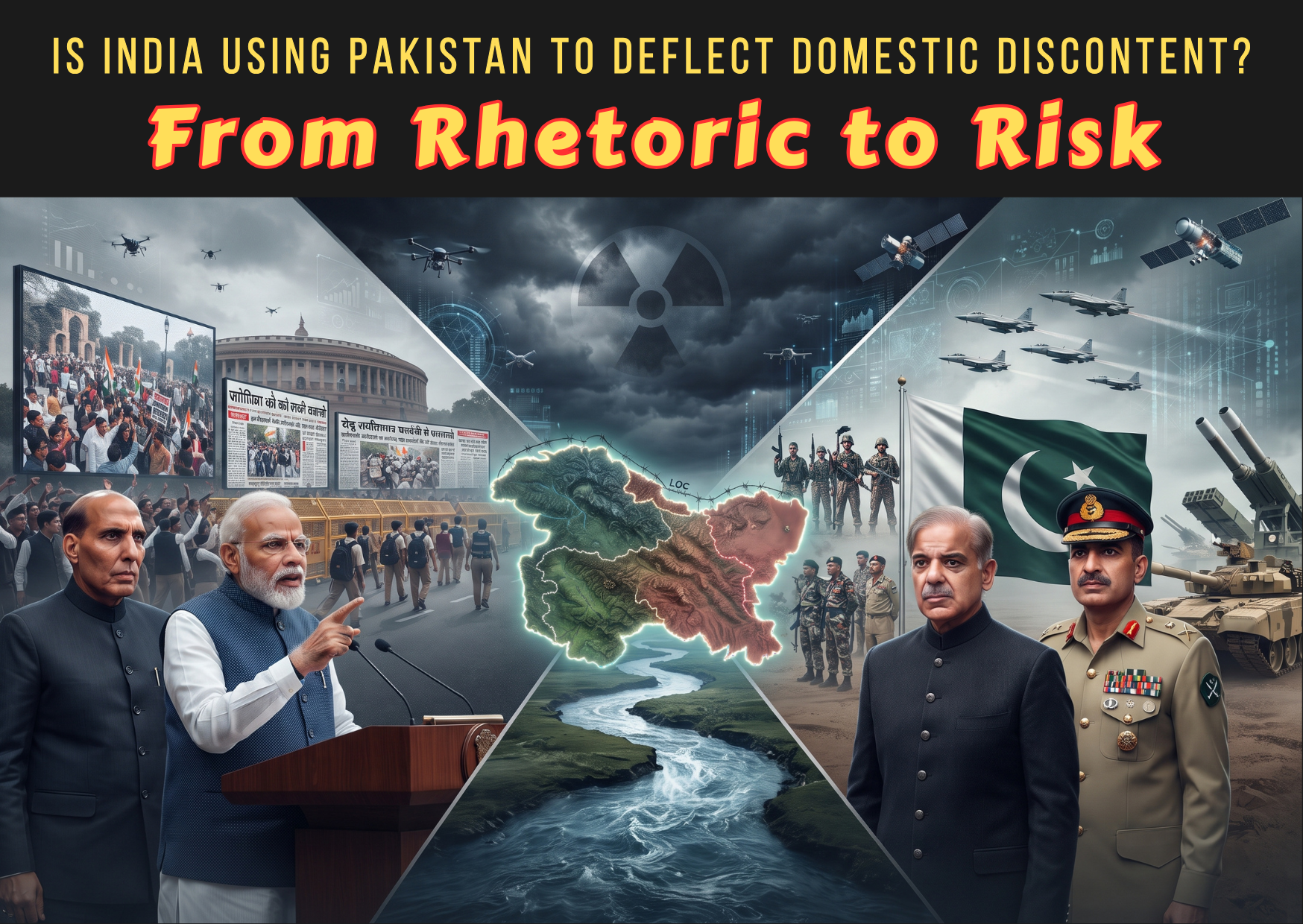
Relations between India and Pakistan have once again entered a period of heightened tension. Speaking on the occasion of the 26th Kargil Vijay Diwas, Indian Defence Minister Rajnath Singh adopted a hardline stance, declaring that any future dialogue with Pakistan would be confined to what India calls Pakistan-occupied Kashmir (PoK). He further warned that any future “misadventure” by Pakistan would invite consequences “beyond their imagination.”
The most controversial remark, however, was his assertion:
“India is manufacturing semiconductors, while Pakistan is producing suicide bombers.”
Such statements may resonate with nationalist audiences, but they also deepen mistrust between two nuclear-armed neighbours whose relationship has been defined by wars, crises, and an unresolved Kashmir dispute.
The remarks also came at a politically significant moment.
Only weeks earlier, India had witnessed widespread public unrest over examination paper leaks, youth unemployment, and governance issues. Thousands of students gathered at New Delhi’s Jantar Mantar before marching toward Parliament, demanding accountability and reforms. The protests became one of the largest youth mobilizations in recent years and placed the BJP government under considerable political pressure.
Against this backdrop, many analysts in Pakistan argue that the renewed emphasis on Pakistan deserves closer scrutiny. While New Delhi maintains that its statements reflect legitimate national security concerns, critics believe the timing raises an important question:
Is the recent escalation in anti-Pakistan rhetoric driven solely by strategic considerations, or is it also influenced by domestic political calculations?
This article explores that question through the lens of recent events, historical experience, and regional security dynamics.
India’s Domestic Crisis and the Return of the Pakistan Narrative
Politics and foreign policy often intersect.
Throughout history, governments facing domestic criticism have sometimes emphasized external security challenges to rally public support. Political scientists describe this as the “Rally Around the Flag” effect, whereby external threats encourage national unity during periods of internal political stress.
India’s recent domestic situation provides important context.
Over the past several weeks, allegations of examination paper leaks, recruitment irregularities, and growing youth unemployment triggered nationwide protests. Thousands of students assembled at Jantar Mantar before launching a “March to Parliament” campaign demanding transparency and accountability.
Images of police barricades, detained protesters, and emotional interviews with disappointed students dominated television channels and social media.
The controversy eventually culminated in the resignation of the Education Minister, dealing a political setback to the government and shifting national attention toward governance issues.
At the same time, criticism from opposition parties intensified, questioning the government’s handling of youth employment, education, and institutional reforms.
It was during this politically sensitive period that Pakistan once again became a central subject of official speeches and televised debates.
For many Pakistani observers, the sequence of events appears noteworthy.
The renewed emphasis on Pakistan coincided with growing domestic dissatisfaction, prompting some analysts to argue that national security issues were once again becoming a dominant political narrative.
Supporters of the Indian government reject this interpretation, arguing that Pakistan remains a genuine security concern and that strong statements merely reflect India’s long-standing strategic policy.
The reality is that both explanations can coexist.
Governments often respond to real security challenges while also recognizing the political value of demonstrating strength before domestic audiences.
Media, Nationalism and Public Opinion
An equally important factor is the role of television and digital media.
Critics frequently refer to sections of India’s television news industry as “Godi Media,” alleging that some broadcasters amplify government narratives while giving comparatively less attention to issues that may be politically uncomfortable for the ruling establishment.
Supporters reject this characterization, arguing that these channels simply adopt a strongly nationalist editorial approach.
Regardless of where one stands, there is little doubt that television has become an important instrument in shaping public opinion.
During periods of India-Pakistan tension, prime-time debates often become highly emotional, portraying bilateral relations in military rather than diplomatic terms.
For Pakistan, this media environment contributes to an atmosphere in which confrontation receives greater public attention than dialogue.
Information warfare has become an important component of modern conflict.
Winning public opinion is increasingly viewed as important as maintaining military preparedness.
Rajnath Singh’s Speech: Strength or Political Messaging?
Against this backdrop, Rajnath Singh’s Kargil Vijay Diwas speech assumes greater significance.
Its principal messages are summarized below.
| Statement | Possible Strategic Objective |
|---|---|
| Dialogue only on India’s position regarding Kashmir | Reinforce India’s uncompromising territorial stance. |
| Warning of consequences “beyond imagination” | Demonstrate military confidence and deterrence. |
| “India makes semiconductors; Pakistan makes suicide bombers.” | Appeal to nationalist audiences while portraying Pakistan negatively. |
From India’s perspective, these remarks project confidence and resolve.
From Pakistan’s perspective, they reduce the already limited space available for diplomatic engagement.
Pakistan has consistently rejected allegations portraying it as a sponsor of terrorism, pointing to the enormous sacrifices made by its civilians and armed forces during two decades of counterterrorism operations.
The concern is not merely the language itself but its cumulative effect.
When political leaders repeatedly employ confrontational rhetoric, public expectations harden, compromise becomes politically costly, and diplomatic flexibility diminishes.
As former UN Secretary-General Kofi Annan observed:
“Knowledge is power. Information is liberating.”
In today’s geopolitical environment, information has become a strategic weapon capable of shaping both domestic politics and international perceptions.
Lessons from the 2025 India-Pakistan Military Confrontation
The recent escalation in political rhetoric cannot be understood without considering the military crisis that shook South Asia in 2025.
Following the Pahalgam terrorist attack in April 2025, India accused Pakistan-based elements of involvement. Pakistan strongly denied the allegations, condemned the attack, and called for an independent international investigation.
Instead of diplomatic engagement, both countries rapidly entered one of their most dangerous confrontations since the Kargil conflict.
Missile strikes, drone operations, aerial engagements, artillery exchanges, cyber activities, and information warfare quickly transformed the crisis into a multidimensional conflict.
Unlike previous confrontations, modern technology compressed decision-making timelines dramatically.
Military actions were accompanied by digital campaigns, satellite imagery, social media narratives, and continuous television coverage.
The world once again witnessed how rapidly tensions between two nuclear powers could escalate.
Although international diplomacy eventually helped reduce tensions, the confrontation left deep political scars that continue to shape bilateral relations today.
For many Pakistani analysts, the events of 2025 demonstrated that South Asia remains dangerously vulnerable to miscalculation, particularly when political rhetoric becomes increasingly uncompromising.
Operation Bunyan-un-Marsoos: Pakistan’s Strategic Response
Pakistan responded to the military escalation through Operation Bunyan-un-Marsoos, presenting it as a defensive military operation intended to restore deterrence and protect national sovereignty.
Pakistani military officials maintained that the operation was designed to respond proportionately while avoiding unnecessary escalation.
From Islamabad’s perspective, the operation reinforced several strategic realities.
| Strategic Lesson | Why It Matters |
|---|---|
| Escalation can occur within hours. | Modern conflicts leave little time for diplomacy once hostilities begin. |
| Credible deterrence remains essential. | Military preparedness continues to play a central role in preventing larger wars. |
| Information warfare is now a battlefield. | Public perception increasingly shapes strategic outcomes. |
| Diplomacy remains indispensable. | Military operations alone cannot resolve political disputes. |
Pakistan’s leadership argued that while the country remains committed to regional peace, it cannot ignore actions that threaten its sovereignty or territorial integrity.
The crisis also highlighted the increasing importance of emerging technologies such as drones, cyber capabilities, artificial intelligence, and electronic warfare in future conflicts.
Military superiority today depends not only on conventional weapons but also on technological innovation and information dominance.
Water, Kashmir and Regional Stability
While military tensions remain the most visible aspect of India-Pakistan relations, they are only one part of a much larger strategic picture.
Following the 2025 crisis, India’s decision to suspend its participation in the Indus Waters Treaty (IWT) added another dimension to bilateral tensions.
For over six decades, the treaty survived wars, political crises, and prolonged diplomatic deadlock.
Its endurance was often cited as evidence that practical cooperation could continue even when political relations deteriorated.
For Pakistan, however, the treaty is more than a water-sharing agreement.
The Indus River system supports the country’s agriculture, food security, hydroelectric generation, and millions of livelihoods.
Any uncertainty regarding water availability therefore carries profound strategic implications.
Islamabad has consistently argued that disputes over the treaty should be resolved through the legal mechanisms established under the agreement rather than through unilateral measures.
Water security has now become intertwined with national security.
Alongside the water issue remains the unresolved dispute over Jammu and Kashmir, which continues to define India-Pakistan relations.
India maintains that Jammu and Kashmir is an integral part of the Indian Union.
Pakistan maintains that Kashmir remains an internationally recognized disputed territory whose future should be resolved peacefully in accordance with international law and the aspirations of the Kashmiri people.
These competing positions remain the principal obstacle to lasting normalization.
No amount of political rhetoric can erase the fact that Kashmir continues to dominate the strategic relationship between the two countries.
Nuclear Powers Cannot Afford Political Theatre
India and Pakistan have now lived under nuclear deterrence for more than a quarter century.
While nuclear weapons have arguably prevented full-scale war, they have not prevented repeated crises.
| Major Crisis | Strategic Outcome |
|---|---|
| Kargil Conflict (1999) | Limited conventional conflict under the nuclear shadow. |
| Parliament Crisis (2001–02) | Massive troop mobilization without general war. |
| Pulwama–Balakot (2019) | Air strikes and aerial engagements between nuclear powers. |
| India–Pakistan Crisis (2025) | Multi-domain conflict involving missiles, drones, cyber operations, and information warfare. |
Each crisis has reinforced the same lesson.
Military escalation between nuclear powers can occur even when neither side seeks all-out war.
Political speeches, media narratives, and public expectations therefore assume strategic importance.
Responsible leadership requires careful communication.
National security is strengthened not only through military capability but also through restraint, diplomacy, and effective crisis management.
Pakistan’s Strategic Response
Pakistan has consistently maintained that it seeks peaceful relations with all neighboring countries while preserving its ability to defend its sovereignty.
Following the 2025 confrontation, Pakistan’s civilian and military leadership emphasized four priorities:
- Maintaining credible deterrence.
- Pursuing dialogue based on mutual respect.
- Defending Pakistan’s position on Kashmir through diplomatic means.
- Strengthening economic resilience as the foundation of national security.
Field Marshal Syed Asim Munir has repeatedly stressed that Pakistan desires peace but remains fully prepared to respond to aggression.
Prime Minister Shehbaz Sharif has likewise reiterated Pakistan’s willingness to engage in comprehensive dialogue provided all outstanding issues—including Kashmir and water disputes—are addressed.
From Pakistan’s perspective, peace and preparedness are complementary rather than contradictory.
Diplomacy is most effective when supported by national strength.
Looking Beyond Confrontation
The greatest tragedy of persistent hostility is the opportunity it denies both nations.
India and Pakistan together represent nearly one-quarter of humanity.
Both possess young populations, expanding technological sectors, growing digital economies, and immense entrepreneurial talent.
Yet enormous financial resources continue to be devoted to managing conflict instead of accelerating development.
Imagine a South Asia where cooperation replaced confrontation.
Cross-border trade could expand significantly.
Energy connectivity could reduce costs.
Academic partnerships could accelerate innovation.
Joint efforts on climate change, water management, public health, and artificial intelligence could benefit hundreds of millions of people.
History demonstrates that former rivals can become economic partners.
Europe rebuilt itself after devastating wars.
Southeast Asia transformed regional rivalries into economic cooperation.
South Asia deserves the same opportunity.
Conclusion
Rajnath Singh’s latest remarks undoubtedly reflect India’s increasingly assertive posture toward Pakistan. However, viewed alongside recent domestic political developments—including youth protests, governance controversies, and growing public dissatisfaction—the timing has naturally generated debate regarding the relationship between domestic politics and foreign policy messaging.
Whether one accepts that interpretation or not, one reality is beyond dispute.
Escalating rhetoric between two nuclear-armed neighbors serves neither regional stability nor long-term prosperity.
The events of 2025 demonstrated how quickly political tensions can evolve into military confrontation. They also demonstrated the importance of credible deterrence, responsible leadership, and sustained diplomatic engagement.
For Pakistan, the path forward lies in strengthening its economy, modernizing its technological capabilities, maintaining credible national defense, and continuing to advocate peaceful resolution of disputes through dialogue and international law.
For India, the challenge is equally significant. As South Asia’s largest economy and an emerging global power, it has an opportunity to demonstrate that strategic confidence is best reflected not only through military strength but also through political maturity and diplomatic leadership.
Geography cannot be changed.
India and Pakistan will remain neighbors.
The question is not whether they will coexist—but whether that coexistence will be defined by confrontation or cooperation.
As former UN Secretary-General Dag Hammarskjöld wisely observed:
“Peace is not merely the absence of war but the presence of justice.”
The future of nearly 1.8 billion South Asians depends on leaders choosing dialogue over division, diplomacy over confrontation, and long-term regional prosperity over short-term political gains.