(By Khalid Masood)
Introduction: When Geography Defeats Military Superiority
Throughout history, geography has often neutralized military superiority. From the mountains of Afghanistan to the jungles of Vietnam, powerful armies have repeatedly discovered that overwhelming firepower alone cannot guarantee strategic success. The Persian Gulf—and particularly the Strait of Hormuz—represents another such battlefield where geography, economics, and military strategy intersect in extraordinary ways.
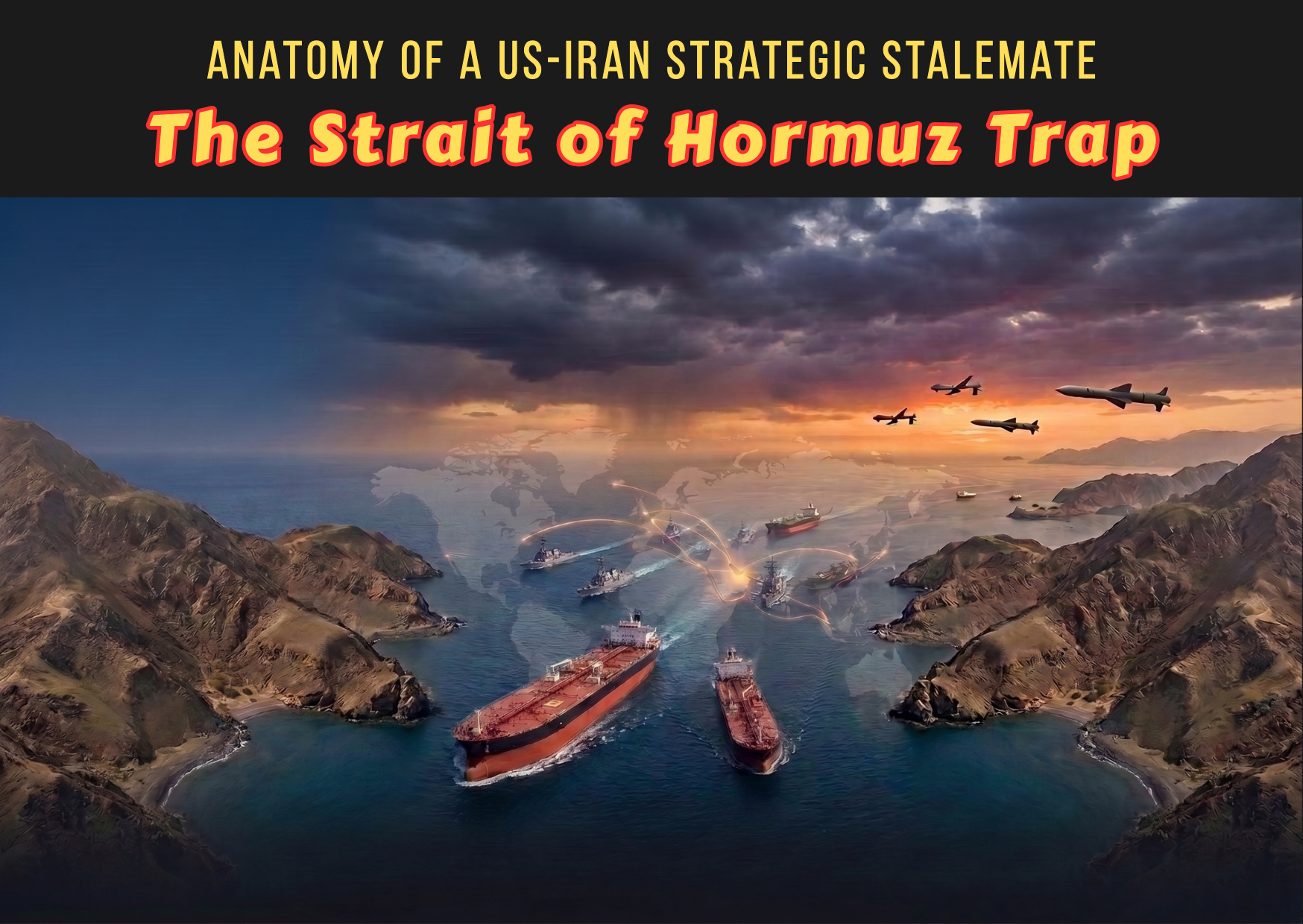
The Strait of Hormuz is far more than a narrow waterway separating Iran from the Arabian Peninsula. It is one of the world’s most critical maritime arteries, carrying approximately one-fifth of globally traded oil and a substantial portion of liquefied natural gas exports. Any prolonged disruption reverberates far beyond the Middle East, affecting global energy markets, inflation, shipping costs, insurance premiums, and the strategic calculations of every major power.
For decades, the United States has regarded the free flow of commerce through Hormuz as a vital national interest, while Iran has viewed its ability to threaten the Strait as its ultimate strategic deterrent against overwhelming American military superiority. These opposing doctrines have created one of the most dangerous military paradoxes of the modern era.
Unlike traditional wars where victory is measured by territorial conquest or destruction of enemy forces, a conflict in the Strait of Hormuz is fundamentally a contest of endurance, deterrence, political will, and economic resilience. Every military option carries enormous strategic costs. Every escalation risks triggering wider regional conflict. Every retreat carries severe political consequences.
This reality has produced what military strategists describe as a strategic stalemate—a situation in which neither side possesses an acceptable pathway to decisive victory, yet neither can afford the political or strategic costs of disengagement. The result is a dangerous equilibrium sustained not by peace, but by mutual constraints.
The Strategic Dilemma: Credibility versus Survival
At the heart of the deadlock lies a profound strategic contradiction.
For the United States, the confrontation is fundamentally about credibility. Since the end of the Second World War, Washington has positioned itself as the principal guarantor of freedom of navigation and maritime security. The global trading system depends heavily upon this commitment, and nowhere is it tested more than in the Strait of Hormuz.
Should Washington implicitly accept Iranian control—or even the credible threat of closing the Strait—it would be interpreted worldwide as a weakening of American strategic resolve. Allies across Europe, the Gulf, and the Indo-Pacific would inevitably question US security guarantees, while strategic competitors would be encouraged to challenge the existing maritime order elsewhere.
For Iran, however, the issue is even more existential.
Tehran fully understands that it cannot defeat the United States in a conventional, force-on-force conflict. Consequently, it has built its national defence doctrine around deterrence through disruption. Its ability to threaten one of the world’s most important energy corridors serves as a strategic equalizer against vastly superior American conventional military power.
Abandoning this capability would deprive Iran of its most powerful bargaining instrument and expose it to overwhelming external pressure. Consequently, neither side possesses sufficient political space to compromise without undermining its own strategic doctrine.
Geography: Iran’s Greatest Strategic Ally
Military power is never exercised in a vacuum.
The Persian Gulf is a confined body of water approximately 990 kilometres long, while the Strait of Hormuz narrows to barely 33 kilometres at its narrowest point. Actual shipping lanes are even narrower, leaving little room for manoeuvre.
Such geography naturally favours the defender.
Iran occupies the entire northern coastline overlooking the Strait, providing commanding positions for surveillance, missile batteries, radar systems, drone operations, and naval forces. Numerous islands and rugged coastal terrain provide ideal locations for concealed military infrastructure.
Unlike the vast expanses of the Pacific Ocean where American carrier strike groups enjoy unrestricted manoeuvrability, the confined waters of Hormuz compress naval operations into predictable corridors, reducing many advantages of technological superiority.
This geographical reality transforms one of the world’s most advanced navies into a force operating within an environment carefully prepared by its adversary over several decades.
Why Air Power Alone Cannot Decide the War
The Limits of Strategic Bombing
Modern air campaigns have demonstrated remarkable precision and destructive capability. Yet history consistently shows that bombing alone rarely compels determined states to surrender.
Iran has deliberately structured its military infrastructure to survive sustained aerial attacks.
Critical command facilities, missile depots, drone production centres, and logistics hubs are widely dispersed, heavily fortified, and in many cases buried deep underground. Redundancy has become a defining feature of Iranian military planning.
Destroying individual facilities does not necessarily eliminate operational capability. New launch sites can emerge, mobile missile launchers can relocate, and decentralized command structures continue functioning despite heavy bombardment.
Consequently, continuous air strikes may degrade capabilities, but they are unlikely to eliminate Iran’s capacity for sustained resistance.
The Challenge of a Ground Offensive
If air power alone cannot produce decisive results, conventional military logic points toward ground operations.
Yet this option presents enormous operational risks.
Amphibious Assault
A large-scale amphibious invasion would require:
- Multiple carrier strike groups
- Amphibious ready groups
- Extensive logistics support
- Air superiority
- Sustained naval protection
- Secure beachheads
Such operations represent some of the most complex military undertakings in modern warfare.
Moreover, assembling such forces would require significant preparation and would likely provide Iran ample warning to reinforce likely landing areas.
Littoral Warfare
Deploying smaller naval forces is equally hazardous.
Iran has spent decades preparing precisely for this scenario.
Its coastal defence architecture includes:
- Anti-ship cruise missiles
- Ballistic anti-ship missiles
- Naval mines
- Armed drones
- Fast attack craft
- Coastal artillery
- Electronic warfare systems
Within the confined waters of the Gulf, these layered defences significantly reduce the operational freedom traditionally enjoyed by larger naval forces.
Iran’s Cost-Imposition Strategy
Perhaps Iran’s greatest military innovation lies not in technological superiority but in economic asymmetry.
Rather than attempting to match American capabilities platform for platform, Tehran has focused on making every American military response disproportionately expensive.
Winning the Economic Exchange Ratio
Iran increasingly relies upon:
- Low-cost drones
- Loitering munitions
- Cruise missiles
- Short-range ballistic missiles
- Fast attack boats
Each individual system may be relatively inexpensive.
By contrast, defending against these threats often requires interceptors costing several million dollars each.
Systems such as THAAD, Patriot, Aegis, and SM-series interceptors achieve impressive interception rates, but their operational economics are unfavourable during prolonged conflict.
This creates an asymmetric cost equation in which the attacker spends thousands while the defender spends millions.
In a prolonged campaign, stockpiles—not technology—may become the decisive factor.
The War of Attrition
Iran’s objective is not necessarily battlefield victory.
Instead, its strategy seeks to impose cumulative military, economic, and political costs until continued conflict becomes increasingly unattractive for its adversaries.
Time therefore becomes a strategic weapon.
Every additional month of conflict means:
- Higher operational costs
- Increased ammunition expenditure
- Greater logistical burdens
- Political fatigue
- Economic uncertainty
- Rising insurance and shipping costs
- Pressure from allies and domestic constituencies
In this form of warfare, endurance often matters more than tactical success.
Decentralized Command: Learning from Iraq
One of Tehran’s most important military lessons came from the 2003 Iraq War.
The rapid collapse of Saddam Hussein’s military demonstrated the vulnerability of highly centralized command systems. Once senior leadership and communications were disrupted, much of the military structure ceased functioning effectively.
Iran deliberately redesigned its military to avoid repeating that mistake.
A Distributed Defence Network
Today, the Islamic Revolutionary Guard Corps (IRGC) and the regular armed forces operate through a highly decentralized network of regional and provincial commands.
Operational authority is distributed across multiple echelons rather than concentrated exclusively in Tehran.
Should national leadership become isolated or eliminated, regional commanders retain the authority to continue military operations independently.
This organizational resilience significantly complicates any campaign based upon leadership decapitation or command paralysis.
Instead of a single vulnerable command centre, an adversary confronts dozens of semi-autonomous operational nodes capable of sustaining resistance.
The Illusion of a Quick Victory
Modern military planning frequently assumes that technological superiority can produce rapid strategic outcomes.
Operations in Iraq (2003), Libya (2011), and earlier air campaigns reinforced confidence in precision strike capabilities and network-centric warfare.
However, asymmetric conflicts follow different rules.
The opening phase of any campaign often favours the technologically superior force.
The later phases increasingly favour the side best prepared for prolonged resistance.
Every additional month shifts the balance from operational excellence toward strategic endurance.
For this reason, expectations of a rapid and decisive victory become increasingly difficult to sustain as conflicts evolve into wars of attrition.
Beyond the Battlefield: The Global Strategic Consequences
A prolonged confrontation in the Strait of Hormuz would not remain confined to military operations.
Its consequences would rapidly spread across the international system.
Global energy prices would likely remain volatile, shipping insurance premiums would rise sharply, supply chains could experience significant disruption, and energy-importing economies would face renewed inflationary pressures. Gulf Arab states would be forced to navigate an increasingly precarious security environment, while major powers such as China, India, Russia, and European nations would intensify diplomatic efforts to prevent further escalation because of their substantial economic stakes in uninterrupted maritime trade.
Thus, even a limited military confrontation carries strategic implications extending far beyond the Persian Gulf.
Diplomacy: The Only Sustainable Exit
History demonstrates that conflicts rooted in mutually incompatible strategic interests are rarely resolved through military means alone.
Neither Washington nor Tehran currently possesses a realistic pathway to an outright military victory at an acceptable cost.
The United States cannot easily abandon its long-standing commitment to safeguarding freedom of navigation without risking damage to its global credibility. Iran, for its part, is unlikely to relinquish the deterrent value of the Strait of Hormuz, which it regards as central to its national security.
This does not mean military operations are impossible; rather, it means that military action by itself may not produce the political outcomes either side seeks.
Consequently, durable de-escalation would likely require sustained diplomacy, crisis-management mechanisms, and negotiated understandings that reduce the risk of miscalculation while addressing the core security concerns of all parties involved.
Conclusion
The military confrontation surrounding the Strait of Hormuz illustrates one of the defining characteristics of twenty-first century warfare: overwhelming conventional superiority does not automatically translate into decisive strategic success.
Geography, asymmetric doctrine, decentralized command structures, economic endurance, and political constraints have combined to create a military environment in which neither side can easily impose its will upon the other.
For the United States, preserving freedom of navigation and maintaining alliance credibility remain strategic imperatives. For Iran, retaining the ability to threaten disruption in the Strait constitutes a cornerstone of its deterrence strategy. These objectives are fundamentally incompatible, yet neither side can pursue them to their logical conclusion without incurring potentially prohibitive costs.
The resulting impasse is less a conventional military contest than a prolonged competition of endurance, deterrence, and political resolve. Until a broader diplomatic framework emerges that addresses the underlying security concerns of both sides, the Strait of Hormuz is likely to remain not merely a maritime chokepoint, but one of the world’s most consequential strategic fault lines.