(By Khalid Masood)
I. The Paradox at the Heart of the Room
Walk into any boardroom in 2026 and mention artificial intelligence. The reaction is predictable: nods of recognition, furrowed brows of concern, and an almost reflexive consensus that AI is a “strategic priority.” Enterprise surveys consistently show that roughly 70% of organizations classify AI as critical to their future competitiveness. The budget allocations follow the rhetoric. The agentic AI market alone is projected to reach $11.79 billion by the end of this year, with overall enterprise AI spending scaling into the hundreds of billions globally.
But ask a different question — the one that matters — and the room goes quiet.
What, precisely, are you getting back?
The answer, for nearly half of those same organizations, is: we’re not entirely sure. Despite the strategic urgency and the capital flowing into AI initiatives, close to 50% of companies lack consistent, rigorous frameworks for measuring return on investment. They can describe what they built. They can demo the dashboard. They can point to “efficiency gains” and “employee satisfaction improvements.” But connect those dots to the balance sheet with the same rigor they’d apply to a new factory or a marketing campaign? Most cannot.
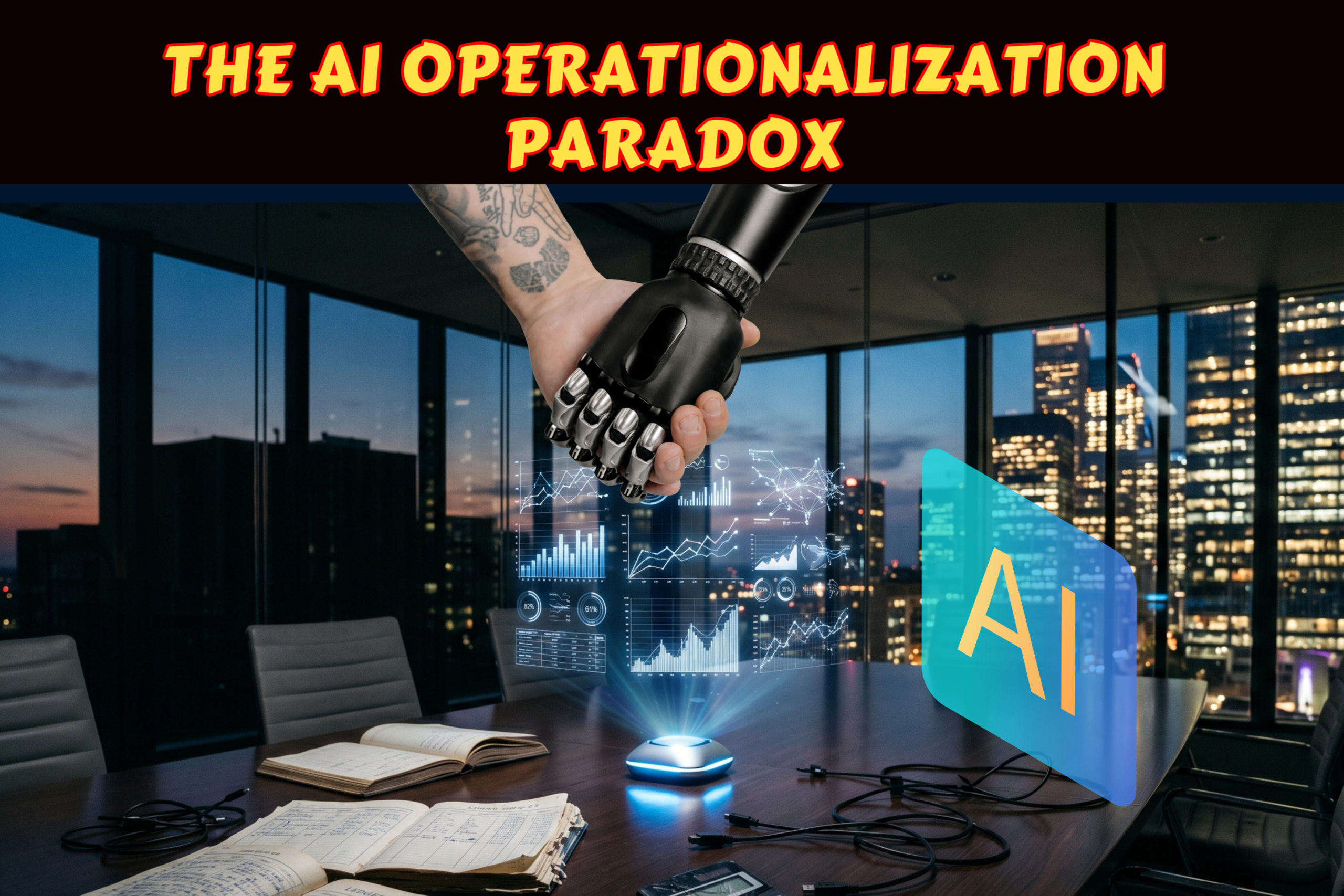
This is the AI Operationalization Paradox: Organizations are investing more in AI than ever before, yet fewer than half can confidently articulate what they’re getting in return. The gap isn’t technological. It’s organizational, cultural, and methodological. And in 2026, with the shift from experimental “pilots” to autonomous “agents” accelerating, this paradox isn’t just a measurement problem — it’s a strategic vulnerability.
II. The Numbers That Tell the Story
The scale of the contradiction is worth examining in detail.
The Priority Stat: 70% of enterprises now list AI as a board-level strategic priority. This isn’t niche experimentation anymore; it’s central to competitive positioning. In sector after sector — finance, healthcare, manufacturing, logistics — AI has migrated from the innovation lab to the executive agenda.
The ROI Gap: Yet when researchers and consultants dig beneath the surface, they find that nearly half of organizations lack consistent ROI measurement frameworks for their AI investments. Many rely on proxy metrics that sound impressive but resist financial translation: “time saved per employee,” “decision velocity,” “innovation culture scores.” These are real phenomena, but they are not ROI. They are inputs to a business case that most companies never complete.
The Market Projection: The agentic AI market — systems that don’t just assist humans but autonomously execute workflows — is projected at $11.79 billion by 2026. This is not speculative R&D spending. This is operational budget, committed to tools that promise to replace or augment human decision-making at scale. The money is real. The accountability for it is not.
The Pilot-to-Production Chasm: Perhaps the most telling statistic is the persistence of the “pilot trap.” Industry estimates suggest that 80% or more of AI initiatives remain in experimental or limited-deployment phases. They generate proof-of-concept results, conference presentations, and internal enthusiasm. They do not generate scaled, sustained business value. The gap between “we built a model” and “we changed how the business operates” remains vast — and widening.
The visual that captures this isn’t a growth curve. It’s a split screen: on one side, the soaring investment lines and strategic priority charts; on the other, the flat or ambiguous outcome metrics and the graveyard of stalled deployments.
III. The Three Pillars of the Paradox
Why does this gap persist, even as AI technology itself improves? The answer lies in three interconnected failures that have little to do with algorithmic sophistication and everything to do with how organizations work.
A. The Measurement Problem
AI return on investment is genuinely harder to measure than traditional technology ROI, but not so hard that it excuses the current neglect.
The difficulty is structural. AI benefits are often intangible, delayed, and compounding. A customer churn prediction model doesn’t save money tomorrow; it improves retention rates over quarters. A supply chain optimization algorithm doesn’t reduce inventory in isolation; its value depends on procurement coordination, warehouse reconfiguration, and sales forecasting alignment. The causal chain is long, and attribution is messy.
But this is not a new problem. It is a familiar one, with a familiar name: the productivity paradox. In the 1980s and early 1990s, economist Robert Solow famously observed that computers were “everywhere but in the productivity statistics.” It took years of organizational learning, infrastructure investment, and process redesign before the benefits of IT became visible in macroeconomic data. Research by Erik Brynjolfsson and others at MIT showed that the payoff came not from buying computers, but from restructuring around them.
AI is repeating this pattern — but faster, and with higher stakes. The difference is that today’s capital markets and competitive pressures are less patient. CFOs, who control the budgets that AI projects need to scale, are increasingly skeptical of probabilistic returns. They are asked to allocate capital against initiatives whose success is uncertain, whose benefits are delayed, and whose measurement frameworks are underdeveloped. Many are saying no, or yes with constraints that doom the project to pilot purgatory.
The common cop-out metrics make this worse. “Employee satisfaction with AI tools” is a useful diagnostic. It is not ROI. “Time saved” is a starting point for analysis; without monetization (what was done with that time? was it redeployed or merely dissipated?), it is not ROI. “Innovation culture” is an aspiration, not an accounting entry.
Organizations that break the paradox start by building financial accountability into the project charter — before the technology is selected.
B. The Organizational Immaturity
Even with perfect measurement, AI fails when the organization around it is unprepared. And most are.
AI operationalization requires four capabilities, in sequence: data infrastructure, governance frameworks, specialized talent, and change management. Most firms have one or two. Few have all four integrated. The result is a predictable pattern of dysfunction.
Siloed deployment is endemic. Marketing acquires a generative AI content tool. Operations deploys a predictive maintenance platform. Customer service experiments with an AI chatbot. Each is purchased separately, measured separately, and governed separately. There is no enterprise architecture connecting them, no shared data layer, no unified view of the customer or the operation. The AI exists in pockets, not in systems.
The “shiny object” trap compounds this. Leadership wants AI visibility — press releases, conference keynotes, investor presentations. Practitioners want incremental automation that reduces friction in their daily work. These desires are not aligned; they are often in conflict. The projects that get funded are those that tell the best story, not those that solve the hardest operational problem. The result is a portfolio of impressive demos with shallow roots.
The skills gap is equally structural. Data scientists and ML engineers can build sophisticated models. Business users can describe their workflows. The chasm between them — the ability to translate a model into a deployed, monitored, maintained operational system — is where most projects die. MLOps, the discipline of operationalizing machine learning, is still immature in most enterprises. Models are built, tested in isolation, and then abandoned when integration proves harder than anticipated.
C. The Agentic AI Shift — Opportunity or Distraction?
The newest variable in this equation is the rise of agentic AI — systems that don’t merely assist human decision-makers but autonomously execute workflows, make choices, and interact with other systems without continuous human oversight.
This is the defining technology shift of 2026. Copilots suggest; agents act. The market projection of $11.79 billion reflects genuine enterprise interest in moving from “AI as advisor” to “AI as operator.”
But agentic AI also complicates the ROI question further. When a copilot recommends a course of action and a human approves it, accountability is clear. When an agent initiates a procurement order, adjusts a production schedule, or flags a transaction for review based on its own reasoning, the chain of accountability becomes diffuse. Auditability, explainability, and error attribution — already weak in traditional AI — become critical and harder to achieve.
The risk is that organizations will leap to agents before mastering basic automation, repeating the pilot failure pattern at higher stakes and with greater exposure. The company that deploys an autonomous supply chain agent without first having robust data pipelines, clear escalation protocols, and measurable baseline performance is not innovating. It is gambling.
The contrast is instructive. Organizations that successfully scaled robotic process automation (RPA) before advancing to AI had a different trajectory. They learned to map workflows, integrate systems, handle exceptions, and measure outcomes at the task level. When they added intelligence to automation, they knew where it belonged and what success looked like. Those that skipped this step — that treated AI as a magic layer that would somehow make broken processes smart — are the ones now struggling to prove value.
IV. Why This Matters Now
The operationalization paradox is not a theoretical concern. In 2026, it has immediate, concrete consequences.
Competitive urgency is real, but misunderstood. First-mover advantage in AI is genuine in many sectors. But “first mover” does not mean “first to pilot.” It means “first to scale.” The organization that deploys one AI process to 10,000 users with measurable ROI is winning against the competitor that has twenty pilots and no production systems. The paradox creates a dangerous illusion: the appearance of AI activity substitutes for the reality of AI impact.
Capital market pressure is intensifying. Investors are no longer satisfied with AI roadmaps. They want proof points. Companies that spend heavily on AI without demonstrating financial returns are seeing valuation discounts, not premiums. The narrative of “invest now, profit later” has a shorter half-life than it did even two years ago.
Talent is voting with its feet. AI practitioners — data scientists, ML engineers, product managers — are leaving organizations where their work never ships. The frustration of building models that sit in notebooks, or deploying systems that are never integrated, is driving migration to companies with mature operationalization cultures. The paradox is self-reinforcing: organizations that can’t operationalize AI can’t retain the talent that would help them learn how.
The regulatory horizon is approaching. The EU AI Act is in force, with enforcement mechanisms tightening. Emerging US frameworks, sector-specific regulations in finance and healthcare, and global standards for algorithmic accountability are converging on a common requirement: operationalized AI must be auditable, explainable, and governable. Most current deployments are not. The gap between regulatory expectation and operational reality is a compliance risk that will materialize suddenly, not gradually.
V. How to Break the Paradox: A Framework
The paradox is solvable. But the solution is not better technology. It is better discipline. Organizations that escape the trap follow a sequence that prioritizes operational readiness over algorithmic sophistication.
Step 1: Define “Operationalized” Before “Optimized”
Start with workflow mapping, not model selection. The rule is simple: if you cannot describe the current process in granular detail — who does what, with what data, under what constraints, with what exceptions — AI will not fix it. It will automate confusion at higher speed. The first investment should be in process documentation and baseline measurement, not in neural networks.
Step 2: Build the ROI Model First
Force financial accountability into the project charter before capital is released. This means defining, in advance: the cost of the current state (error rates, delays, labor costs), the cost of the AI solution (licensing, infrastructure, talent, maintenance), and the monetization of improvement (revenue uplift, cost reduction, risk mitigation). Use control groups and A/B testing where ethical and practical. If the experiment cannot be measured, it should not be funded.
Step 3: Invest in the “Boring” Infrastructure
Data quality, integration layers, MLOps pipelines, governance protocols — these are not exciting investments. They are the determinants of whether AI scales or stalls. The organizations that succeed treat this infrastructure as a prerequisite, not a follow-on. They accept that the first year of an AI program may produce no visible AI at all, only cleaner data and better systems.
Step 4: Start with Augmentation, Not Automation
Prove value with human-in-the-loop systems before removing the human. This lowers risk, makes ROI clearer (the human provides a baseline for comparison), and improves change management. The progression from “AI suggests, human decides” to “AI decides, human monitors” to “AI operates, human intervenes by exception” is deliberate and measured. It is not a leap.
Step 5: Measure What Matters, Not What’s Easy
Shift from technical metrics to business outcome metrics. The model with 95% prediction accuracy is not the success story. The success story is the $2.3 million reduction in inventory carrying costs that resulted from acting on those predictions. This requires cross-functional collaboration between data scientists and business operators — the very collaboration that siloed structures prevent.
VI. The Real Test of 2026
The AI Operationalization Paradox is not a temporary growing pain. It is the defining business challenge of this era. The technology is advancing faster than the organizational capacity to absorb it. The investment is flowing faster than the measurement frameworks can validate it. The rhetoric is outpacing the reality by a widening margin.
The companies that win this decade will not be those with the most AI pilots, the most impressive demos, or the most conference presentations. They will be those with the fewest — because they focused their resources on making one or two initiatives actually work, at scale, with measurable returns.
In 2026, AI is no longer a technology problem. It is a leadership discipline problem. And most leaders are still failing the exam.
The question for the remainder of this year is not whether your organization will use AI. It is whether your organization can operationalize it — and prove that it was worth the cost.
The paradox demands an answer. The market will not wait forever for one.