(By Khalid Masood)
On June 14, 2026 — coincidentally Donald Trump’s 80th birthday — the United States and Iran digitally signed a Memorandum of Understanding (MoU) that could, if implemented, end nearly five decades of confrontation between Washington and Tehran. The agreement, scheduled for formal signing in Geneva on June 20, 2026, represents the most significant diplomatic breakthrough since the 2015 Joint Comprehensive Plan of Action (JCPOA). Yet beneath the surface of this historic handshake lies a web of existential threats that could unravel the deal before it ever takes effect.
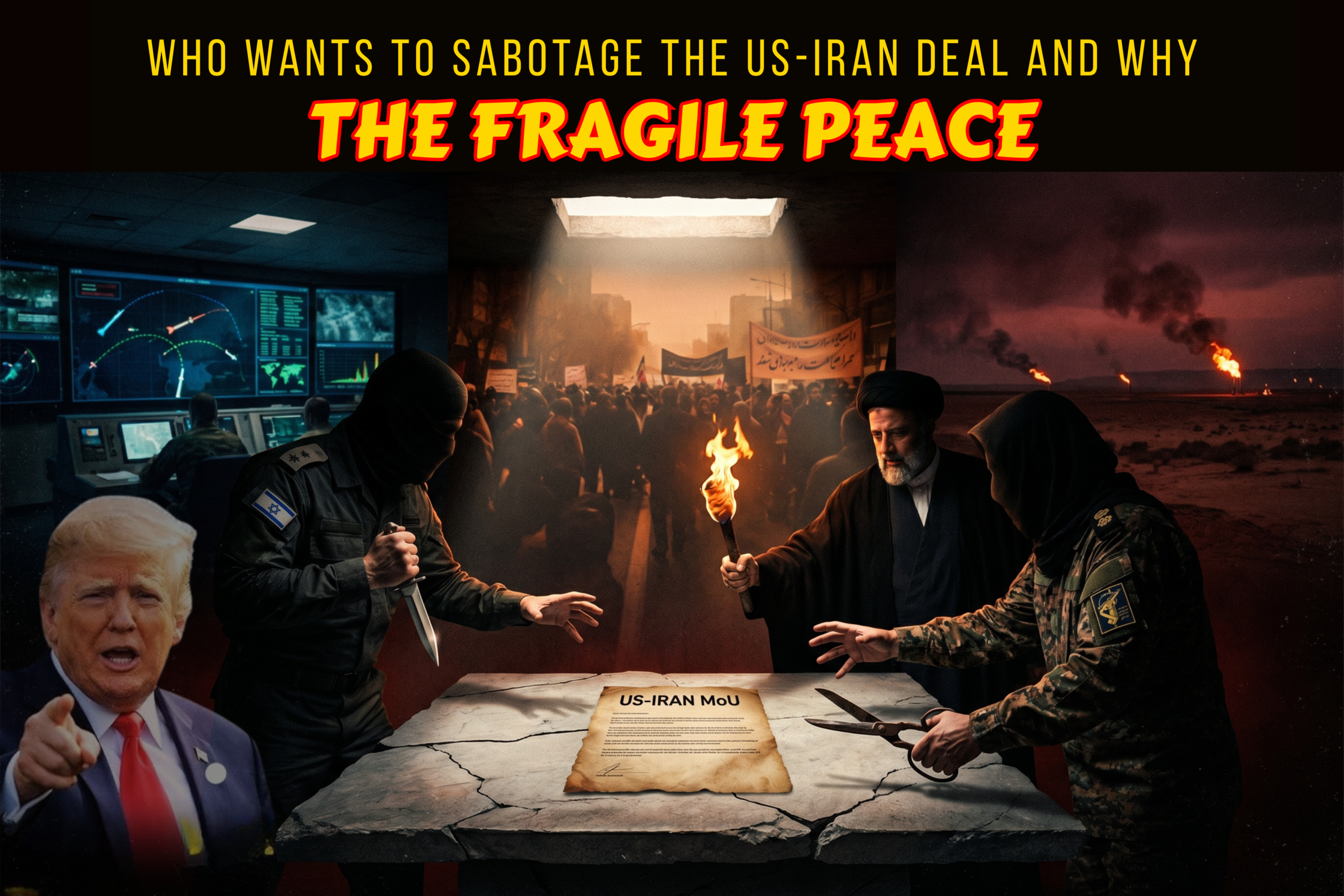
This article examines the three primary actors positioned to sabotage the US-Iran MoU: Israeli Prime Minister Benjamin Netanyahu, who US intelligence agencies warn is “likely to take steps” to undermine the agreement; Iran’s hardline Paydari Front, which has responded with death threats against its own negotiators; and a hardened faction within Iran’s Islamic Revolutionary Guard Corps (IRGC) that may see the deal as a temporary obstacle rather than a permanent settlement. Drawing on US intelligence assessments, expert analysis, and on-the-ground reporting from Tehran and Washington, we assess the probability of each threat and the catastrophic consequences should the MoU collapse.
Background: What the MoU Actually Says
The US-Iran Memorandum of Understanding is not a treaty. It is a framework agreement — an MoU — that lacks the constitutional requirement of Senate ratification and can theoretically be undone by a future US administration with the stroke of a pen. This structural fragility is both its political enabler and its strategic vulnerability.
Key Provisions
Based on reporting from Iran International, Reuters, and official statements from both capitals, the MoU contains the following core elements:
- Iran commits to halting uranium enrichment and not pursuing nuclear weapons. This is the central concession Tehran has made.
- The United States agrees to lift sanctions and end the naval blockade that has strangled Iran’s oil exports and banking access.
- The deal operates on a 15-year framework with what critics call a “sunset clause” — after 2041, Iran could theoretically resume enrichment activities.
- Crucially, the MoU does NOT restrict Iran’s ballistic missile program. Iran retains its missile arsenal, which Israeli officials consider the most dangerous remaining capability.
- The agreement was digitally signed on June 14, 2026, with a formal signing ceremony planned for Geneva on June 20, 2026.
The Context: Operation Midnight Hammer
The MoU did not emerge in a vacuum. It follows Operation Midnight Hammer in June 2025 — a massive US-Israeli air campaign that, according to testimony from Director of National Intelligence Tulsi Gabbard before Congress in March 2026, “obliterated” Iran’s nuclear enrichment program. Gabbard stated that “the entrances to the underground facilities that were bombed have been buried and shuttered with cement” and that “there has been no efforts since then to try to rebuild their enrichment capability.”
This military devastation created the conditions for diplomacy. Iran, facing economic collapse and military incapacitation, came to the table from a position of weakness. The MoU is, in essence, a ceasefire agreement dressed in diplomatic language — a mechanism for both sides to step back from the brink without admitting defeat.
Why an MoU, Not a Treaty?
The choice of an MoU rather than a formal treaty reflects political reality in Washington. The 2015 JCPOA was negotiated as an executive agreement precisely because Senate ratification was impossible. President Trump, who withdrew from the JCPOA in 2018, has now embraced the same legal mechanism — ironically, to secure a deal that his own administration’s military strikes made possible. The MoU format allows rapid implementation but provides no guarantee of permanence. A future administration could abandon it as quickly as Trump abandoned the JCPOA.
Threat Actor #1: Israel and Prime Minister Netanyahu
The most immediate and dangerous external threat to the MoU comes from Israel. On June 19, 2026, The Washington Post and Haaretz reported that US intelligence agencies had presented President Trump with an assessment warning that Prime Minister Benjamin Netanyahu is “likely to take steps” to sabotage the Iran deal — a remarkable instance of American intelligence directly warning an American president about the intentions of a close ally.
The US Intelligence Assessment
According to US officials who spoke to The Washington Post, the intelligence assessment indicates that Netanyahu, facing Israeli elections in October 2026, is “increasingly likely to push for an intensified campaign against Hezbollah” and that “any truce or an IDF withdrawal would likely be perceived in Israel as a defeat.” The assessment frames Netanyahu’s potential sabotage of the Iran deal as linked to his domestic political survival — a leader who built his career on confronting Iran cannot easily pivot to accepting a diplomatic settlement that leaves Tehran’s capabilities intact.
This is not the first time US intelligence has flagged Israeli interference. In April 2025, Iranian Foreign Minister Abbas Araghchi publicly accused Israel of actively trying to sabotage nuclear talks, stating that “the Zionist regime is employing every possible tactic to dictate terms and undermine diplomacy.” The new assessment suggests those concerns were not unfounded.
Israel’s Strategic Concerns
Israeli opposition to the MoU is rooted in specific, substantive grievances that extend beyond Netanyahu’s political calculations:
The 15-Year Sunset Clause: Israeli officials have reportedly described the agreement as “very bad for Israel” precisely because it is temporary. After 2041, Iran could resume enrichment with its industrial knowledge intact. For a country that measures existential threats in generational terms, a 15-year pause is not a solution — it is a deferral.
Ballistic Missile Proliferation: The MoU explicitly does not address Iran’s ballistic missile program. Iran retains missiles capable of striking Israel, and sanctions relief could fund their modernization. As one Israeli official reportedly told Reuters, “What Trump has gained immediately is Iran’s loss of credibility among the resistance front, lower oil prices, and having the agreement announced on his birthday” — but Israel gained no corresponding security benefit.
Regime Entrenchment: Israeli strategists argue that sanctions relief will strengthen the Islamic Republic rather than weaken it. Billions in unfrozen assets and renewed oil revenues could flow to the IRGC, Hezbollah, and other regional proxies. The deal, from this perspective, throws a “lifeline” to a regime that Operation Midnight Hammer had brought to the edge of collapse.
Proxy Network Funding: Hezbollah in Lebanon, the Houthis in Yemen, and Iraqi Shiite militias all depend on Iranian financial support. A cash-flush Tehran means a better-armed “axis of resistance” on Israel’s borders.
Netanyahu’s Domestic Politics
Israel’s October 2026 elections create a powerful incentive for Netanyahu to derail the MoU. His political brand is built on security hawkishness and opposition to Iranian nuclear ambitions. A deal that leaves Iran’s missiles intact, its regime in power, and its enrichment capability merely paused is politically toxic to his base.
Moreover, any truce with Hezbollah or withdrawal of IDF forces from Lebanon — both likely conditions for regional stabilization under the MoU — would be framed by Netanyahu’s opponents as military failure. Sabotaging the Iran deal, by contrast, could rally nationalist voters and shift the election narrative back to security.
Historical Precedent: Israel’s Sabotage Track Record
Israel has a documented history of sabotaging Iranian nuclear infrastructure:
- Stuxnet (2010): The cyberweapon that damaged Iranian centrifuges at Natanz, widely attributed to Israeli and US intelligence collaboration.
- Assassination of Scientists (2010–2020): At least four Iranian nuclear scientists were killed in operations linked to Israeli intelligence.
- Natanz Explosion (2021): A sophisticated attack on Iran’s primary enrichment facility, attributed to Israel, set back the program by months.
- JCPOA Opposition (2013–2015): Netanyahu’s 2015 address to the US Congress, arranged without White House coordination, was an unprecedented attempt to sabotage American diplomacy by an allied leader.
This history suggests that Israeli sabotage is not hypothetical — it is a established policy tool.
Potential Methods of Sabotage
If Netanyahu chooses to act, the methods could include:
- Military strikes on remaining Iranian nuclear or missile facilities, forcing Iran to retaliate and collapse the MoU.
- Intelligence leaks designed to expose Iranian cheating or embarrass US negotiators, undermining trust.
- Congressional lobbying to block sanctions relief legislation or attach poison-pill amendments.
- Encouraging Gulf allies (Saudi Arabia, UAE) to publicly oppose the deal, creating a diplomatic counterweight.
- Proxy provocations — encouraging Hezbollah or other allied groups to launch attacks that force Iranian or US military responses.
The US intelligence assessment that Netanyahu is “likely” to pursue sabotage should be understood in this context: not as a prediction of certainty, but as a warning that the incentives for sabotage are overwhelming and the historical pattern is clear.
Threat Actor #2: Iranian Hardliners — The Paydari Front
While Israel threatens the MoU from the outside, Iran’s own hardliners threaten it from within. The response to the MoU’s announcement in Tehran was not celebration — it was rage.
Who They Are: The Paydari Front
The Paydari Front (literally “Steadfastness Front”) is a hardline political faction that sees itself as the guardian of the 1979 Islamic Revolution’s ideological purity. They oppose any engagement with the West, advocate a Shia Islamist vision of the state, and have historically resisted all diplomatic overtures to Washington. They are not a fringe group — they hold parliamentary seats, control hardline media outlets, and have deep roots in the Basij paramilitary network.
Their Reaction to the MoU
The hardliner response to the MoU has been visceral and, in some cases, violent:
- Death chants against negotiators: Protesters in Tehran chanted for the execution of Foreign Minister Abbas Araghchi and Parliamentary Speaker Mohammad Bagher Ghalibaf, the two chief negotiators. Some chants invoked the memory of the late Supreme Leader Ayatollah Ali Khamenei: “Ghalibaf, Araghchi — what about my Leader’s blood?”
- Street protests: Hardline rallies over the weekend of June 14–15, 2026, called for the resignations of both men.
- Lawmaker Mahmoud Nabavian: A prominent Paydari Front parliamentarian warned that accepting the agreement would turn Iran into “a colony of the United States.” He also criticized provisions related to the Strait of Hormuz, arguing they surrendered one of Iran’s most important strategic levers.
- The “we will not accept” campaign: Hardline activists launched an organized opposition movement to reject the MoU.
The hardline newspaper Kayhan denounced the MoU as “surrendering to the Great Satan under the guise of an ‘antidote’ or regional de-escalation,” calling it “a betrayal of our long-standing resistance.” The conservative Khorasan daily, close to chief negotiator Ghalibaf, framed it more cautiously as “a tactical pause” rather than peace — “merely delaying the ‘final battle.'”
Ideological vs. Pragmatic Divide
The hardliner opposition is not, fundamentally, about whether to preserve the Islamic Republic. It is about how to preserve it. As Iran analyst Arash Azizi argues, the regime is shifting from ideological hardliners toward a “more pragmatic — though still authoritarian — collective leadership focused on regime survival.”
- Hardliners want revolutionary purity: no compromise with the West, resistance at all costs, maintenance of Iran’s “resistance economy” and regional proxy network.
- Pragmatists want survival: they recognize that economic collapse, military devastation, and popular exhaustion require a tactical retreat to rebuild.
“The hardliners are loud, but they have a weak case to make,” says Alex Vatanka, a senior fellow at the Middle East Institute. “This regime has now proven beyond doubt that they’re much more entrenched and resilient than people thought they were. That doesn’t make them nice, just makes them harder adversaries.”
Why They May Fail
Despite the ferocity of hardline opposition, several factors suggest they cannot stop the MoU:
- Institutional Approval: President Masoud Pezeshkian stated that “an overwhelming majority of members of Iran’s Supreme National Security Council had approved the text.” This is the highest security body in Iran; its endorsement carries more weight than parliamentary dissent.
- Collective Leadership: Real power, according to Azizi, lies with a collective leadership centered around Ghalibaf, the IRGC leadership, and the Supreme National Security Council — not the ideological hardliners around Saeed Jalili.
- Supreme Leader Authority: Jason Brodsky, policy director at United Against Nuclear Iran, notes that “the Supreme Leader made a decision, and that’s going to carry the day.” This was the pattern during the 2013–2015 JCPOA negotiations, when hardliners attacked Rouhani and Zarif but ultimately failed to block the deal.
The Mojtaba Khamenei Factor
The new Supreme Leader, Mojtaba Khamenei, has not publicly commented on the MoU. His silence is significant. His father, Ayatollah Ali Khamenei, was the ultimate arbiter of Iranian policy for 35 years; his word was law. Mojtaba’s absence from public view has fueled speculation that a new power structure is consolidating — one in which the Supreme Leader’s role is more symbolic and real authority rests with the IRGC and the Supreme National Security Council.
If Mojtaba does eventually endorse the MoU, hardline opposition will likely collapse. If he remains silent, the ambiguity could embolden the Paydari Front to continue resistance.
Threat Actor #3: The IRGC’s Hardline Faction
The Islamic Revolutionary Guard Corps is not a monolith. Within its ranks, a bifurcation exists between economic pragmatists who see opportunity in sanctions relief and military hardliners who view the MoU as a temporary obstacle to be endured, not a permanent settlement to be honored.
The IRGC’s Internal Divide
- Economic Pragmatists: These IRGC commanders control vast business empires (construction, shipping, telecommunications) that have been crippled by sanctions. They see the MoU as a chance to legitimize their economic activities and access global markets.
- Military Hardliners: These commanders, particularly in the IRGC’s aerospace and missile forces, view Iran’s military capabilities — especially its missile program and proxy networks — as the regime’s true insurance policy. They distrust any deal with the United States and see Operation Midnight Hammer as proof that Washington’s ultimate goal is regime change.
The “Rebuilding” Scenario
Jason Brodsky’s analysis is particularly chilling: “There will be those who want to use resources toward economic rebuilding, but there will be a very hardened IRGC contingent … who are going to want to rebuild their military, rebuild the nuclear program, and rebuild the terror apparatus.”
This suggests a long-term sabotage strategy: accept the MoU now, pocket the sanctions relief, and use the 15-year window to secretly rebuild capabilities. When the sunset clause expires in 2041, Iran could emerge with a revitalized military, a reconstructed nuclear infrastructure, and a restored proxy network — all funded by the very sanctions relief the MoU provided.
The Sanctions Paradox
There is a profound irony in the IRGC’s position: the organization has actually benefited from sanctions. Its control of smuggling networks, black-market currency exchanges, and sanctions-evasion channels has made it indispensable to the Iranian economy and enriched its commanders personally. Full normalization could threaten this lucrative ecosystem by opening legitimate channels that bypass IRGC middlemen.
Some IRGC hardliners may therefore sabotage the MoU not out of ideological opposition, but out of economic self-interest.
Potential Methods of IRGC Sabotage
- Covert enrichment activities: Small-scale, hidden enrichment in facilities not declared to inspectors.
- Proxy attacks: Encouraging Hezbollah, the Houthis, or Iraqi militias to launch attacks that provoke US or Israeli retaliation, collapsing the deal.
- Intelligence deception: Providing false compliance data to inspectors while maintaining hidden capabilities.
- Waiting game: Simply waiting for the 15-year sunset clause to expire, using the interim to rebuild.
The US Intelligence Community’s Role
The US intelligence community is both a guardian of the MoU and a potential source of its unraveling. Its assessments shape policy, but it operates under intense political pressure.
The 2026 Annual Threat Assessment
In March 2026, Director of National Intelligence Tulsi Gabbard presented the Annual Threat Assessment to Congress. Key findings relevant to the MoU include:
- Iran’s enrichment program was “obliterated” by the June 2025 strikes.
- “There has been no efforts since then to try to rebuild their enrichment capability.”
- Underground facilities at Natanz and Fordow have been “buried and shuttered with cement.”
- The IC continues monitoring for “indicators of a new leadership position on authorizing a nuclear weapons program.”
This assessment is the foundation of US confidence that Iran cannot quickly rebuild — and therefore that the MoU is verifiable.
Earlier Assessments (2025)
Before Operation Midnight Hammer, US intelligence was more cautious:
- The 2025 Annual Threat Assessment stated Iran was “not constructing a nuclear weapon” and that Ayatollah Khamenei had “not reauthorized” the weapons program suspended in 2003.
- The Defense Intelligence Agency (DIA) assessed in May 2025 that Iran was “almost certainly” not producing nuclear weapons — though it noted that “Iranian officials probably recognize that a complete nuclear weapons program would require a nuclear test.”
The Verification Challenge
The intelligence community’s central challenge is verification. Iran has a documented history of deception:
- Fordow (2009): A secret enrichment facility revealed by Western intelligence, not declared by Iran.
- Natanz (2021): A facility supposedly under IAEA inspection that suffered a major attack — suggesting hidden capabilities or vulnerabilities.
- IAEA unresolved issues: The International Atomic Energy Agency has long-standing questions about Iran’s pre-2003 weapons research that Tehran has never fully answered.
The MoU’s success depends on the intelligence community’s ability to detect any cheating — but as former US diplomat Charles W. Dunne notes, “From a Western or an American point of view, this pressure that’s been exerted on the regime should have resulted in its collapse already. But that’s not how this system works.”
Political Pressure on Intelligence
President Trump has claimed that “regime change” has already occurred in Iran — a statement that intelligence officials privately dispute. Dunne, a non-resident fellow at the Arab Center Washington DC, argues that “those now in charge seem to be even more hardline and determined to prevail than their predecessors.”
This creates tension: the intelligence community must provide objective assessments while navigating a political environment where the President has already declared victory. If intelligence later reveals Iranian cheating, it could embarrass the administration — creating pressure to downplay or suppress inconvenient findings.
Other Potential Spoilers
Beyond the three primary actors, several other forces could derail the MoU:
Saudi Arabia and Gulf States
Saudi Arabia, the UAE, and other Gulf monarchies fear an Iranian resurgence funded by sanctions relief. While they have quietly welcomed the de-escalation, they may:
- Lobby Washington to maintain some sanctions or military presence in the Gulf.
- Fund opposition groups inside Iran to destabilize the regime and collapse the deal.
- Develop their own nuclear programs in response, triggering a regional arms race.
US Congress
Republican opposition to any deal with Iran remains fierce. Congress could:
- Pass legislation attaching conditions to sanctions relief that Iran cannot accept.
- Use the Congressional Review Act to block executive actions implementing the MoU.
- Hold hearings featuring Israeli or opposition voices to undermine public support.
Regional Proxies
Hezbollah, the Houthis, and Iraqi Shiite militias have their own agendas. A rogue attack — a missile strike on a US base, a drone attack on a Saudi oil facility — could force retaliation that collapses the MoU, even if Tehran did not order it.
Accidental Escalation
The Strait of Hormuz remains a flashpoint. A naval incident, a misunderstood military maneuver, or a cyberattack attributed to either side could spiral into confrontation before diplomats can intervene.
The Stakes: What Happens if the MoU Fails?
The collapse of the MoU would not simply return the region to the status quo ante. It would likely trigger a catastrophic escalation:
- Operation Midnight Hammer 2.0: The US and Israel would likely resume military strikes, this time potentially targeting Iran’s leadership, oil infrastructure, or civilian economic assets.
- Regional War Expansion: Hezbollah could launch its full missile arsenal at Israel; the Houthis could attack Saudi oil fields; Iraqi militias could target US bases across the Middle East.
- Iranian Hardliner Consolidation: The collapse of diplomacy would vindicate the Paydari Front and IRGC hardliners, likely producing an even more aggressive Iranian regime.
- Economic Collapse and Humanitarian Crisis: Renewed sanctions and military destruction would deepen Iran’s already severe economic crisis, potentially producing refugee flows into Turkey, Europe, and the Gulf.
- Global Oil Price Spike: Disruption of Iranian oil exports and potential closure of the Strait of Hormuz could send global oil prices above $150 per barrel, triggering a worldwide recession.
Conclusion
The US-Iran MoU is not a peace treaty. It is a pause — a 15-year ceasefire born of exhaustion rather than trust. Its survival depends on three fragile conditions:
- US political will to enforce the deal despite Israeli pressure, congressional opposition, and the temptation to declare premature victory.
- Iranian leadership cohesion to suppress hardliner opposition, control IRGC factions, and maintain compliance even when sanctions relief is slow to materialize.
- Absence of a catalytic event — an Israeli strike, a proxy attack, a naval incident, or an intelligence revelation that forces either side to abandon diplomacy.
The question that haunts this agreement is not whether it is perfect. No diplomatic settlement in the Middle East ever is. The question is whether it can outlast the political cycles, intelligence assessments, and regional rivalries that threaten it from all sides.
In 15 years, when the sunset clause expires, a new generation of leaders in Washington, Tehran, and Jerusalem will decide whether to extend the pause or resume the conflict. Until then, the MoU exists in a state of precarious balance — a fragile peace held together by the shared fear of something worse.