(By Khalid Masood)
“If you know the enemy and know yourself, you need not fear the result of a hundred battles. If you know yourself but not the enemy, for every victory gained you will also suffer a defeat. If you know neither the enemy nor yourself, you will succumb in every battle.” — Sun Tzu
I. The Announcement: Timing, Context, and Significance
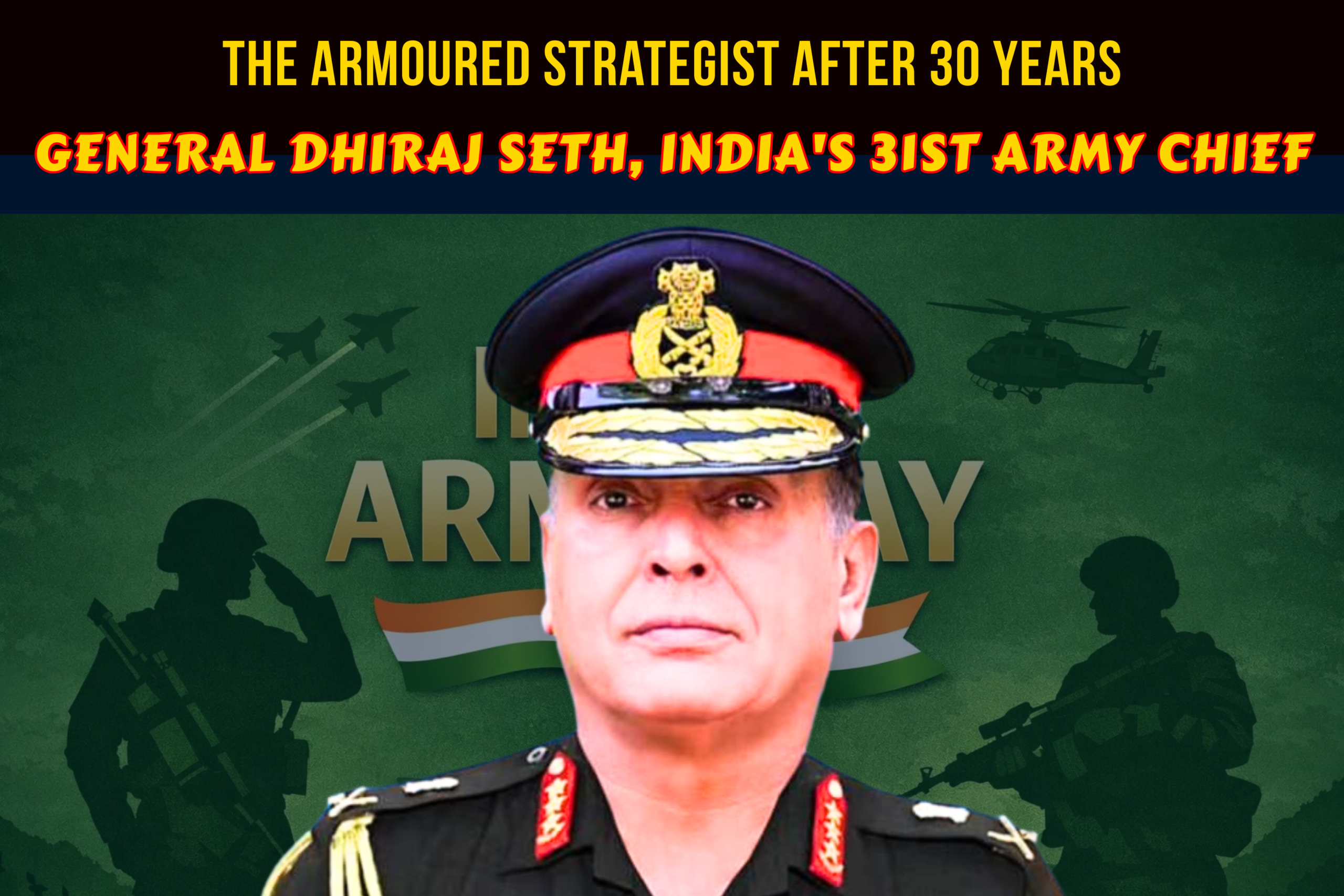
On the afternoon of 13 June 2026, a terse press release from the Ministry of Defence in New Delhi set in motion one of the most consequential leadership transitions in the Indian Army’s recent history. Lieutenant General Dhiraj Seth, PVSM, UYSM, AVSM, the serving Vice Chief of the Army Staff, was appointed the 31st Chief of the Army Staff, with effect from the afternoon of 30 June 2026. He would succeed General Upendra Dwivedi, who was superannuating after a tenure that had seen the Indian Army tested by fire — most notably during Operation Sindoor in May 2025.
For the casual observer, military succession in India follows a predictable rhythm: the senior-most eligible Army Commander ascends to the vice chief’s chair, and from there, barring exceptional circumstances, to the chief’s office. Yet Seth’s appointment is anything but routine. It breaks a three-decade drought for the Armoured Corps, whose last officer to occupy the chief’s office was General Sunith Francis Rodrigues in the early 1990s. It crowns a career that has spanned nearly four decades, every conceivable operational terrain, and a rare dual-command tenure at the Army Commander level. And it places at the helm of the world’s second-largest standing army an officer who has spent as much time shaping its future capabilities as he has commanding its present forces.
To understand what General Seth’s leadership portends, one must look beyond the press release. One must examine the man, the dynasty, the doctrine, and the moment.
II. The Dynasty: Blood, Honour, and the Regimental System
To encounter Dhiraj Seth is to encounter the Indian Army’s deep, almost feudal, relationship with lineage. He is not a self-made officer in the conventional sense; he is the inheritor of a tradition, and the custodian of a legacy that stretches across two services and three generations.
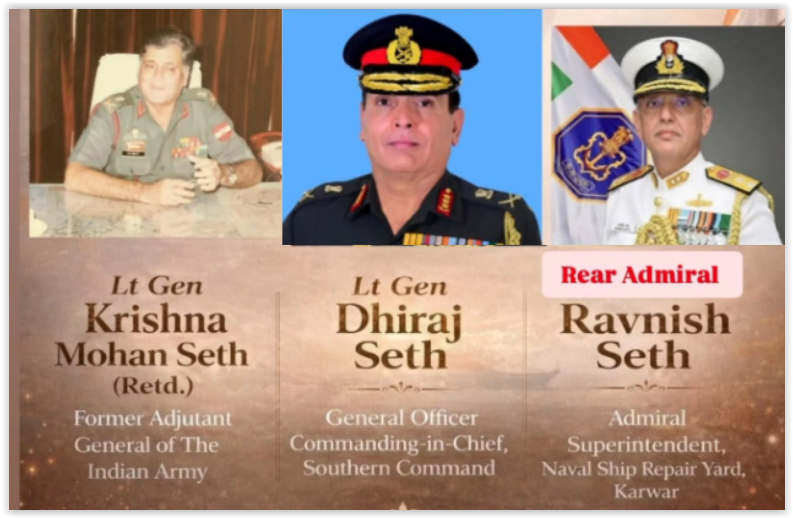
The Father: Lieutenant General Krishna Mohan Seth, PVSM, AVSM (Retd.)
His father was a towering figure in the post-Independence Army. Commissioned into the Armoured Corps, K.M. Seth rose to become the Adjutant General of the Indian Army in 1997, the senior-most administrative authority responsible for personnel, discipline, and welfare across the force. Before that, he had commanded both the XXI Strike Corps and III Corps, formations that remain among the most strategically sensitive in the Indian order of battle. His decorations tell their own story: the Param Vishisht Seva Medal in 1996 and the Ati Vishisht Seva Medal in 1985, the latter earned during gruelling counter-insurgency operations in India’s Northeast. After retirement, the elder Seth served as Governor of Tripura (2000–2003) and Governor of Chhattisgarh (2003–2007), and briefly as Acting Governor of Madhya Pradesh (2004) — a rare bridge between military and civil governance.
The Brother: Rear Admiral Ravnish Seth
The younger Seth’s brother, Rear Admiral Ravnish Seth, is a serving flag officer in the Indian Navy, currently the Admiral Superintendent of the Naval Ship Repair Yard at Karwar. This makes the Seth family one of the very few in India to have concurrent or recent three-star representation in both the Army and the Navy — a distinction that speaks to a culture of service embedded at the familial level.
The Family Today
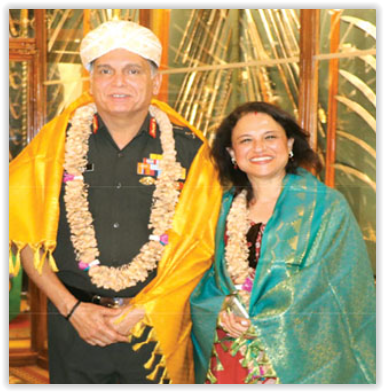
Seth is married to Mrs. Komal Seth, who has served as the Regional President of the Army Wives Welfare Association (AWWA) for the Southern Command. AWWA is not a ceremonial appendage; it is the backbone of the Army’s social welfare architecture, running vocational training centres, schools, and rehabilitation programmes for widows and families of fallen soldiers. Her work at the Vocational Training Centre in Belagavi Military Station is indicative of the dual-career reality of senior military households: one partner commands formations, the other sustains the institution’s moral and social fabric. The couple has two daughters.
This dynastic backdrop is not mere biography. In the Indian Army’s regimental culture, lineage matters. It shapes expectations, opens doors, and imposes burdens. For Dhiraj Seth, the burden was to match — and exceed — a father who had commanded the very corps he would one day lead.
III. The Making of an Officer: From Rewa to Paris
Sainik School, Rewa
Dhiraj Seth’s formal military education began at Sainik School, Rewa, in Madhya Pradesh. The Sainik Schools, modelled after British public schools but infused with Indian nationalist purpose, were established to prepare boys for the National Defence Academy. Rewa, nestled in the Vindhya ranges, has produced a disproportionate number of general officers, and Seth’s time there would have inculcated the foundational virtues of the Indian military ethos: discipline, physical endurance, and a sense of historical destiny.
National Defence Academy & Indian Military Academy
From Rewa, he entered the National Defence Academy (NDA), Khadakwasla, the crucible where India’s future service chiefs are forged. The NDA’s tri-service environment — Army, Navy, and Air Force cadets training together — would have given Seth an early appreciation for jointmanship, a concept that would later define his strategic outlook. He was commissioned from the Indian Military Academy (IMA), Dehradun, on 20 December 1986, into the 2nd Lancers (Gardner’s Horse).
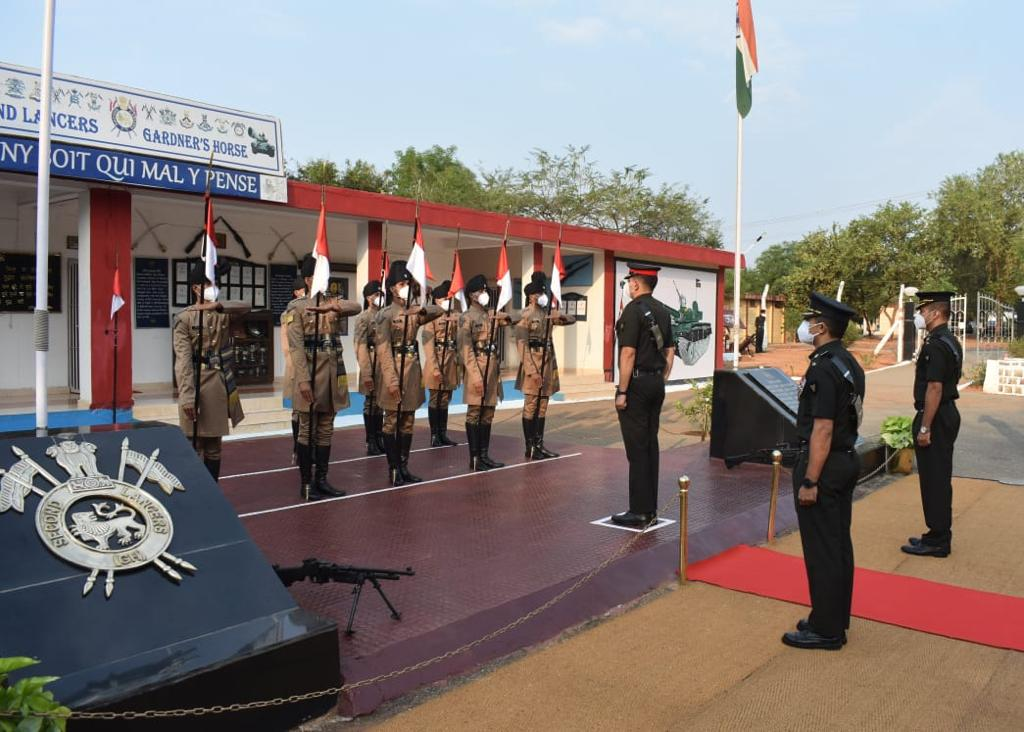
The choice of regiment is significant. The 2nd Lancers is one of the oldest cavalry regiments in the Indian Army, with lineage tracing back to 1809. It is a unit that has fought in the First and Second World Wars, in the Indo-Pak conflicts of 1965 and 1971, and in peacekeeping operations across the globe. For Seth to rise from a young officer in this regiment to become its Colonel-in-Chief, and eventually the Army Chief, is a narrative arc that regimental histories are made of. It also places him in a direct line of succession: the 2nd Lancers has now produced three Chiefs of Army Staff, an unparalleled record.
Advanced Military Education
Seth’s academic trajectory after commissioning reveals an officer determined to master not just tactics, but strategy and administration:
| Institution | Course | Distinction |
|---|---|---|
| Defence Services Staff College, Wellington | Staff Course | Best All-Round Student Officer |
| Army War College, Mhow | Higher Command Course | Graduate |
| National Defence College, New Delhi | Strategic Studies | Graduate |
| Collège interarmées de Défense, Paris | Command & Staff Course | General Staff qualification |
| Naval Postgraduate School, Monterey, USA | International Defence Acquisition Management | Graduate |
The international dimension is critical. The French exposure placed Seth at the intersection of combined arms and rapid manoeuvre doctrine. The American course positioned him at the nexus of operational command and defence procurement — a relationship that has historically been problematic for India.
Throughout his career, Seth accumulated academic laurels with almost monastic consistency: the Silver Centurion in the Young Officers’ Course, first position in the Radio Instructor Course, first in the Junior Command Course, and top honours at DSSC. In an Army where professional education is fiercely competitive, this record marks him as an intellectual as much as a warrior.
IV. The Command Ladder: From Regiment to Army Commander
Seth’s operational career is a textbook illustration of the Indian Army’s command philosophy: progressive responsibility, diverse terrain, and alternating spells of command, staff, and instructional duties.
Regimental and Brigade Command
He began, as all must, with his regiment. After serving in the 2nd Lancers (Gardner’s Horse), he commanded Skinner’s Horse (1st Horse), another fabled cavalry unit. From there, he moved to brigade command, leading the 98 Armoured Brigade in the Western Theatre — likely in the Punjab or Rajasthan sectors, the most heavily militarized armoured corridors in South Asia. This is the realm of the tank-versus-tank duel, of minefields and anti-tank ditches, of the operational plans that would unfold in the event of a full-scale continental war.
Counter-Insurgency: The Uniform Force
But Seth was not confined to the desert and the plains. He commanded the Uniform Force in Jammu and Kashmir, a counter-insurgency formation operating in one of the world’s most complex sub-conventional environments. The transition from armoured manoeuvre warfare to counter-insurgency is not automatic; it requires a different mindset, different rules of engagement, and a different relationship with civil society. That Seth excelled in both domains is a testament to his operational adaptability.
Key Staff Appointments
| Appointment | Level | Significance |
|---|---|---|
| Brigade Major, Independent Armoured Brigade | Brigade | Tactical staff experience |
| Assistant Military Secretary | Army HQ | Personnel management |
| BGS (Operations), South Western Command | Command HQ | Operational planning |
| Brigadier Perspective Plans | Strategic Planning Directorate | Long-term force structuring |
| Additional DG Weapons & Equipment | Army HQ | Modernization & procurement |
The Brigadier Perspective Plans appointment is particularly significant: it placed Seth at the heart of the Army’s long-term capability development, where he would have influenced decisions on force structuring, equipment acquisition, and doctrinal evolution.
Lieutenant General Appointments
| Appointment | Tenure | Significance |
|---|---|---|
| Director General (Discipline, Ceremonial & Welfare) | Post-2021 | Institutional health & morale |
| GOC, XXI Corps (Sudarshan Chakra Corps) | 31 July 2021 – 31 July 2022 | Premier strike formation; same corps his father commanded |
| GOC, Delhi Area | August 2022 – October 2023 | Capital’s military & ceremonial face |
| GOC-in-C, South Western Command | 1 Nov 2023 – 30 June 2024 | Western theatre operations |
| GOC-in-C, Southern Command | 1 July 2024 – 31 March 2026 | 51st Army Commander; largest command |
| Vice Chief of the Army Staff | 1 April 2026 – 30 June 2026 | Second-highest position |
The XXI Corps appointment carries special resonance. For a son to inherit his father’s corps is a rare occurrence in any army; for it to happen in India’s strike-oriented corps system is remarkable. The XXI Corps is one of the Army’s premier strike formations, designed for rapid offensive operations into enemy territory. Commanding it is a rite of passage for any officer with aspirations to the chief’s office.
The Rare Dual-Command Distinction
The significance of commanding two operational Army Commands cannot be overstated. In the Indian Army’s hierarchy, an Army Command is the highest operational formation, typically encompassing multiple corps and covering vast geographical swathes. Most officers who reach the rank of Army Commander serve in one command before retirement or promotion to vice chief. Seth served in two — South Western and Southern — giving him continuous strategic oversight of the western theatre for over two and a half years. This dual exposure is exceptionally rare and suggests a level of institutional trust that goes beyond mere seniority.
V. The Internationalist: Angola and the UN Experience
Amidst the parade of domestic commands and staff appointments, one entry in Seth’s service record stands out for its international colour: his deployment with the United Nations Angola Verification Mission III (UNAVEM-III) from 1995 to 1996.
Angola in the mid-1990s was a shattered country. The Lusaka Protocol, signed in 1994, had ended decades of civil war between the MPLA government and Jonas Savimbi’s UNITA rebels, but the peace was fragile. UNAVEM-III was tasked with monitoring the ceasefire, verifying troop disarmament, and facilitating the transition to elections. As an operations officer, Seth would have been immersed in the granular, often frustrating work of peacekeeping: coordinating with rival factions, navigating linguistic and cultural barriers, and operating under rules of engagement that were restrictive by design.
This UN experience is more than a line on a curriculum vitae. It exposed a young Indian officer to the complexities of multinational operations, the politics of the Security Council, and the gap between strategic mandates and tactical realities. In an era when India is increasingly contributing to UN peacekeeping and seeking a permanent seat on the Security Council, Seth’s firsthand familiarity with the UN’s operational machinery is a valuable asset.
VI. The Modernizer: Capability Development and Force Transformation
If Seth’s operational career demonstrates his mastery of the Army’s present, his staff appointments reveal his shaping of its future. The Indian Army of the 2020s is in the throes of a modernization crisis that is simultaneously technological, doctrinal, and organizational. Legacy platforms from the Soviet era are aging; indigenous systems like the Arjun tank and various missile programmes are maturing but slowly; and the threat environment has expanded from conventional border wars to multi-domain operations involving cyber, space, and electronic warfare.
Architect of the LTIPP
Seth has been at the centre of this transformation. As Colonel, Capability Development (Mechanized Forces), and later as Brigadier, Perspective Planning and Acquisition, he influenced the Long-Term Integrated Perspective Plan (LTIPP) — the document that guides the Army’s equipment and force structure priorities over 15-year horizons. As Additional Director General, Weapons and Equipment, he navigated the labyrinth of defence procurement, where projects often languish for years between the General Staff Qualitative Requirements and actual induction.
The Ministry of Defence’s official announcement of his appointment specifically highlighted this dimension: Seth, it noted, has made “pivotal appointments in the Strategic Planning and Capability Development verticals of the Army Headquarters, shaping its modernisation trajectory, capability roadmap and long-term force structuring initiatives.” His contributions were described as “instrumental in aligning operational requirements with emerging technologies and future battlefield imperatives.”
The Trilateral Perspective
This is the language of reform. It suggests that Seth is not merely a custodian of tradition but an active architect of change. His American education in defence acquisition management, his French exposure to combined arms doctrine, and his Indian grounding in the regimental system give him a rare trilateral perspective on modernization — one that understands the bureaucratic machinery of procurement, the doctrinal imperatives of manoeuvre warfare, and the cultural resistance to change within a hierarchical institution.
VII. Operation Sindoor and the Test of High Command
No assessment of Seth’s qualifications would be complete without addressing the elephant in the room: Operation Sindoor, in May 2025.
The Context
On 22 April 2025, terrorists attacked tourists in Pahalgam, Kashmir, killing 26 people — one of the deadliest civilian massacres in the region’s recent history. The Indian government’s response was swift and, by historical standards, unprecedentedly escalatory.
The Operation
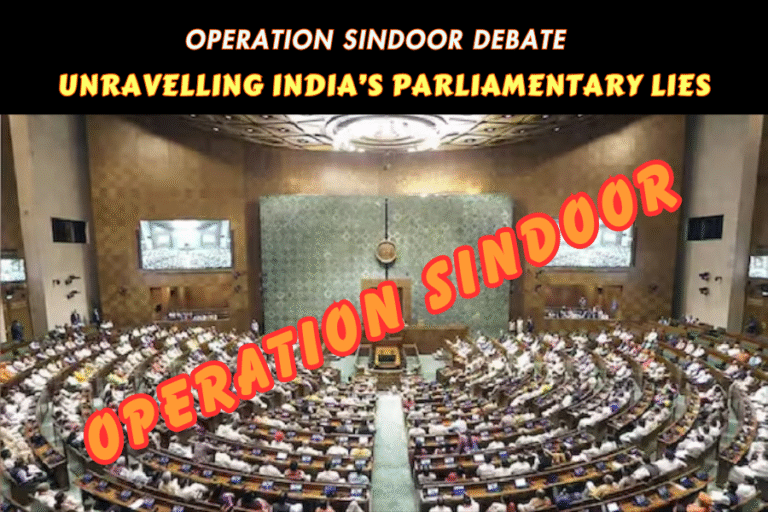
On the night of 6–7 May 2025, the Indian armed forces launched coordinated strikes against nine alleged terrorist infrastructure targets across the border. Seven were struck by the Indian Army, two by the Indian Air Force. The operation involved:
- Precision missile strikes on terror launch pads
- Large-scale drone warfare
- Artillery barrages on a scale not seen since the 1971 war
- Integrated tri-service command and control
Seth’s Role
At the time of Operation Sindoor, Lieutenant General Dhiraj Seth was the General Officer Commanding-in-Chief of the Southern Command. While the Southern Command is not the primary operational command for the western border (that role falls to the Western and South Western Commands), the operation was a tri-service endeavour requiring coordination across multiple commands, services, and strategic agencies. As an Army Commander with deep experience in the western theatre from his previous tenure at South Western Command, Seth would have been intimately involved in the planning and execution architecture.
The operation succeeded in its immediate objectives: the nine targets were destroyed, however, IAF lost several aircraft including three Rafale fighter jets. For next 2-3 days, there was heavy exchange of missiles and drones strikes from both side and finally US brokered a ceasefire by 10 May 2025. Seth later described the operation as a demonstration of India’s “fortitude, perseverance and resilience.”
Exercise Trishul: Consolidating Jointmanship
In November 2025, Seth also witnessed the tri-services exercise “Trishul” off the coast of Porbandar, Gujarat, alongside the Navy and Air Force chiefs. This exercise, conducted in the aftermath of Sindoor, was designed to test integrated command and control in a maritime environment, further underscoring the shift towards theatre-centric warfare.
More broadly, Operation Sindoor represented a doctrinal shift: the use of conventional military force against non-state actor infrastructure across an international border, executed with precision and integrated across services. For Seth, it was a validation of the modernization and jointmanship principles he had long advocated. As he assumes the chief’s office, the lessons of Sindoor — on targeting, escalation management, and tri-service integration — will inform his tenure.
VIII. The Regimental Connection: Three Chiefs from One Regiment
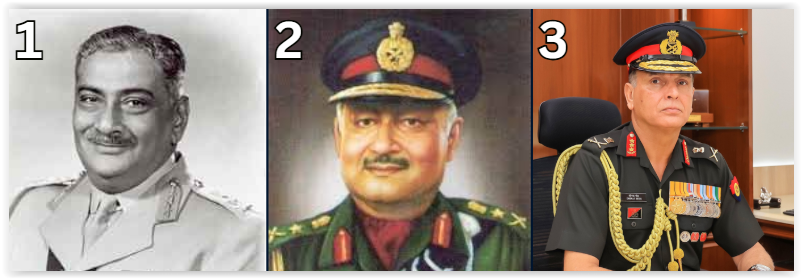
A word must be said about the 2nd Lancers (Gardner’s Horse), Seth’s parent regiment. With Seth’s appointment, this unit becomes the only regiment in the Indian Army — and quite possibly in the Commonwealth — to have produced three Chiefs of Army Staff. This is not a statistical anomaly; it is a reflection of the regiment’s culture, its historical role in India’s major wars, and its ability to nurture officers who combine tactical brilliance with strategic vision.
| No. | Name | Tenure | Notes |
|---|---|---|---|
| 1 | General Maharaj Shri Rajendrasinhji Jadeja | 15 January 1953 – 14 May 1955 | Second Indian Commander-in-Chief/Chief of Army Staff after Field Marshal Cariappa; from royal family of Nawanagar (Jamnagar); DSO for WWII gallantry |
| 2 | General Bipin Chandra Joshi | 1 July 1993 – 19 November 1994 | Died in office; commanded 64 Armoured Regiment in 1971 War; raised Rashtriya Rifles |
| 3 | General Dhiraj Seth | 30 June 2026 – Present | First Armoured Corps Chief in 30 years; commanded two Army Commands; VCOAS |
In the Indian Army, the regimental system is not merely an administrative convenience. It is the emotional and professional spine of the force. Officers remain affiliated with their regiments throughout their careers, returning for ceremonial duties, mentoring young officers, and drawing upon the collective memory of the unit. For Seth to rise from a subaltern in the 2nd Lancers to become its Colonel-in-Chief and then the Army Chief is a narrative that will be told in the regiment’s mess halls for generations.
The regiment’s battle honours — from the Napoleonic Wars through the two World Wars to the Indo-Pak conflicts — provide a historical canvas against which Seth’s own leadership will be measured. The pressure is not merely to lead the Army well, but to honour the regiment’s legacy.
IX. Awards, Decorations, and Institutional Recognition
Seth’s medal rack tells the story of a career marked by consistent excellence:
| Decoration | Year | Significance |
|---|---|---|
| Param Vishisht Seva Medal (PVSM) | 2025 | Highest peacetime decoration; distinguished service of the most exceptional order |
| Uttam Yudh Seva Medal (UYSM) | 2026 | Wartime distinguished service; significant in context of Operation Sindoor |
| Ati Vishisht Seva Medal (AVSM) | 2022 | Distinguished service of a high order |
| Samanya Seva Medal | — | Active service in specified areas |
| Special Service Medal | — | Special operations/service |
| Sainya Seva Medal | — | Long service recognition |
| High Altitude Medal | — | Service in high altitude areas |
| Videsh Seva Medal | — | Foreign service |
| 75th Independence Anniversary Medal | — | Commemorative |
| 50th Independence Anniversary Medal | — | Commemorative |
| 30/20/9 Years Long Service Medals | — | Long service recognition |
| UNAVEM III Medal | 1995–96 | UN peacekeeping service in Angola |
The progression from AVSM to PVSM to UYSM mirrors his career trajectory: excellence in staff and command roles (AVSM), culminating in the highest peacetime recognition (PVSM), followed by the wartime service medal (UYSM) after Operation Sindoor. This is a rare and telling sequence.
X. The Challenges Ahead: What Awaits the 31st Chief
As General Dhiraj Seth takes the salute as Chief of the Army Staff on 30 June 2026, he inherits an Army at a crossroads. The challenges are formidable, interconnected, and in some cases, existential to the force’s future relevance.
1. Theatre Command Restructuring
The most significant organizational reform in India’s military history is currently underway: the transition from single-service commands to integrated theatre commands. This involves dismantling decades of institutional turf, redefining the roles of the Army, Navy, and Air Force, and creating unified command structures that can conduct multi-domain operations. Seth’s experience in tri-service operations during Operation Sindoor and Exercise Trishul makes him uniquely qualified to lead this transition, but the political and bureaucratic resistance will be immense. The Army, as the largest service, has the most to lose — and the most to gain — from this restructuring.
2. The China-Pakistan Two-Front Challenge
The Indian Army continues to face a live border with China in Ladakh, where tensions have persisted since the 2020 Galwan clash, and a volatile Line of Control with Pakistan, where ceasefire violations and infiltration attempts remain routine. The nightmare scenario — a coordinated two-front conflict — requires not just manpower but integrated surveillance, rapid mobilization, and precision strike capabilities. Seth’s dual-command experience in the western theatre gives him an intimate understanding of the terrain, the forces, and the operational plans.
3. Indigenous Platforms and the Atmanirbhar Imperative
The political push for Atmanirbhar Bharat (Self-Reliant India) in defence production has created both opportunities and pressures. Indigenous systems like the Arjun Main Battle Tank, various artillery programmes, and missile systems are maturing, but the Army still relies heavily on imported platforms — particularly from Russia, whose supply chains have been disrupted by the Ukraine war. Seth’s background in capability development and acquisition management positions him to accelerate indigenization, but he must balance political imperatives with operational readiness.
4. Force Modernization in a Fiscally Constrained Environment
The Indian Army’s modernization budget has historically been squeezed by personnel costs — pensions and salaries consume a disproportionate share of the defence allocation. Seth must find ways to modernize without expanding the force structure, possibly through greater automation, drone swarms, and network-centric warfare. His work on the LTIPP gives him the roadmap; his challenge is to secure the resources and political will to implement it.
5. Multi-Domain Operations: Cyber, Space, and Electronic Warfare
The future battlefield is not just land, air, and sea; it is cyber, space, and the electromagnetic spectrum. The Indian Army has been slow to integrate these domains into its operational doctrine. Seth’s exposure to French and American military education — both countries with advanced cyber and space capabilities — suggests he understands the imperative. But transforming understanding into institutional capability requires investment, talent recruitment, and doctrinal innovation.
6. Manpower, Morale, and the Agnipath Legacy
The Agnipath scheme, introduced in 2022, fundamentally altered the Army’s recruitment model by introducing short-term contractual service. While designed to reduce the pension burden and infuse youth, it has created anxiety about unit cohesion, regimental loyalty, and the quality of leadership at the junior level. Seth must manage the transition from a predominantly long-service force to a mixed model, ensuring that the Army’s institutional culture — its greatest strength — is not eroded.
7. The Pakistan Dimension: Deterrence and Escalation Management
For Pakistani military planners and policy analysts, Seth’s appointment carries specific signals. His command of two western theatre Army Commands means he knows the Pakistan border intimately — its sectors, its vulnerabilities, its escalation dynamics. His role in Operation Sindoor demonstrates his willingness to authorize and execute cross-border strikes. Yet his UN experience in Angola also suggests an understanding of the limits of military force and the value of negotiated settlements. The challenge for Rawalpindi will be to calibrate its own posture against an Indian Army Chief who is neither averse to escalation nor ignorant of its costs.
XI. Conclusion: The Armoured Strategist at the Helm
Lieutenant General Dhiraj Seth is not a conventional choice for Chief of the Army Staff, if convention is defined by recent precedent. He is not from the Infantry, which has dominated the office for three decades. He is not a product of the counter-insurgency campaigns that have consumed the Army’s attention since the 1990s. He is, instead, an armoured warfare specialist who has spent his career thinking about manoeuvre, combined arms, and the operational level of war — the very capabilities that will define the next Indo-Pak or Sino-Indian conflict.
He is also a modernizer who has worked inside the Army’s bureaucratic machinery, understands the politics of procurement, and has the international exposure to benchmark India’s capabilities against global standards. His American and French education, his UN deployment, and his tri-service operational experience give him a breadth of vision that is rare in an institution often criticized for insularity.
He is, finally, a dynast in the best sense of the word — not an inheritor of privilege, but a custodian of tradition who has earned his place through merit, tested in the desert, the mountains, the counter-insurgency grid, and the corridors of South Block. His father commanded the XXI Corps; he commanded the XXI Corps. His father served as Adjutant General; he now serves as the Army’s highest officer. The parallel is not coincidence; it is the Indian Army’s regimental system working as designed — identifying talent, nurturing it, and placing it where it can serve the nation.
As he assumes office on 30 June 2026, General Dhiraj Seth faces a world that is more dangerous, more complex, and more technologically disruptive than any his predecessors encountered. The Chinese threat is structural and long-term. The Pakistani threat is persistent and opportunistic. The internal challenges of modernization, restructuring, and morale are no less daunting. But if his four decades of service are any indication, Seth is prepared — not with certainty, but with the combination of operational experience, strategic education, and institutional knowledge that the moment demands.
The Indain Armoured Corps has waited thirty years for one of its own to lead the Army. The Army, and the Indian nation, will now watch to see what he does with the opportunity.
About the Author: Khalid Masood is a former Pakistan Army officer with a keen interest in geopolitics, strategic affairs, and public relations. A passionate writer and digital creator, he analyzes regional and global developments through the lens of history, security, and diplomacy, bringing complex issues to a wider audience in a clear and engaging manner.