(By Khalid Masood)
Introduction
For millennia, the sword stood as the ultimate symbol of military power, personal honor, and martial prowess. Long before gunpowder transformed the battlefield, armies marched behind the gleaming edge of steel—swords that were not merely weapons but extensions of the warrior’s will, cultural identity, and technological achievement. From the disciplined ranks of Roman legions to the thundering charges of European cavalry, from the silent precision of samurai duels to the brutal efficiency of Viking raids, the sword shaped the course of human conflict and civilization itself.
The significance of swords in military history extends far beyond their function as cutting implements. These blades carried the weight of empires, embodied spiritual philosophies, and became enduring symbols of authority that persist in military insignia to this day. A general’s sword was both his weapon and his badge of office; a soldier’s blade was his closest companion and often his only inheritance.
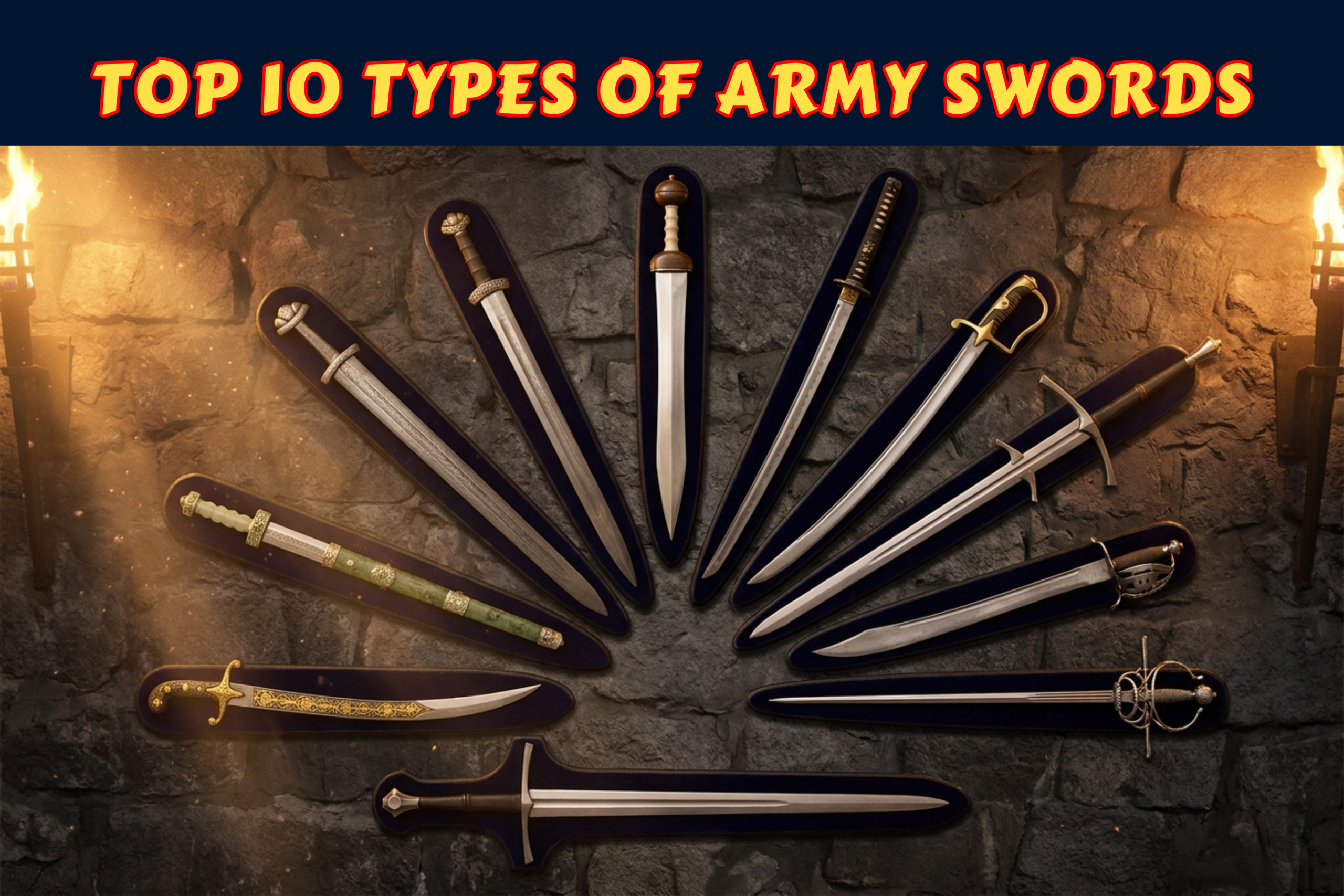
In this comprehensive exploration, we unveil ten of history’s most legendary army swords—each representing a pinnacle of craftsmanship, a distinctive approach to warfare, and a cultural legacy that transcends its original battlefield purpose. From the compact lethality of the Roman gladius to the sweeping elegance of the cavalry sabre, from the spiritual refinement of the Japanese katana to the raw power of the Scottish claymore, these blades tell the story of human ingenuity in the art of war.
Prepare to journey across continents and centuries, examining not merely the metallurgy and geometry of these weapons, but the hands that wielded them, the tactics they enabled, and the enduring fascination they command in our modern imagination.
The Evolution of Army Swords
Early Origins and Development of Swords for Combat
The sword’s ancestry stretches back to the Bronze Age, when early civilizations first discovered that a sharpened length of metal could deliver death more efficiently than stone or wood. The earliest true swords emerged around 3300 BCE in Mesopotamia and Anatolia—short, heavy blades cast from arsenical copper and later bronze. These primitive weapons, rarely exceeding 60 centimeters in length, were as much status symbols as practical arms, owned only by elite warriors and chieftains.
The transition from bronze to iron around 1200 BCE revolutionized sword production. Iron ore was more abundant than copper and tin, and iron blades could be worked to greater lengths without sacrificing strength. The Hittites and later the Celts pioneered iron sword-making, producing blades that reached 90 centimeters or more. These longer weapons enabled new fighting techniques—slashing attacks from horseback, reach advantages in infantry combat, and the devastating charge that would define cavalry warfare for centuries.
Steel, an iron-carbon alloy, represented the next quantum leap. By the early medieval period, smiths across Europe, the Middle East, and Asia had developed sophisticated methods of steel production. Pattern welding, case hardening, and differential heat treatment transformed swords from simple iron bars into sophisticated composite weapons capable of holding razor edges while maintaining flexible, shock-absorbing cores. The legendary Damascus steel of the Middle East and the folded steel of Japanese katanas represent pinnacles of this metallurgical evolution.
Technological Advancements Influencing Sword Design
Sword design did not evolve in a vacuum—it responded dynamically to changes in armor, battlefield conditions, and manufacturing capabilities. The Roman gladius, for instance, emerged as a response to the phalanx warfare of the Mediterranean world; its short, stabbing design proved devastating against the large shields and relatively light body armor of Rome’s adversaries. When Roman legions encountered heavily armored Parthian cataphracts, however, the spatha—a longer, slashing sword—gradually supplanted the gladius for cavalry use.
The medieval period witnessed an arms race between sword and armor that drove remarkable innovation. As chainmail gave way to plate armor in the 14th and 15th centuries, swordsmiths responded with specialized designs. The estoc, a long, rigid thrusting sword with a triangular cross-section, was developed specifically to pierce the gaps in plate armor. The longsword, with its two-handed grip and complex hilt, allowed knights to use the blade as a lever against armored opponents, striking with the pommel or crossguard when the edge proved insufficient.
Gunpowder ultimately rendered the sword obsolete as a primary battlefield weapon, but technological refinement continued in specialized roles. The cavalry sabre of the 18th and 19th centuries represented a marriage of metallurgical precision and equestrian dynamics—curved blades optimized for the slashing attack of a mounted charge, balanced for single-handed use while controlling a galloping horse.
Cultural Influences on the Shaping of Sword Types
Perhaps no weapon category reflects cultural values as profoundly as the sword. The Japanese katana was not merely a tool of war but a spiritual object, its creation governed by Shinto ritual and its possession restricted to the samurai class. The folding and differential hardening of Japanese blades produced not only superior metallurgy but a visible hamon (temper line) that became an aesthetic standard inseparable from the weapon’s function.
European swords similarly encoded social hierarchies. The knightly longsword was a weapon of the aristocracy, its expensive construction and the extensive training required for its use making it an exclusive badge of noble status. By contrast, the basket-hilted broadsword of Scottish clansmen and the falchion of medieval infantry represented more democratic weapons—effective, relatively affordable, and associated with popular military traditions rather than aristocratic culture.
Religious and philosophical beliefs profoundly shaped sword design and use. Islamic scimitars often featured inscriptions from the Quran, and the curved blade became associated with the faith’s expansion. Chinese jian swords embodied Daoist principles of balance and harmony in their symmetrical design. Viking swords frequently bore the names of gods and were believed to possess spirits, receiving ceremonial burials alongside their owners.
The Ten Legendary Army Swords
1. Gladius — The Sword of the Roman Legions
Historical Significance and Design Features
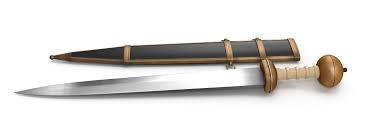
The gladius represents one of history’s most militarily successful sword designs—a weapon so effective that it remained essentially unchanged for over four centuries of Roman expansion. Derived from the swords of Iberian Celtiberians, the gladius was adopted by Rome during the Punic Wars of the 3rd century BCE and became the standard sidearm of every legionary.
Typically measuring 60–85 centimeters in length with a blade width of 5–7 centimeters and weighing approximately 1 kilogram, the gladius was remarkably compact. Its double-edged blade featured a distinctive triangular or leaf-shaped profile, tapering to a vicious point capable of punching through chainmail and leather armor. The short grip, usually fashioned from bone or wood and protected by a simple pommel and guard, was designed for single-handed use in conjunction with the large scutum shield.
Several variants evolved over Rome’s history. The gladius Hispaniensis, the earliest type, was longer and more leaf-shaped. The Mainz type, prevalent during the early Imperial period, featured a shorter, broader blade with a long point—optimized for the thrusting tactics of close-order legionary combat. The Pompeii type, which became standard by the 1st century CE, had parallel edges and a shorter point, representing a balanced design for both cut and thrust.
Impact on Roman Military Tactics and Conquests
The gladius was inseparable from the tactical system that built the Roman Empire. Roman infantry doctrine emphasized close-order combat, with legionaries advancing in disciplined ranks behind their scuta. The short gladius was perfectly suited to this formation fighting—it could be thrust around the edges of shields in the press of melee, whereas longer weapons would be impossible to wield effectively in such cramped conditions.
Roman tactical manuals describe the standard attack: the legionary would use his scutum to knock an opponent off balance, then drive the gladius into the enemy’s exposed torso in a swift, economical motion. The gladius’s point was particularly devastating against the relatively unarmored warriors Rome frequently encountered in Gaul, Britain, and the Germanic frontier. Against more heavily armored opponents, the gladius could exploit gaps in armor at close range.
This tactical system, built around the gladius and scutum combination, enabled Rome to defeat numerically superior forces repeatedly. From the conquest of Gaul under Caesar to the expansion into Britain and the Dacian Wars of Trajan, the gladius proved its lethality across diverse combat environments. Even as Roman tactics evolved and the spatha gradually replaced the gladius for cavalry and eventually infantry use, the weapon’s influence persisted in military thinking about close combat.
Cultural Legacy and Influence on Modern Military Symbolism
The gladius endures as a potent symbol of Roman military virtue—discipline, organization, and ruthless efficiency. The very word “gladiator” derives from this sword, forever linking it to the martial spectacle of the arena. In modern military culture, the gladius represents the ideal of the citizen-soldier, the professional fighting man whose strength lay not in individual heroics but in collective discipline.
Contemporary military units, particularly those with historical connections to Roman tradition, frequently incorporate gladius imagery into their insignia. The gladius appears in the emblems of numerous infantry regiments worldwide, symbolizing close combat prowess and the infantry’s role as the foundation of military power. The U.S. Army’s 18th Infantry Regiment, for instance, bears a gladius in its crest, as do various units of the British and Commonwealth armies.
The gladius also represents an enduring ideal in military education—the concept that superior tactics and training can overcome raw numerical advantage. Modern infantry manuals still reference Roman close-combat techniques, and the gladius remains a touchstone for discussions about the evolution of military technology and tactics.
2. Katana — The Iconic Sword of the Samurai
Unique Characteristics and Craftsmanship of the Katana
The Japanese katana stands as perhaps the most culturally significant sword ever forged—a weapon that transcended its martial function to become a spiritual object, an artistic masterpiece, and a symbol of an entire social class. Emerging in its recognizable form during the Kamakura period (1185–1333 CE), the katana represented the culmination of centuries of Japanese metallurgical innovation.
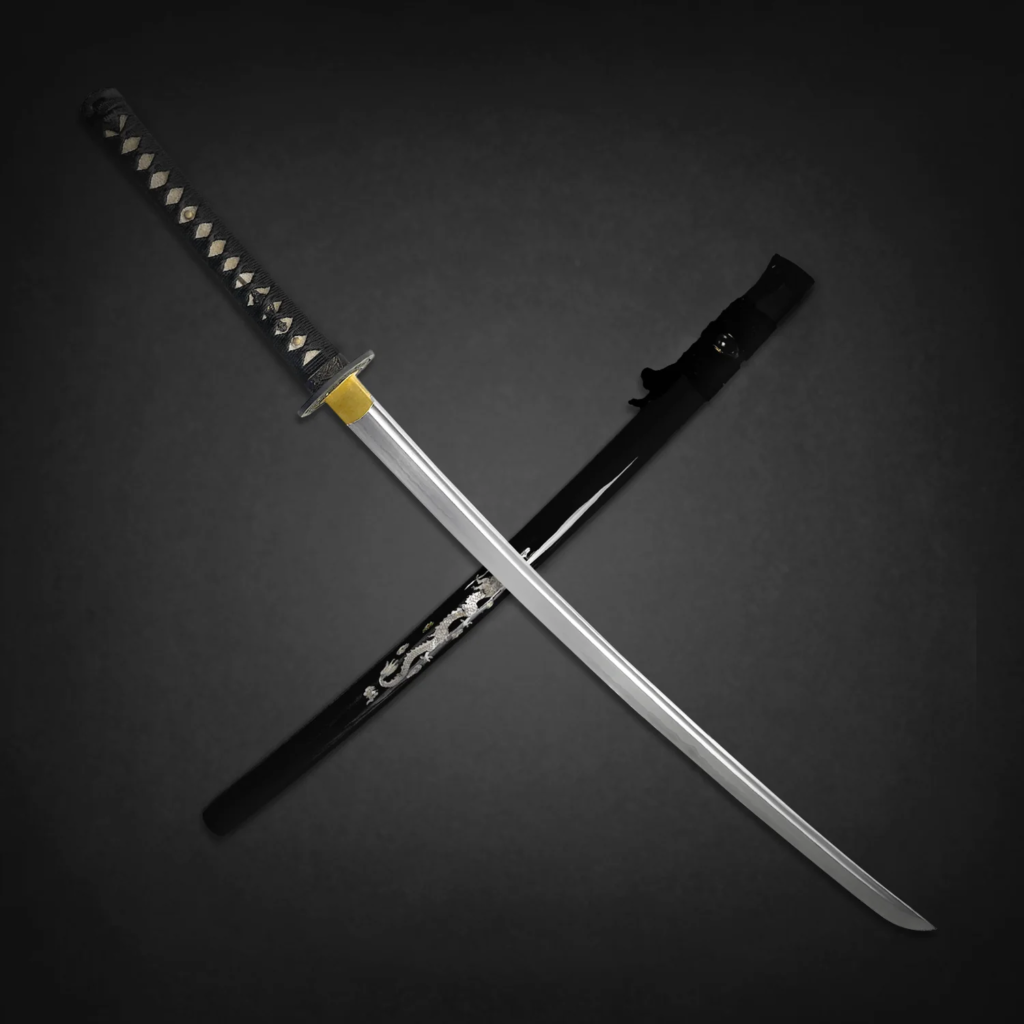
The katana’s most distinctive feature is its single-edged, curved blade, typically measuring 60–80 centimeters in length. This curvature (sori) is not merely aesthetic; it optimizes the blade for the drawing cut (iaido), allowing the samurai to deliver a devastating slash as the sword leaves its scabbard. The blade’s cross-section features a complex geometry—the shinogi (ridge line) creates a strong spine while the delicate edge (ha) can be sharpened to extraordinary keenness.
The legendary craftsmanship of the katana involves techniques unmatched in sword-making history. Traditional tamahagane steel is produced in a tatara furnace, then folded and hammered repeatedly—sometimes over 15,000 times—to homogenize the carbon content and eliminate impurities. The differential hardening process (yaki-ire) involves coating the blade with clay in precise patterns before quenching; this creates the characteristic hamon (temper line) and produces a blade with a hard, razor-sharp edge supported by a softer, more flexible spine. The result is a weapon of extraordinary cutting ability and surprising resilience—a blade that can slice through silk falling through the air yet withstand the shock of combat.
The katana’s mounting (koshirae) is equally refined. The tsuka (hilt) is wrapped in silk or leather over ray skin, the tsuba (guard) is often a work of art in itself, and the saya (scabbard) is lacquered and fitted with elaborate furniture. Every component reflects both functional requirements and aesthetic principles.
Spiritual and Philosophical Significance in Japanese Culture
No sword in history has been as thoroughly integrated into a culture’s spiritual and philosophical framework as the katana. For the samurai, the katana was not merely a weapon but the “soul of the samurai” (bushi no tamashii)—an object of reverence that embodied the warrior’s honor, discipline, and connection to the divine.
Shinto beliefs permeated every aspect of katana production and use. Smiths underwent purification rituals before forging; swords were believed to possess kami (spirits) and were treated with the respect due sacred objects. The legendary swords of Japan—such as the Kusanagi, one of the Three Imperial Regalia—were venerated as national treasures with supernatural powers.
The katana was central to bushido, the “way of the warrior,” which evolved from a practical martial ethos into a comprehensive philosophical system. Drawing the katana represented a profound commitment; the weapon was to be used only in defense of honor, and its misuse brought shame upon the wielder. The practice of seppuku (ritual suicide) required the katana, further binding the weapon to concepts of honor and self-determination.
This spiritual dimension elevated the katana above mere military equipment. Even after firearms rendered swords obsolete in combat, the katana retained its significance as a symbol of authority and cultural identity. During the Edo period (1603–1868), when samurai rarely saw combat, the katana became increasingly ceremonial, its artistic and symbolic value surpassing its martial function.
Comparison with Other Swords in Terms of Design and Purpose
The katana’s design reflects fundamentally different combat assumptions than European swords. Where the longsword was optimized for armored knightly combat, the katana was designed primarily for use against lightly armored or unarmored opponents in a society where full plate armor never developed. This explains its emphasis on cutting power over thrusting ability—the draw cut could incapacitate an opponent before he could mount an effective defense.
Compared to the curved scimitar of the Middle East, the katana features a more subtle curve and a completely different edge geometry optimized for slicing rather than slashing from horseback. The scimitar’s curvature is more pronounced and its blade typically broader, reflecting its origins in cavalry warfare against similarly armored opponents.
The katana’s single-edged design contrasts with the double-edged European arming sword, offering advantages in draw cuts and simplified maintenance but sacrificing the versatility of thrusting with either edge. The katana’s two-handed grip (though some techniques used one hand) provides greater cutting power than single-handed swords but reduces shield use—appropriate for a warrior class that often fought from horseback or in loose formations rather than the shield walls of medieval Europe.
In terms of metallurgical sophistication, the katana’s folded steel and differential hardening represent unique solutions to the challenge of creating a blade that is both hard and flexible. European pattern-welded swords achieved similar results through different methods, while later European steel production using blast furnaces produced homogeneous steel of excellent quality through entirely different technological pathways.
3. Sabre — The Elegant Blade of Cavalry
Role of the Sabre in Mounted Warfare
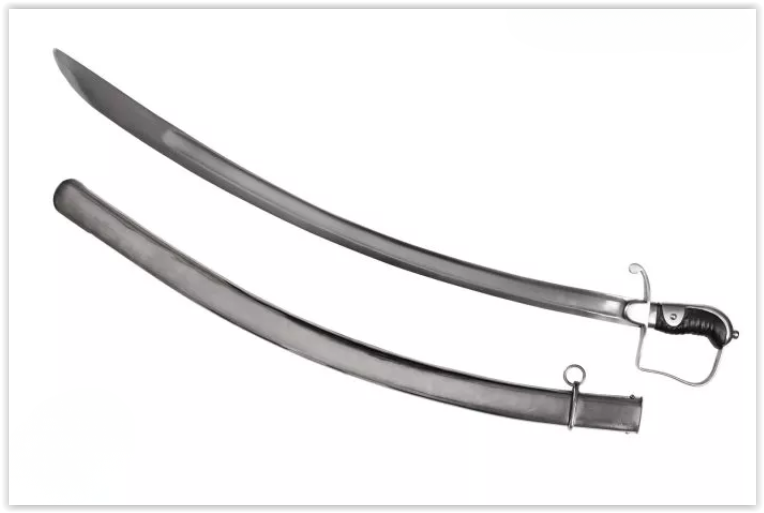
The sabre defined cavalry warfare for over three centuries, becoming the quintessential weapon of the mounted warrior from the steppes of Central Asia to the battlefields of Napoleonic Europe. Its curved blade, optimized for the slashing attack of a horseman in motion, represented the perfect marriage of equestrian dynamics and edged weapon design.
The sabre’s effectiveness in cavalry combat stems from fundamental physics. A galloping horse imparts tremendous momentum to its rider; the curved sabre blade, drawn across a target in a slashing motion, concentrates this force along a cutting edge while the curvature prevents the blade from becoming stuck in the target. The result is a devastating cut that can incapacitate an opponent without the risk of losing the weapon—a critical consideration for a cavalryman who cannot easily dismount to retrieve a stuck blade.
Cavalry sabre tactics evolved into sophisticated systems. The charge, with sabres drawn and extended, relied on shock and momentum to break enemy formations. Individual combat emphasized the cut at the head, arm, or sword arm—disabling the opponent while preserving the cavalryman’s mobility. The “Parthian shot” of earlier eras evolved into the wheeling charge, where cavalry would strike and withdraw repeatedly, using their mobility to exploit the sabre’s slashing advantage.
The sabre was not limited to cavalry use. Infantry officers frequently carried lighter sabre variants as symbols of rank and for personal defense. Naval boarding parties used cutlass-style sabres optimized for close-quarters combat. But it was in the hands of the cavalry—cuirassiers, hussars, lancers, and dragoons—that the sabre achieved its fullest military expression.
Variations in Design for Different Cavalry Units
The sabre’s design varied enormously across cultures and military units, each adaptation reflecting specific tactical requirements and aesthetic traditions.
European Cavalry Sabres: The 1796 British light cavalry sabre, designed by John Le Marchant, featured a pronounced curve and broad blade—brutally effective but criticized as too “cutting-oriented” at the expense of thrusting ability. The 1821 pattern introduced a more moderate curve, reflecting evolving tactical doctrine. French sabres, particularly those of the Napoleonic era, tended toward elegant, relatively light designs that balanced cut and thrust. Prussian and Austrian sabres were often heavier, reflecting the shock role of Central European heavy cavalry.
Eastern European and Asian Variants: The Polish szabla, with its distinctive eagle-head pommel and complex hilt, represented a sophisticated evolution of steppe traditions. Russian Cossack shashkas, technically sabres though often without guards, featured extreme curvature and were wielded with devastating effect in irregular warfare. The Afghan pulwar and Indian talwar carried Islamic and Hindu design traditions into sabre construction, with disc-shaped pommels and elaborate decoration.
American Adaptations: The U.S. Model 1840 cavalry sabre, known as the “Old Wristbreaker,” was a heavy, straight-bladed weapon influenced by French designs. The Model 1860 light cavalry sabre, used extensively in the Civil War, featured a more curved blade better suited to actual cavalry combat. Confederate forces often used imported European sabres, particularly British and French patterns.
Modern Military Sabres: By the late 19th century, sabres were becoming increasingly ceremonial. The British 1896 and 1908 patterns, the latter a straight thrusting sword, represented attempts to maintain cavalry relevance in an age of repeating firearms. These weapons saw limited use in World War I before cavalry charges became obsolete.
Influence of the Sabre on Ceremonial Military Dress
The sabre’s transition from battlefield weapon to ceremonial symbol is one of the most visible aspects of its legacy. Military dress uniforms across the world retain sabres as symbols of rank, tradition, and martial heritage.
In the British Army, officers of cavalry regiments and certain infantry regiments with cavalry traditions still wear sabres with full dress uniform. The Household Cavalry’s ceremonial duties, performed with gleaming steel sabres, represent one of the most spectacular survivals of cavalry tradition. The Royal Navy’s ceremonial sword, worn by officers, evolved from the naval cutlass and retains the curved blade profile.
The United States military maintains sabre traditions across services. Marine Corps officers wear the Mameluke sword, a curved blade adopted in 1805 after the First Barbary War, reflecting early American military engagement with Islamic military traditions. Army officers wear sabres with Army Blue and full dress uniforms. Air Force officers carry a distinctive sword derived from the sabre tradition.
Perhaps nowhere is the sabre’s ceremonial role more prominent than in the military traditions of the Middle East and South Asia. The saif or shamshir remains a symbol of authority in many Arab states, presented to graduating officers and carried in state ceremonies. In Pakistan and India, the talwar tradition persists in military ceremonies, with decorated swords presented as honors and carried by honor guards.
The sabre’s elegant curve has become a universal symbol of cavalry and, by extension, of military mobility, élan, and the romantic ideal of the mounted warrior. Even in an age of mechanized warfare, the sabre’s silhouette evokes a martial heritage that military institutions worldwide remain eager to claim.
4. Claymore — The Mighty Sword of the Highlanders
Origins and Cultural Symbolism of the Claymore
The claymore (from Scottish Gaelic claidheamh mòr, “great sword”) stands as one of history’s most imposing infantry weapons—a massive two-handed sword that became synonymous with Scottish Highland warfare and, eventually, with Scottish cultural identity itself. Emerging in the 15th century and reaching its classic form by the 16th, the claymore represented a distinctive response to the tactical conditions of Highland combat.
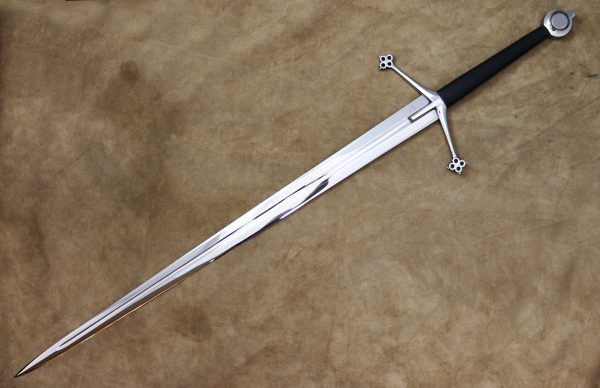
The classic claymore measured approximately 120–140 centimeters in overall length, with a straight, double-edged blade of about 100 centimeters and a long grip accommodating both hands. It typically weighed between 2 and 2.5 kilograms—lighter than its appearance suggests, thanks to the distal taper that reduced blade thickness toward the point. The distinctive forward-sloping quillons, often terminating in quatrefoil or other decorative shapes, and the leather-wrapped ricasso (the unsharpened section near the guard) allowed the wielder to “choke up” on the blade for close-quarters control.
The claymore’s origins reflect both European and indigenous Scottish influences. The late medieval European “great sword” or Bidenhänder tradition clearly influenced Scottish smiths, but the claymore developed distinctive characteristics suited to Highland warfare. The basket-hilted “claymore” of the 18th century, technically a different weapon type (the broadsword), inherited the name and cultural associations of the earlier two-handed sword.
Culturally, the claymore became inseparable from Highland clan identity. These swords were expensive weapons, often passed down through generations and bearing the marks of clan smiths. The claymore represented the warrior ethos of a society where every able-bodied man was expected to bear arms in defense of clan and chief. The weapon’s imposing presence in clan gatherings and its use in ceremonial contexts reinforced its role as a symbol of collective martial pride.
Combat Techniques Associated with the Claymore
The claymore’s size and weight dictated distinctive combat techniques that exploited its reach and momentum while managing its inertia. Unlike the nimble rapier or the versatile longsword, the claymore was essentially a battlefield weapon—cumbersome for individual duels but devastating in formation fighting and the chaotic melee of Highland warfare.
Highland combat tactics emphasized the “Highland charge”—a rapid advance culminating in a ferocious rush into enemy lines. Claymore-wielding warriors, often supported by troops with targes (small round shields) and dirks, would use the great sword’s reach to strike over the heads of the front rank or to deliver sweeping cuts that could incapacitate multiple opponents. The claymore’s length allowed Highlanders to engage pike formations more effectively than swordsmen with shorter weapons, though the claymore was never a true anti-pike weapon like the European zweihänder.
Individual claymore technique emphasized powerful cuts delivered from the shoulder and elbow, using the weapon’s momentum rather than wrist action. The long grip allowed for leverage-based techniques—using the crossguard to trap or bind opponent’s weapons, and employing the pommel as a striking surface in close quarters. The leather-wrapped ricasso enabled a “half-swording” grip for thrusting in tight formations, though the claymore was primarily a cutting weapon.
The claymore’s effectiveness must be understood within the context of Highland warfare, which rarely involved heavily armored opponents. Against the relatively lightly equipped troops of Lowland Scotland and England, the claymore’s reach and cutting power were formidable. However, against disciplined pike formations or heavily armored cavalry, Highland swordsmen were at a significant disadvantage—a reality demonstrated at battles like Culloden (1746), where traditional Highland tactics proved obsolete against modern military organization.
Legacy in Popular Culture and Modern Depictions
The claymore occupies a unique place in popular imagination, perhaps more prominent in modern culture than in its historical period of military relevance. Sir Walter Scott’s novels, particularly Waverley (1814), romanticized Highland warfare and cemented the claymore as a symbol of noble martial virtue. Victorian Scotland’s cultural revival embraced the claymore as an emblem of national identity, producing countless paintings, statuary, and decorative reproductions.
In contemporary popular culture, the claymore appears frequently in fantasy literature, film, and gaming—often depicted as even larger and heavier than historical examples. Characters like William Wallace in Braveheart (1995) wield massive swords in the claymore tradition, though the film’s weapons are exaggerated for cinematic effect. The claymore’s silhouette—long straight blade, distinctive quillons, and elongated grip—has become visual shorthand for “barbarian” or “Highland” warrior archetypes.
Modern historical European martial arts (HEMA) practitioners have reconstructed claymore techniques from 16th-century fencing manuals, particularly German sources that influenced Scottish swordplay. These reconstructions emphasize the weapon’s surprising maneuverability when proper technique is applied, challenging popular misconceptions about the claymore as an unwieldy brute-force weapon.
The claymore remains a powerful symbol of Scottish heritage, featured in military regalia, clan heraldry, and tourist iconography. The Royal Regiment of Scotland and predecessor Highland regiments carried claymore-derived swords in ceremonial contexts, maintaining a living connection to this formidable weapon’s legacy.
5. Cutlass — The Swashbuckling Sword of Pirates
Design Features Optimized for Close-Quarters Combat
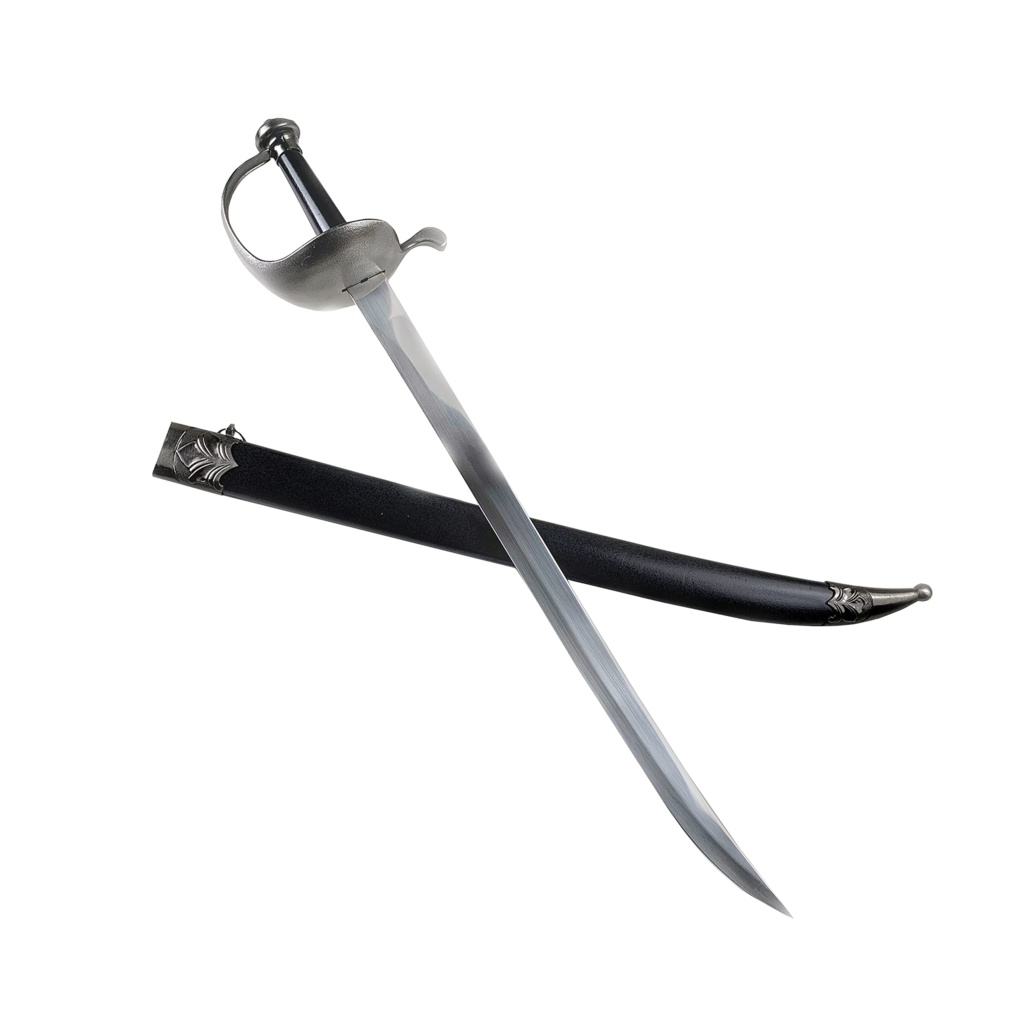
The cutlass represents the ultimate evolution of the short, robust cutting sword—a weapon designed specifically for the chaotic, confined environment of naval combat. With its broad, curved blade, substantial guard, and compact dimensions, the cutlass was optimized for the unique demands of fighting aboard ships, where long weapons were impractical and elaborate fencing techniques impossible.
The typical naval cutlass featured a blade of 60–75 centimeters—short enough for use in the cramped spaces between decks, in rigging, and during boarding actions. The blade was broad and relatively heavy, with a pronounced curve toward the point that enhanced cutting power in slashing attacks. Unlike the refined cavalry sabre, the cutlass blade was often relatively crude in finish, prioritizing function over form. The guard was substantial, frequently a simple basket or half-basket of iron or brass that protected the hand without the complexity of a rapier’s elaborate hilt.
The cutlass’s weight distribution favored the blade, making it a powerful cutter despite its short length. This forward balance, while reducing the speed of recovery between cuts, delivered tremendous force in the slashing attacks that dominated naval boarding combat. The cutlass could also be used effectively as a tool—clearing rigging, cutting lines, and performing various shipboard tasks that a more delicate weapon could not endure.
The weapon’s robust construction reflected its harsh operating environment. Salt air, sea spray, and rough handling would quickly ruin a finely crafted sword; the cutlass was built to withstand abuse that would destroy more refined weapons. Many naval cutlasses featured simple wooden grips and minimal decoration, emphasizing utility over aesthetics.
Notable Historical Uses by Pirates and Navies
While popular culture associates the cutlass primarily with pirates, its military use was far broader and more significant. Naval powers worldwide adopted cutlass-style swords for their boarding parties and naval infantry.
Royal Navy: The British Royal Navy standardized the cutlass from the early 18th century, with numerous pattern variations issued over the following two centuries. The 1804 pattern, with its distinctive “figure-eight” guard, became iconic. British sailors received cutlasses for boarding actions and for repelling enemy boarders; the weapon’s simplicity meant that even minimally trained seamen could wield it effectively. Nelson’s victory at Trafalgar (1805) involved extensive cutlass combat during the boarding actions that decided the battle.
Other Naval Powers: France, Spain, the Netherlands, and later the United States all adopted similar weapons for naval use. The American Model 1860 naval cutlass, with its distinctive bowl guard, remained in service into the early 20th century. These weapons saw action in the War of 1812, the American Civil War, and countless smaller naval engagements.
Pirate Use: Pirates indeed favored cutlasses, but not because of any unique “pirate design.” Rather, pirates acquired weapons from captured vessels and colonial armories, and the cutlass’s availability in naval stores made it the natural choice. Pirate combat emphasized boarding and close-quarters action where the cutlass excelled. Famous pirates like Blackbeard and Calico Jack would have carried cutlasses as sidearms, though they likely also possessed pistols, boarding axes, and other weapons.
Privateers and Merchant Marine: Privateers—state-sponsored pirates—carried cutlasses as standard equipment. Merchant vessels often kept cutlasses in armories for defense against pirates and privateers, though merchant crews were typically less skilled in their use than naval personnel.
Transition from Naval Weapon to Ceremonial Item
The cutlass’s functional career effectively ended with the transition from sail to steam and the disappearance of boarding as a primary naval tactic. By the late 19th century, naval combat was dominated by long-range gunnery; the cutlass remained in inventory but saw little use.
However, the weapon’s distinctive appearance and romantic associations ensured its survival in ceremonial roles. The Royal Navy maintained cutlasses for ceremonial use long after their combat obsolescence, and they remain part of naval tradition today. The U.S. Navy similarly preserved the cutlass for ceremonial purposes, with naval officers occasionally wearing them with full dress uniforms.
The cutlass’s popular cultural significance far exceeds its historical military importance. The “swashbuckler” archetype—the daring, cutlass-wielding adventurer—has become a staple of adventure literature and film. From Errol Flynn’s Captain Blood (1935) to the Pirates of the Caribbean franchise, the cutlass represents romantic rebellion and maritime adventure. This cultural afterlife has made the cutlass one of history’s most recognizable swords, despite its relatively brief period of genuine military significance.
6. Rapier — The Elegant Duelling Sword
Evolution from Military Weapon to Civilian Duelling Sword
The rapier’s development traces one of the most fascinating trajectories in sword history—from a military sidearm to the quintessential civilian weapon, and eventually to the sporting implement that became modern fencing. This evolution reflects broader changes in European society, warfare, and concepts of personal honor.
The rapier emerged in 16th-century Spain and Italy as a refinement of the civilian espada ropera (dress sword). Early rapiers were not dramatically different from military swords; they featured complex hilts with rings and plates to protect the hand, straight double-edged blades capable of both cut and thrust, and were worn as part of civilian dress by gentlemen of status. The term “rapier” itself likely derives from the Spanish espada ropera, referring to a sword worn with robes rather than armor.
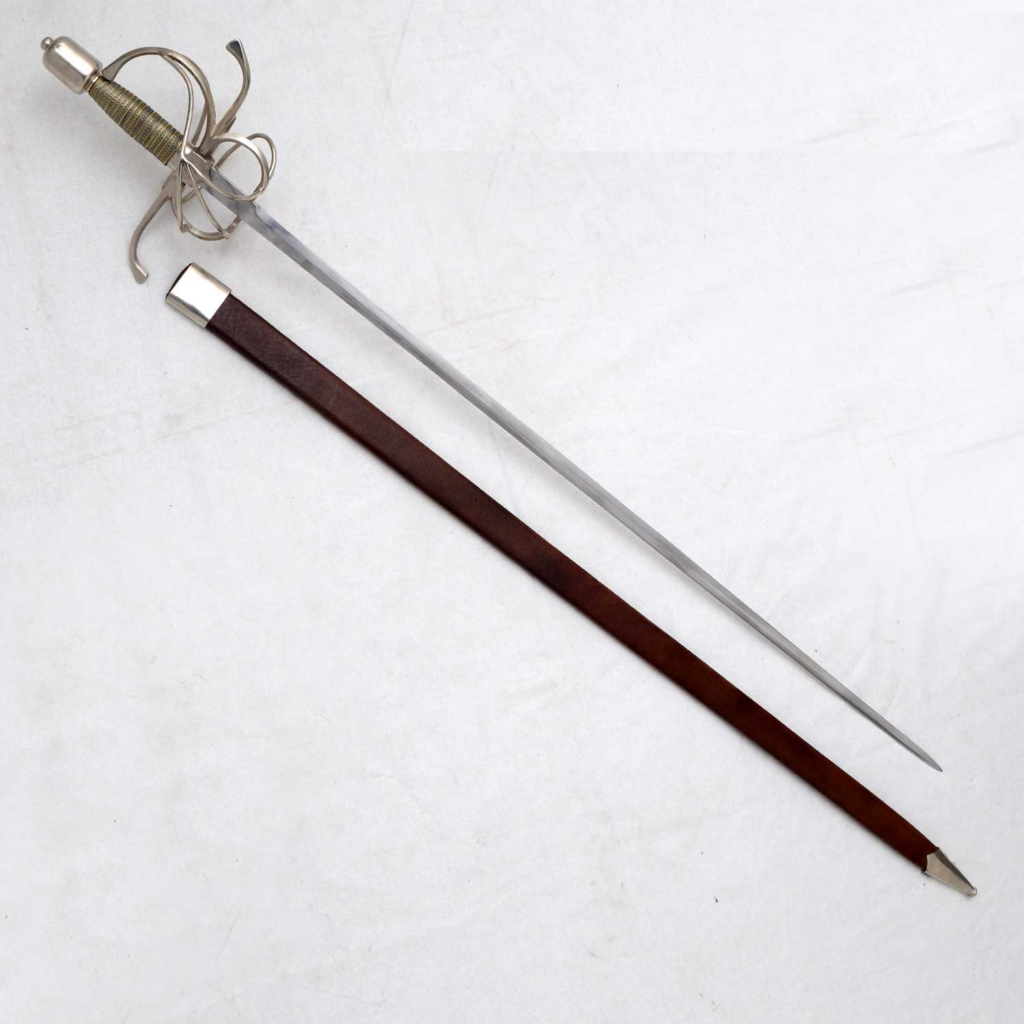
By the late 16th century, the rapier had evolved into a distinct weapon type. Blades became longer, narrower, and increasingly specialized for the thrust. The complex hilt developed into the elaborate basket of bars, plates, and rings that characterizes the classic rapier—offering protection without the weight of a full basket hilt. Blade lengths reached 100 centimeters or more, with some Spanish rapiers extending to 120 centimeters, requiring a long grip for two-handed use or a specialized one-handed technique.
This evolution was driven by changing patterns of violence. As centralized states reduced the frequency of battlefield combat for the aristocracy, interpersonal violence shifted to duels, street fights, and assassinations—contexts where the thrusting rapier, with its reach and precision, offered advantages over the cutting swords of military tradition. The rapier became the weapon of urban self-defense and aristocratic honor culture, its elaborate design reflecting the status of its bearer as much as practical combat requirements.
Techniques and Skills Associated with Rapier Combat
Rapier combat demanded skills fundamentally different from those of the cutting swords that preceded it. Where medieval swordplay emphasized powerful cuts, leverage, and close-quarters binding, rapier fencing prioritized speed, precision, and geometric positioning.
The rapier’s length and point orientation made thrusting the primary attack. Fencers learned to extend the blade in a straight line toward the target, using the weapon’s reach to strike before the opponent could close distance. The classic rapier guard positioned the blade horizontally or diagonally, point directed at the opponent’s face or chest, creating a threatening line that discouraged rash advances.
Footwork became critically important in rapier combat. Italian masters like Achille Marozzo and later Ridolfo Capo Ferro developed sophisticated systems of movement—advances, retreats, lunges, and circular steps—that allowed the fencer to control distance and angle. The lunge, in particular, became the signature rapier technique—a explosive extension of the body that projected the blade toward the target with maximum reach and minimal exposure.
The off-hand played a crucial role. Rapier fencers typically employed a dagger, cloak, or buckler in the left hand to parry the opponent’s blade and create openings for the rapier’s thrust. This “case of rapiers” (rapier and dagger) style required ambidextrous coordination and represented one of the most sophisticated martial arts of the Renaissance period.
By the 17th century, French masters had refined rapier technique into the classical system that would evolve into modern fencing. The emphasis on the thrust, the linear footwork, and the concept of “right of way” (priority in attack) all originated in this period. The rapier’s blade gradually shortened and lightened, becoming the smallsword of the 18th century—a weapon optimized for the sporting duel rather than lethal combat.
Influence on Fencing as a Sport and Martial Art
The rapier is the direct ancestor of modern Olympic fencing, and its influence permeates every aspect of the sport. The three modern fencing weapons—foil, épée, and sabre—all descend from rapier traditions, though each evolved along different paths.
The foil, with its flexible blade and restricted target area, developed from the practice weapons used by 18th-century fencing masters to teach rapier technique safely. The conventions of “right of way” that govern foil fencing originated in the rapier’s tactical principles—the attack takes priority, and the defender must establish control before counterattacking.
The épée represents the closest modern equivalent to the rapier’s dueling function. With its stiff blade and unrestricted target (the entire body is valid), épée fencing preserves the rapier’s lethal logic: the first touch wins, with no conventions to protect the attacker. This “dueling sword” was developed in the 19th century specifically to preserve the skills of lethal swordplay in an age when actual dueling had become illegal.
Even the sabre, a cutting weapon, owes organizational and conventional debts to rapier traditions. The classical Italian and Hungarian sabre schools emerged from masters who also taught rapier and smallsword, and the linear footwork and tactical concepts reflect this heritage.
Beyond sport, historical rapier techniques have experienced a significant revival through HEMA and related martial arts movements. Practitioners study original treatises by masters like Capo Ferro, Giganti, and Fabris, reconstructing a martial art that was once the pinnacle of European personal combat. This revival has revealed the rapier to be a remarkably sophisticated system, combining physical precision with mathematical geometry in ways that continue to challenge and fascinate modern practitioners.
7. Scimitar — The Curved Blade of the Middle East
Cultural and Religious Significance of the Scimitar
The scimitar—a term encompassing the various curved swords of Islamic civilization—represents far more than a weapon type. It became a symbol of Islamic military expansion, a religious icon, and a cultural artifact whose influence extended from the Atlantic to the Indian Ocean.
The curved sword was not originally an Islamic invention. Central Asian nomads had employed curved blades for millennia before the rise of Islam, and the Turkish tribes that became the military backbone of early Islamic empires brought their sabre traditions with them. However, the scimitar became so thoroughly identified with Islamic civilization that it acquired religious and cultural significance transcending its military function.
The scimitar appears frequently in Islamic art, literature, and religious symbolism. The zulfiqar, the legendary bifurcated sword of Ali ibn Abi Talib (the Prophet Muhammad’s cousin and son-in-law), is one of the most potent symbols in Shia Islam, often depicted as a scimitar or scimitar-like weapon. Swords bearing Quranic inscriptions were common, with blades and hilts decorated with verses, names of Allah, and religious invocations. These “swords of faith” were believed to carry divine blessing into battle.
The scimitar also symbolized legitimate authority in Islamic states. The Ottoman sultans possessed ceremonial swords that were part of the regalia of rule; the taklid-i seyf (sword girding) ceremony was an essential part of the Ottoman accession ritual. Mamluk sultans and Mughal emperors similarly invested swords with royal authority, presenting them to favored commanders as marks of imperial favor.
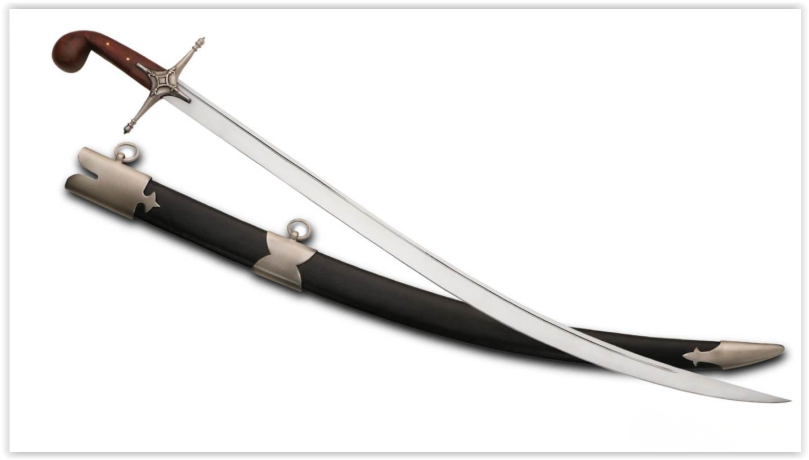
The term “scimitar” itself is a European catch-all for various distinct sword types. The Arabian saif, the Persian shamshir, the Turkish kilij, and the Indian talwar each represent distinct design traditions with unique characteristics, though all share the fundamental curved blade profile that defines the scimitar family.
Design Adaptations for Various Combat Styles
The scimitar family encompasses remarkable diversity, with designs optimized for different combat contexts, equestrian traditions, and cultural preferences.
The Arabian Saif: Early Islamic swords derived from pre-Islamic Arabian and Roman spatha traditions, initially featuring relatively straight blades. By the medieval period, Arabian swords had adopted the curved profile, though typically with less pronounced curvature than later Turkish or Persian designs. The saif was primarily a cutting sword, used from horseback or in infantry combat against lightly armored opponents.
The Persian Shamshir: Emerging in the 16th century, the shamshir represents the most extreme expression of scimitar curvature. Its blade curves continuously from hilt to point, creating a weapon optimized for the draw cut. The shamshir’s blade is relatively narrow and light, emphasizing speed and precision over brute cutting power. This design reflects Persian equestrian traditions and the tactical preferences of Persian cavalry, who valued the ability to deliver precise cuts at full gallop.
The Turkish Kilij: The kilij, particularly in its classic Ottoman form, features a distinctive blade geometry—a relatively straight section near the hilt that curves dramatically in the final third (the “yelman” or false edge). This design creates a devastating cutting section while preserving some thrusting ability and structural strength. The kilij was the primary weapon of Ottoman sipahi cavalry and janissary infantry, and its influence extended across the Ottoman Empire’s vast territories.
The Indian Talwar: The talwar combined Islamic curved-blade traditions with Indian metallurgical expertise and aesthetic preferences. Characterized by a disc-shaped pommel, a distinctive grip that curves downward, and a broad, moderately curved blade, the talwar became the standard sword of Mughal and Rajput cavalry. Talwars were often elaborately decorated with gold koftgari work, gemstone inlays, and watered steel blades that rivaled Damascus in quality.
The Mameluke Sword: Egyptian Mameluk warriors developed distinctive sword styles that influenced European military fashion. The “Mameluke sword” adopted by U.S. Marine Corps officers and British Light Cavalry officers in the 19th century was directly inspired by swords captured from Mameluk forces during the Napoleonic campaigns in Egypt.
Role in Shaping Military Tactics in the Region
The scimitar’s influence on Middle Eastern and Central Asian military tactics was profound, particularly in cavalry warfare. The curved blade’s optimization for the slashing attack from horseback shaped the development of light cavalry traditions that dominated regional warfare for centuries.
Turkish and Mongol cavalry tactics, built around the curved sabre and composite bow, created mobile warfare systems that repeatedly defeated more heavily armored opponents. The Seljuk victory at Manzikert (1071), which opened Anatolia to Turkish settlement, demonstrated the effectiveness of light cavalry armed with curved swords against Byzantine heavy cavalry. Ottoman military success similarly relied on the tactical flexibility of sipahi cavalry, whose kilijs delivered devastating slashing attacks.
The scimitar also influenced infantry combat in the region. Janissary units, though primarily firearm-equipped, carried swords for close combat, and various Islamic infantry traditions developed sophisticated sword techniques. The zanjir (chain) fighting of some Sufi orders and the sword dances performed across the Islamic world preserved martial techniques even as firearms became dominant.
The scimitar’s cultural persistence is remarkable. Unlike the European longsword or the Japanese katana, which became obsolete with the disappearance of the social classes that wielded them, scimitar traditions persisted in many Islamic societies well into the modern era. Bedouin warriors carried saifs into the 20th century; Afghan fighters wielded pulwars against British forces in the 19th and 20th centuries. The scimitar’s silhouette remains a powerful symbol in Islamic military and national iconography, from the flags of Saudi Arabia to the regalia of modern Middle Eastern armed forces.
8. Jian — The Exquisite Sword of Ancient China
Symbolism and Craftsmanship of the Jian
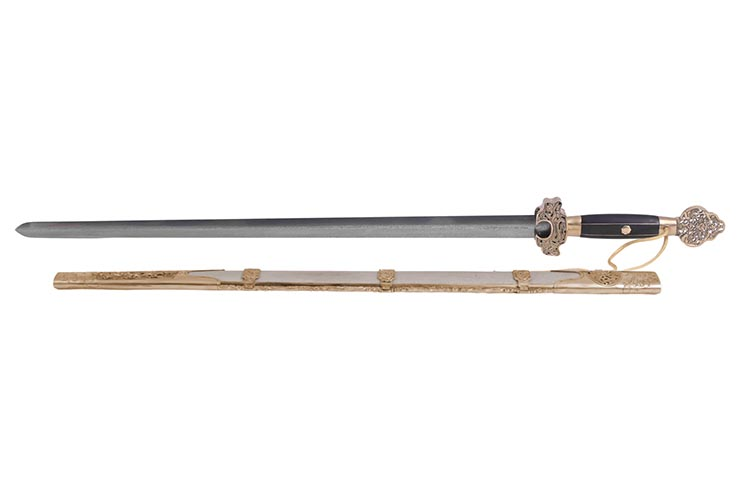
The jian (劍), often called the “gentleman of weapons” in Chinese tradition, represents one of the world’s most aesthetically refined sword designs—a weapon that achieved its fullest expression not on the battlefield but in the realms of philosophy, art, and martial spirituality. With its straight, double-edged blade, symmetrical guard, and elegant proportions, the jian embodies principles of balance and harmony that reflect deep Chinese philosophical traditions.
The classic jian features a straight blade of 70–100 centimeters, double-edged and tapering to a sharp point. Unlike the curved dao (sabre) that became China’s primary military sword, the jian maintains perfect symmetry along its longitudinal axis—a design choice with profound cultural implications. The guard is typically small and symmetrical, the grip straight and often wrapped in cord or ray skin, and the pommel balanced to create a weapon that feels centered and controlled in the hand.
Chinese sword craftsmanship achieved extraordinary sophistication. Bronze jians of the Warring States period (475–221 BCE) already featured complex castings with intricate patterns and exceptionally sharp edges. The transition to iron and steel production during the Han dynasty (206 BCE–220 CE) brought new techniques, including pattern welding and differential heat treatment that produced blades of remarkable quality. Chinese metallurgists developed methods of producing “flowing water” patterns in steel that rivaled the famous Damascus and wootz steels of the Middle East and India.
The jian’s construction reflected not merely functional requirements but cosmological principles. The balance point (zhongxin) was carefully calculated; the blade’s geometry embodied concepts of yin and yang in its contrasting edges and spine. Some jians were inscribed with talismanic symbols or crafted to specific measurements believed to enhance their spiritual power. The finest jians were considered works of art comparable to the greatest paintings or calligraphy.
Martial Arts Forms Developed Around the Jian
The jian occupies a unique position in Chinese martial arts, serving as the primary weapon of the internal martial arts tradition and countless external styles. Unlike the dao, which was the practical weapon of soldiers and bandits, the jian became associated with the scholar-warrior ideal—the wuxia (martial hero) who combined physical prowess with spiritual cultivation and intellectual refinement.
Taijijian (Tai Chi sword) represents perhaps the most philosophically sophisticated jian tradition. Developed as part of taijiquan (Tai Chi) practice, taijijian forms emphasize slow, controlled movements that cultivate internal energy (qi) while developing precise body mechanics. The jian’s balance and symmetry make it ideal for this practice; the weapon becomes an extension of the body’s center, moving in continuous circles and spirals that embody taiji principles. Despite its martial origins, taijijian is often practiced today primarily for health and meditation, though traditional applications remain part of advanced training.
Wudang jian traditions, associated with the Daoist Wudang Mountains, preserve some of China’s most ancient sword techniques. These styles emphasize the jian as a spiritual tool, with forms that mimic the movements of animals and natural forces. The Wudang approach treats the jian not merely as a weapon but as a implement for Daoist cultivation, with sword practice integrated into broader spiritual disciplines.
Numerous other jian traditions exist across China’s martial landscape—Shaolin jian, Emei jian, Kunlun jian, and countless regional and family styles. Each developed distinctive forms, techniques, and philosophical frameworks, but all share the fundamental appreciation of the jian as a weapon requiring precision, control, and cultivated skill rather than brute force.
Influence on Chinese Military Strategy and Philosophy
The jian’s influence on Chinese military thought extends beyond practical combat applications to shape fundamental concepts about warfare, leadership, and the relationship between civil and military virtue.
In classical Chinese thought, the jian symbolized the ruler’s authority and the legitimate use of force. The Spring and Autumn Annals and other classical texts describe the ceremonial presentation of swords as marks of royal favor and military command. The jian’s straightness was morally significant—it represented upright conduct and the correct path, contrasting with the devious or crooked. A ruler who “wore the jian” bore the responsibility of righteous governance.
Sun Tzu’s The Art of War, while not specifically focused on swords, reflects the strategic thinking that valued the jian’s precision and control over brute force. Chinese military philosophy consistently emphasized winning without fighting, subduing the enemy through strategy rather than slaughter—a perspective that aligned with the jian’s image as a refined weapon of the educated elite rather than the common soldier.
The jian also influenced concepts of personal cultivation for military leaders. The ideal Chinese general was expected to be proficient in the “six arts” including archery and charioteering, but swordsmanship—particularly jian technique—was considered essential for the complete warrior. Military examination systems during various dynasties tested candidates’ martial skills, and jian proficiency was a marker of cultivated military virtue.
In literature and popular culture, the jian became the weapon of heroes, immortals, and righteous defenders. The wuxia genre of martial arts fiction, which flourished from classical vernacular novels to modern cinema, consistently associates the jian with protagonists of noble character. The “sword immortal” archetype—a warrior who has transcended mere technique to achieve spiritual unity with the blade—represents the ultimate expression of jian philosophy.
9. Viking Sword — The Norse Weapon of Conquest
Characteristics and Construction of Viking Swords
The Viking Age sword (8th–11th centuries CE) represents a remarkable synthesis of European metallurgical traditions, Norse cultural values, and the practical demands of raiding warfare. These weapons were not merely tools of combat but powerful symbols of status, sacred objects with supernatural associations, and essential components of the Norse warrior identity.
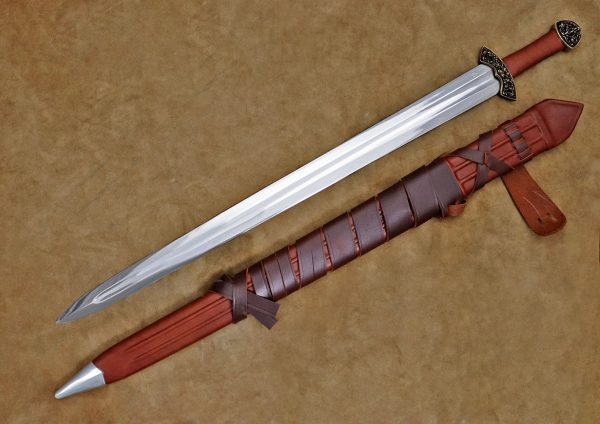
Viking swords typically featured straight, double-edged blades of 70–90 centimeters, with a broad, flat profile optimized for slashing cuts. The blades were pattern-welded—constructed by twisting and forge-welding together rods of iron with different carbon contents, then grinding and etching to reveal intricate patterns on the blade surface. This technique produced blades with hard, sharp edges supported by a softer, more flexible core, combining cutting ability with resistance to breakage.
The hilt construction of Viking swords evolved significantly over the Viking Age. Early “Viking Age swords” (as classified by Jan Petersen in his typology) featured relatively simple hilts with short guards and pommels of various shapes—triangular, lobed, or disc-shaped. By the late Viking period, the “Norman sword” with its characteristic Brazil-nut pommel and straight crossguard had emerged, representing a transitional form between the Viking sword and the medieval knightly sword.
Viking swords were relatively light, typically weighing between 1 and 1.5 kilograms, with a balance point close to the hilt that allowed for quick, controlled cuts. The grip was usually of wood, wrapped in leather or textile, and sized for a single hand—Viking warriors typically carried a shield in the off-hand rather than using two-handed sword techniques.
The quality of Viking swords varied enormously. Wealthy chieftains and successful warriors possessed blades of pattern-welded steel, sometimes imported from Frankish workshops (the legendary Ulfberht swords represent high-quality Frankish blades found across the Viking world). Common fighters might carry simpler iron blades of local manufacture. Archaeological finds suggest that swords were relatively rare compared to spears and axes, indicating that they were prestige weapons rather than standard equipment.
Role in Viking Raids and Warfare Tactics
The Viking sword’s design reflects the tactical requirements of Viking warfare—raiding, skirmishing, and the shield-wall combat that characterized pitched battles.
In raiding contexts, the sword’s slashing ability was devastating against lightly armored or unarmored opponents. Viking raids targeted monasteries, villages, and undefended settlements where a swift, terrifying attack could secure plunder before organized resistance could form. The sword’s broad blade delivered incapacitating wounds that spread panic and facilitated rapid withdrawal—a tactical pattern that made Viking raids so difficult to counter.
In ship combat, the sword’s compact length was advantageous. Fighting from the deck of a longship or during boarding actions required weapons that could be wielded in cramped conditions. The sword complemented the spear, axe, and seax (short knife) in the Viking warrior’s arsenal, offering versatility when longer weapons became impractical.
The shield wall (skjaldborg) represented the Viking tactical system at its most sophisticated. Warriors formed a dense line, shields overlapping, and engaged the enemy in a grinding melee where individual swordsmanship mattered less than collective discipline. In this context, the sword’s ability to deliver powerful overhand cuts and to exploit gaps in enemy shield walls made it a valuable weapon, though spears remained the primary armament for most warriors.
Viking swords also served as status symbols and diplomatic gifts. A fine sword was a treasure worth boasting about in poetry, a fitting gift to cement alliances, and an heirloom passed down through generations. The sagas are filled with swords that have names, histories, and supernatural powers—reflecting the profound cultural significance these weapons held.
Cultural Impact and Legacy in Norse Mythology
The Viking sword occupies a central place in Norse mythology and literature, reflecting its importance in Viking society. Mythological swords were not merely weapons but agents of fate, divine gifts, and cursed objects that shaped the destinies of gods and heroes.
Legendary Swords: The Poetic Edda and Prose Edda describe swords of supernatural power. Gram, the sword that Sigurd used to slay the dragon Fafnir, was forged by the dwarf Regin and could cut through iron as if it were cloth. Tyrfing, cursed to kill a man every time it was drawn, passed through generations of heroes in the Hervarar saga. Skofnung, the sword of the Danish king Hrolf Kraki, was said to contain the souls of twelve berserkers in its guard.
Sword Names and Personalities: The Norse tradition of naming swords and attributing personalities to them reflects a worldview in which weapons possessed spirits. A warrior’s relationship with his sword was intimate and reciprocal—the sword served the warrior faithfully, and the warrior honored the sword with maintenance, praise, and eventually burial. This animistic perspective explains the elaborate grave goods found in Viking burials, where swords were often ritually “killed” (bent or broken) to release their spirits before burial.
Ritual and Religion: Swords played roles in Norse religious practice. Oaths sworn on swords were considered particularly binding. The blót (sacrifice) sometimes involved swords, and swords appear in accounts of religious ceremonies. The concept of the “sword of justice”—a weapon that punishes the guilty and protects the innocent—has roots in Norse as well as broader Germanic traditions.
The Viking sword’s legacy extends far beyond the Viking Age. Norman knights, descended from Viking settlers in France, carried swords derived from Viking designs when they conquered England in 1066. The medieval knightly sword, with its crossguard and wheel pommel, evolved directly from late Viking forms. In modern popular culture, Viking swords appear in films, television, literature, and gaming, often depicted with varying degrees of historical accuracy but consistently representing the romantic image of the Norse warrior.
10. Longsword — The Versatile European Blade
Development of the Longsword for Knightly Combat
The longsword (also called the bastard sword or hand-and-a-half sword) represents the culmination of European medieval sword development—a weapon optimized for the armored combat of the High and Late Middle Ages and the sophisticated martial arts that evolved around it. Emerging in the 13th century and reaching its classic form in the 14th and 15th centuries, the longsword was the defining weapon of the European knight.
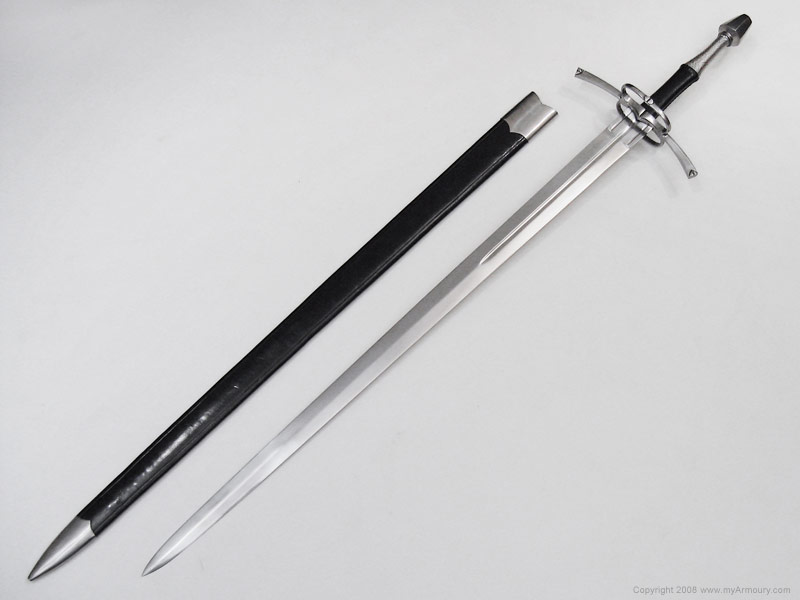
The longsword’s defining characteristic is its grip, long enough to accommodate two hands but balanced for effective one-handed use when necessary. This “hand-and-a-half” design provided the leverage and power of a two-handed weapon while preserving the versatility of a single-handed blade. Typical longswords measured 100–130 centimeters in overall length, with blades of 80–100 centimeters and weights of 1.2–1.8 kilograms—lighter than popular imagination suggests, thanks to sophisticated distal tapering that reduced blade mass toward the point.
The longsword evolved in response to the arms race between sword and armor. As plate armor became increasingly comprehensive and effective in the 14th century, swordsmiths developed blades capable of defeating it. The classic longsword blade featured a stiff, diamond-shaped or hexagonal cross-section that provided the rigidity necessary for thrusting into armor gaps. Some specialized forms, like the estoc, sacrificed cutting ability entirely for maximum thrusting penetration.
Hilt design became increasingly complex to protect the hand against armored opponents and to facilitate advanced techniques. The crossguard lengthened and curved; side rings and eventually full baskets of steel bars developed to encase the hand. The pommel, often disc-shaped or wheel-shaped, provided counterbalance and served as a striking surface in close combat.
The longsword was not exclusively a knightly weapon. Mercenaries, men-at-arms, and even trained commoners wielded longswords, though the expense of quality blades and the extensive training required for proficiency made it predominantly a weapon of the wealthy and professionally military. By the 15th century, specialized infantry longswords (like the German Kriegsmesser) had emerged, representing a democratization of the weapon type.
Techniques and Fighting Styles Associated with the Longsword
The longsword was the centerpiece of the most sophisticated martial art developed in pre-modern Europe—a comprehensive combat system preserved in numerous fencing treatises from the 14th through 16th centuries. Masters like Johannes Liechtenauer, Fiore dei Liberi, and Sigmund Ringeck documented techniques of extraordinary complexity, revealing a martial tradition that rivaled any in world history.
The Five Meisterhäue (Master Cuts): The German tradition organized longsword technique around five principal cuts—Zornhau (wrath cut), Krumphau (crooked cut), Zwerchhau (thwart cut), Schielhau (squinting cut), and Scheitelhau (parting cut). Each countered specific guards and initiated tactical sequences that could end in a lethal thrust or cut. These were not merely physical techniques but conceptual frameworks for understanding the geometry of combat.
Half-Swording: Against armored opponents, longsword fighters employed half-swording—grabbing the blade with the off hand to use the sword as a short spear for precise thrusts into armor gaps. The ricasso (unsharpened section near the guard) was specifically designed for this grip. Half-swording transformed the longsword from a cutting weapon into a thrusting and levering tool capable of defeating even comprehensive plate armor.
Mordhau (Murder Stroke): An extreme application of half-swording, the mordhau involved gripping the blade with both hands and striking with the pommel—effectively using the sword as a war hammer. This technique delivered concussive force capable of damaging armor and incapacitating the opponent without needing to penetrate the steel.
Wrestling and Grappling: Longsword treatises extensively cover the transition from blade combat to wrestling. When blades bound together, fighters would attempt to control the opponent’s weapon, throw them to the ground, or draw daggers for the kill. The longsword’s crossguard and pommel provided leverage points for these techniques, making the weapon as much a grappling implement as a cutting tool.
The Italian Tradition: Fiore dei Liberi’s Fior di Battaglia (Flower of Battle, c. 1410) presents a comprehensive martial art including longsword, spear, dagger, and unarmed combat. The Italian school emphasized pragmatic efficiency and adaptability, with techniques flowing seamlessly between weapons and ranges.
Transition from Battlefield Weapon to Ceremonial Item
The longsword’s functional military career ended with the obsolescence of plate armor and the rise of firearms, but its cultural significance ensured its survival in ceremonial and sporting contexts.
By the 16th century, the longsword was becoming a specialized dueling weapon rather than a battlefield arm. The Fechtschwert (fencing sword) developed for the German Fechtschule tradition—blunt longswords used in competitive bouting with relatively safe techniques. These schools preserved longsword technique into the 17th century, even as military swords evolved toward the rapier and sabre.
The two-handed sword persisted longest in ceremonial roles. The Zweihänder (true two-handed sword) and Bidenhänder were carried by ceremonial guards and in processions, their impressive size serving symbolic rather than practical functions. The Swiss and German Landsknecht tradition of carrying enormous two-handed swords into battle had always been partially theatrical, and this ceremonial dimension outlasted the weapons’ military utility.
In modern times, the longsword has experienced a remarkable revival through HEMA. Practitioners study historical treatises, reconstruct techniques, and engage in competitive bouting with blunted replicas. This movement has revealed the longsword to be a martial art of extraordinary sophistication, challenging popular misconceptions about “clumsy medieval swordplay” and demonstrating the lethal effectiveness of historical European martial traditions.
The longsword also survives in military ceremonial. Some European regiments retain longsword-derived weapons for formal occasions, and the sword’s silhouette remains a powerful symbol of knightly virtue and medieval romance in popular culture. From Excalibur to Game of Thrones, the longsword represents the archetypal “hero’s sword”—a weapon whose cultural resonance far exceeds its historical period of military dominance.
Mastering the Art of Sword Appreciation
Understanding the Symbolism of Swords
Symbolic Meanings Associated with Different Sword Types
Swords have carried symbolic meanings that transcend their physical form, with different types embodying distinct cultural values, social ideals, and philosophical concepts.
The gladius symbolizes collective discipline and organizational efficiency. Its short, utilitarian form represents the Roman ideal that individual prowess matters less than coordinated action. In modern symbolism, the gladius evokes professional military virtue and the power of institutional strength over individual heroics.
The katana embodies spiritual refinement and the unity of purpose. Its association with bushido and Shinto tradition makes it a symbol of honor, self-discipline, and the integration of physical and spiritual cultivation. The katana’s symbolism emphasizes that true mastery requires internal development as much as technical skill.
The sabre represents mobility, élan, and the romantic ideal of the warrior-aristocrat. Its curved blade evokes cavalry charges and the golden age of mounted warfare. The sabre’s symbolism is particularly associated with youth, daring, and the chivalric virtues of courage and gallantry.
The claymore symbolizes raw martial power and communal resistance. Its massive form represents the Highland warrior’s strength and the collective identity of clan society. The claymore evokes a more primal, less refined martial ideal than the rapier or katana—power derived from community and tradition rather than individual cultivation.
The rapier embodies intellect, precision, and aristocratic refinement. Its association with civilian dueling and philosophical fencing traditions makes it a symbol of educated martial virtue—the warrior as thinker rather than mere fighter. The rapier represents the civilizing of violence, the subordination of brute force to technique and judgment.
The jian symbolizes balance, harmony, and the integration of opposites. Its symmetrical form embodies Chinese philosophical concepts of yin and yang, and its association with the scholar-warrior ideal represents the unity of civil and military excellence. The jian’s symbolism emphasizes that the highest martial achievement transcends combat itself.
The longsword represents the medieval synthesis of faith, chivalry, and martial prowess. Its cruciform hilt evokes Christian symbolism, while its association with knighthood embodies the feudal ideal of the armed protector. The longsword symbolizes a world where martial skill, religious devotion, and social responsibility were inseparable.
Cultural Perceptions of Swords in Various Societies
Different cultures have perceived swords through lenses shaped by their unique historical experiences, religious beliefs, and social structures.
In Japanese culture, the sword occupies a position of almost religious reverence. The katana is not merely a weapon but a sacred object, its creation a spiritual practice and its possession restricted to a specific social class. This perception reflects the unique development of Japanese civilization, where warrior values became thoroughly integrated with Buddhist and Shinto spirituality.
European sword perception has been more ambivalent, reflecting Christianity’s complex relationship with violence. The sword appears in Christian symbolism both as a tool of righteous judgment (the sword of St. Peter, the sword of the Archangel Michael) and as an instrument of worldly sin. The medieval knight’s sword was blessed by the Church, yet Christian teaching also emphasized the spiritual dangers of violence. This tension produced a rich tradition of sword symbolism that acknowledged both the necessity and the moral peril of armed force.
In Islamic cultures, the sword became a primary symbol of the faith’s expansion and divine favor. The scimitar’s curve was sometimes interpreted as representing the Islamic crescent, and swords bearing Quranic inscriptions were believed to carry religious blessing. However, Islamic tradition also emphasized that the spiritual “sword” of faith was superior to any physical weapon—a perspective that produced sophisticated theological reflections on the meaning of martial violence.
Chinese sword culture reflects the Confucian ideal of the junzi (gentleman) who combines civil and military excellence. The jian, as the “gentleman of weapons,” embodies this synthesis. However, Chinese culture also maintained a distinction between the refined jian of the educated elite and the practical dao of common soldiers—a distinction that reveals much about Chinese social hierarchies.
In African and Indigenous American cultures, where iron and steel swords were less central to military tradition, swords that did exist often carried primarily ceremonial and status significance. The relative rarity of sword traditions in these cultures reminds us that the sword’s symbolic prominence is historically contingent rather than universal.
How Sword Symbolism Continues to Influence Modern Culture
Sword symbolism permeates contemporary culture in ways both obvious and subtle, demonstrating the enduring power of these ancient weapons in the modern imagination.
Military Insignia: Swords remain ubiquitous in military heraldry worldwide. The crossed swords of general officers’ rank insignia, the sword in countless regimental badges, and the ceremonial swords carried by honor guards all maintain living connections to martial traditions. These symbols assert continuity with historical military virtues—courage, skill, honor—that institutions wish to claim.
Popular Entertainment: Film, television, and gaming have made swords more visible in popular culture than at any time since their military obsolescence. From Star Wars‘ lightsabers (explicitly called “swords” and drawing on katana and longsword traditions) to the fantasy weapons of The Lord of the Rings and Game of Thrones, swords represent heroism, destiny, and the struggle between good and evil. The specific type of sword often carries symbolic weight—the katana for disciplined Eastern wisdom, the longsword for Western chivalric virtue, the scimitar for exotic menace or noble Islamic tradition.
Martial Arts and Sports: Modern fencing, kendo, and HEMA preserve sword traditions as living practices. These activities carry symbolic dimensions—fencing’s association with aristocratic refinement, kendo’s embodiment of Japanese spiritual discipline, HEMA’s reclamation of European martial heritage. Participants often describe their practice in terms that transcend sport, speaking of character development, historical connection, and philosophical insight.
Political and Social Symbolism: Swords appear in political iconography, from the “sword of justice” in legal traditions to revolutionary symbols of armed resistance. The specific sword type chosen often signals ideological positioning—a gladius might evoke republican virtue, a katana might suggest Eastern wisdom, a sabre might recall aristocratic or military traditions.