(By Khalid Masood)
1. Opening Hook: When a Podcast Becomes a Geopolitical Firestorm
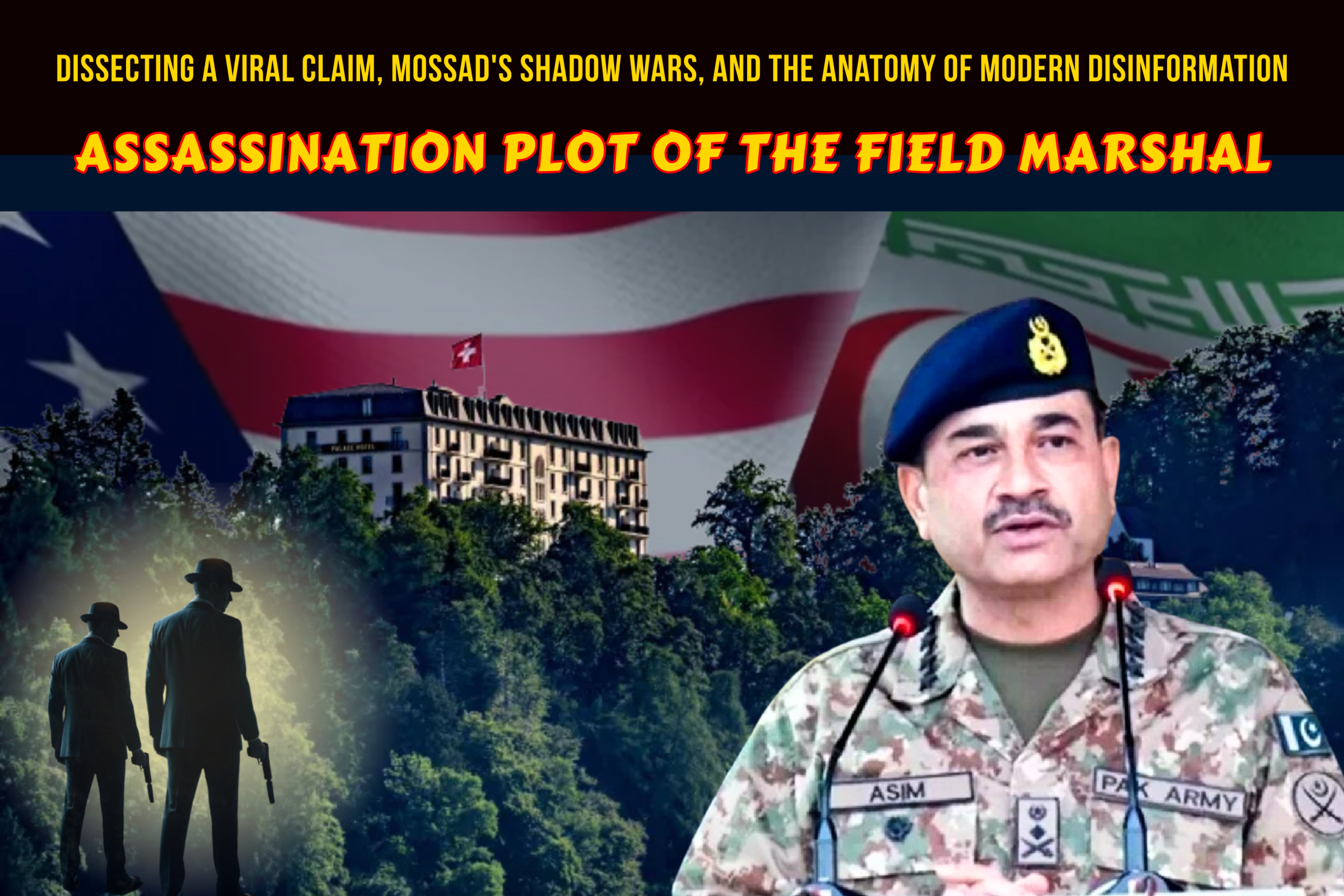
In the early hours of June 2026, a claim of extraordinary gravity began circulating through the arteries of social media. Brazilian journalist Pepe Escobar, appearing on a podcast with internet commentator Mario Nawfal, dropped what he described as a bombshell: Israel’s Mossad had planned to assassinate Pakistani Field Marshal Asim Munir during his visit to Switzerland for US-Iran peace talks at the Burgenstock Resort. The plot, Escobar claimed, had been foiled after Pakistani intelligence intercepted “ultra-credible information” and sent a chilling warning to Israel via Oman: “If you touch our delegation, we’re going to wipe you off the map, period.”
Within hours, the claim metastasized across platforms. Telegram channels amplified it. Twitter threads dissected it. YouTube channels devoted entire segments to analyzing the “implications.” For a brief moment, the internet’s collective imagination conjured a scenario of almost cinematic proportions: the world’s most feared intelligence agency, thwarted at the eleventh hour by a defiant South Asian nuclear power, in the pristine Alpine setting of Swiss neutrality.
Then came the official response.
A senior Pakistani security official, speaking through ARY News chairman Kamran Khan, delivered a blunt assessment: the claim was “absolutely rubbish and complete nonsense.” The official noted that the visit had proceeded without any security alerts, that Swiss and US security teams had raised no concerns, and that Pakistan’s own security arrangements had remained fully operational throughout the delegation’s stay in Lucerne. No corroboration emerged from Swiss, American, or Israeli authorities. The story, as quickly as it had ignited, began to smolder under the weight of official silence and denial.
This episode raises a question far more important than the claim itself: In an age of information warfare, where intelligence allegations can circumnavigate the globe before a single fact-checker has tied their shoelaces, how do we evaluate explosive claims that arrive not through official channels but through the democratized megaphone of podcast culture and social media? The Field Marshal Asim Munir assassination plot — whether it was disinformation, misinformation, or something more complex — offers a case study in the anatomy of modern narrative warfare.
2. The Claim: Tracing the Source
To understand how this story gained traction, one must first understand its originator. Pepe Escobar is a Brazilian journalist and geopolitical commentator known for his critical stance toward Western foreign policy and his extensive network of sources in the Global South, particularly in Russia, China, and Iran. A former correspondent for Asia Times, Escobar has built a reputation as a contrarian voice who frequently challenges mainstream narratives. His work appears across alternative media platforms, and he has cultivated a significant following among audiences skeptical of Western intelligence agencies and corporate media.
Escobar’s claim, as articulated during the Nawfal podcast, contained several specific elements that lent it an air of specificity:
First, the intelligence source: Pakistani military intelligence (likely the Inter-Services Intelligence, or ISI) had allegedly intercepted “ultra-credible information” regarding the plot. The use of the term “ultra-credible” is itself noteworthy — intelligence professionals rarely use such superlatives, as credibility in the intelligence world exists on a spectrum of probability and corroboration, not as a binary quality.
Second, the method of communication: Pakistan had allegedly sent its warning to Israel not through direct diplomatic channels (which do not exist, as Pakistan does not recognize Israel) but through Oman, a country that has historically served as a backchannel between Israel and various Muslim-majority nations.
Third, the nature of the threat: The alleged Pakistani message was not a diplomatic protest but a existential deterrent — “wipe you off the map” — language that evokes nuclear capability and strategic ambiguity.
The dissemination channel matters as much as the content. Mario Nawfal, the podcast host, has built a substantial online following through his “Roundtable” format, which brings together commentators, analysts, and self-described intelligence insiders to discuss breaking geopolitical developments. The podcast format — unscripted, conversational, often lacking the editorial rigor of traditional journalism — has become a powerful vector for narrative propagation. Unlike a newspaper article, which must pass through editorial review and legal vetting, a podcast claim can be made, amplified, and retracted (or not) with minimal friction.
The narrative gained traction because it intersected with multiple pre-existing geopolitical tensions. Pakistan and Israel have no diplomatic relations; Pakistan does not recognize Israel’s existence and has historically supported Palestinian causes. The context of US-Iran peace talks at Burgenstock added another layer — any event involving Iran, Israel, and nuclear diplomacy automatically triggers heightened attention. For audiences already primed to believe in Israeli malfeasance and Pakistani resilience, the claim offered perfect confirmation bias.
3. The Official Response: The Silence of the Institutions
The Pakistani denial was swift and unequivocal. Kamran Khan, chairman of ARY News and a journalist with extensive security contacts, relayed the official position: “A senior Pakistani security official has strongly denied the claim that Pakistan warned Israel against targeting Army Chief Field Marshal Asim Munir during his recent visit to Switzerland, calling it ‘absolutely rubbish and complete nonsense.'”
The official’s statement contained several points worth analyzing:
- No security alerts were issued: During the visit, neither Swiss authorities nor US security teams raised any alarms. This is significant because high-level diplomatic visits involving military chiefs from nuclear-armed nations trigger extensive security protocols. If a genuine assassination threat had been detected, the response would have been visible — enhanced security perimeters, route changes, curtailed public appearances, or even cancellation of the visit.
- Security arrangements remained operational: Pakistan’s own security detail, which travels with high-ranking officials, reported no disruptions or concerns.
- No corroboration from other nations: Switzerland, the United States, and Israel all maintained silence. In intelligence matters, silence can mean many things — confirmation, denial, or simply lack of knowledge — but in this case, the absence of any supporting statement from any official source is telling.
The strategic logic of Pakistan’s denial deserves examination. If Pakistani intelligence had genuinely foiled a Mossad assassination plot, would Islamabad publicly deny it? There are arguments on both sides. A genuine foiling might be kept secret to avoid escalation, or it might be publicized to deter future attempts and gain diplomatic leverage. Conversely, a denial might indicate that the claim was fabricated, or that Pakistan wished to avoid being drawn into a confrontation it could not control.
However, the most straightforward explanation is often the correct one: Pakistan denied the claim because it was false. The burden of proof for extraordinary claims rests with the claimant, and Escobar provided no documentary evidence, no named sources, and no corroborating details that could be independently verified.
4. Mossad’s Track Record: Capabilities vs. Claims
To evaluate whether Field Marshal Asim Munir plot was plausible, one must understand Mossad’s actual operational history. The Israeli intelligence agency has conducted targeted killings for over five decades, and its track record reveals both extraordinary capability and occasional catastrophic failure.
Operation Wrath of God (1972–1988)
The most systematic assassination campaign in Mossad’s history began after the 1972 Munich Olympics massacre, in which Palestinian Black September members killed eleven Israeli athletes and coaches. Prime Minister Golda Meir authorized a global operation to hunt down those responsible. Over the next sixteen years, Mossad operatives tracked and killed multiple targets across Europe and the Middle East.
The operation’s most infamous moment came in 1973 in Lillehammer, Norway, when Mossad agents mistakenly identified Ahmed Bouchiki, a Moroccan waiter, as Ali Hassan Salameh, the Black September operations chief. Bouchiki was shot and killed in front of his pregnant wife. The agents were captured, tried, and imprisoned, and the incident became a permanent stain on Mossad’s reputation — a stark reminder that even the most professional intelligence agencies can commit lethal errors.
The Dubai Operation (2010)
The assassination of Hamas operative Mahmoud al-Mabhouh in a Dubai hotel room in January 2010 demonstrated Mossad’s operational sophistication — and its vulnerability to exposure. A team of at least twenty-seven operatives, using forged passports from multiple countries, disguises, and coordinated surveillance, suffocated al-Mabhouh in his hotel room. The operation was technically successful, but Dubai police released extensive CCTV footage showing the operatives’ movements, leading to international diplomatic fallout and the expulsion of Israeli diplomats from several countries.
The Khaled Mashal Failure (1997)
In September 1997, Mossad agents attempted to poison Hamas political leader Khaled Mashal on the streets of Amman, Jordan, using a toxin sprayed from a device disguised as a camera. The operation failed when Mashal’s assistant realized something was wrong and chased the agents. They were captured by Jordanian police. King Hussein of Jordan demanded the antidote, and Israel — facing a diplomatic crisis — was forced to provide it and release Hamas spiritual leader Sheikh Ahmed Yassin from prison in exchange for the agents’ freedom. The incident demonstrated that even “simple” street operations could spiral into strategic disasters.
Iranian Nuclear Scientists (2010–2020)
Between 2010 and 2020, at least four Iranian nuclear scientists were assassinated in Tehran and other Iranian cities. Methods included magnetic bombs attached to cars, drive-by shootings, and motorcycle-mounted attacks. While Israel never officially confirmed involvement, US officials and international observers widely attributed the killings to Mossad. The most high-profile killing was that of Mohsen Fakhrizadeh in November 2020, who was ambushed near Tehran by a remotely operated machine gun — a killing that showcased advanced technological capabilities.
Operational Signature Analysis
Mossad’s successful operations share common characteristics: meticulous planning, extensive surveillance, use of false identities and forged documents, multi-person teams with specialized roles, and exploitation of the target’s routines and vulnerabilities. The agency prefers operations that minimize collateral damage and maximize deniability — though the Dubai operation showed that even careful planning can unravel under modern surveillance.
Does the alleged Field Marshal Asim Munir assassination plot fit this signature? Several factors suggest it does not:
- Target profile: Field Marshal Asim Munir is the head of a nuclear-armed military, traveling with a full security detail in a neutral country with robust security infrastructure. This is not the profile of a “soft target.”
- Political context: The assassination of a Pakistani military chief during US-Iran peace talks would constitute an act of war against Pakistan and a direct sabotage of American diplomatic efforts. Israel, despite its willingness to conduct risky operations, has historically avoided actions that would alienate the United States or trigger full-scale war with a nuclear power.
- Operational environment: Switzerland’s security services are highly competent, and the Burgenstock Resort would have been under heavy protection during negotiations involving the United States and Iran. The logistical challenges of mounting an assassination in such an environment would be extraordinary.
- The “warning” element: Escobar’s claim that Pakistan intercepted the plot and warned Israel is inconsistent with Mossad’s operational security. The agency compartmentalizes information to an extreme degree; the idea that Pakistani intelligence could penetrate an active assassination plot to the point of issuing a specific deterrent warning suggests a level of operational failure unprecedented in Mossad’s history.
5. The Kidon Unit: Anatomy of an Assassination Squad
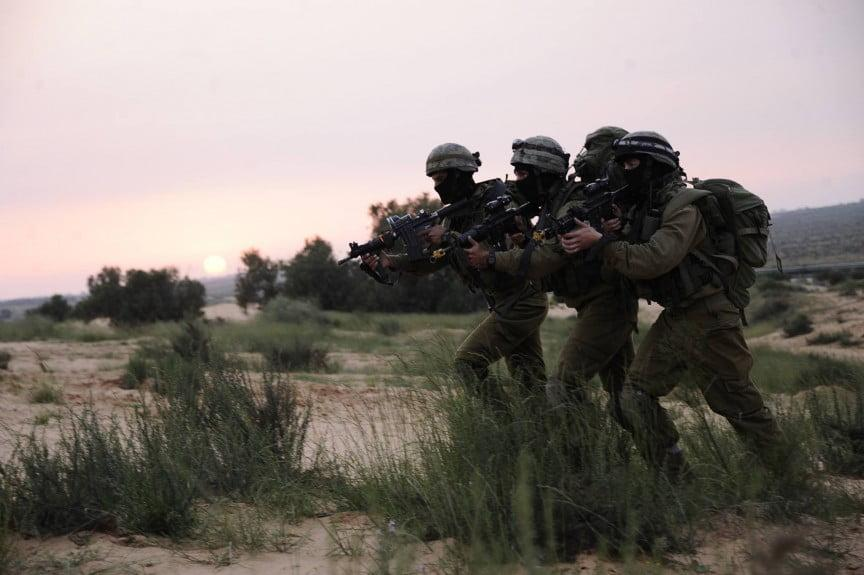
The name “Kidon” — Hebrew for “bayonet” or “tip of the spear” — evokes the unit’s function within Mossad’s Caesarea Division. Kidon is not a standalone agency but an elite sub-unit comprising fewer than seventy-five operatives, drawn from the most accomplished graduates of Israel’s special forces: Sayeret Matkal (the army’s premier counterterrorism unit), Shayetet 13 (naval commandos), and other elite formations.
Recruitment and Training
Kidon operatives are not recruited through advertisements or standard civil service examinations. They are identified during their military service, observed for qualities that transcend physical capability: psychological resilience, adaptability, language skills, and the ability to operate under extreme stress without external support. Those selected undergo training that includes advanced combat techniques, surveillance and countersurveillance, disguise and identity transformation, tradecraft (dead drops, brush passes, secure communications), and — critically — psychological conditioning to manage the moral and emotional weight of killing.
Operational Lifespan
The psychological toll of assassination work is well-documented, even if rarely discussed publicly. Kidon contracts are relatively short — typically a few years — followed by mandatory psychological evaluation and often reassignment to less intense roles. Burnout is common; the combination of constant vigilance, moral ambiguity, and the knowledge that any mistake could mean death or capture creates stress levels comparable to combat pilots or submarine crews.
Famous Operations
While Mossad does not confirm Kidon’s involvement in specific operations, intelligence analysts attribute several high-profile killings to the unit:
- The Wrath of God operations of the 1970s and 1980s
- The killing of Fathi Shaqaqi in Malta (1995)
- The assassination of Mahmoud al-Mabhouh in Dubai (2010)
- The targeting of Iranian nuclear scientists in Tehran
The Human Cost
Beyond the political and legal implications, Kidon’s work extracts a human cost from its operatives. The knowledge that one has killed — even in the service of national security — does not dissipate easily. Former operatives who have spoken (anonymously) describe years of nightmares, hypervigilance, and difficulty in civilian relationships. The unit’s short operational contracts are not merely practical; they are psychological necessities.
The existence of Kidon confirms that Israel possesses the capability to conduct assassinations. But capability is not intent, and the unit’s very professionalism makes this assassination less plausible, not more. A professional assassination unit does not mount operations that have been “intercepted” by the target’s intelligence service. Such a breach would represent a catastrophic failure of operational security — the kind of failure that Mossad has experienced only rarely, and never without severe consequences.
6. The Authorization Chain: Who Can Order a Killing?
In democratic societies, the question of who may authorize the killing of another human being — even an enemy — strikes at the heart of the social contract. Israel has developed a legal framework for targeted killings that, while controversial, establishes clear lines of authority.
The Prime Minister’s Prerogative
Only the Israeli Prime Minister possesses the legal authority to approve Mossad assassination operations. This is not a delegated power; it is a personal responsibility that cannot be transferred to the defence minister, the intelligence chief, or any committee.
The process typically unfolds as follows:
- Target identification: Mossad’s operational units, including Kidon, compile intelligence on potential targets — their movements, vulnerabilities, and the strategic value of their elimination.
- VARASH consultation: The file is presented to VARASH (Va’adat Rashei HaSherutim), the Committee of Intelligence Service Chiefs, which includes the heads of Mossad, Shin Bet (internal security), and military intelligence. VARASH provides analysis and recommendations but cannot approve the operation.
- Prime Ministerial decision: The Prime Minister reviews the file and makes the final determination. This decision is often taken in consultation with the Defence Minister and, in some cases, the Attorney General, but the authority is ultimately the Prime Minister’s alone.
- Operational execution: Once approved, the operation is planned and executed by the relevant units, with strict compartmentalization to prevent leaks.
Historical Precedent
Former Mossad chief Zvi Zamir confirmed this process regarding Operation Wrath of God. Targets were proposed by Mossad, reviewed by Prime Minister Golda Meir and her top advisors, and approved based on a combination of intelligence assessment and political calculation. The system has remained largely unchanged for five decades.
Political Accountability
The framework raises profound questions about democratic oversight. Targeted killings occur in the shadows, and the Prime Minister’s approval is not subject to parliamentary debate or judicial review in real time. In some cases, the Attorney General has been consulted to ensure operations comply with Israeli law, but the process lacks the transparency that would characterize a judicial execution.
International Law
Under international law, targeted killings occupy a contested space. Article 51 of the UN Charter recognizes the right of self-defence against armed attack, and Israel has justified its operations under this framework — arguing that individuals targeted are combatants in an ongoing armed conflict. Critics, however, characterize these killings as extrajudicial executions that violate the right to life and due process under international human rights law. The International Court of Justice and various UN special rapporteurs have expressed concern about the practice, though no binding international ruling has prohibited it outright.
The authorization framework is relevant to the Field Marshal Asim Munir claim because it underscores the political stakes. Any assassination of a foreign military chief would require the Israeli Prime Minister’s personal approval. Such a decision would not be taken lightly, nor would it be made without consideration of the potential consequences — including war with a nuclear-armed nation and the rupture of relations with the United States. The absence of any evidence that such a decision was even contemplated further undermines the credibility of Escobar’s claim.
7. The Warning Question: Does Mossad Give Notice?
A central element of Escobar’s claim is the alleged Pakistani warning to Israel via Oman. This raises a broader question: Does Mossad, or any intelligence agency conducting assassinations, typically issue warnings to its targets?
Standard Operating Procedure: No Warnings
The answer, in almost all cases, is no. The entire philosophy of targeted assassination relies on surprise. Warning a target would defeat the operational purpose, allowing them to alter routines, increase security, or disappear entirely. Mossad’s operational doctrine emphasizes that the target should not know they are a target until the moment of execution.
Strategic Deterrence vs. Tactical Warning
There is a distinction between warning a specific target and issuing strategic deterrent messages. In 2023, Mossad chief David Barnea publicly threatened that Israel would assassinate Iranian officials if Iran attacked Israeli citizens worldwide. This was not a warning to specific individuals but a strategic communication intended to influence Iranian decision-making. It was deterrence, not notification.
Failed Operations as Exposures
The closest historical parallel to a “warning” is the Khaled Mashal poisoning in 1997. Mashal did not receive a warning; rather, the operation failed because his assistant noticed the attack in progress and reacted. The subsequent exposure — the capture of Mossad agents, the demand for antidote, the release of Sheikh Yassin — was a consequence of failure, not a deliberate warning.
The Oman Channel
The claim that Pakistan warned Israel via Oman is operationally unusual. Backchannel communications between Israel and Muslim-majority nations exist — Oman has historically maintained discreet relations with Israel — but using such a channel for an explicit death threat (“wipe you off the map”) would be unprecedented. Such communications are typically used for de-escalation, not escalation. The language attributed to Pakistan in Escobar’s claim sounds more like social media rhetoric than diplomatic communication.
Intelligence Community Practice
No major intelligence agency — CIA, MI6, DGSE, BND, or Mossad — has a practice of warning assassination targets in advance. The very concept contradicts the purpose of covert killing. If Pakistani intelligence had genuinely intercepted a Mossad plot, the logical response would be to protect the target through enhanced security and, possibly, to expose the plot publicly for diplomatic leverage. A private warning via Oman would achieve neither objective effectively.
8. Disinformation and Geopolitical Narrative Warfare
The Field Marshal Asim Munir claim did not emerge in a vacuum. It belongs to a broader ecosystem of information operations that have proliferated in the digital age, particularly in the geopolitically charged regions of South Asia and the Middle East.
The Context of Information Warfare
Multiple actors have incentives to spread narratives involving Israeli plots against Muslim leaders:
- Domestic Pakistani politics: Military governments and intelligence agencies in Pakistan have historically used the “foreign threat” narrative to consolidate internal support. While the current government denied this specific claim, the narrative template — brave Pakistani intelligence foiling a Zionist plot — resonates with certain domestic audiences.
- Iranian narrative warfare: Iran and its proxies have invested heavily in information operations that portray Israel as a rogue state conducting assassinations globally. While Israel’s actual assassination program provides factual basis for some of these narratives, the amplification often exceeds the evidence.
- Anti-Israel sentiment: In parts of the Muslim world and among certain Western audiences, claims of Israeli malfeasance spread rapidly regardless of evidence, driven by pre-existing political frameworks.
- Engagement farming: In the attention economy of social media, sensational claims generate clicks, views, and revenue. Commentators like Nawfal and Escobar benefit from controversy, regardless of its veracity.
Similar Past Allegations
History offers numerous examples of assassination claims that proved false or unsubstantiated:
- In 2011, Iranian officials claimed Mossad had killed a nuclear scientist, but evidence later suggested internal Iranian factional violence.
- Multiple claims of “Mossad plots” against various Muslim leaders in Africa and Asia have surfaced over the years, rarely with corroborating evidence.
- The “Dahlan affair” and various Palestinian claims of Israeli poisoning plots have often collapsed under scrutiny.
The Role of Alternative Media
The podcast format — conversational, unscripted, often lacking editorial oversight — has become a significant vector for narrative dissemination. Unlike traditional journalism, which requires multiple sources, fact-checking, and legal review, podcasts allow claims to be made and amplified with minimal friction. The “roundtable” format, in which multiple commentators reinforce each other’s assertions, creates an echo chamber that can lend false credibility to unverified claims.
Evaluating Intelligence Claims
For readers navigating this landscape, several principles apply:
- Source verification: Who is making the claim? What is their track record? Do they have access to the information they claim?
- Corroboration: Are other sources, particularly official ones, confirming the claim?
- Operational plausibility: Does the claim align with known capabilities and patterns of the actor involved?
- Motivation analysis: Who benefits from this claim being believed?
- Linguistic precision: Does the claim use intelligence jargon correctly, or does it sound like narrative fiction?
9. Conclusion: Truth in the Shadows
The claim that Mossad planned to assassinate Field Marshal Asim Munir in Switzerland, as articulated by Pepe Escobar, rests on a foundation of sand. It lacks corroboration from any official source. It has been explicitly denied by the nation that would have been its beneficiary. Its operational details do not align with Mossad’s known patterns. And its dissemination through podcast culture exemplifies the challenges of maintaining epistemic standards in an age of viral narrative.
This is not to say that Mossad is incapable of such an operation. The agency’s history — from Munich to Dubai to Tehran — demonstrates that Israel possesses both the will and the capability to conduct targeted killings across borders. The Kidon unit exists. The Prime Ministerial authorization process exists. The operational doctrine of surprise and deniability exists. But capability is not intent, and the existence of a weapon does not prove it was fired.
The danger of claims like the Field Marshal Asim Munir plot lies not in their specific falsehood but in their broader effect. They erode the already fragile trust between publics and institutions. They blur the line between genuine intelligence analysis and narrative fiction. They provide ammunition for those who would dismiss all allegations against powerful states as “fake news,” even when those allegations are well-documented.
In the world of intelligence, the most dangerous weapon is not a Kidon operative with a forged passport and a silenced pistol. It is a compelling lie that travels faster than truth, that confirms our biases before we have examined our evidence, that transforms speculation into certainty through the alchemy of repetition.
Field Marshal Asim Munir returned safely from Switzerland. The US-Iran talks continued. And the claim of his assassination plot, like so many before it, will likely fade into the digital ether, leaving behind not evidence but a question: In an age when anyone can claim anything, how do we preserve the capacity for critical thought?
The answer, as always, begins with skepticism — not the cynical dismissal of all claims, but the disciplined refusal to believe without evidence. In the shadows where intelligence operates, that discipline is the only light we have.
Disclaimer: This article analyzes a claim that remains unsubstantiated as of the publication date. Intelligence matters are inherently opaque, and new information may emerge that alters the assessment. Readers are encouraged to evaluate sources critically and to distinguish between verified facts, official statements, and unverified allegations.