In the early days of Muharram al-Haram, 61 AH, when the caravan of Sayyiduna Imam Hussain (رضی اللہ عنہ)—brief in number yet immense in dignity, resolve, and faith—reached that desolate plain of Iraq which history would forever immortalize as Karbala, it appeared to be but an ordinary halt. Yet in truth, it marked the beginning of one of humanity’s greatest moral and spiritual trials.
This was no war for empire. No political campaign for power. It was a struggle between truth and falsehood, principle and expediency, conscience and coercion—a struggle whose echoes would resound across centuries.
Before Imam Hussain (رضی اللہ عنہ) stood a force that sought allegiance and obedience through might, dominion, and fear. On the other side stood the noble Imam (رضی اللہ عنہ), defending the very soul of Islam: justice, freedom of conscience, and the courage to speak truth. His aim was not to seize government, but to refuse bowing before tyranny. He made it unequivocally clear: he could not endorse a system that violated the spirit of faith and the collective conscience of the Ummah.
When the Hussaini caravan pitched tents at Karbala, Ubaydullah ibn Ziyad, governor of Kufa, at the behest of the ruler Yazid bin Mu’awiya, resolved to crush the matter through pressure, fear, and force. He dispatched Umar ibn Sa’d with a massive army. Umar found himself torn in an agonizing conflict: on one side, worldly power, position, and the governorship of Ray—a fertile province; on the other, the crushing weight of standing against the grandson of the Messenger of Allah (ﷺ). Yet there are moments in history when human weakness overwhelms awareness and faith. This is precisely what befell Umar ibn Sa’d.
A profound truth about Karbala is this: the army that confronted Imam Hussain (رضی اللہ عنہ) comprised most of the very people who had written letters inviting him to Kufa. These were the same souls who had given him hope, then—driven by fear, self-interest, and coercion—reneged on their promises. Rarely in human history has betrayal cut so deep as it did on the plains of Karbala.
The situation at Karbala grew increasingly dire. Umar ibn Sa’d conveyed Imam Hussain’s peace proposals to Ibn Ziyad. For a fleeting moment, hope flickered that bloodshed might be averted. Yet extremist elements at court sabotaged every conciliatory effort. The intoxication of power had vanquished reason, justice, and humanity.
Then came the day when the waters of the Euphrates were cut off from the Household of the Prophet. This was no mere military tactic—it was an indelible stain upon the conscience of humanity, one that time can never erase. Infants, women, youth, and elders suffered in the agony of severe thirst, yet the cruelty of oppression had reached such depths that not a single drop of water was permitted to reach them.
Despite this tormenting siege, Imam Hussain (رضی اللہ عنہ) never relinquished patience, dignity, or wisdom. Once more, he offered peace, requesting that they be allowed to depart for another place. The sole purpose: to prevent Muslim blood from being spilled. But those seated in the halls of power sought not peace—they demanded absolute, unquestioning submission.
When all avenues were sealed and war became inevitable, on the evening of the 9th of Muharram, Imam Hussain (رضی اللہ عنہ) requested a night’s respite. This delay was not for military strategy, but for worship, supplication, Qur’anic recitation, and seeking forgiveness. The Imam knew that the coming day might be his last in this world; thus, he chose to spend his final night in the presence of his Lord.
The Night of Ashura—a soul-stirring, heart-rending scene unparalleled in history. The tents reverberated with the recitation of the Qur’an, voices rose in prayer and intimate supplication, and every soul prepared to meet its Creator. These were people who did not view death as defeat, but as triumph—for to them, dying upon truth was infinitely nobler than living in submission to falsehood.
That night, Imam Hussain (رضی اللہ عنہ) gathered his companions and said:
“I know no companions more loyal than mine, nor any family more virtuous and loving than my household. Tomorrow, the enemy seeks only my blood. Whoever among you wishes to leave, let him go. I release you all from your pledge of allegiance.”
Upon hearing these words, not a single soul intended to depart. From every direction emerged stories of loyalty, love, and sacrifice that redefined the very meaning of selflessness in human history. One said: “If we were slain a thousand times and brought back to life, we would not abandon you.” Another pleaded: “Life holds no meaning after you.”
Thus, the Night of Ashura became an immortal epic of fidelity, devotion, sacrifice, and steadfastness. The following morning, history witnessed a spectacle: on one side, numbers, might, and government; on the other, a handful of thirsty yet unyielding human beings. But time would prove that victory does not always belong to numbers or swords—true victory belongs to principle, truth, and character.
The message of Karbala is this: however powerful tyranny may be, a single voice of truth lives for centuries. Imam Hussain (رضی اللہ عنہ) inscribed with his blood the lesson that an honorable death is superior to a humiliating life, and that one who stands for truth may fall as a martyr, yet in reality, lives forever.
The Morning of the Tenth of Muharram, 61 AH
That blood-drenched, heavy, history-shaping dawn rose—a dawn that would imprint upon the conscience of humanity a mark time could never erase. As the first rays of sun touched the sands of Karbala, the very heavens seemed draped in mourning for the tragedy to come.
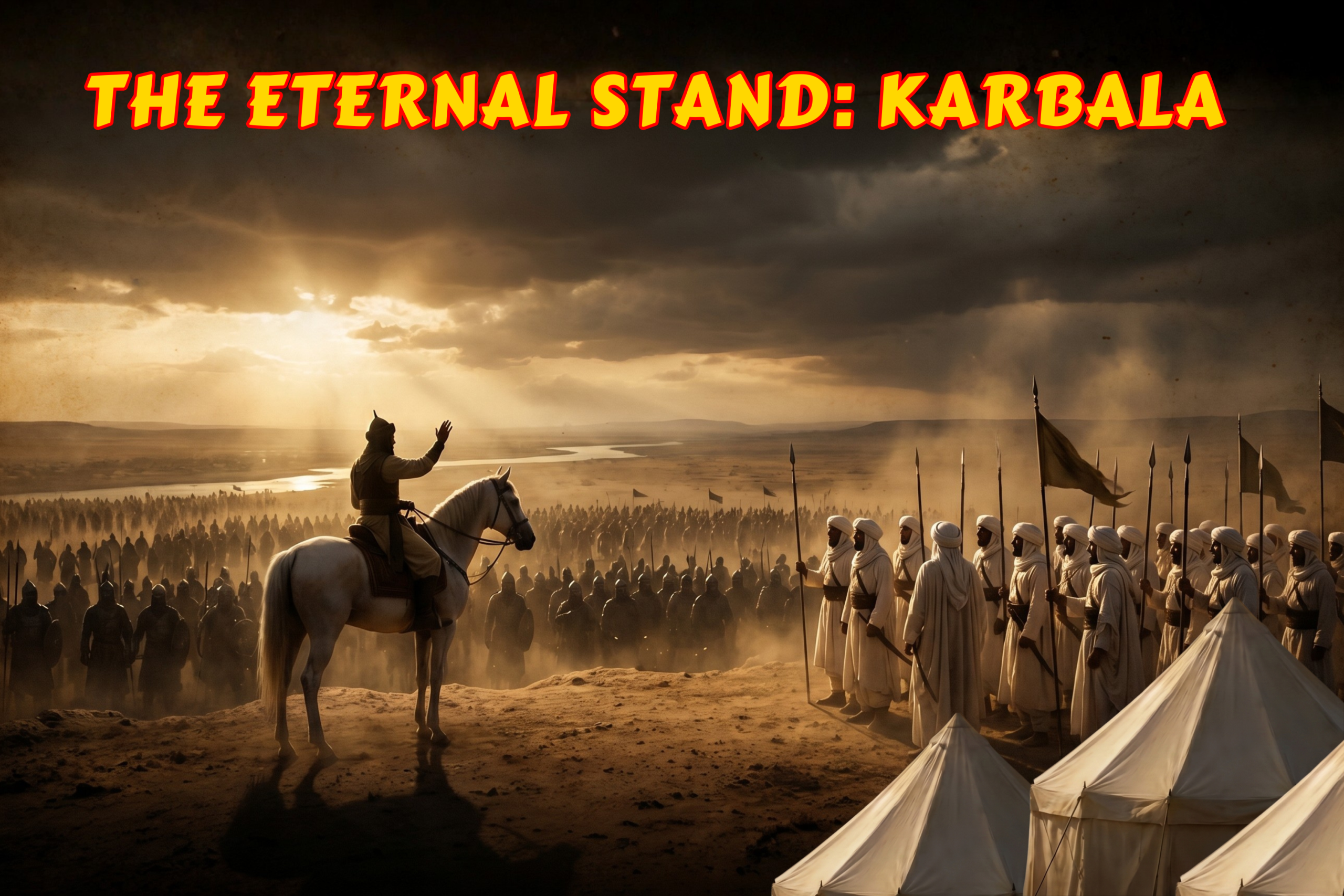
Sayyiduna Imam Hussain (رضی اللہ عنہ) offered the Fajr prayer, then arranged his small yet magnificent caravan in formation. This was no conquering army, no military detachment marching for empire, but an unprecedented caravan standing for truth, integrity, and the defense of honor.
The noble Imam (رضی اللہ عنہ) organized his approximately seventy-two devoted companions into three divisions. The right flank was entrusted to Zuhayr ibn Qayn (رضی اللہ عنہ), the left to Habib ibn Muzahir (رضی اللہ عنہ), and the standard of the army was placed in the hands of his loyal brother, Hazrat Abbas ibn Ali (رضی اللہ عنہ).
This formation was not for attack, but for defence—the defence of a besieged caravan surrounded by innumerable armed soldiers, with the threat of assault looming every moment. Until the final instant, Imam Hussain (رضی اللہ عنہ) strove to avert bloodshed and find a path to peace, yet those blinded by the lust for power rejected every proposal for reconciliation.
On the other side, Umar ibn Sa’d’s army of many hundred thousands stood in battle array. Before hostilities commenced, Imam Hussain (رضی اللہ عنہ), mounted upon his horse, advanced before the enemy and delivered a sermon whose reverberations are heard to this day:
“O people! Reflect: who am I? Am I not the son of the Prophet’s daughter? Have you not heard the Messenger of Allah (peace be upon him) declare that Hasan and Hussain are the chiefs of the youth of Paradise?”
Then he asked:
“What is my crime? Have I shed anyone’s blood? Have I seized anyone’s wealth? If not, then why do you seek to spill my blood?”
These words were no plea of weakness or request for compromise—they were the completion of proof. The grandson of the Messenger (peace be upon him) was shaking his would-be murderers one last time, hoping perhaps that some ember of faith still glowed in a heart.
But upon this army, intoxicated by power, these words had no effect. Among thousands, only one heart trembled. This was Hurr ibn Yazid al-Riyahi.
This was the very man who had first intercepted Imam Hussain’s caravan and forced them toward Karbala. Yet when he saw that the decision to kill the grandson of the Messenger of Allah (ﷺ) had been made, and all paths to peace sealed, his conscience awakened.
Trembling, he spoke to his comrades:
“I see myself standing between Paradise and Hell, and by God! I shall choose nothing but Paradise.”
Then, weeping, he fell at the feet of Imam Hussain (رضی اللہ عنہ) and pleaded:
“O son of the Messenger! Can my repentance be accepted? I am the one who blocked your path. Now I wish to offer my life as expiation for that sin.”
This scene from Karbala shall teach humanity until the Day of Resurrection: the door to return to truth remains open until the final breath.
The Battle
The formal commencement of battle was marked by Umar ibn Sa’d’s first arrow, shot toward the Hussaini tents as he declared: “Bear witness before the Amir that I fired the first arrow!” Then a rain of thousands of arrows engulfed the field of Karbala.
The devoted warriors of the Hussaini force displayed such valor—despite their small numbers, severe thirst, and continuous siege—that even the enemy was left astonished. Habib ibn Muzahir, Zuhayr ibn Qayn, Muslim ibn Awsaja, and other heroes entered the field one by one, offering the sacrifice of their lives.
By mid-afternoon, nearly all companions had attained the station of martyrdom.
Now it was the turn of the Household of the Prophet.
The young men of the Prophetic family entered the field one after another. Ali Akbar (رضی اللہ عنہ), whose appearance and character resembled the Messenger of Allah (ﷺ), inscribed a history of valor before being martyred. Other young men of Banu Hashim were sacrificed one by one.
Then Hazrat Abbas ibn Ali (رضی اللہ عنہ) set out to bring water for his thirsty family. He reached the Euphrates, but on his return, the enemy surrounded him. Displaying unparalleled courage, he drank the cup of martyrdom.
In the tents, the children’s thirst intensified. Innocent little ones cried for water, yet the stony hearts of the cruel enemy did not soften.
When even the infant son of Imam Hussain (رضی اللہ عنہ) grew restless with thirst, the Imam carried him into the field, hoping perhaps that mercy might enter an enemy heart. But the response was an arrow that extinguished the lamp of that innocent child’s life.
This scene is forever engraved upon the heart of history.
Now Imam Hussain (رضی اللہ عنہ) stood alone.
His blessed body was wounded, thirst had reached its extreme, his companions and family had been martyred—yet the mountain of resolve and steadfastness remained unmoved.
The great warriors of the enemy hesitated to approach him. They knew this was no ordinary man, but a living symbol of truth, honor, and courage.
At last, attacks came from all directions. Spears, swords, and arrows rained down together. And then that moment of history arrived when the grandson of the Messenger (ﷺ) prostrated in submission before his Lord.
The earth of Karbala turned crimson with blood. The heavens bowed in grief. And humanity was struck by a wound that remains fresh to this day.
The Verdict of History
Superficially, the sword was in the hand of Yazid’s army, and the field fell under their control. But history delivered a different verdict. Time proved that true victory belongs not to might, but to principle; not to government, but to character.
Yazid’s power crumbled within a few years. His palaces became ruins. His soldiers were lost in the dark pages of history. Yet the name of Hussain (رضی اللہ عنہ) beats today in the hearts of millions.
This is the eternal message of Karbala: tyranny may prevail temporarily, but the force that lives forever is that of truth, integrity, and sacrifice. That head raised upon the spear still reminds the world: to die with honor is far nobler than to live with humiliation.