(By Khalid Masood)
Pakistan’s Federal Budget for fiscal year 2026-27, presented by Finance Minister Muhammad Aurangzeb on June 13, 2026, unveils an Rs18.8 trillion fiscal plan that reveals the deepening structural crisis facing the country’s 240 million citizens. While the government projects a 4 percent GDP growth rate and targets Rs15.264 trillion in tax revenue through the Federal Board of Revenue, the underlying reality is one of extraordinary fiscal stress where debt servicing consumes 43.5 percent of the entire federal budget, development spending remains frozen at Rs1 trillion, and the burden of revenue extraction falls disproportionately on the most compliant and vulnerable segments of society.
This analysis examines the multidimensional economic burden carried by ordinary Pakistanis through an evidence-based analysis of taxation, utility charges, inflation, public debt, and governance failures. Our investigation reveals that the salaried class pays 352 percent more income tax than traders, retailers, and exporters combined, while petroleum levy collection has skyrocketed 14-fold from Rs120 billion in FY18 to a projected Rs1.73 trillion in FY27. Independent Power Producers receive Rs2.2 trillion in capacity payments annually for power that may never be generated, even as circular debt in the energy sector balloons to Rs2.8 trillion. State-owned enterprises recorded Rs832.8 billion in losses during FY25, with the National Highway Authority alone losing Rs294.9 billion.
The report presents case studies demonstrating that a typical salaried employee earning Rs100,000 per month contributes approximately Rs216,000 annually to the government through various direct and indirect channels, representing 18 percent of gross income, while receiving minimal public services in return. Pakistan’s ranking on Transparency International’s Corruption Perceptions Index remains dismal at 28 out of 100, placing the country at 136 out of 182 nations globally. With national poverty headcount rising to 28.9 percent and inflation surging to 11.7 percent in May 2026, the disconnect between citizen contributions and government service delivery has never been more acute.
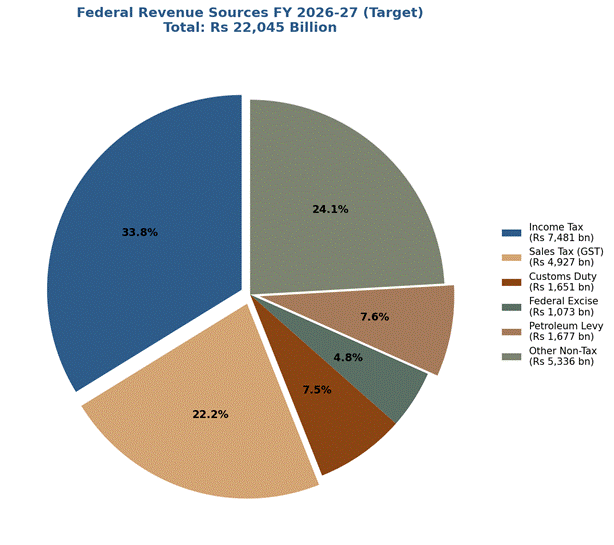
Figure 1: Federal Revenue Sources FY 2026-27 (Target)
Part I: Revenue Extraction from Citizens
1.1 Petroleum Levy: The Invisible Engine of Inflation
The petroleum levy stands as perhaps the most consequential yet least understood mechanism through which the government extracts revenue from every Pakistani citizen, regardless of income level. For FY26, the government achieved record petroleum levy collection of Rs1.55 trillion, surpassing the original target of Rs1.468 trillion. For FY27, the IMF has mandated an even more ambitious target of Rs1.73 trillion, representing an 18 percent increase over the current year’s target.
The mechanics of this extraction are particularly insidious because the petroleum levy functions as a regressive tax that affects the poor disproportionately. Unlike income tax, which at least theoretically scales with ability to pay, every litre of petrol or diesel carries the same levy whether purchased by a billionaire or a daily wage labourer. The levy has undergone a dramatic escalation over the past decade, growing from Rs120 billion in FY18 to a projected Rs1.73 trillion in FY27, a staggering 14-fold increase in just nine years.
The per-litre levy rates have reached unprecedented levels. As of early 2026, petroleum levy on petrol reached Rs117.05 per litre before being marginally reduced to Rs108.17 per litre in subsequent revisions. On March 15, 2026, the government increased the petroleum levy on petrol by Rs20.97 per litre, raising it to Rs105.37 per litre. The total petroleum levy collection of Rs2.725 trillion over just two years has surpassed the combined value of Pakistan’s two ongoing IMF loan programmes, worth approximately Rs2.34 trillion ($8.4 billion).
Pakistan’s fuel prices have surged by 54.9 percent for petrol and 44.9 percent for diesel between February and May 2026, following the Middle East crisis, among the highest increases globally. While India increased petrol prices by only 4.2 percent during the same period, and Bangladesh raised them by 16.7 percent, Pakistan’s 54.9 percent increase placed it among the most severely affected nations globally.
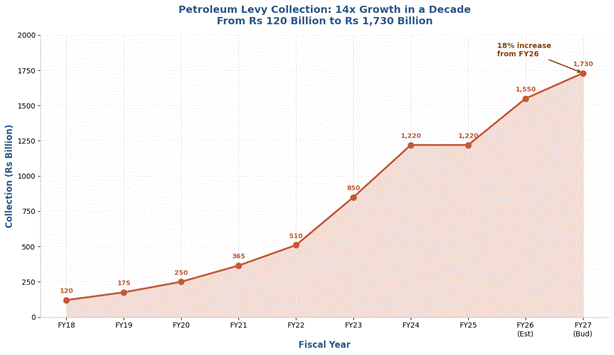
Figure 2: Petroleum Levy Collection History FY18-FY27
1.2 Electricity Bills: Paying for Darkness
The electricity sector represents perhaps the most broken and exploitative revenue extraction mechanism in Pakistan. Despite having 46,000 megawatts of installed capacity, nearly 65 percent more than peak summer demand of approximately 28,000 megawatts, Pakistanis endure 6-8 hours of daily load shedding in urban areas and 14-16 hours in rural regions. The gap between capacity and reliable delivery is financed by consumers through a tariff structure laden with taxes, surcharges, and capacity payments to Independent Power Producers (IPPs).
The anatomy of a typical electricity bill reveals the extent of embedded taxation. For a residential consumer using 200 units per month, the bill calculation begins with the base energy charge of approximately Rs13.27-16.62 per unit, then layers on multiple additional charges: Fuel Adjustment Charges (FCA), which in April 2026 amounted to Rs1.73 per unit; Electricity Duty at 1.5 percent; General Sales Tax at 17 percent; Neelum-Jhelum Surcharge; Meter Rent; and various other surcharges approved by NEPRA. The effective per-unit cost typically exceeds Rs34.37 per unit for residential consumers after all charges.
The most egregious component of electricity pricing is capacity payments to IPPs, which reached approximately Rs2.2 trillion in FY2025, accounting for over 60 percent of the consumer tariff. These payments are made under “take-or-pay” contractual structures that guarantee returns to private power producers regardless of whether their capacity is actually utilized. The World Bank confirmed in 2025 that capacity charges constitute 60 percent of the average consumer tariff in Pakistan, compared to 35 percent in Vietnam and just 25 percent in Turkey.
The circular debt in the power sector has accumulated to approximately Rs2.8 trillion as of April 2026, growing from Rs1.1 trillion in 2019, an increase of over 150 percent in just five years. This debt represents unpaid obligations between distribution companies (DISCOs), generation companies, IPPs, and the government, essentially a fiscal black hole that grows inexorably regardless of tariff increases.
1.3 Income Tax: The Salaried Class as Cash Cow
Pakistan’s income tax system represents a stark study in structural inequity, where the most documented and compliant segment of society, the salaried class, bears a disproportionate burden while vast sectors of the economy remain effectively untaxed. The FY27 budget introduces modest relief for higher earners, reducing rates for incomes between Rs2.2-3.2 million from 23 percent to 20 percent, between Rs3.2-4.1 million from 30 percent to 25 percent, and between Rs4.1-5.6 million from 35 percent to 29 percent, while abolishing the 9 percent surcharge on incomes above Rs10 million. However, these concessions primarily benefit higher earners, with minimal change for those earning between Rs100,000-183,000 monthly where a large segment of the middle class falls.
The disparity in tax burden becomes stark when comparing Pakistan with India. A salaried individual in Pakistan begins paying income tax at Rs600,000 annual income (Rs50,000 monthly), while in India, after standard rebates and deductions, the effective threshold is approximately Rs2.1 million annually. This means Pakistan taxes income at less than one-third the level where India effectively begins taxation. At an annual income of Rs5 million, a Pakistani professional faces an income tax liability of Rs931,000, while an Indian counterpart earning the same amount would pay roughly Rs307,212, Pakistani professionals pay nearly three times the tax as their Indian peers.
The most striking evidence of inequity emerges from comparative contribution data. The salaried class paid Rs391 billion in income tax in 2024, compared with just Rs276 billion in 2023, reflecting a 41.66 percent increase within a year. This contribution is 352 percent higher than the combined taxes paid by exporters, retailers, wholesalers, and distributors. Between 2019 and 2024, tax collection from the salaried segment increased by an extraordinary 412.6 percent, indicating a structural shift toward ever-greater reliance on this compliant segment rather than genuine base broadening.
During the first eight months of FY25 alone, the salaried class paid Rs331 billion in income tax, a figure that was 1,350 percent more than the taxes paid by the retail sector, which contributed a mere Rs23 billion. Retailers, who constitute approximately 19 percent of the economy, contributed just 0.4 percent of total income tax, a discrepancy that speaks to massive under-documentation and tax evasion in this sector.
1.4 General Sales Tax: The Hidden Burden on Essentials
Pakistan’s General Sales Tax (GST) regime operates at a standard rate of 17-18 percent on goods and 15-16 percent on services, with numerous reduced rates, exemptions, and zero-ratings that create complexity and undermine revenue potential. The GST collection target for FY26 was Rs4.753 trillion, with actual collection reaching Rs3.5 trillion in the first eleven months, showing 26.5 percent growth over the previous year. For FY27, the GST target has been maintained at approximately Rs4.927 billion.
The GST is fundamentally regressive because it applies uniformly regardless of the purchaser’s income. A World Bank analysis revealed that Pakistan lost an average of 26 percent of its sales tax revenue potential annually between FY20 and FY22 due to exemptions and concessionary rates. In FY19 alone, had Pakistan eliminated all concessionary rates, exemptions, and zero-ratings while registering all firms in the tax net, it would have had a total sales tax revenue potential of 6.53 percent of GDP, compared to actual collection of 3.33 percent of GDP, representing a gap of 51 percent.
The GST’s burden on the poor is particularly severe because it applies to essential commodities including food items, cooking oil, and household necessities. For a low-income household spending Rs25,000 monthly, GST embedded in purchases may amount to Rs2,000-3,000 monthly (Rs24,000-36,000 annually), representing 8-12 percent of income from this single tax alone.
1.5 Customs Duties: Protecting Industry, Taxing Consumers
Customs duties represent another significant revenue source, with FY26 collection estimated at Rs1.588 trillion and FY27 targeting Rs1.651 trillion. The FY27 budget proposes slashing additional customs duties on 3,149 tariff lines and reducing regulatory duties to 20 percent on more than 1,900 tariff lines. These reductions, while potentially lowering consumer prices for some imports, primarily reflect IMF pressure for trade liberalization rather than a genuine revenue strategy.
Thirteen sectors contributed 70 percent of total customs duty collection in FY21, led by vehicles (Rs97.5 billion, up 86 percent), iron and steel (Rs52.6 billion), and machinery (Rs37.8 billion). The automobile sector has been particularly protected, with maximum duties at 150 percent on some categories, a rate that the Tariff Policy Board recommended slashing to 75 percent, though this decision remains on hold due to pressure from local manufacturers. This protectionism effectively transfers wealth from consumers to domestic auto assemblers, keeping vehicle prices artificially high.
1.6 Debt Servicing: The Black Hole Consuming Pakistan’s Future
Debt servicing represents the single largest item in Pakistan’s federal budget, and its dominance explains virtually every other fiscal pathology. For FY26, interest payments on public debt reached Rs8.207 trillion, consuming nearly half of total federal expenditure. In the first half of FY26 alone, interest payments reached Rs3.56 trillion, more than double the combined allocations for defence and the entire Public Sector Development Programme. For FY27, the government has budgeted Rs7.824 trillion for debt servicing.
Pakistan’s gross government debt stood at 70.1 percent of GDP in FY26, with total federal debt reaching Rs79.9 trillion by February 2026, including external debt of Rs23.2 trillion. The debt-to-GDP ratio, while declining from 75.2 percent in FY23 to 68.5 percent in FY26, remains at a level that crowds out virtually all productive spending. The FY26 budget had a total outlay of Rs17.573 trillion, of which debt servicing (Rs8.207 trillion), pension spending (Rs1.055 trillion), and defence (Rs2.55 trillion) together consumed over Rs11.8 trillion, leaving less than Rs6 trillion for everything else.
The historical trajectory is alarming. Federal interest payments rose from 3.8 percent of GDP in FY2017 to 7.8 percent in FY2025, approximately 37 percent of all consolidated spending and a 70 percent increase in real, inflation-adjusted terms over just five years. The Center borrows and the Center pays interest, 92 paisas of every rupee the Center retains after NFC transfers in FY25 went to debt servicing. This means that for every 100 rupees the federal government raises through taxes and non-tax revenue, approximately 43 rupees go directly to interest payments before a single road is built, school is funded, or hospital is equipped.
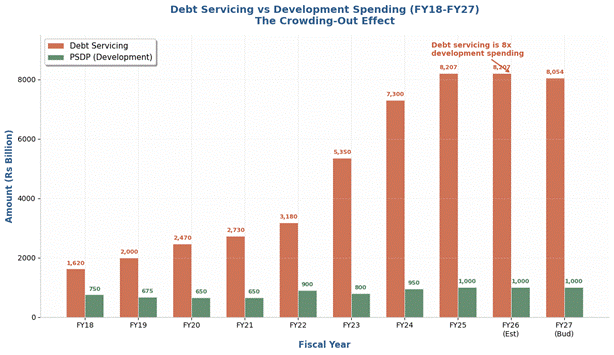
Figure 3: Debt Servicing vs Development Spending (FY18-FY27)
Part II: Leakage, Waste, and Corruption
2.1 State-Owned Enterprises: The Permanent Drain
Pakistan’s state-owned enterprises represent perhaps the most visible manifestation of governance failure and fiscal waste. In FY25, Pakistan’s top 25 SOEs posted aggregate losses of Rs832.8 billion, while net losses surged to Rs123 billion from just Rs30.6 billion in FY24, a 300 percent increase in net losses year-on-year. These losses are not an aberration but a structural feature of Pakistan’s public sector, with accumulated SOE losses reaching Rs6.563 trillion by FY25.
The National Highway Authority (NHA) reported the largest deficit at Rs294.9 billion, followed by Quetta Electric Supply Company (Rs112.7 billion), Peshawar Electric Supply Company (Rs92.7 billion), Pakistan Railways (Rs60.3 billion), and PIA Holding Company (Rs48.9 billion). Other major loss-makers included the Neelum-Jhelum Hydropower Company (Rs29.4 billion) and Pakistan Steel Mills (Rs26 billion), the latter having been effectively non-operational for years while still consuming billions in bailout funds.
The fiscal support extended by the government to sustain these entities increased 37 percent to Rs2,078.5 billion in FY25, including Rs728.9 billion in equity injections (primarily for circular debt adjustments in the power sector), Rs354.1 billion in loans, and Rs726.3 billion in subsidies. This support represents 13 percent of federal budget receipts, greater than the entire federal development programme. Sovereign guarantees to SOEs increased to Rs2,164 billion from Rs1,419 billion, creating contingent liabilities that could explode onto the government’s balance sheet at any time.
The polarization of SOE performance is extreme. Just five entities, led by Oil and Gas Development Company Limited (OGDCL) at Rs169.9 billion profit and Pakistan Petroleum Limited (PPL) at Rs89.9 billion, accounted for nearly 90 percent of all SOE profits. This concentration means that the vast majority of SOEs are either marginal or loss-making, kept alive through government support that diverts resources from education, health, and infrastructure development.
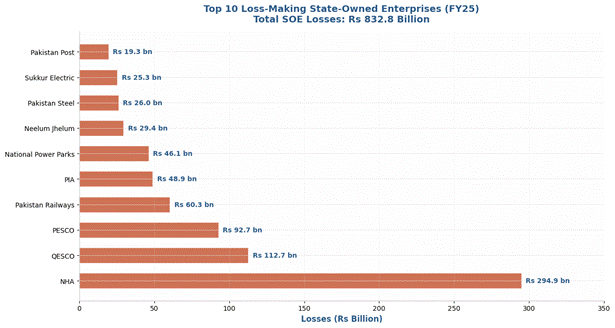
Figure 4: Top 10 Loss-Making State-Owned Enterprises (FY25)
2.2 Public Sector Development Programme: Development Deferred
The Public Sector Development Programme, which funds infrastructure and development projects nationwide, has been systematically hollowed out by debt servicing pressures. For FY27, the federal PSDP is set at Rs1 trillion, unchanged from FY26 and FY25. When adjusted for inflation averaging 8-11 percent, this represents a real-term cut of approximately 8-10 percent annually. The Planning Ministry had submitted demands of Rs2.9 trillion, but fiscal constraints forced a reduction of nearly two-thirds.
The provincial development programmes have faced even more severe compression. The National Economic Council froze provincial development plans at actual spending levels, with Punjab’s plan nearly halved from its previous budget of Rs1.455 trillion to just Rs749 billion. Sindh’s ADP was contained at Rs706 billion (down 13.5 percent), Khyber Pakhtunkhwa at Rs455 billion (unchanged), while Balochistan retained its Rs308 billion allocation. The consolidated national development outlay of Rs3.669 trillion represents a 22.2 percent reduction from the Rs4.715 trillion announced just a week earlier by the APCC.
The consequences are visible in delayed and underfunded projects. The Diamer-Bhasha Dam, Pakistan’s most critical water infrastructure project, requires approximately Rs170 billion annually but received just Rs14-20 billion in allocations, meaning the project, already decades behind schedule, will take generations to complete at current funding levels. The water sector as a whole received just Rs103 billion against requirements many times larger.
2.3 Benazir Income Support Programme: Safety Net or Sieve?
The Benazir Income Support Programme, Pakistan’s flagship social protection initiative, saw its allocation increase by 17 percent to Rs838 billion for FY27, with coverage expanding from 10 million to 12 million families and the quarterly payment increasing from Rs14,500 to Rs18,000 per family. While these increases represent a genuine expansion of social protection, questions about targeting efficiency, administrative costs, and transparency persist.
In FY25, BISP’s budget was Rs598.7 billion, of which the unconditional cash transfer (Kafaalat) programme consumed Rs461 billion for 10 million beneficiary families. Administrative and general expenditures amounted to Rs6.2 billion, representing approximately 1 percent of total spending, a relatively efficient ratio compared to other government programmes. The educational conditional cash transfer (Taleemi Wazifa) reached 8.7 million children, and the nutritional programme (Nashonuma) covered 1.06 million beneficiaries.
However, independent assessments have identified significant targeting challenges. A 2022 study by the Pakistan Institute of Development Economics found that approximately 15-20 percent of BISP beneficiaries were either non-poor or faced exclusion errors where genuinely poor households were left out. The National Socio-Economic Registry (NSER) used for beneficiary identification has not been comprehensively updated since 2019, meaning that the economic shocks of the past five years are not fully reflected in beneficiary profiles.
2.4 Tax Evasion: The Rs3.2 Trillion Leakage
Tax evasion represents the most significant source of fiscal leakage in Pakistan, with annual revenue losses estimated at Rs3.2 trillion (7 percent of GDP). The informal economy, accounting for 60-70 percent of economic activity, operates largely outside the tax net, with businesses and individuals neither filing returns nor appearing on official records. This vast unregulated segment undermines the government’s revenue capacity while creating an uneven playing field where documented businesses face full taxation while informal competitors operate tax-free.
The FBR itself reported that Rs2.2 trillion was lost to tax evasion through fake and flying invoices over just two fiscal years. The FBR’s enforcement actions have uncovered massive fraud in sectors ranging from tobacco (where illicit manufacturing deprives the exchequer of Rs19 billion annually) to textiles, real estate, and retail.
The retail sector exemplifies the evasion challenge. With an estimated 5 million retailers nationwide, formal tax registration covers less than 100,000, approximately 2 percent. The government’s Tajir Dost scheme, intended to bring small retailers into a simplified tax regime with a target of Rs50 billion, collected only a fraction of this amount. Even the 2.5 percent withholding tax on trader sales, intended as a minimum levy, raised just Rs12 billion in additional revenue while being largely passed on to consumers rather than broadening the tax base.
Part III: Impact on the Common Citizen
This section presents detailed case studies estimating the total annual government revenue extraction from five representative citizen profiles under the FY27 budget framework. Each case study calculates direct income tax, indirect GST embedded in consumption, petroleum levy (direct and indirect), and electricity surcharges to arrive at a total government extraction figure expressed as a percentage of gross income.
Case Study 1: The Salaried Employee
Profile: A mid-level professional in Lahore earning Rs100,000 per month (Rs1.2 million annually). Direct Income Tax: Rs72,000 annually. Indirect GST: Rs113,400 annually. Petroleum Levy: Rs108,000 annually. Electricity Taxes: Rs47,000 annually. Total Annual Government Extraction: Rs340,400, representing 28.4 percent of gross income. After absorbing 11.7 percent inflation, the effective loss reaches approximately 39 percent of gross income.
Case Study 2: The Retired Pensioner
Profile: A retired government servant receiving Rs30,000 monthly pension. Direct Income Tax: Rs0 (below threshold). Indirect GST: Rs40,500 annually. Petroleum Levy (indirect): Rs18,000 annually. Electricity Taxes: Rs21,000 annually. Total Annual Government Extraction: Rs79,500, representing 22 percent of pension income. With inflation at 11.7 percent, real purchasing power declines by an additional Rs42,120, meaning the pensioner effectively loses 34 percent of nominal income value annually.
Case Study 3: The Small Shopkeeper
Profile: A retail shop owner in a secondary city earning Rs50,000 monthly (Rs600,000 annually). Direct Income Tax: Rs3,000 (estimated under Tajir Dost). Indirect GST: Rs56,700 annually. Petroleum Levy: Rs43,200 annually. Electricity Taxes: Rs39,000 annually. Total Annual Government Extraction: Rs141,900, representing 23.7 percent of income. The shopkeeper’s advantage over the salaried employee comes entirely from income tax avoidance; on indirect taxes, the burden is comparable.
Case Study 4: The Farmer
Profile: A smallholder farmer in Punjab with 12 acres, earning Rs40,000 monthly (Rs480,000 annually). Direct Income Tax: Rs0 (agricultural income exempt). Indirect GST: Rs40,500 annually. Petroleum Levy (diesel for tubewell/tractor): Rs157,200 annually, the heaviest petroleum levy burden of any citizen type. Electricity Taxes: Rs12,000 annually. Total Annual Government Extraction: Rs209,700, representing 43.7 percent of income. The farmer pays no income tax but bears the heaviest burden through petroleum levy on diesel, an essential production input.
Case Study 5: The Daily Wage Laborer
Profile: An unskilled construction worker in Karachi earning Rs25,000 monthly (Rs300,000 annually). Direct Income Tax: Rs0. Indirect GST: Rs32,400 annually. Petroleum Levy (indirect via transport costs): Rs18,000 annually. Electricity Taxes: Rs7,500 annually. Total Annual Government Extraction: Rs57,900, representing 19.3 percent of income. While the percentage appears lower than other profiles, the absolute burden is crushing because this laborer has no disposable margin. Every rupee extracted directly reduces food consumption, healthcare access, or children’s education.
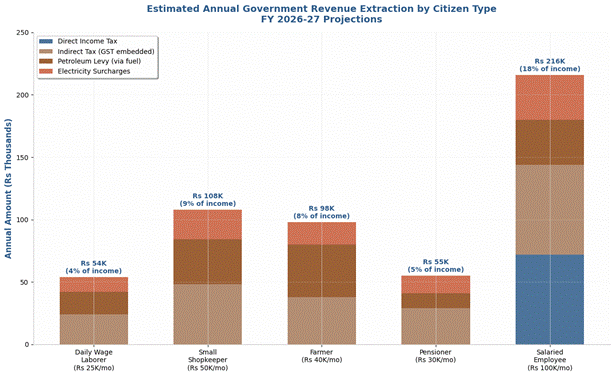
Figure 5: Estimated Annual Government Revenue Extraction by Citizen Type
Part IV: International Comparison
4.1 Tax Burden and Equity
Comparative analysis reveals Pakistan’s tax system as an outlier in its regressive structure and narrow base. India’s income tax threshold of approximately Rs2.1 million (after rebates) contrasts sharply with Pakistan’s Rs600,000 threshold, meaning India effectively exempts middle-income earners who face full taxation in Pakistan. At Rs5 million annual income, Pakistani professionals pay three times the tax of Indian counterparts, a disparity that drives talent migration and discourages formal employment.
Malaysia’s GST rate of 10 percent (sales tax) and 8 percent service tax is significantly lower than Pakistan’s 17-18 percent standard rate, while Malaysia’s income tax system provides meaningful relief for middle-income households. Turkey’s VAT rate of 20 percent exceeds Pakistan’s, but Turkey provides substantially greater public services, including universal healthcare, quality public education, and modern infrastructure, that justify higher tax rates through visible service delivery.
4.2 Fuel Taxation and Energy Costs
The fuel price surge following the Middle East crisis (February-May 2026) exposed Pakistan’s extreme vulnerability to petroleum price shocks. Pakistan’s 54.9 percent petrol price increase placed it among the worst-affected nations globally, exceeded only by Myanmar (89.7%) and Malaysia (56.3%), and far ahead of India (4.2%), Bangladesh (16.7%), and Turkey (7.8%). This divergence reflects both Pakistan’s greater import dependence and its government’s decision to pass global price increases directly to consumers.
The petroleum levy per litre in Pakistan (Rs80-117 per litre) far exceeds India’s fuel excise (approximately Rs20-25 per litre equivalent). Electricity costs in Pakistan (Rs34.37 per unit residential) compare unfavourably with India’s average of approximately Rs8-12 per unit and Bangladesh’s Rs8-10 per unit. Pakistan’s uniquely high costs stem from the IPP capacity payment structure, which adds a burden that no other regional country faces to comparable extent.
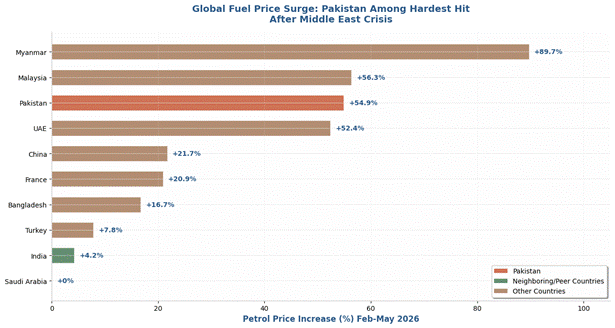
Figure 6: Global Fuel Price Surge Comparison (Feb-May 2026)
4.3 Corruption and Governance
Transparency International’s Corruption Perceptions Index 2025 places Pakistan at 28 out of 100, ranked 136 out of 182 countries globally. This represents a marginal improvement from 27 in 2024, but Pakistan remains firmly in the category of countries with serious corruption problems. The comparison group presents a mixed picture: Malaysia (52/100, rank 54), India (38/100), Turkey (31/100, rank 124), Sri Lanka (34/100), and Bangladesh (26/100).
Malaysia’s CPI score of 52 reflects sustained anti-corruption efforts including the Finance and Fiscal Responsibility Act 2023, amendments to expand Auditor-General oversight to government-linked companies, and sustained enforcement against senior officials. Turkey’s decline from 41 to 31 over the past decade demonstrates that governance deterioration is possible even in middle-income countries. Pakistan’s stagnation at 28 suggests that reform efforts have been insufficient to change systemic corruption dynamics.
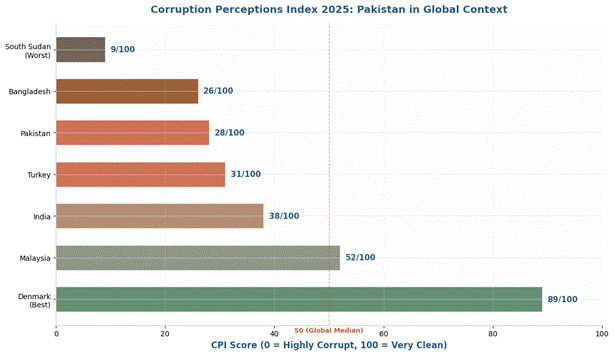
Figure 7: Corruption Perceptions Index 2025: Pakistan in Global Context
4.4 Value for Taxpayer Money
The ultimate test of any fiscal system is whether citizens receive commensurate value for their contributions. On this metric, Pakistan performs poorly relative to all comparison countries. Public spending on education and health remains below 2.4 percent of GDP, far below the 4-6 percent that economists consider necessary for meaningful human capital development. Infrastructure quality in Pakistan lags behind Malaysia and Turkey, which have invested consistently in modern transport networks. Healthcare access remains inadequate, with out-of-pocket medical expenses pushing millions into poverty annually.
The contrast with Malaysia is particularly instructive. Malaysia collects similar taxes (income tax, GST/sales tax, customs duties) but delivers substantially better governance, infrastructure, education, healthcare, and public safety. Malaysia’s higher CPI score (52 vs 28) reflects not merely lower corruption but better institutional capacity to convert tax revenue into public goods. Pakistan’s failure to deliver equivalent value stems from governance weaknesses, institutional capture, and the diversion of resources to debt servicing and SOE bailouts that provide no citizen benefit.
Part V: Accountability Assessment
5.1 How Much Does an Average Household Contribute?
Based on our case studies and national data, an average Pakistani household (defined as 5-6 persons with monthly income of Rs50,000-100,000) contributes approximately Rs100,000-340,000 annually to the government through direct and indirect channels. This comprises: direct income tax (Rs0-72,000), embedded GST (Rs28,000-126,000), petroleum levy (Rs18,000-157,000), and electricity taxes/surcharges (Rs6,000-57,000). For the median household earning Rs50,000 monthly, total annual extraction of approximately Rs140,000 represents roughly 23 percent of gross income, a burden that exceeds comparable thresholds in India, Bangladesh, and Malaysia.
5.2 What Percentage of Revenue Reaches Citizens as Services?
This is the most damning calculation. Of every Rs100 the federal government collects in revenue: Rs43 goes to debt servicing (interest payments), Rs16 to defence, Rs6 to pensions, Rs6 to subsidies (primarily for power sector and SOEs), Rs6 to civil administration, Rs5 to grants for AJK/GB/FATA, Rs3 to SOE investment, and just Rs5 to the PSDP that builds infrastructure, schools, hospitals, and development projects. After accounting for leakage, corruption, and inefficiency in PSDP execution, perhaps Rs2-3 of every Rs100 collected actually translates into tangible public services for citizens. The remaining Rs97-98 funds debt inherited from previous governments, military capabilities, bureaucratic administration, and the perpetuation of inefficient SOEs.
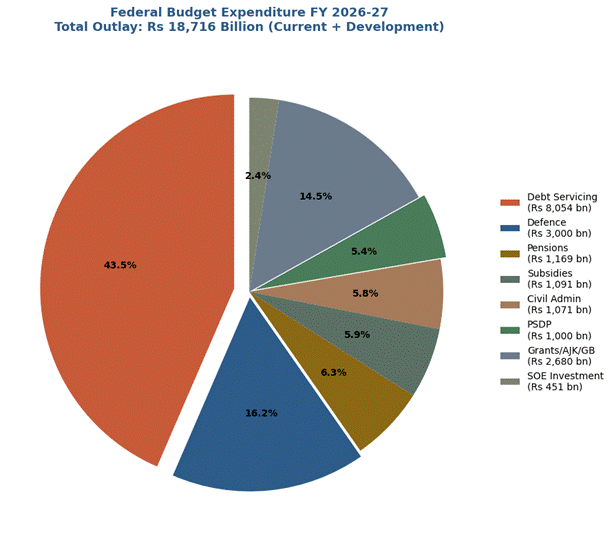
Figure 8: Federal Budget Expenditure Breakdown FY 2026-27
5.3 Which Taxes Impose the Greatest Burden on the Poor and Middle Class?
The petroleum levy is the most regressive tax, affecting all citizens equally per litre regardless of income, while cascading through the economy to raise food and transport costs. For a daily wage laborer, indirect petroleum levy effects may consume 5-8 percent of income. The GST on electricity at 17 percent adds crushing burden to an already expensive utility, with poor households paying GST on unreliable supply. Indirect taxes (GST) overall consume 8-12 percent of low-income household budgets because these families spend a higher proportion of income on consumption. The income tax system’s low threshold captures middle-income earners at Rs50,000 monthly, far below a living wage in urban Pakistan, while exempting agricultural income and most informal sector earnings.
5.4 Which Sectors Receive the Largest Share of Public Funds?
Debt servicing dominates at 43.5 percent of the budget (Rs8,054 billion), followed by defence at 16.2 percent (Rs3,000 billion). Together, these two items consume nearly 60 percent of federal resources. Subsidies and grants (including BISP and provincial transfers) account for approximately 20 percent, while civil administration consumes 6 percent. The PSDP receives just 5 percent, and SOE investment approximately 2 percent. This allocation reflects Pakistan’s priorities as a debt-burdened security state with limited fiscal space for development or human capital investment.
5.5 What Reforms Could Reduce Waste, Corruption, and Inefficiency?
Immediate reforms should include: (1) Renegotiating IPP contracts to shift from take-or-pay to take-and-pay structures, reducing capacity payments that now consume 60 percent of electricity tariffs; (2) Privatizing chronically loss-making SOEs (PIA, Pakistan Steel Mills, Pakistan Railways) with transparent processes; (3) Broadening the tax base by bringing retailers, wholesalers, and agricultural income into the net; (4) Reducing petroleum levy during high global price periods to prevent inflationary spirals; and (5) Implementing genuine budget transparency by publishing all budget documents online.
Medium-term reforms should include: (1) Comprehensive civil service reform to reduce administrative costs; (2) DISCO privatization starting with the most viable entities; (3) Reforming the NFC award to incentivize provincial revenue mobilization; (4) Establishing independent regulatory oversight of procurement and contracting; and (5) Creating a sovereign wealth fund to manage SOE assets professionally.
5.6 How Transparent is the Federal Budget 2026-27?
The FY27 budget exhibits minimal transparency improvement over previous years. While the government publishes budget documents on the Finance Division website, these are presented in aggregate categories that obscure meaningful analysis. Line-item details for SOE subsidies, defence spending, and debt servicing are not publicly available. The budget speech focused on macroeconomic achievements while avoiding discussion of distributional impacts, implementation failures, or citizen burden.
The Open Budget Index historically rates Pakistan poorly on transparency dimensions including public participation in budget processes, legislative oversight, and audit effectiveness. No mechanism exists for citizens to track whether budgeted funds actually reach intended projects. Pakistan’s budget transparency remains far below Malaysia and even India, both of which provide more granular public access to fiscal information.
5.7 Who Are the Biggest Winners and Losers?
Winners include: (1) High-income salaried earners (above Rs500,000 monthly) who benefit from FY27 rate reductions and surcharge abolition; (2) Property investors who saw withholding tax on transfers halved from 2.5 percent to 1.25 percent; (3) IT/freelance exporters whose final tax regime was extended three years; (4) Large businesses with super tax reduction from 10 percent to 8 percent; and (5) Military and civil service elites who receive protected salaries, pensions, and perks.
Losers include: (1) Middle-class salaried workers (Rs100,000-200,000 monthly) who see minimal tax relief while bearing indirect tax burdens; (2) The poor and vulnerable who face inflation at 11.7 percent, electricity costs at Rs34/unit, and transport costs inflated by petroleum levy; (3) Small businesses that remain in the documented sector and face full taxation while informal competitors evade; (4) Future generations who inherit Rs79.9 trillion in public debt; and (5) Provincial governments whose development budgets are frozen to generate federal fiscal space.
Conclusion: Where Does the Pakistani Citizen’s Money Go?
The evidence assembled in this report presents a sobering picture of fiscal extraction without commensurate service delivery. Of every Rs100 that an average Pakistani household contributes to the government annually, approximately Rs43 funds interest payments on debt accumulated over decades of mismanagement; Rs16 funds defence capabilities; Rs12 covers subsidies and transfers (including BISP, which returns some support to the poor); Rs6 pays for civil administration; and Rs5 funds development projects that might eventually improve living standards. The remaining Rs13 is lost to SOE bailouts, procurement inefficiency, and outright corruption.
The salaried class, Pakistan’s most documented and compliant taxpayers, contribute 352 percent more than traders, retailers, and exporters combined, a structural inequity that penalizes formal employment and encourages informality. The petroleum levy, which has grown 14-fold in nine years, functions as a regressive consumption tax that affects the poor disproportionately while generating revenue that avoids provincial sharing. Electricity tariffs embed Rs2.2 trillion in IPP capacity payments for power that may never be generated, creating a burden that no comparable regional country faces.
State-owned enterprises consumed Rs2,078 billion in government support during FY25 alone while delivering deteriorating services. The Public Sector Development Programme, the portion of the budget that actually builds things, has been frozen at Rs1 trillion while debt servicing balloons, meaning that Pakistan invests less than 0.6 percent of GDP in development even as it spends 7.8 percent of GDP on interest payments.
The Corruption Perceptions Index score of 28/100 and budget transparency failures mean citizens cannot track how their money is spent, creating accountability gaps that enable continued waste. International comparison reveals that Malaysia collects similar taxes but delivers vastly better governance, while India taxes its citizens far less at equivalent income levels.
Without fundamental reform, broadening the tax base to capture the 70 percent informal economy, renegotiating exploitative IPP contracts, privatizing loss-making SOEs, and implementing genuine transparency, Pakistan’s fiscal model will continue to extract maximum revenue from the most vulnerable while delivering minimum accountability. The Federal Budget 2026-27, despite its ambitious revenue targets and modest income tax relief for high earners, represents a continuation of this unsustainable model. For the daily wage laborer paying 19 percent of income in hidden taxes, the pensioner watching purchasing power erode by 34 percent annually, and the salaried employee contributing 28 percent of gross income to a system that returns minimal services, the question is not where their money goes, but when the cycle will break.