
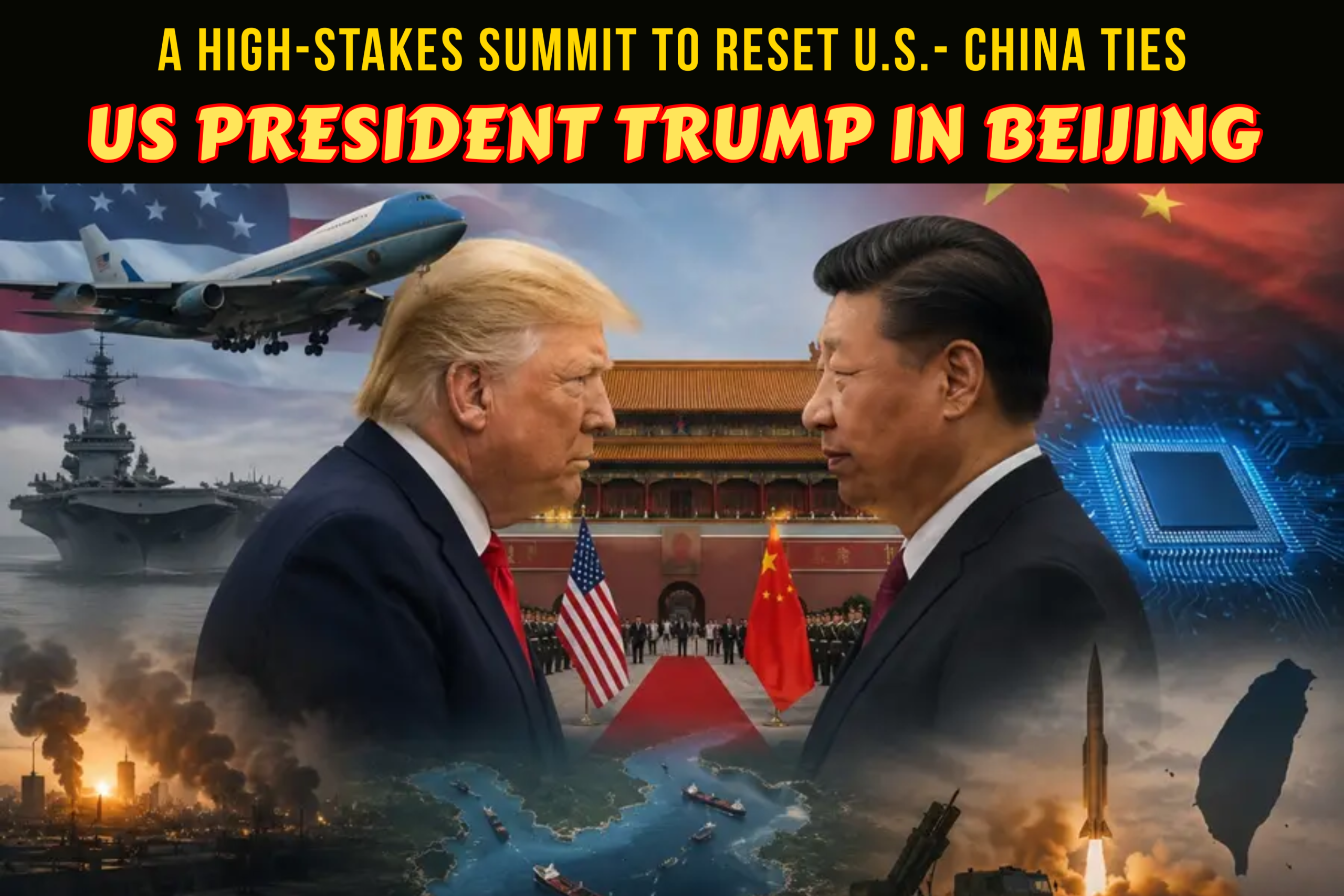
Amid trade truces, AI diplomacy, and the Iran conflict, the president’s second-term visit tests whether cooperation can outpace competition.
(By Khalid Masood)
As Air Force One touched down at Beijing Capital International Airport on 12 May, the stage was set for the most consequential U.S.-China diplomatic engagement in nearly a decade. President Donald Trump’s state visit, hosted by President Xi Jinping, arrives at a precarious juncture in trans-Pacific relations. Postponed from April due to escalating hostilities in the Middle East, the four-day summit seeks to stabilise a relationship defined by deep economic interdependence yet sharpened strategic rivalry. With both leaders navigating domestic pressures and global crises, the Beijing talks aim not at sweeping resolutions, but at establishing guardrails for a new era of managed competition.
Logistics & Delegation
The visit carries the full ceremonial weight of a state occasion. Alongside President Trump, a high-level delegation featuring Secretary of State Marco Rubio and Secretary of War Pete Hegseth will navigate a packed itinerary across Beijing’s political and cultural heart. Business titans including Elon Musk, Tim Cook, and BlackRock’s Larry Fink accompany the official party, underscoring the commercial imperatives underpinning the diplomatic mission. The schedule includes a state banquet at the Great Hall of the People and a symbolic tour of the Temple of Heaven. Notably, Eric and Lara Trump are present in a strictly private capacity, a move designed to separate personal diplomacy from official statecraft.
Core Agenda & Negotiation Priorities
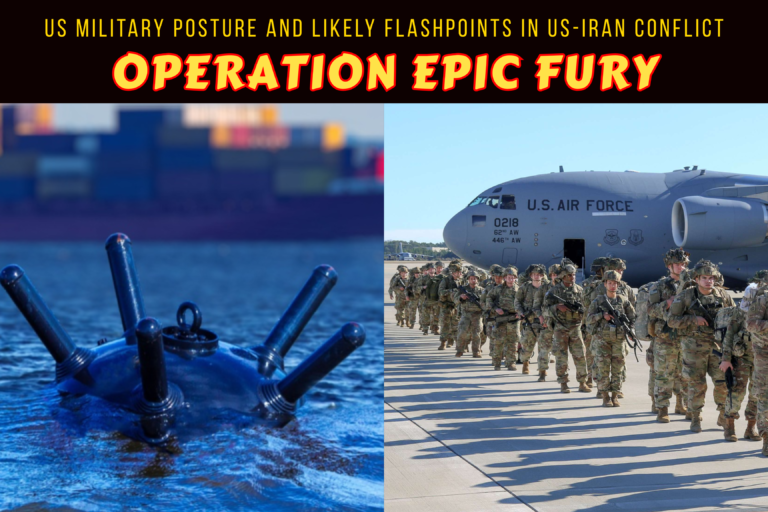
The summit’s agenda reflects a delicate balancing act. Trade and economic security dominate early discussions, with both sides exploring an extension of the existing tariff truce while addressing Beijing’s recent export restrictions on rare earth minerals—critical components for American defence and technology sectors. Simultaneously, Washington is pushing for concrete assurances regarding the ongoing Iran conflict. Defence Secretary Hegseth has publicly noted China’s commitment not to supply military equipment to Tehran, a pledge that could prove vital for stabilising global oil markets and securing the Strait of Hormuz.
The Taiwan question remains a persistent flashpoint. In a notable departure from previous rhetoric, President Trump indicated he would raise U.S. arms sales to Taipei directly with President Xi, signalling a willingness to test diplomatic boundaries while managing escalation risks. Perhaps most forward-looking is the proposed framework for artificial intelligence governance. Both nations are exploring bilateral communication channels to mitigate risks associated with advanced AI development, marking a rare area of potential cooperation amid broader technological decoupling.
Historical Context: 2017 vs 2026
The 2026 summit inevitably invites comparisons to President Trump’s landmark November 2017 state visit. That trip yielded unprecedented commercial commitments, including a $253.5 billion suite of agreements spanning aviation, energy, and agriculture. Yet the geopolitical landscape has shifted dramatically. Where 2017 was characterised by economic optimism and broad memoranda of understanding, 2026 is defined by strategic caution, targeted crisis management, and an acknowledgment of structural friction.
Table 1: U.S.-China Presidential Visits at a Glance (2017 vs 2026)
| Feature | November 2017 Visit | May 2026 Visit |
|---|---|---|
| Primary Focus | Commercial expansion & economic diplomacy | Strategic stabilisation & crisis management |
| Key Deliverables | $253.5bn in commercial MOUs (Boeing, LNG, agriculture) | Tariff truce extension, AI risk dialogue, rare earth supply assurances |
| Geopolitical Context | Korean Peninsula denuclearisation talks | Iran conflict mediation, Taiwan arms policy recalibration |
| Diplomatic Tone | Optimistic engagement & personal rapport-building | Pragmatic negotiation & managed competition |
Strategic Implications & Expert Analysis
Experts caution against viewing the Beijing summit as a diplomatic reset. “This is not about bridging fundamental differences over the South China Sea, technology decoupling, or Russia’s alignment with Beijing,” noted a Council on Foreign Relations analysis released ahead of the summit. “Rather, it is about building mechanisms to prevent competition from spiralling into conflict.”
The leverage dynamics have also evolved. China’s control over critical mineral supply chains and its diplomatic channels with Tehran provide Beijing with significant bargaining power, particularly as Washington remains heavily committed in the Middle East. Conversely, the U.S. retains advantages in advanced semiconductor technology, financial market access, and a network of Indo-Pacific alliances. “Both sides recognise that mutual economic dependence remains a stabilising force,” remarked Dr Eleanor Vance, a senior fellow at the Chatham House Asia Programme. “But trust is in short supply, and implementation will be the true test.”
Challenges & Risk Mitigation
Structural tensions persist. The South China Sea disputes, differing approaches to digital governance, and China’s deepening partnership with Moscow continue to complicate bilateral engagement. Moreover, the historical gap between headline agreements and on-the-ground execution remains a recurring challenge. Media management will also prove critical; both administrations must frame outcomes carefully to satisfy domestic audiences without provoking hardline backlash.
Table 2: Key Risk Factors & Diplomatic Mitigations
| Risk Factor | Potential Impact | Proposed Mitigation |
|---|---|---|
| Rare earth export restrictions | Disruption to U.S. defence & tech manufacturing | Bilateral supply chain working group & strategic stockpiling |
| Taiwan arms sales escalation | Cross-strait military posturing & diplomatic fallout | Direct leader-to-leader communication & transparency protocols |
| Iran conflict spillover | Global oil market volatility & regional instability | Chinese diplomatic assurances & Strait navigation guarantees |
| AI technological race | Unregulated autonomous systems & cyber vulnerabilities | Bilateral AI risk assessment hotline & export control coordination |
Conclusion: What Comes Next
As presidential delegations conclude their Beijing itinerary, the immediate diplomatic machinery will shift towards implementation. A joint statement is expected, alongside announcements of ministerial working groups and preliminary AI governance frameworks. The medium-term trajectory will depend on whether both capitals can translate diplomatic rhetoric into actionable policy.
Notably, the original itinerary had envisaged a further diplomatic leg: President Trump was scheduled to travel to Islamabad following the Beijing summit to pursue a trilateral arrangement involving Iran, with Pakistan positioned as a neutral convening ground. However, this component did not materialise. According to senior U.S. officials briefed on the matter, Tehran declined to accept key American proposals regarding ceasefire verification mechanisms and regional security guarantees, prompting the White House to postpone the Pakistan visit indefinitely. “The door remains open for future engagement,” a State Department spokesperson stated, “but any agreement must be grounded in verifiable commitments from all parties.”
In an era where neither Washington nor Beijing can afford rupture, yet neither can fully embrace trust, the 2026 summit may ultimately be remembered not for what it resolved, but for what it prevented. The delicate art of managed competition continues—and the next move may well depend on developments in Tehran.
One Comment