(By Khalid Masood)
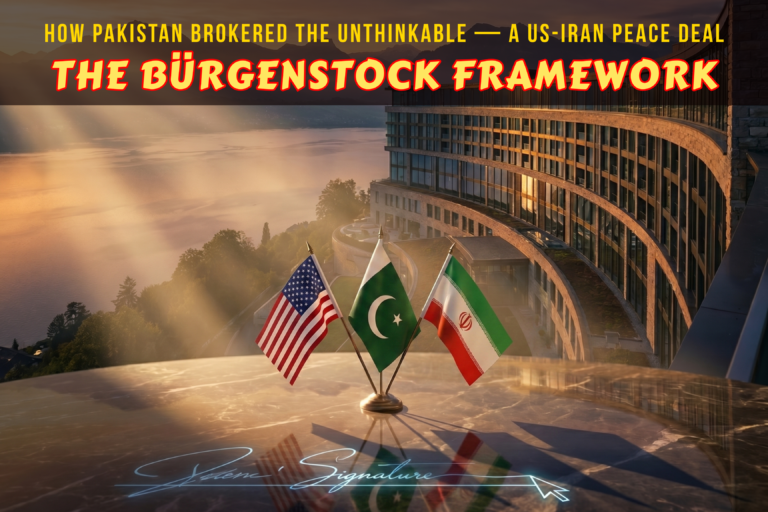
As the calendar turns toward April 22, when a fragile, Pakistan-brokered ceasefire between the United States and Iran is set to expire, global diplomatic attention remains fixed on Islamabad. Yet contrary to widespread speculation and unverified social media reports, Pakistan’s Foreign Office has confirmed that no date has been finalized for a second round of US-Iran talks, and no official delegations have arrived. What is unfolding is not a scheduled summit, but a high-stakes diplomatic holding pattern—one that reveals both the promise and the peril of Pakistan’s emerging mediation model, increasingly referred to by analysts as the “Islamabad Process.”
“We are in a phase of active consultation,” noted Foreign Office spokesperson Tahir Andrabi, carefully navigating between confirming and denying imminent talks. “No dates have been set as yet, but the channels remain open.”
Defining the Model: Incremental Diplomacy Over Grand Bargains
Unlike the high-stakes summits of Camp David or the technical marathon negotiations in Vienna, the Islamabad Process does not aim for a single, sweeping agreement. Instead, it operates on sequential confidence-building, confidential shuttle diplomacy, and a dual-track structure that blends civilian statecraft with military-backed credibility.
The first round on April 11–12 yielded no breakthrough, but as Andrabi assessed, there was “neither a breakthrough nor a breakdown.” That modest outcome was by design. The process treats diplomacy not as a discrete event, but as a continuum—keeping channels open, managing expectations, and buying time for political will to mature in both capitals.
“Hosting the US-Iran negotiations in Islamabad is an honour for Pakistan,” Interior Minister Mohsin Naqvi stated, reflecting the national pride intertwined with diplomatic risk. “We are committed to facilitating dialogue that serves regional peace.”
Why Pakistan? The Mediator’s Credentials
Pakistan’s selection as mediator is neither accidental nor purely convenient. It is rooted in a unique constellation of relationships: a major non-NATO ally of the United States with a long history of counterterrorism cooperation; a neighbor to Iran with a 900-kilometer border and shared security concerns; a defense partner of Saudi Arabia and the Gulf states; and a strategic ally of China.
“We will do talks in Pakistan and nowhere else, because we trust Pakistan,” Iranian Ambassador Reza Amiri Moghadam recently observed—a statement that carries weight in Tehran’s diplomatic circles. But this trust comes with asymmetrical risks. If the process is perceived as leaning too far toward Tehran, Washington’s political establishment may balk. If seen as enabling Iranian regional influence, Riyadh and Abu Dhabi could grow wary.
Chief of Defence Forces Field Marshal Asim Munir’s mid-April visit to Tehran—his second in three months—underscored the military’s central role. Pakistani diplomatic sources describe Munir as having “direct access to both sides’ security establishments,” a channel that civilian diplomats alone cannot replicate.
The Current Reality: Diplomacy in Limbo
Despite intense media speculation, Pakistan’s diplomatic establishment has maintained deliberate ambiguity. When pressed on delegation details, Andrabi deferred: “Who will come, how large the delegation will be… this is for the parties to decide.”
This strategic silence serves multiple purposes: it preserves negotiating flexibility, prevents hardliners from sabotaging talks through public posturing, and maintains Pakistan’s credibility as a neutral venue. Behind the scenes, the actual diplomatic work continues through backchannels that rarely make headlines.
“There is reason to believe the second phase of talks could yield a positive outcome,” one senior diplomatic source told reporters on condition of anonymity, balancing optimism with the discipline of not overpromising.
Bridging the Divides: Core Sticking Points
The agenda remains familiar, but the gaps are wide. The following table outlines the fundamental disagreements:
| Issue | US Position | Iranian Position | Mediation Challenge |
|---|---|---|---|
| Nuclear Programme | Verifiable, irreversible commitment to forgo weapons capability | Sovereign right to peaceful nuclear energy under NPT | Bridging verification protocols with sovereignty red lines |
| Strait of Hormuz | Unconditional freedom of navigation; zero tolerance for restrictions | Conditional access; reserves right to respond to “naval blockade” | Sequencing concessions without either side losing face |
| Sanctions Relief | Step-by-step, behavior-linked; relief after verification | Upfront economic breathing room; sanctions first, then compliance | Trust deficit over implementation timelines and enforcement |
| Regional Security | Keep Lebanon, Yemen, Iraq on separate bilateral tracks | Insist on interconnected regional framework addressing all grievances | Preventing proxy linkages from derailing core US-Iran talks |
| Ceasefire Extension | Conditional on demonstrated Iranian restraint | Open to extension but demands reciprocal US naval pullback | Building confidence amid mutual accusations of bad faith |
“The gaps are wide and some fundamental points remain,” Iranian Parliament Speaker Mohammad Bagher Ghalibaf warned after the first round—a candid assessment that underscores the scale of the challenge.
Yet Pakistani mediators argue that the very act of tabling these issues in a structured format represents progress. “You cannot solve what you will not discuss,” one Pakistani official noted. “Now, at least, everything is on the table.”
The Regional Ecosystem: Who Else Is in the Room?
The Islamabad Process does not operate in isolation. It is embedded within a broader diplomatic ecosystem:
- Saudi Arabia & UAE: Support de-escalation but remain wary of Iranian empowerment; Pakistan’s defense pact with Riyadh adds complexity
- Türkiye: Running parallel diplomatic initiatives; NATO member with Iranian ties serves as a bridge
- China: Economic stake in regional stability through CPEC; provides quiet diplomatic cover
- Russia: Traditional Iranian ally but cautious about Gulf instability affecting energy markets
“This is not just about Washington and Tehran,” explained a regional analyst familiar with the consultations. “Pakistan is weaving a safety net of regional stakeholders so that any agreement has multiple guarantors.”
Scenarios: What Comes Next?
Realism must temper expectations. A comprehensive deal remains unlikely in the short term. Three scenarios are analytically plausible:
| Scenario | Probability | Key Features | Implications |
|---|---|---|---|
| Muddling Through | 50% | Short ceasefire extension; technical working groups established; monthly talks continue | Process survives but progress slow; regional tensions managed, not resolved |
| Framework Breakthrough | 25% | Hormuz protocols agreed; limited sanctions relief; nuclear verification roadmap | Pakistan’s mediation hailed as success; model replicated for other conflicts |
| Process Stall/Collapse | 25% | Ceasefire expires; talks break down; naval tensions resume | Pakistan’s credibility dented but crisis channels remain; risk of escalation |
“We are not hosting a summit. We are building a bridge. And bridges take time to cross,” one senior Pakistani diplomat noted off the record—a metaphor that captures both the ambition and the patience required.
Conclusion: A Necessary, Not Sufficient, Step
The Islamabad Process is not a magic formula. It cannot erase decades of hostility, override domestic political constraints in Washington or Tehran, or instantly resolve proxy conflicts that extend far beyond bilateral negotiations. But it does something previous frameworks failed to do: it creates a sustainable, regionally anchored space for dialogue where none existed.
White House Press Secretary Karoline Leavitt recently struck an optimistic note: “We feel good about the prospects of a deal.” Whether that optimism is warranted will become clear in the coming days.
By treating diplomacy as an iterative continuum rather than a zero-sum event, Pakistan has already altered the strategic calculus. Whether the next round convenes tomorrow, next week, or next month, the process itself holds value. In a region accustomed to escalation, keeping the door open is not a minor achievement—it is the foundation of whatever comes next.
The world is watching Islamabad not just for what is signed, but for whether a new model of conflict management can take root. And in that sense, the Islamabad Process is already writing its own chapter in diplomatic history—cautiously, deliberately, and with full awareness of the stakes.