(By Quratulain Khalid)
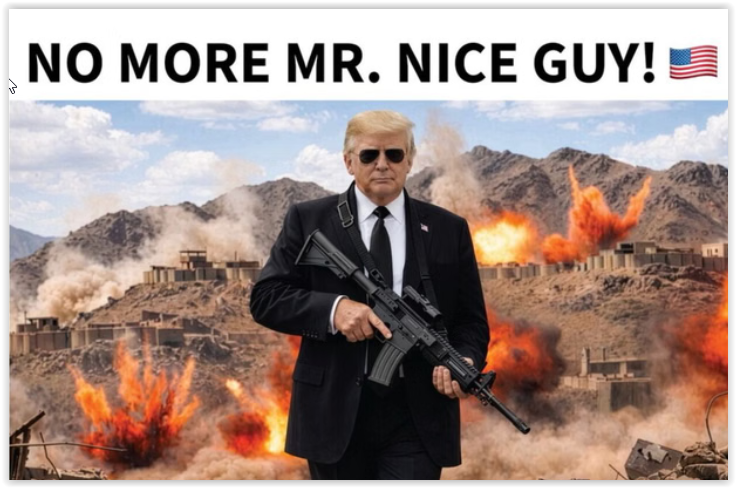
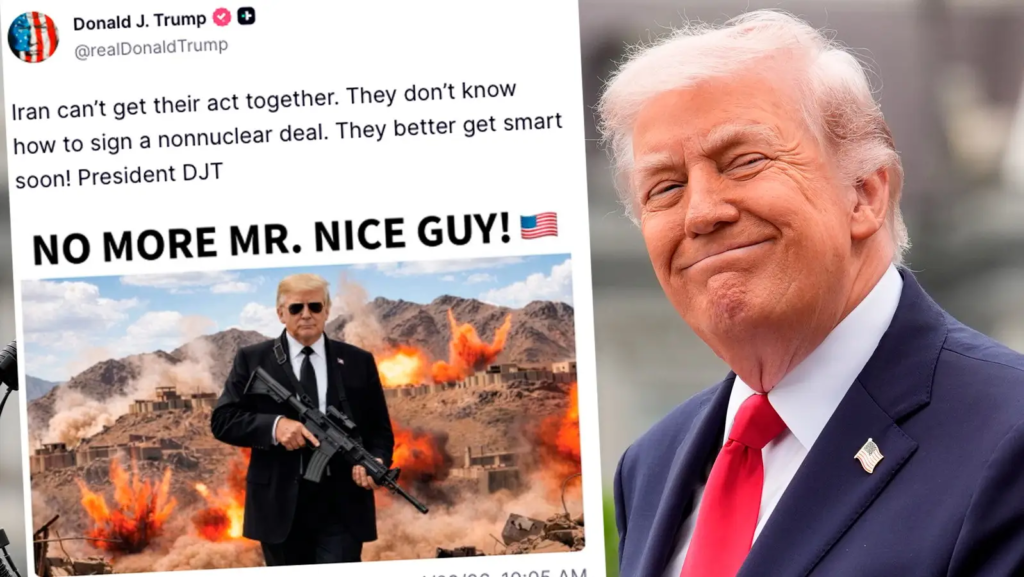
Early on Wednesday morning, a single post on Truth Social cut through diplomatic backchannels and military briefings. President Donald Trump shared an AI-generated image of himself holding an M4 rifle against a stylised backdrop of explosions, captioned with the phrase: “No more Mr Nice Guy.” The post, published during the state visit of King Charles III and amid an eight-week military stalemate, declared that Iran “can’t get their act together” and urged Tehran to “get smart soon.” While digital in nature, the message underscored a stark reality: the United States and Iran are locked in an escalating naval confrontation that threatens to redraw the strategic architecture of the Middle East and destabilise global energy markets. This article examines the dual blockade strategy, the geopolitical calculus driving it, and the mounting humanitarian and economic toll.
From Surgical Strikes to Naval Standoff
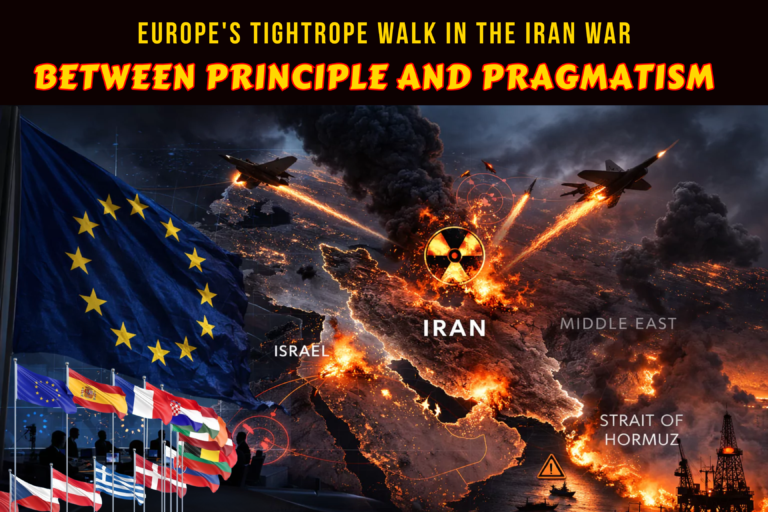
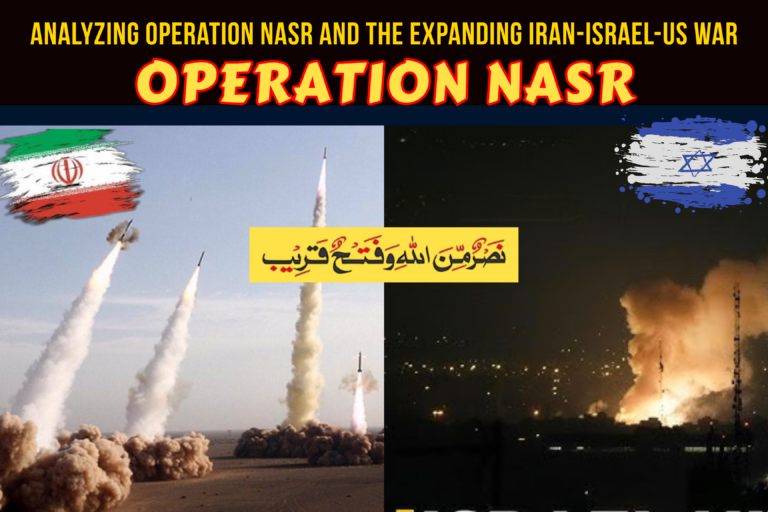
The current crisis traces its origins to late February 2026, when US and Israeli forces launched coordinated airstrikes under Operation Epic Fury. The campaign, initiated during active nuclear negotiations, targeted key Iranian military and command infrastructure, resulting in the deaths of senior officials, including Supreme Leader Ali Khamenei. Tehran responded with a barrage of missiles and drones aimed at US regional bases and Gulf partner states, swiftly announcing the closure of the Strait of Hormuz.
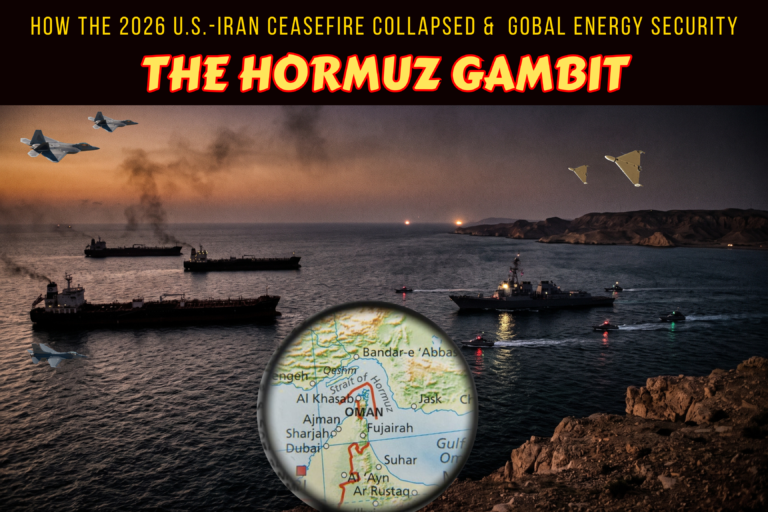
A Pakistani-mediated two-week ceasefire, brokered in early April, briefly paused hostilities. However, talks in Islamabad collapsed over Tehran’s refusal to guarantee the strait’s full reopening. On 13 April, Washington announced a comprehensive naval blockade of Iranian ports, deploying over 10,000 personnel and a substantial fleet of warships. Iran retaliated by reimposing its own restrictions on commercial shipping through the Persian Gulf, creating a dual blockade that has effectively paralysed regional maritime trade. Though the ceasefire has been extended indefinitely, its provisions remain unimplemented, leaving both navies in a tense, high-readiness posture.
The Rhetoric of Confrontation
The Truth Social post exemplifies the growing intersection of social media diplomacy and kinetic military strategy. The AI-generated imagery, widely circulated within hours, was met with cautious distancing by Buckingham Palace and private concern among White House officials, who feared it could undermine fragile diplomatic channels. “The optics are actively sabotaging the backchannel,” noted a senior administration official speaking on condition of anonymity. “You cannot credibly negotiate a ceasefire while broadcasting artillery threats to a global audience.”
Trump’s rhetoric has grown increasingly maximalist, following earlier warnings that “a whole civilisation will die tonight” and claims that Iran is in a “state of collapse.” Yet, internal dissent within the administration, notably from Vice-President JD Vance, suggests growing scepticism regarding the accuracy of intelligence briefings and the feasibility of regime-change objectives.
Military Manoeuvres and Economic Warfare
The US naval blockade operates on a dual mandate: interdict Iranian vessels suspected of transferring weapons or mining equipment, and enforce economic isolation on a global scale. Washington has authorised naval assets to pursue Iran-linked shipping worldwide, a move that has already led to the seizure of an Iranian cargo vessel in late April. Tehran’s response has been unequivocal. “This naval aggression is a flagrant violation of international maritime law,” stated a spokesperson for Iran’s Foreign Ministry. “The Strait belongs to the littoral states, not to foreign warships conducting arbitrary interdictions.”
Iran’s counter-blockade leverages its geographic advantage in the Strait of Hormuz, through which approximately 20 per cent of global oil and a third of seaborne crude transit. The economic fallout is immediate and severe.
Table 1: Dual Blockade Impact Assessment (April 2026)
| Indicator | US-Led Naval Blockade (Iranian Ports) | Iranian Counter-Blockade (Strait of Hormuz) | Broader Regional/Global Impact |
|---|---|---|---|
| Primary Objective | Interdict weapons transfers, enforce sanctions, compel nuclear concessions | Restrict regional energy exports, pressure Gulf states & US allies | Disrupt 20% of global oil supply; trigger energy market volatility |
| Daily Economic Cost (Est.) | ~$435 million to Iranian economy | ~$320 million in lost regional export revenue | Global oil prices up 45%; supply chain delays across Asia & Europe |
| Shipping Restrictions | 100% suspension of Iranian commercial port access | 60–70% reduction in Hormuz transit; heightened insurance premiums | 1.8 million barrels/day rerouted; strategic reserves activated in 12 nations |
| Reported Military/Civilian Toll | 3,400+ Iranian casualties; 26,500 injured | 15 US personnel killed; 538 wounded; GCC infrastructure damaged | 6 UNIFIL peacekeepers killed; regional displacement exceeds 1.2 million |
| Enforcement Mechanism | Global interdiction orders; naval task group deployments | Asymmetric naval tactics; drone/missile surveillance; mining threats | Prediction markets price 82% probability of blockade continuation beyond 30 days |
Estimates indicate direct infrastructure damage in Iran exceeding $270 billion, while Gulf Cooperation Council (GCC) states have incurred over $120 billion in associated costs. Financial markets remain volatile as airlines, logistics firms and emerging economies brace for prolonged supply chain disruptions.
Geo-Strategic Calculus and Great Power Competition
Washington’s stated objectives centre on neutralising Iran’s missile capabilities, preventing nuclear weapons development, and curtailing regional proxy networks. However, International Atomic Energy Agency (IAEA) assessments have found no conclusive evidence of an active Iranian nuclear weapons programme, complicating the legal and moral justification for sustained military pressure. “The blockade is achieving economic attrition, but not strategic surrender,” observed Dr Elena Rostova, a senior fellow at a London-based conflict research institute. “Historical precedent shows that sieges tend to harden domestic resolve rather than fracture command structures.”
Regionally, the crisis has exposed strategic fractures. Gulf states hosting US military infrastructure face heightened retaliation risks, while Israel’s security establishment continues to pressure Washington to maintain maximum pressure. Pakistan’s failed mediation underscores the limitations of neutral diplomacy when core security guarantees remain unaddressed. Meanwhile, Russia and China have quietly bolstered alternative payment systems and energy trade frameworks, accelerating de-dollarisation efforts and deepening multipolar alignments in Eurasia.
Legal Questions and Diplomatic Deadlock
The legality of the US blockade and preceding strikes remains contested under international law. Legal scholars argue that preemptive strikes during active negotiations contravene UN Charter principles governing self-defence and sovereign immunity. Maritime law experts similarly question the proportionality and legitimacy of a global interdiction campaign. Diplomatically, the trust deficit is profound. Core negotiation pillars—nuclear inspection protocols, sanctions relief, and regional security guarantees—remain irreconcilable under current conditions. With prediction markets pricing an 82 per cent probability that the blockade will not be lifted within thirty days, the window for diplomatic off-ramps narrows daily.
The Human and Regional Toll
Beyond geopolitical chessboards, the human cost mounts steadily. Iranian monitoring groups report over 3,600 fatalities, including more than 1,700 civilians, alongside widespread damage to hospitals, schools and critical water infrastructure. Regional spillover has been significant: Lebanon records over 2,500 killed, Iraq suffers military and civilian casualties, and UNIFIL peacekeepers in southern Lebanon have sustained losses. Domestically, the US faces mounting financial strain, with military expenditures surpassing $18 billion and an additional $200 billion requested for sustained operations. Casualty figures stand at 15 service personnel killed and over 500 wounded, fuelling domestic debate over strategic objectives and fiscal responsibility.
Scenarios and Strategic Outlook
In the short term, the risk of a naval incident triggering broader conflict remains elevated. US directives to neutralise mine-laying vessels, combined with Iran’s asymmetric naval capabilities, create a volatile operational environment. Medium-term projections suggest potential escalation into direct combat, broader regional activation of proxy networks, or a protracted economic crisis capable of triggering global recessionary pressures. Long-term implications point towards accelerated nuclear proliferation incentives, particularly in Saudi Arabia and Turkey, alongside a structural shift away from Gulf-dependent energy markets. The conflict may ultimately cement a multipolar world order, where alternative financial networks and regional security architectures operate independently of Western-led frameworks.
Conclusion
The image of a digital rifle and a slogan borrowed from popular culture belies the gravity of a conflict reshaping global security, energy flows and international law. The dual blockade has trapped both Washington and Tehran in an escalatory cycle where military posturing substitutes for diplomatic resolution. As the economic toll mounts and civilian casualties accumulate, the central question remains: can social media-driven brinkmanship yield sustainable security, or does it merely accelerate the march towards an unmanaged regional conflagration? In the absence of verified intelligence, transparent dialogue and multilateral engagement, the phrase “No more Mr Nice Guy” may prove less a warning than a prophecy of prolonged instability.