(By Khalid Masood)
Introduction: The Demographic Puzzle
The Subcontinent represents one of humanity’s most remarkable demographic concentrations. Home to nearly two billion people spread across seven nations, this region accounts for approximately 25 percent of the world’s total population. India alone, with 1.46 billion citizens, is poised to become the world(‘s most populous nation. Pakistan, with 255 million people, ranks as the fifth-most populous country globally. Bangladesh, with 176 million, would be the eighth-largest nation if counted among the world’s economies by population. Add Nepal (29.6 million), Sri Lanka (23.2 million), Bhutan (787,000), and the Maldives (528,000), and the scale becomes staggering.
Yet when the world’s gaze turns to the FIFA World Cup, the most-watched sporting event on Earth, the Subcontinent is conspicuously absent. No nation from this region has participated in the tournament since India’s qualification in 1950, a campaign they ultimately withdrew from. No South Asian team has ever won a match at the FIFA World Cup. No South Asian player has lifted the trophy. The region that gave the world mathematical zero has contributed virtually nothing to the global football stage.
This is the Football Paradox of the Subcontinent: how can nearly one-quarter of humanity, representing an enormous reservoir of potential athletic talent, remain so thoroughly absent from the world’s most popular sport at its highest level? This article examines the historical, economic, social, administrative, and cultural factors that have conspired to keep South Asian football in the shadows.
Population of South Asian Nations (2024)
| TOTAL | ~1,949,000,000 | FIFA Postion | ~24.3% |
| India | 1,463,865,525 | 121st | ~18.2% |
| Pakistan | 255,219,554 | 195th | ~3.2% |
| Bangladesh | 175,686,899 | 184th | ~2.2% |
| Nepal | 29,618,118 | 178th | ~0.4% |
| Sri Lanka | 23,229,470 | 204th | ~0.3% |
| Bhutan | 787,425 | 185th | <0.1% |
| Maldives | 527,799 | 161st | <0.1% |
The Subcontinent accounts for roughly 1.95 billion people, nearly 25% of global population.
Historical Background
Football arrived in the Indian Subcontinent on the coattails of British colonialism. By the late 19th century, British soldiers, administrators, and merchants had established the sport in the major colonial cities. The Durand Football Tournament, established in 1888 in Shimla, remains one of Asia’s oldest football competitions. Mohun Bagan Athletic Club was founded in 1889 in Kolkata, and their victory over East Yorkshire Regiment in the 1911 IFA Shield final marked a watershed moment for Indian nationalism, proving that Indians could defeat their colonial masters on the sporting field.
The colonial era witnessed the establishment of football clubs across the region. Kolkata emerged as the epicenter, with the rivalry between Mohun Bagan and East Bengal becoming one of football’s most passionate derbies. In Goa, then a Portuguese colony, football took root differently, absorbing Iberian influences that persist today. British India’s participation in the 1948 London Olympics, where they pushed France to the brink before losing 2-1, demonstrated genuine potential. Several Indian players competed barefoot, their taped feet becoming an iconic image of post-colonial sporting pride.
India’s qualification for the 1950 FIFA World Cup in Brazil remains the region’s closest brush with football’s grandest stage. When Burma, Indonesia, and the Philippines withdrew from the Asian qualifying group, India advanced by default. However, the All India Football Federation (AIFF) ultimately withdrew, citing financial constraints, the logistical difficulty of travel, and a belief that Olympic football held greater prestige than the World Cup. The popular myth that India withdrew because FIFA banned barefoot play has been thoroughly debunked; FIFA had no such rule until 1953, and India continued playing barefoot at the 1952 Olympics without objection.
The missed opportunity of 1950 haunted Indian football. A credible performance in Brazil might have ignited national passion for the sport, much as Kapil Dev’s 1983 Cricket World Cup triumph transformed cricket into a national obsession. Instead, football drifted into marginalization as cricket captured the national imagination.
Pakistan’s football journey began after independence in 1947, with the Pakistan Football Federation established in 1947. Despite early promise, the sport never achieved the cultural penetration of cricket. Bangladesh, independent since 1971, showed football passion in its early years but saw the game eclipsed by cricket following the 1999 World Cup and the rise of Mashrafe Mortaza and Shakib Al Hasan. Nepal, Sri Lanka, Bhutan, and the Maldives have similarly struggled to build sustainable football ecosystems, though each possesses unique sporting cultures with football playing varying roles.
The Population Myth
The casual observer might assume that population size correlates directly with sporting success. After all, larger populations should produce more talented athletes, creating deeper talent pools and stronger national teams. The reality is far more nuanced.
Consider the evidence: Uruguay, with just 3.4 million people, has won the FIFA World Cup twice and produced one of the most formidable national teams in history. Croatia, population 4 million, reached the World Cup final in 2018 and finished third in 2022. The Netherlands, with 17 million citizens, has reached three World Cup finals and consistently produces elite players. Portugal, home to 10 million people, won Euro 2016 and the 2019 Nations League, led by one of the greatest players in history.
By contrast, China, with 1.4 billion people, has qualified for the World Cup only once (2002) and failed to score a single goal. India, despite 1.46 billion citizens, has never qualified. Indonesia, with 275 million people, has qualified only once, in 1938 as the Dutch East Indies. These examples shatter the population-equals-success myth.
What matters is not population size but talent identification systems, coaching infrastructure, competitive pathways, sports science support, and cultural emphasis on particular sports. Uruguay’s success stems from a deeply embedded football culture, extensive scouting networks, and a professional league system that identifies and develops talent from early age. Croatia’s football academies, particularly Dinamo Zagreb’s youth system, have produced a remarkable conveyor belt of world-class players relative to the country’s size.
South Asia’s population advantage is therefore neutralized by systemic deficiencies. Raw talent exists in abundance, millions of young people play informal football across the region. But without structured pathways from grassroots to professional levels, without qualified coaches to identify and nurture potential, and without competitive leagues to test and refine skills, that talent dissipates into the ether.
The Dominance of Cricket
To understand South Asian football’s struggles, one must first understand cricket’s dominance. In India, cricket is not merely a sport; it is a cultural phenomenon approaching religious devotion. The Indian Premier League (IPL), launched in 2008, has transformed cricket into an industrial entertainment complex. The league’s media rights for the 2023-2027 cycle were sold for over $6 billion. The IPL’s opening match of the 2024 season drew approximately 168 million television viewers. The Pro Kabaddi League, launched in 2014, attracted 435 million TV viewers in its inaugural season, surpassing the football World Cup’s Indian viewership.
This commercial dominance has profound implications for football. Media coverage, sponsorship dollars, celebrity endorsements, and fan attention flow overwhelmingly toward cricket. Young athletes, observing where fame and fortune accumulate, gravitate naturally toward cricket. Parents, understanding the economic realities of professional sports, encourage cricket over football. Schools and educational institutions invest in cricket facilities and coaching while neglecting football.
The Board of Control for Cricket in India (BCCI) ranks among the wealthiest sports organizations globally, with annual revenues exceeding most national football federations. This financial muscle enables investment in grassroots cricket programs, professional coaching, sports science, and facilities that football federations cannot match. The BCCI’s budget for a single IPL season dwarfs the All India Football Federation’s entire annual operating budget.
Football’s position is further complicated by the popularity of European football leagues among South Asian fans. Millions of Indians support Manchester United, Liverpool, Real Madrid, and Barcelona, watching Premier League and La Liga matches at odd hours with religious devotion. This European football fandom, however, does not translate into support for domestic Indian football. Fans who can watch Cristiano Ronaldo or Erling Haaland on high-definition broadcasts see little reason to attend local matches featuring players of vastly inferior quality.
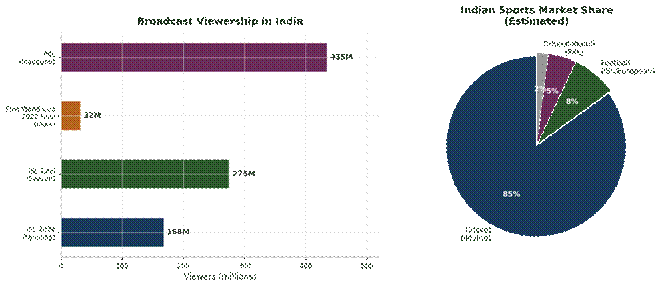
Figure 1: Cricket dominates India’s sports landscape in both viewership and market share, leaving limited space for football development.
Weak Sporting Infrastructure
The Subcontinent’s football infrastructure ranges from inadequate to nonexistent. While cricket stadiums dot the landscape, purpose-built football facilities remain rare. The Indian Super League’s 2024-25 season saw matches played in multi-purpose stadiums often designed for athletics, with running tracks separating fans from the pitch, destroying the intimate atmosphere that makes football special.
Grassroots football development faces severe challenges. Unlike cricket, which has penetrated even remote villages with makeshift pitches and tape-ball variants, football requires larger, properly maintained fields. Urbanization has consumed open spaces in cities like Mumbai, Delhi, Karachi, and Dhaka, where land values make football pitches economically unviable. Children in densely populated urban areas lack safe spaces to play, forcing football onto streets and congested public areas.
Coaching standards present another critical weakness. While Japan requires J-League youth coaches to hold AFC A licenses or equivalent, South Asian coaching education remains underdeveloped. The AIFF has made progress in implementing AFC coaching conventions, but the number of qualified coaches relative to the population remains minuscule. Pakistan, Bangladesh, and Nepal face even graver shortages, with many coaches lacking even basic certification.
Sports science, nutrition, and fitness programming lag decades behind global standards. European and East Asian football academies incorporate strength and conditioning specialists, sports psychologists, nutritionists, and data analysts into their development programs. South Asian academies rarely have access to such resources. The gap is not merely financial but educational; many administrators and coaches lack awareness of modern performance science.
Rural areas present both the greatest challenge and the greatest opportunity. Approximately 65 percent of India’s population lives in rural areas, where football talent remains largely undiscovered. Without scouting networks, trial camps, and digital identification systems, countless potentially gifted players never encounter structured football. The story is similar across Pakistan’s Punjab and Sindh provinces, Bangladesh’s rural heartland, and Nepal’s hill regions.
Governance and Administrative Challenges
Football governance in South Asia has been plagued by political interference, bureaucratic inefficiency, financial mismanagement, and chronic instability. These administrative failures cascade through every level of football development, from youth academies to the senior national team.
India’s AIFF was placed under a FIFA ban in August 2022 due to third-party influence, specifically after a Supreme Court-appointed Committee of Administrators took control of the federation. The ban, though lifted in August 2022 after constitutional amendments, exemplified the governance dysfunction that has plagued Indian football. Frequent changes in leadership, court interventions, and political maneuvering have prevented coherent long-term planning.
Pakistan’s football administration has been even more turbulent. The Pakistan Football Federation has faced multiple suspensions from FIFA due to internal power struggles and government interference. These suspensions prevent Pakistani teams from participating in international competitions, denying players crucial developmental experience. The federation’s inability to maintain consistent leadership has paralyzed domestic football development.
Bangladesh, Nepal, and Sri Lanka face similar governance challenges. Political appointments to federation positions prioritize loyalty over competence. Financial transparency remains elusive. Long-term strategic planning is virtually impossible when federation presidents change with government transitions.
The consequences extend far beyond boardroom politics. Administrative instability disrupts league scheduling, coaching appointments, youth development programs, and international competition planning. Sponsors, already reluctant to invest in football given cricket’s dominance, are further deterred by administrative chaos. Talented administrators and coaches seek opportunities abroad or in other sports.
Economic and Social Factors
Poverty remains the most fundamental barrier to football development in South Asia. Despite significant economic growth over the past two decades, approximately 230 million Indians live below the poverty line. In Pakistan, Bangladesh, and Nepal, poverty rates remain similarly high. For families struggling to meet basic needs, organized sports participation represents an unaffordable luxury.
Educational pressures compound the problem. South Asian education systems emphasize academic achievement above all else, with intense competition for limited university placements and professional opportunities. Parents view sports careers as risky and unstable, preferring their children pursue engineering, medicine, or civil service. The concept of a football academy as an alternative educational pathway, common in Europe and East Asia, remains alien to most South Asian families.
The middle-class expansion underway across South Asia may gradually shift these attitudes. India’s middle class, estimated at 400 million people and growing, has begun investing in children’s sports activities. Private football academies in Delhi, Mumbai, Bangalore, and Kolkata attract middle-class families seeking structured physical activity and character development for their children. Whether this translates into professional football careers remains to be seen.
Urbanization presents both challenges and opportunities. As rural populations migrate to cities, traditional community football spaces disappear. However, urban concentration also creates larger markets for professional leagues and increases exposure to international football through media. The Indian Super League’s strongest attendance figures come from cities like Kolkata, Kochi, and Bengaluru, where football culture has survived cricket’s onslaught.
Comparison with Successful Asian Nations
The contrast between South Asia and successful Asian football nations is stark. Japan, South Korea, Australia, Saudi Arabia, and Iran have all established themselves as competitive forces in Asian and world football. Understanding their development models offers crucial lessons for the Subcontinent.
Japan’s football revolution began with the J-League’s establishment in 1993, but its foundations were laid through decades of systematic development. The J-League’s ‘100-Year Vision’ emphasizes community-based clubs, youth development, and sustainable growth over short-term results. Japanese clubs invest heavily in academies, with Kawasaki Frontale and Kashima Antlers producing players who have starred in Europe. Japan requires all professional clubs to operate youth teams, ensuring a structured pathway from childhood to professional football. The J1 League averaged over 20,000 spectators per match in 2024, reflecting deep community engagement.
South Korea’s football development was catalyzed by the 2002 FIFA World Cup, which they co-hosted with Japan. The tournament’s legacy includes improved stadium infrastructure, increased youth participation, and strengthened professional structures. The K-League, Asia’s oldest professional league, has faced attendance challenges but continues producing world-class talent like Son Heung-min. Korea’s football ecosystem benefits from strong government support, mandatory school sports programs, and cultural acceptance of sports careers.
Saudi Arabia’s recent football strategy represents a different model: massive state investment in infrastructure, foreign star recruitment, and sports diplomacy. While this approach has drawn criticism for distorting competitive balance, it has undeniably raised the Saudi Pro League’s profile. The kingdom’s investment in grassroots facilities and coaching education may yield long-term benefits.
Iran and Uzbekistan demonstrate that football success does not require enormous wealth. Despite economic challenges and international sanctions, Iran consistently qualifies for the World Cup and produces technically gifted players. Uzbekistan has emerged as Central Asia’s football powerhouse through systematic investment in youth development and domestic league quality.
The common thread among these successful Asian nations is sustained, coherent investment in football ecosystems: professional leagues with sustainable business models, mandatory youth development requirements, qualified coaching at all levels, modern facilities, and government support for sports infrastructure. South Asia lacks all of these elements in sufficient quantity.
The Professional League Problem
The Indian Super League (ISL), launched in 2014, represented the region’s most ambitious attempt to establish a viable professional football league. Initial seasons produced impressive attendance figures, with the inaugural season averaging 24,711 spectators per match and peaking at 27,111 in the second season. The ISL briefly ranked as Asia’s best-attended league and among the world’s top ten by crowd figures.
However, the ISL’s trajectory has proven unsustainable. By the 2024-25 season, average attendance had declined to 11,870 per match, a 56 percent decrease from the peak. The COVID-19 pandemic accelerated this decline, with two seasons played behind closed doors. Post-pandemic recovery has been uneven, with marquee fixtures like the Kolkata derby still drawing 60,000-plus crowds while many matches attract fewer than 2,000 spectators.
The ISL’s challenges mirror broader structural issues. The league initially relied on celebrity owners, imported stars past their prime, and spectacle over substance. While this generated initial excitement, it failed to build sustainable fan cultures around most clubs. Unlike European clubs rooted in century-old community identities, ISL franchises often lack organic connections to their cities.
Financial sustainability remains elusive. Most ISL clubs operate at losses, subsidized by corporate owners or wealthy individuals. Broadcasting revenues, while growing, remain modest compared to cricket. Sponsorship deals are limited by football’s secondary status in the Indian sports market. Player salaries, while improved, cannot compete with international standards, leading to an exodus of the best Indian players or discouraging them from pursuing football professionally.
The I-League, India’s second-tier competition, averages fewer than 2,000 spectators per match, reflecting the sport’s marginalization outside ISL markets. Pakistan’s Premier League, Bangladesh’s Premier League, and Nepal’s Martyr’s Memorial A-Division League face similar challenges with minimal attendance, limited media coverage, and chronic financial instability.
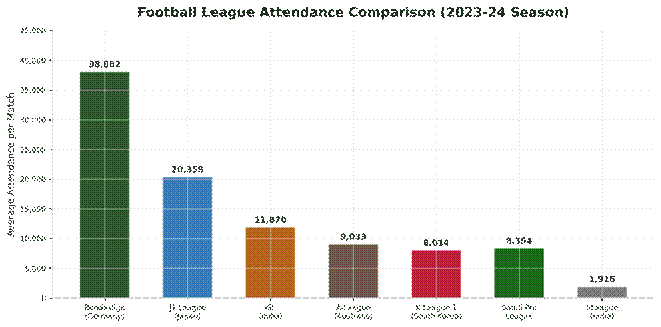
Figure 2: ISL attendance compares favorably to K-League and A-League but trails Japan’s J1 League and European standards significantly.
Cultural and Psychological Factors
National sporting identity profoundly influences football development. In England, football is woven into the national fabric; every town has its club, every child knows the local team’s history. In Brazil, football is a source of national pride and cultural expression. In South Asia, cricket occupies this cultural space. Football exists on the periphery of national consciousness, except in specific regional pockets.
West Bengal, Goa, Kerala, and the northeastern states of India represent football’s cultural strongholds. Kolkata’s football culture dates to colonial times, producing clubs like Mohun Bagan, East Bengal, and Mohammedan Sporting that command fierce loyalty. Goa’s Portuguese heritage created a football-centric culture distinct from cricket-obsessed North India. Kerala’s football passion, exemplified by Kerala Blasters’ consistently high ISL attendance, defies the sport’s marginalization elsewhere.
These regional pockets, however, remain isolated. There is no all-India football culture comparable to cricket’s national reach. Media narratives reinforce this hierarchy; cricket dominates sports coverage, football receives perfunctory attention except during World Cups or major ISL fixtures. When Indian football is covered, the narrative often emphasizes failure and disappointment rather than progress and potential.
Public expectations present another paradox. Indian football fans, accustomed to watching European superstars on television, hold domestic football to impossibly high standards. The gap between expectations and reality creates frustration that further reduces engagement. Breaking this cycle requires either dramatically improved domestic quality, which will take decades, or a reframing of what domestic football represents: not entertainment comparable to the Premier League, but a community experience rooted in local identity.
Country-by-Country Assessment
Each South Asian nation presents a unique football profile, shaped by distinct historical, cultural, and economic factors. The following assessment examines the current state of football across the region.
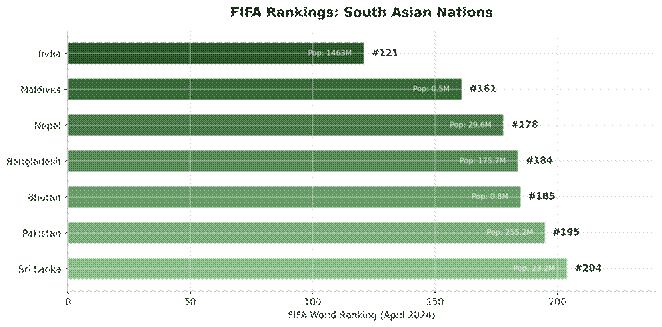
Figure 4: FIFA rankings of South Asian nations (April 2024). India leads the region at 121st globally.
India
FIFA Ranking: 121st (April 2024). Population: 1.46 billion. India remains South Asia’s strongest football nation by a considerable margin, though this achievement must be viewed in perspective. Despite possessing the world’s largest population and one of the fastest-growing economies, India has yet to translate its demographic and economic advantages into meaningful success on the global football stage.
The Indian Super League (ISL) has improved professional standards, infrastructure, and the sport’s visibility. The national team, led for over a decade by the legendary Sunil Chhetri, achieved periods of regional success, but repeated World Cup qualifying failures and disappointing AFC Asian Cup campaigns continue to expose the gap between regional prominence and continental competitiveness.
India’s underachievement is particularly striking given its vast talent pool. With more than 1.4 billion people, the country should theoretically be a major football power. However, cricket continues to dominate public attention, sponsorship, media coverage, and sporting aspirations, drawing away many talented athletes.
The Indian Army and other government institutions have invested significantly in sports development through training centers and talent identification programs. While these initiatives have produced capable footballers and strengthened domestic competitions, they have not delivered the breakthrough required to elevate India into Asia’s top tier.
India’s strengths include an improving professional league, growing private investment, better infrastructure, and a huge reservoir of potential talent. Its weaknesses remain weak grassroots development, inconsistent coaching standards, administrative challenges, and football’s struggle to compete with cricket for resources and attention.
India therefore represents one of football’s greatest paradoxes: a nation of 1.46 billion people with enormous potential but limited international success. If grassroots development, coaching quality, and long-term football governance improve, India possesses the resources and talent base to become the first South Asian nation to establish itself as a regular FIFA World Cup contender.
Pakistan
FIFA Ranking: 195th. Population: 255 million. Pakistan represents perhaps the region’s greatest untapped football potential. With a young and rapidly growing population, a deep sporting culture, and physical attributes well suited to athletic competition, Pakistan should be far more competitive on the international stage than its current ranking suggests.
Yet governance dysfunction, repeated FIFA suspensions, administrative infighting, and cricket’s overwhelming dominance have crippled the sport’s development. The Pakistan Premier League operates on a largely semi-professional basis, football infrastructure remains limited, and the national team rarely enjoys the continuity of competitive fixtures necessary for sustained progress. Decades of mismanagement have prevented the emergence of a coherent pathway from grassroots football to the national team.
What makes this underperformance particularly striking is the country’s immense reservoir of natural talent. Regions such as Balochistan and Khyber Pakhtunkhwa have long been renowned for producing physically gifted athletes possessing endurance, strength, agility, resilience, and a fiercely competitive spirit. Many football observers argue that Baloch and Pashtun youth possess the raw athletic qualities that, if identified early and developed through modern coaching, nutrition, sports science, and professional competition, could produce footballers capable of competing at the highest international levels. Some even contend that these communities may contain some of the finest untapped football talent in the world.
The tragedy of Pakistani football is therefore not a lack of talent but the absence of a system capable of discovering, nurturing, and refining it. While nations such as Japan, South Korea, Iran, and Saudi Arabia have spent decades building academies, coaching networks, and professional leagues, Pakistan has failed to create the institutional framework necessary to transform natural ability into international success.
With more than 255 million people, Pakistan possesses a player pool larger than that of many countries that regularly qualify for the FIFA World Cup. If governance reforms, professional league development, grassroots academies, and sustained investment in football infrastructure were prioritized, Pakistan could potentially become one of Asia’s most improved football nations. Until then, it will remain a compelling example of how immense potential can be squandered when talent is not matched by vision, planning, and effective administration.
Bangladesh
FIFA Ranking: 184th. Population: 176 million. Bangladesh possesses genuine football passion, particularly in Dhaka and Chittagong. The Bangladesh Football Federation has made grassroots strides, accrediting 250 academies and running the BFF Academy Championship involving 168 academies and 4,800 players. However, the domestic league struggles for sustainability, and the national team has never threatened continental qualification. Poverty, limited infrastructure, and cricket’s rising popularity remain significant barriers.
Nepal
FIFA Ranking: 178th. Population: 29.6 million. Despite its small population and challenging geography, Nepal has produced competitive moments in South Asian football. The national team benefits from strong domestic interest and the ‘ANFA Complex’ training facilities in Lalitpur. However, political instability within the football federation, limited financial resources, and the country’s mountainous terrain impede development. Nepal’s football future depends on sustained governance reform and international technical assistance.
Sri Lanka
FIFA Ranking: 204th (lowest in South Asia). Population: 23.2 million. Sri Lanka’s football decline is particularly disappointing given the island’s sporting tradition. Once competitive in South Asian tournaments, Sri Lanka has fallen to the bottom of regional rankings. Cricket’s total dominance, civil war’s legacy, and chronic federation mismanagement have devastated football. The domestic league operates at amateur levels, and emigration of talented players and coaches further weakens the sport.
Bhutan
FIFA Ranking: 185th. Population: 787,000. Bhutan’s most celebrated football moment came in 2015, when the national team defeated Sri Lanka in World Cup qualifying, sparking national jubilation in the Himalayan kingdom. With a population smaller than many world cities, Bhutan’s football ambitions must be modest. The country’s ‘Gross National Happiness’ philosophy prioritizes wellbeing over competitive results, creating a unique sporting culture. Development focuses on grassroots participation and regional competitiveness rather than World Cup aspirations.
Maldives
FIFA Ranking: 161st. Population: 528,000. The Maldives punches above its weight in South Asian football, ranking second in the region behind India. The island nation’s compact geography facilitates centralized development, and football benefits from being the dominant sport (cricket is impractical on small islands). The Maldives has won the SAFF Championship and remains competitive in regional tournaments. However, the tiny population limits ultimate potential.
Can the Subcontinent Become a Football Power?
Despite decades of underperformance, there are reasons for measured optimism about South Asian football’s future. Demographic trends, economic growth, technological change, and evolving cultural attitudes may gradually shift the region’s football trajectory.
The demographic advantage is undeniable and growing. India’s median age is 28, Pakistan’s is 22, Bangladesh’s is 27. These young populations represent enormous talent pools if even a fraction can be reached through structured programs. The region’s physical diversity, from the Himalayan heights to the coastal plains, produces varied athletic types adaptable to different football positions.
Economic growth, while uneven, is expanding the middle class across the region. India’s sports industry, valued at approximately $2 billion in 2024, is projected to reach $130 billion by 2030 according to industry reports. While cricket will capture the lion’s share, football’s absolute slice should grow significantly. The Indian government’s increased sports budget, from $79 million in 2011-12 to $211 million in 2021-22, indicates growing official recognition of sports development.
European football’s popularity among South Asian youth creates both challenge and opportunity. The challenge is competition for attention; the opportunity is a generation that understands and loves football deeply. Digital platforms enable unprecedented access to tactical analysis, training methodologies, and inspirational content. Young South Asian football enthusiasts consume Premier League matches, follow European academies on social media, and understand modern football at sophisticated levels.
Technology offers particular promise for talent identification. Digital scouting platforms, AI-powered performance analysis, and video-based trial systems can help identify talent in remote areas where traditional scouting cannot reach. European clubs have begun exploring South Asian markets, not merely for commercial reasons but because the talent pool is simply too large to ignore indefinitely.
However, optimism must be tempered by realism. Structural challenges, cricket’s dominance, governance dysfunction, and infrastructure deficits will not resolve overnight. Meaningful progress requires decades of sustained investment, not years. A South Asian nation reaching the World Cup within the next 20-30 years would represent a remarkable achievement, not an expectation.
A Roadmap for the Future
Transforming South Asian football requires a comprehensive, long-term approach addressing every level of the sport’s ecosystem. The following roadmap outlines priorities for regional stakeholders.
School Football Programs: Mandatory football curriculum in government schools, starting at the primary level. Government-funded coaching appointments, equipment provision, and inter-school competitions. This is the foundation upon which everything else must be built. Without millions of children regularly playing structured football, the talent pipeline remains a trickle.
Regional Competitions: Strengthening the South Asian Football Federation (SAFF) Championship and establishing regional club competitions. Regular international exposure is essential for development; South Asian nations need competitive matches against quality opposition. A unified regional calendar would provide structure and meaning to international fixtures.
Investment Priorities: Government and private investment should prioritize grassroots facilities over elite stadiums. Small-sided pitches in urban areas, community football centers, and rural facility development. Every investment should be evaluated on its contribution to participation and development, not its photogenic value.
Academy Networks: Establishing networks of licensed academies with standardized curricula, qualified coaches, and clear pathways to professional football. Learning from models like Japan’s JFA academy system and Germany’s regional training centers. Mandatory youth development requirements for professional clubs, as in the J-League.
Coaching Reforms: Massive investment in coach education, producing thousands of qualified coaches at grassroots levels. International partnerships with established football nations for coach education exchange programs. Incentivizing coaching careers through government subsidies and employment guarantees.
Women’s Football Development: Women’s football represents a particularly underdeveloped opportunity. Cultural barriers remain significant, but changing attitudes toward women’s sports create openings. Early investment in women’s football could yield disproportionate returns, given the lack of established competition.
Public-Private Partnerships: Successful football development requires collaboration between government, private sector, and civil society. Models like India’s Khelo India program, corporate social responsibility initiatives, and international development agency partnerships can combine resources and expertise.
Long-Term Strategic Planning: Perhaps the most critical need is patience. South Asian football requires 20-year development plans insulated from political cycles and federation changes. Japan’s 100-Year Vision provides the model: sustained, consistent investment in football infrastructure and culture, measured in generations rather than electoral terms.
Conclusion: The Untapped Billion
The Football Paradox of the Subcontinent is not a mystery without explanation. It is the predictable result of historical circumstance, cricket’s cultural dominance, weak infrastructure, administrative dysfunction, economic constraints, and the absence of sustained strategic investment. Population alone cannot overcome these structural barriers.
Yet the paradox persists in the sheer magnitude of wasted potential. Nearly two billion people, representing the world’s largest concentration of youth, humanity’s most diverse genetic pool, and some of its most passionate sports fans, contribute virtually nothing to the world’s most popular sport. The Subcontinent’s absence from the FIFA World Cup is not merely a sporting disappointment; it represents a failure of human development on a massive scale.
The question of whether the next 20 to 30 years could see a South Asian nation become a regular World Cup participant depends on choices made today. India, with its growing economy, improving infrastructure, and expanding middle class, represents the most plausible candidate. A credible Indian World Cup qualification would require sustained investment in grassroots development, professional league reform, coaching education, and administrative reform. It is achievable, but only with patience, resources, and strategic coherence rarely seen in South Asian football governance.
More modestly, the region might aspire to produce competitive continental teams, regular AFC Asian Cup participants, and a professional league ecosystem that provides sustainable careers for talented athletes. The Maldives and Nepal have shown that South Asian nations can be competitive within the region. Building from this foundation, through regional cooperation and targeted development, represents a realistic near-term goal.
Ultimately, the story of South Asian football is a story of untapped human potential. Somewhere in the streets of Mumbai, the fields of rural Bangladesh, the mountain villages of Nepal, and the beaches of Sri Lanka, future football stars are growing up without ever touching a proper football or meeting a qualified coach. The region’s challenge is not finding talent; it is building the systems that talent requires to flourish.
2026 FIFA World Cup has been kicked off in North America, nearly two billion South Asians will watch as spectators rather than participants. The dream of seeing their colors on football’s grandest stage remains distant. But the potential, the raw human material from which footballing nations are built, is present in quantities unmatched anywhere on Earth. Unlocking that potential, transforming the world’s largest population into a genuine football force, remains one of global sport’s greatest unfulfilled promises.