(By Khalid Masood)
From Himalayan Skies to Arabian Sands: A Year of Aerial Dominance
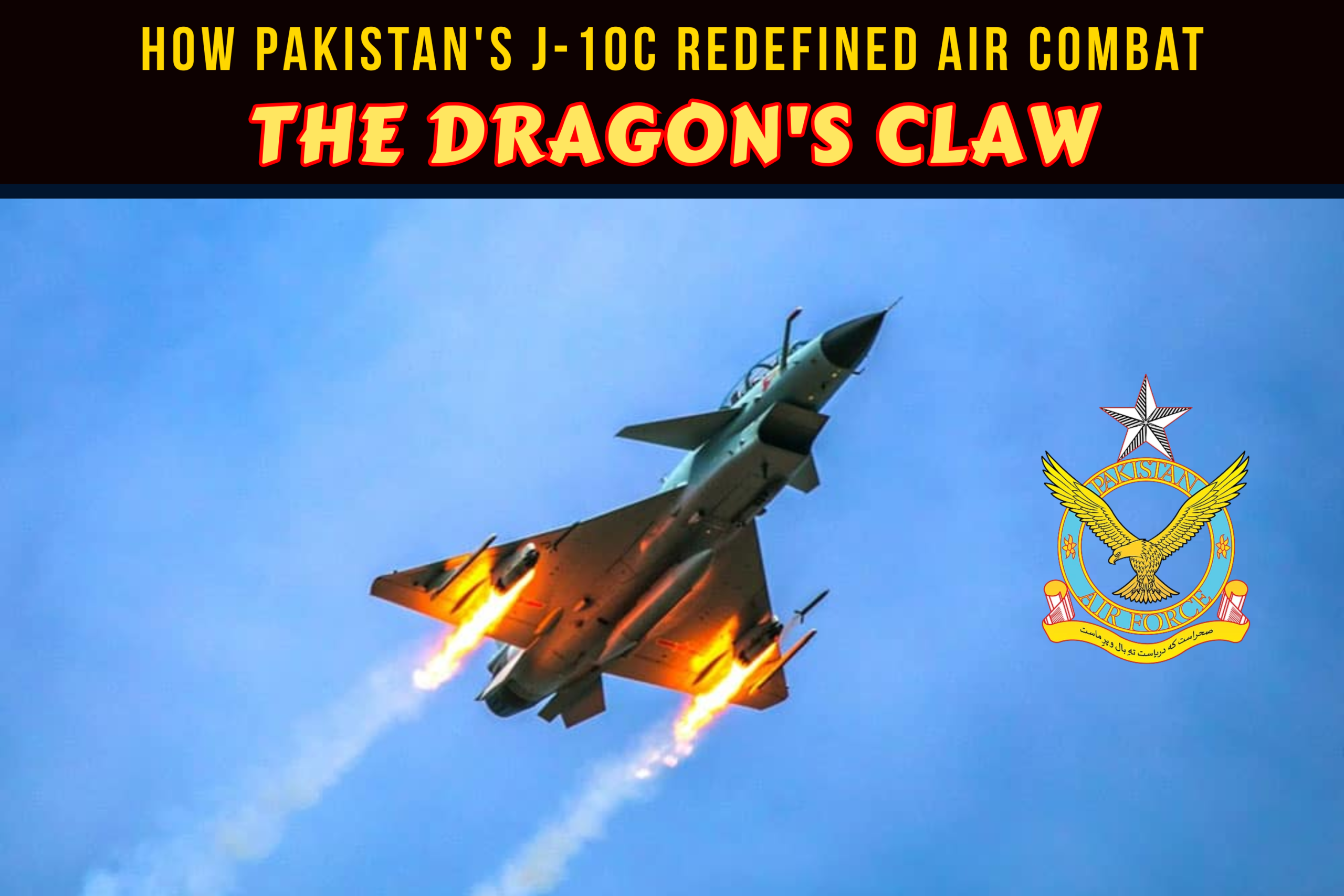
The morning of May 7, 2025, marked a watershed moment in modern aerial warfare. As tensions between nuclear-armed neighbors India and Pakistan erupted into open conflict following the Pahalgam terror attack, the Pakistan Air Force (PAF) unveiled a new dimension of combat power that would send shockwaves through global defence markets and military academies alike. Operating in a sophisticated multi-domain battle network, PAF J-10CE fighters—equipped with China’s PL-15 beyond-visual-range missiles and supported by ZDK-03 airborne early warning platforms—engaged Indian Air Force formations in what would become one of the most lopsided aerial exchanges in recent history.
Pakistan Air Force J-10CE fighters shot down between six and seven Indian aircraft during the opening night of the conflict, including at least three advanced Dassault Rafale fighters—aircraft that had been touted as India’s aerial game-changer. The J-10CEs maintained radar and radio silence throughout much of the engagement, firing PL-15 missiles from safe standoff distances while target acquisition and mid-course guidance were handled by airborne early warning aircraft via secure data links. By the time the missiles’ active seekers activated approximately 20 kilometers from their targets, Indian pilots had virtually no time to react. This was not merely a platform-versus-platform victory; it was the triumph of a fully integrated multi-domain operational concept—where fighters, missiles, AWACS, and electronic warfare systems functioned as a single, distributed organism.
China would later confirm the J-10CE’s first combat success, with CCTV airing interviews with Chengdu Aircraft Corporation engineers who provided on-the-ground technical support in Pakistan during the hostilities. The acknowledgment was deliberate and strategic: Beijing understood that in the arms bazaar, combat performance is the most powerful advertisement.
A Legacy Written in Israeli Sky: The PAF’s Arab-Israeli Pedigree
To understand why Pakistani pilots extracted maximum lethality from the J-10C, one must look back nearly six decades. The PAF is the only air force in the world whose pilots have confirmed aerial victories against the Israeli Air Force while flying under Arab colors—a distinction that speaks to a culture of tactical excellence forged in the Middle East’s crucible.
During the 1967 Six-Day War, Flight Lieutenant Saiful Azam—on deputation to the Royal Jordanian Air Force—shot down four Israeli aircraft, including Dassault Mystère IVs and a Vautour IIA, while flying Hawker Hunters. Transferred to an Iraqi air base under Israeli attack, he added a Dassault Mirage III to his tally. Azam remains the highest-scoring ace against the Israeli Air Force in history. Air Commodore (retd) Sattar Alvi continued this legacy in the 1973 Yom Kippur War, downing an Israeli Mirage while piloting a Syrian Air Force MiG-21. Even Air Marshal Nur Khan, then commander-in-chief of the PAF, witnessed dogfights during the 1967 war, earning the grudging respect of Israeli Air Force Commander Ezer Weizman, who later wrote: “He was a formidable fellow and I was glad that he was Pakistani and not an Egyptian.”
This lineage matters. When PAF pilots strapped into J-10CE cockpits in May 2025, they brought with them an institutional memory of fighting against technologically superior adversaries and winning through superior tactics, discipline, and situational awareness. The Israeli Air Force has long been considered the gold standard of tactical aviation; the PAF is the only air force to have repeatedly drawn its blood.
The Market Speaks: Hong Kong and Shenzhen React
The financial markets rendered their verdict before the smoke cleared over Kashmir. As news of the J-10CE’s combat success spread, shares of AVIC-related companies surged dramatically. On May 8, 2025, AVIC Chengdu Aircraft Corporation’s Shenzhen-listed shares (302132.SZ) soared as much as 16%, while Hong Kong-listed AviChina Industry & Technology (2357.HK)—a major AVIC subsidiary manufacturing helicopters, trainers, and defence avionics—jumped over 6% in a single session, with some trading days seeing gains as high as 27%.
The Hang Seng China A Aerospace & Defence Index rallied sharply as investors recalibrated the global fighter market, recognizing that Chinese platforms had transitioned from “cost-effective alternatives” to “battlefield-proven systems.”
The surge was not merely speculative. Chengdu Aircraft Corporation reported 2025 revenues of approximately 75.4 billion yuan (roughly $11 billion), up 15.8% year-on-year, with first-quarter 2026 sales jumping nearly 80%.
Zhuzhou Hongda Electronics, manufacturer of the PL-15 missile’s guidance systems, also posted significant gains. For developing nations watching the conflict, the message was unmistakable: Western platforms carried a prestige premium that combat reality no longer justified.
Zilzal-II: The Exercise That Shocked Europe
Yet even before the May 2025 conflict, there had been a harbinger—an exercise so one-sided that many dismissed initial reports as propaganda. In January 2024, the PAF deployed its J-10CE fighters to Qatar for Exercise Zilzal-II, marking the first overseas deployment of the type and the first-ever encounter between a Chinese 4.5-generation fighter and Europe’s premier non-stealth combat aircraft: the Eurofighter Typhoon.
Operated by Qatar’s 12th Squadron—a joint UK-Qatar unit with British exchange pilots—the Typhoons represented the pinnacle of European fighter technology: twin-engine canard-delta configuration, Mach 2.0 capability, CAPTOR-E AESA radar, PIRATE IRST, and the feared Meteor beyond-visual-range missile. On paper, the Typhoon held advantages in thrust-to-weight ratio, high-altitude performance, and raw kinematics. What transpired over the Qatari desert defied every expectation.
According to reports later validated by Chinese state broadcaster CCTV, PAF J-10CEs defeated the Eurofighter Typhoons in all nine simulated air-to-air engagements—scoring 4-0 in beyond-visual-range combat and 5-0 in within-visual-range dogfights. A clean sweep. Nine encounters. Nine victories.
Deconstructing the 9-0
How did a single-engine Chinese fighter, dismissed by many Western analysts as a “cheap alternative,” achieve a perfect record against one of NATO’s most capable platforms?
AESA Radar and Sensor Architecture: The J-10CE fields a mature gallium nitride (GaN) active electronically scanned array radar that had been operational and refined for years. Qatar’s Typhoons, while equipped with the CAPTOR-E AESA, were reportedly from an early MK 0 production batch with certain functional limitations. The J-10CE’s larger infrared search and track (IRST) aperture provided additional passive detection capability, reducing reliance on active emissions that could betray the aircraft’s position.
Low Observability in the 4.5-Gen Era: Neither aircraft is stealthy in the F-35 sense, but the J-10CE’s divertless supersonic inlet (DSI), composite material usage, and radar-absorbent treatments give it a reduced radar cross-section compared to the Typhoon’s conventional inlet design. In an era where the first sighting often dictates the outcome, every decibel of signature reduction matters.
Missile Employment Philosophy: The J-10CE carried the PL-15E and PL-10E missile combination. The PL-15E’s reported 145-200 kilometer range, combined with mid-course guidance via data link, allows “launch and leave” tactics where the fighter need not maintain active radar illumination. The PL-10E high-off-boresight missile, paired with a helmet-mounted display, gives the J-10CE a lethal close-combat capability. The Typhoon’s AIM-132 ASRAAM and Meteor are world-class weapons, but missiles are only as effective as the targeting architecture that supports them.
Aerodynamics and Energy Management: While the Typhoon dominates at high altitude and high speed, the J-10CE’s aerodynamic optimization for subsonic and transonic maneuvering—particularly its canard vortex coupling—allows sustained turn rates and higher angles of attack (tested to approximately 27.6° versus the Typhoon’s ~24°) in the dense air where dogfights actually occur. If the Typhoon fought with external fuel tanks while the J-10CE operated clean, the weight and drag differential would have been decisive.
The Human Factor: Perhaps most critically, the PAF brought decades of operational experience against a peer adversary (the Indian Air Force) to the fight. Qatar’s Typhoon force, though competent, had received its aircraft only shortly before the exercise, and some pilots were British exchange personnel rather than Qataris with deep operational seasoning. As one analyst noted, “You can buy the finest aircraft in the world, but you cannot buy the institutional memory of combat.”
The Multi-Domain Revolution
What tied both the Zilzal-II exercise and the May 2025 combat success together was not merely the J-10CE airframe, but the operational ecosystem surrounding it. The PAF has spent years developing an integrated air defence and strike network where fighters, AWACS, ground-based radars, electronic warfare assets, and missile systems communicate through secure data links. In May 2025, J-10CEs did not fight as individual knights jousting in the sky; they were the striking elements of a distributed kill web, with the ZDK-03 providing eyes and the PL-15 providing the reach.
This is the essence of multi-domain operations: the aircraft becomes a node in a larger system, its effectiveness multiplied by the sensors and shooters around it. India, by contrast, operated a heterogeneous fleet of Russian, French, and indigenous platforms with limited interoperability—a “museum fleet” problem that Pakistan ruthlessly exploited.
2026: The Dragon Spreads Its Wings
The momentum generated by the J-10C’s combat and exercise triumphs has only accelerated into 2026, with the platform evolving from a proven fighter into a global strategic asset.
Network-Centric Warfare Node: In March 2026, marking the 28th anniversary of the J-10’s maiden flight, multiple PLAAF units conducted high-intensity combat drills under complex electromagnetic conditions. State media footage showed J-10C fighters operating as integrated nodes within a “system-of-systems” architecture—coordinating with KJ-500 airborne early warning aircraft and ground-based air defence batteries via secure data links. Chinese military expert Zhang Junshe explained that the J-10C now approaches targets while keeping its radar emissions minimal, activating onboard systems only at close range for final confirmation and engagement. Ground radars detect low-altitude threats and vector the fighters, while the fighters reciprocate by feeding targeting data back to surface-based missile units. This two-way information sharing creates a combined air-ground operational framework that enhances survivability and coordinated defence.
Border Tensions and Operational Readiness: In March 2026, reports emerged of a Chinese J-10C being locked onto by a hostile aircraft during a border engagement, underscoring the platform’s continued deployment in high-tension frontier zones. While details remain classified, the incident highlighted the J-10C’s role as a frontline deterrent in contested airspace.
Global Reach and Export Push: The J-10C made its debut at the Singapore Airshow in February 2026, with the PLAAF Bayi aerobatic team performing new routines including six-aircraft formation barrel rolls and dedicated axis rotation maneuvers. Seven J-10 series jets arrived at Changi Airport accompanied by a YY-20A tanker for in-flight refueling—a direct long-range transit demonstrating the PLAAF’s expanding strategic mobility. The appearance was explicitly linked to export promotion efforts, with the J-10CE drawing intense interest from Southeast Asian and South Asian delegations.
Continued Pakistan-China Integration: By May 2026, Beijing had reportedly confirmed the presence of Chinese technical personnel on the ground in Pakistan to support J-10CE operations against India—an unprecedented level of operational integration between the two air forces. The deployment signaled that the J-10CE is no longer merely an exported product but a jointly sustained combat system, with Chinese engineers and maintainers embedded in PAF operational infrastructure.
Conclusion: The New Arithmetic of Air Power
The J-10CE’s journey from a controversial Chinese export to a battlefield-proven “Rafale Slayer” and Typhoon-beater represents more than a shift in the fighter market. It signals the arrival of Chinese military aviation as a genuine peer competitor, not merely in industrial capacity but in operational design and tactical integration. For the PAF, the victories of 2024 and 2025 are the latest chapters in a story that began over Jordanian airfields in 1967—a story of outnumbered pilots from a developing nation consistently punching above their weight against adversaries who underestimated them.
As defence ministries from Cairo to Jakarta reconsider their procurement plans, and as Hong Kong traders watch AVIC stock tickers with renewed interest, one truth has become inescapable: the era of automatic Western aerial dominance is over. The dragon has learned to fly—and it has learned to fight.