(By Faraz Ahmed)
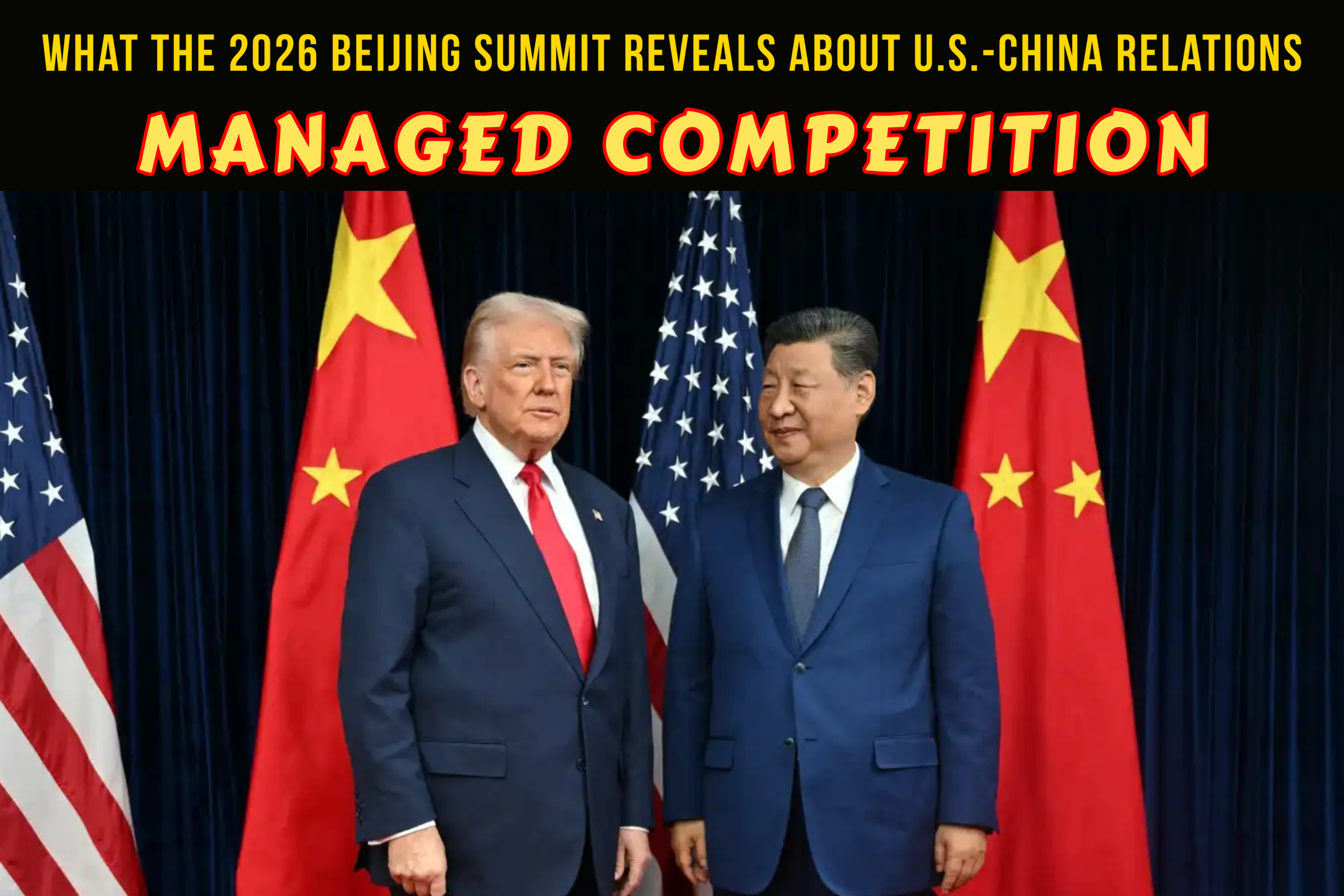
When President Donald Trump first visited China in November 2017, the diplomatic theatre was defined by commercial optimism and headline-grabbing memoranda of understanding. Nearly nine years later, his return to Beijing in May 2026 presents a markedly different tableau. The pageantry of state visits remains, but the substance has shifted from expansion to containment, from breakthrough diplomacy to structural risk management. This summit does not seek to reset the relationship; rather, it confirms that Washington and Beijing have settled into a paradigm of managed competition. By prioritising crisis guardrails over comprehensive settlements, both capitals acknowledge a reality where deep strategic rivalry coexists with unavoidable interdependence. The 2026 Beijing talks serve as a diagnostic moment, revealing how the trans-Pacific relationship has matured into a system of calibrated engagement where predictability trumps resolution, and stability is measured in crises averted rather than treaties signed.
The Beijing Framework: Guardrails Over Grand Bargains
The architectural shift is evident in the summit’s agenda. Where previous decades prioritised sweeping trade pacts and strategic alignments, the 2026 dialogue focuses on institutionalising communication channels and establishing diplomatic firewalls. Tariff truce extensions, proposed artificial intelligence risk-assessment hotlines, and ministerial working groups on supply chain resilience dominate the schedule. This preference for mechanism-building over grand bargaining reflects a sobering calculus in both capitals. Domestic political constraints, the high cost of miscalculation, and mutual vulnerability in critical sectors have rendered comprehensive détente unfeasible. Instead, both administrations have embraced a pragmatic model: acknowledge irreconcilable differences, but build institutional buffers to prevent friction from escalating into conflict. As a Council on Foreign Relations analysis noted ahead of the summit, “This is not about bridging fundamental differences. It is about building firewalls so competition does not become conflict.” The absence of transformative announcements should not be mistaken for diplomatic failure; rather, it signals a deliberate recalibration towards sustainable, if uneasy, coexistence.
The Iran-Pakistan Dimension: A Test of Diplomatic Leverage
Nowhere are the limits of bilateral leverage more apparent than in the summit’s most conspicuous omission: a planned follow-on visit to Islamabad. White House officials had initially envisaged President Trump travelling to Pakistan immediately after Beijing to convene trilateral negotiations aimed at de-escalating the ongoing Iran conflict. Islamabad, maintaining longstanding channels with Tehran while preserving working ties with Washington, was positioned as a neutral convening ground. Yet the itinerary was quietly revised. According to senior U.S. officials, Iranian negotiators declined to accept key American proposals regarding ceasefire verification mechanisms and regional security guarantees. “We presented a framework that balanced accountability with off-ramps for de-escalation,” a State Department briefing document stated. “Tehran’s response did not provide the necessary confidence for a presidential-level engagement at this time.” The postponement underscores a critical reality: U.S. diplomatic leverage remains constrained by the strategic autonomy of regional actors, while China’s role has evolved into that of a cautious facilitator rather than a security guarantor. Pakistan, meanwhile, continues its delicate balancing act, preserving diplomatic channels without committing to binding trilateral architectures.
Table 1: Diplomatic Contingency – The Beijing–Islamabad–Iran Triangle
| Dimension | Original Plan | Actual Outcome | Strategic Implication |
|---|---|---|---|
| U.S. Objective | Trilateral ceasefire framework | Postponed indefinitely | Leverage limited without Iranian buy-in |
| China’s Role | Indirect facilitator via Pakistan | Cautious neutrality | Prefers stability over binding commitments |
| Pakistan’s Position | Neutral convening ground | Maintains open channels | Balances security ties with Beijing & Washington |
| Regional Impact | Potential Middle East de-escalation | Status quo with monitoring | Diplomacy remains transactional, not transformational |
Economic & Technological Interdependence: The Real Anchors
Beneath the geopolitical posturing, economic and technological interdependence remains the relationship’s primary ballast. Both sides are actively negotiating an extension of the tariff truce, with Beijing signalling willingness to facilitate new Boeing aircraft purchases and agricultural imports. Yet this commercial engagement operates alongside strategic decoupling. China’s recent export restrictions on rare earth minerals—critical to American defence and advanced manufacturing—are met with continued U.S. semiconductor controls. This mutual vulnerability has effectively institutionalised a form of deterrence through interdependence. The presence of corporate leaders such as Elon Musk, Tim Cook, and Larry Fink in the official delegation is no mere ceremonial gesture; it reflects the private sector’s urgent demand for regulatory predictability and supply chain continuity. As financial markets and manufacturing ecosystems remain deeply entwined, commercial ties act as structural guardrails, constraining escalation even as strategic rivalry intensifies. In this new paradigm, economics does not resolve geopolitical friction, but it ensures that neither side can afford a complete rupture.
Taiwan & Regional Security: Navigating the Red Lines
The Taiwan question remains the most volatile fault line in U.S.–China relations, yet the 2026 summit demonstrates a shift from strategic ambiguity to calibrated transparency. President Trump confirmed he raised the $11 billion arms package authorised for Taipei directly with President Xi, a move that signals a willingness to test diplomatic boundaries while simultaneously managing escalation risks. Beijing’s response was characteristically firm. Ahead of the summit, People’s Daily reiterated that “Taiwan remains the first red line that cannot be crossed in China–US relations,” underscoring the non-negotiable nature of its territorial claims. Rather than avoiding the topic, both leaders addressed it directly, replacing uncertainty with frank, if contentious, dialogue. This approach does not resolve the underlying dispute, but it significantly reduces the likelihood of miscalculation. By institutionalising direct communication channels between military and diplomatic establishments, both capitals have prioritised crisis management over resolution—a pragmatic acknowledgment that stability, not settlement, is the achievable objective.
What the Summit Reveals: Five Strategic Takeaways
Synthesising the agenda, the omissions, and the diplomatic choreography, five strategic realities emerge from the 2026 Beijing summit:
- Crisis management supersedes comprehensive settlement: Both capitals accept unresolved structural disputes but prioritise institutionalised communication to prevent escalation.
- Economic interdependence remains the primary stabiliser: Trade and supply chain linkages constrain strategic friction despite ongoing technological decoupling.
- Third-party dynamics complicate bilateral calculus: Regional actors such as Iran and Pakistan demonstrate that U.S.–China leverage is increasingly mediated by multipolar diplomacy.
- Leader-to-leader channels are now routine, not exceptional: Direct dialogue has become the baseline for high-stakes engagement, reducing reliance on backchannel speculation.
- “Managed competition” is the definitive 2020s paradigm: Stability is achieved through calibrated friction, structured deterrence, and the explicit rejection of both cold war isolation and unconditional engagement.
Table 2: The Managed Competition Framework – Principles vs. Practice
| Principle | Diplomatic Practice | Real-World Test |
|---|---|---|
| Predictability over breakthroughs | Tariff truce extensions, AI hotlines | Implementation gap remains |
| Mutual vulnerability as deterrence | Rare earths vs semiconductors | Supply chain stockpiling accelerates |
| Direct communication channels | Leader-to-leader talks, defence hotlines | Tested during regional incidents |
| Third-party mediation | Pakistan convening role, Chinese assurances | Limited without Iranian consent |
Conclusion: The New Normal in Trans-Pacific Diplomacy
The May 2026 Beijing summit confirms that U.S.–China relations have transitioned from an era of hopeful engagement to one of disciplined coexistence. Deep disputes over technology dominance, regional security, and global governance remain unresolved, and the implementation of diplomatic commitments will inevitably face testing. Yet the summit’s true significance lies in its institutionalisation of constraint. Ministerial follow-ups, monitoring of AI governance protocols, and sustained dialogue on Taiwan and Iran will define the medium-term trajectory. In an era defined by interdependence and distrust, diplomatic success is no longer measured by grand treaties or strategic realignments, but by the quiet prevention of crisis. The Beijing summit did not reset the relationship; it codified its boundaries. And in a multipolar world where miscalculation carries existential costs, that may be the most realistic form of diplomacy available.