(By Khalid Masood)
I. Lead / Executive Summary
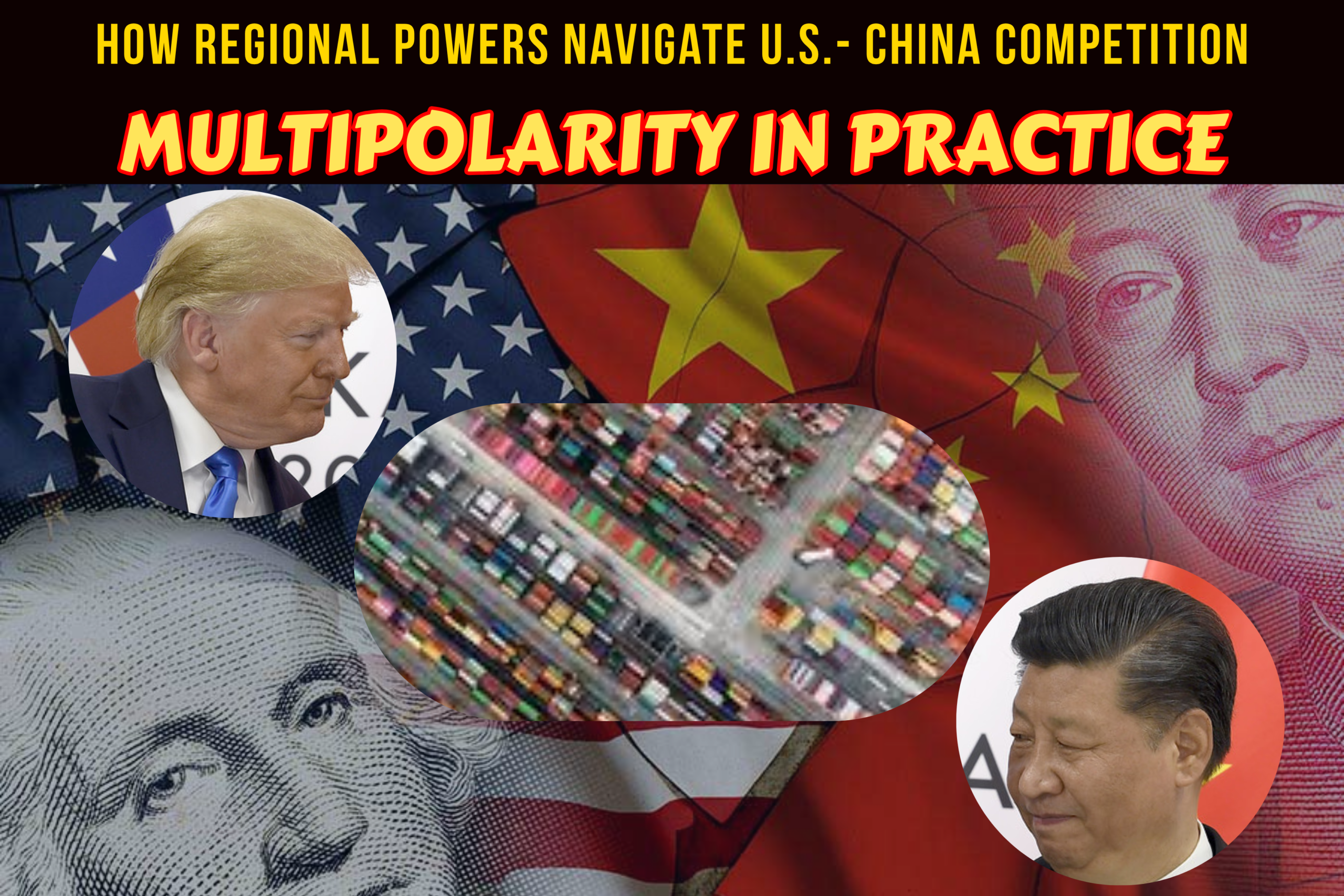
The international order is no longer defined by a rigid bipolar divide, but by a complex mosaic of regional powers exercising calibrated strategic autonomy. As President Donald Trump prepares for a two-day summit with President Xi Jinping in Beijing on 14–15 May 2026, the global landscape has already shifted beneath the surface of great-power diplomacy. Rather than choosing sides, states across the Global South, mid-tier economies, and regional blocs are deploying strategic hedging, issue-based alignment, and institutional diversification to maximise sovereignty, economic resilience, and diplomatic leverage.
This article examines how regional powers are actively shaping a fluid, multi-aligned international system, using the upcoming Beijing summit as a critical stress test for practical multipolarity. Through geo-economic realignment, technological standard-setting, and transactional diplomacy, middle powers are proving that the future of global governance will not be dictated solely by Washington and Beijing, but negotiated by those who refuse to be forced into binary choices.
II. Introduction: From Bipolar Framing to Multipolar Reality
The persistent narrative of a “New Cold War” obscures a more complex geopolitical reality. While U.S.-China strategic competition remains the dominant structural feature of 21st-century international relations, it no longer operates through the clean ideological or institutional divisions of the 20th century. Deep trade interdependencies, intertwined financial networks, and globally dispersed supply chains resist neat bloc formation. Instead, what has emerged is a system of practical multipolarity—a condition in which states navigate great-power rivalry not through permanent alignment, but through calculated flexibility.
In 2026, U.S.-China competition manifests primarily as economic statecraft: export controls, tariff regimes, investment screening, technological decoupling in critical sectors, and competing infrastructure financing models. Military posturing remains significant, particularly in the Indo-Pacific, but it is increasingly channelled through deterrence architectures, arms modernisation, and proxy security partnerships rather than direct confrontation. Within this environment, regional powers have recognised that strategic autonomy is not a luxury, but a necessity. They are leveraging competing great-power interests to secure better trade terms, diversify defence procurement, access alternative financing, and preserve policy space for domestic development agendas. The question is no longer which side a country will take, but how effectively it can manage multiple alignments simultaneously without triggering coercion or economic retaliation. The May 2026 Beijing summit will not resolve this dynamic; rather, it will expose how regional actors interpret, adapt to, and ultimately shape the evolving rules of the game.
III. The Regional Power Playbook: Core Navigation Strategies
Across continents, states have converged on a set of diplomatic and economic strategies designed to navigate U.S.-China competition while safeguarding national interests. These approaches are not ideological; they are pragmatic, data-driven, and increasingly institutionalised.
Strategic hedging remains the most widely adopted framework. Countries maintain security and defence partnerships with one pole while cultivating deep trade, investment, and technological ties with the other. This dual-track approach minimises vulnerability to coercion from either side while preserving long-term policy optionality. India’s simultaneous participation in the Quad and BRICS+ exemplifies this balance, as do Gulf states that rely on U.S. security guarantees while expanding Chinese technology partnerships and energy investments.
Issue-based alignment has replaced blanket alliance structures. States now cooperate selectively on specific dossiers—climate adaptation, maritime security, AI governance, public health, or critical infrastructure—without committing to broader strategic frameworks. This allows governments to extract maximum value from partnerships while avoiding entanglement in great-power disputes unrelated to their core interests.
Institutional diversification serves as a diplomatic safety valve. Active participation in overlapping multilateral forums—ASEAN, the African Union, CELAC, the GCC, BRICS+, and the Shanghai Cooperation Organisation—creates parallel channels for negotiation, financing, and norm-setting. When one institution faces gridlock or great-power dominance, states can pivot to alternatives that better reflect their priorities.
Finally, the domestic-first calculus underpins all foreign policy decisions. Regional powers increasingly measure international engagements against internal benchmarks: economic growth, job creation, regime stability, technological capacity building, and public sentiment. Foreign policy is no longer an end in itself, but an instrument for domestic consolidation and development.
Data from the World Economic Forum’s 2026 Global Risks Report confirms that geoeconomic confrontation ranks as the top systemic threat, while IMF tracking indicates that over 60 per cent of emerging markets now maintain structured dual partnerships with both the U.S. and China. This is not accidental fragmentation; it is deliberate statecraft.
IV. Regional Case Studies: How the Playbook Unfolds
The practical application of these strategies varies significantly by region, shaped by historical ties, geographic proximity, resource endowments, and domestic political structures. Examining key regions reveals how multipolarity operates on the ground.
In the Indo-Pacific, ASEAN’s centrality doctrine remains the cornerstone of regional statecraft. Despite intensifying South China Sea disputes and competing U.S. and Chinese military deployments, ASEAN members have consistently rejected binary alignment, emphasising inclusive security architectures and the finalisation of a binding Code of Conduct. India’s approach is equally calibrated: it deepens defence interoperability with Quad partners while expanding economic engagement through BRICS+ and maintaining substantial trade volumes with China. Meanwhile, Japan and Australia navigate a more complex balancing act, strengthening security integration with Washington while managing deep economic interdependence with Beijing, particularly in critical minerals, manufacturing, and energy supply chains.
The Middle East and Gulf states have transformed energy diplomacy into comprehensive strategic diversification. Saudi Arabia and the UAE maintain foundational security partnerships with the United States while actively investing in Chinese technology, infrastructure, and sovereign wealth co-investment vehicles. OPEC+ coordination demonstrates how regional producers leverage energy markets to preserve autonomy, while defence procurement has expanded beyond traditional Western suppliers to include European and Chinese systems. This multi-vendor approach reduces dependency and strengthens bargaining power in both security and economic negotiations.
Africa’s navigation strategy centres on resource diplomacy and financing alternatives. Critical minerals essential for digital infrastructure, battery production, and defence systems have become diplomatic bargaining chips. The African Union and individual states are actively comparing financing models: China’s Belt and Road Initiative, the EU’s Global Gateway, and the U.S. Partnership for Global Infrastructure and Investment. Rather than accepting extractive frameworks, many African governments now demand value-addition requirements, technology transfer clauses, and local content mandates. The African Continental Free Trade Area (AfCFTA) further strengthens intra-regional leverage, enabling collective negotiation rather than fragmented bilateral concessions.
Latin America’s positioning is heavily influenced by trade dependency and electoral cycles. China remains the largest trading partner for much of South America, particularly in agricultural and mineral exports, while the United States promotes nearshoring and friend-shoring initiatives to integrate regional supply chains into North American production networks. Lithium nationalisation debates in the Andes, copper policy shifts, and critical mineral frameworks illustrate how domestic resource management intersects with global supply chain restructuring. Upcoming electoral cycles in Bolivia, Brazil, Colombia, and Chile will test policy continuity, but the underlying trend remains consistent: maximising economic returns from both poles while resisting external political conditionality.
Europe’s approach is defined by the tension between transatlantic security reliance and economic strategic autonomy. The EU’s “de-risking” framework has institutionalised export controls, investment screening, and supply chain resilience measures, particularly in semiconductors, clean tech, and critical raw materials. Simultaneously, European defence industrial rebuilding initiatives aim to reduce long-term dependency on external security guarantees. The challenge for EU member states lies in coordinating a unified economic posture while accommodating divergent national trade priorities, particularly as U.S. tariff policies and Chinese industrial subsidies continue to reshape competitive landscapes.
V. The May 2026 Beijing Summit: A Multipolarity Stress Test
The upcoming two-day summit between President Trump and President Xi Jinping in Beijing (14–15 May 2026) arrives at a critical juncture. Described by U.S. officials as “potentially historic”, the meeting occurs against a backdrop of sustained trade friction, critical mineral supply chain vulnerabilities, technological standard competition, and regional security tensions. Rather than signalling a return to cooperative bipolarity, the summit will function as a stress test for practical multipolarity, revealing how regional powers interpret, adapt to, and exploit great-power negotiations.
The confirmed agenda centres on trade stability and tariff frameworks, critical mineral supply chains, technology standards in AI and next-generation telecommunications, regional security flashpoints including the South China Sea and Taiwan Strait, and narrow climate and energy cooperation. U.S. policy guidance emphasises “fair trade, supply chain resilience, technological protection, and deterrence commitments”, while Chinese diplomatic framing stresses “mutual respect, opposition to decoupling, and technological sovereignty”. Both sides recognise that outright confrontation carries unacceptable economic and strategic costs, yet structural competition remains deeply entrenched.
Regional positioning ahead of the summit reveals a coordinated emphasis on strategic autonomy. ASEAN foreign ministers have reiterated that “multilateralism must be inclusive, not exclusive”, signalling that small and middle states will resist forced alignment while monitoring potential tariff spillovers and maritime escalation. Gulf producers are closely tracking oil price volatility, which has remained above $100 per barrel amid broader Middle East tensions, while sovereign wealth funds continue diversifying into dual-track energy and technology investments. India is advancing domestic semiconductor and defence industrial capacity to reduce import dependency, regardless of summit outcomes. The African Union is advocating for mineral partnership frameworks that prioritise value addition and debt sustainability, while the EU is coordinating a “de-risking” posture designed to preserve strategic autonomy irrespective of Washington-Beijing agreements.
Four plausible summit scenarios carry distinct implications for regional powers. A limited deal involving a tariff pause, critical mineral memorandum of understanding, and climate working group would reinforce transactional multipolarity, allowing states to continue hedging without structural disruption. A broader framework agreement establishing tech standards dialogue and maritime crisis communication mechanisms would create new institutional space for middle powers to shape emerging norms. A breakdown or escalation, marked by new sanctions or expanded export controls, would force sharper alignment choices and accelerate regional bloc formation. Finally, symbolic diplomacy featuring vague communiqués and photo-ops would maintain the status quo, empowering regional actors to fill governance gaps and advance independent initiatives.
Verified trade data underscores the interdependence that complicates binary narratives. U.S.-China bilateral trade held steady at approximately $580 billion in 2025 despite sustained tariff regimes, while ASEAN now accounts for over 22 per cent of China’s trade growth, reflecting supply chain reconfiguration rather than decoupling. Policy language from both capitals remains carefully calibrated: U.S. frameworks emphasise “competition, not conflict”, while Chinese statements reiterate that “cooperation is the only correct choice”. The analytical takeaway is clear: the summit’s true test lies not in the final communiqué, but in post-summit implementation tracking. Tariff rollbacks, MOU execution, joint working group formations, and regional statements in the 72 hours following the meeting will reveal whether multipolarity stabilises as an adaptive system or fragments into competing spheres of influence.
VI. Geo-Economic & Technological Dimensions
The architecture of practical multipolarity is increasingly defined by geo-economic and technological competition. Supply chain fragmentation has moved beyond rhetoric into operational reality. The “China+1” model, nearshoring incentives, and regional production hubs are reshaping global manufacturing networks, with Southeast Asia, Mexico, India, and Eastern Europe emerging as critical nodes. Countries are no longer optimising solely for cost efficiency; they are prioritising resilience, regulatory compatibility, and strategic access.
Technology standards have become the new battleground for influence. 5G/6G deployment architectures, AI governance frameworks, semiconductor ecosystem development, and digital infrastructure financing determine long-term strategic alignment. States are actively navigating dual ecosystems, adopting interoperable standards where possible while maintaining sovereign control over critical data and defence-related technologies. The race to establish normative frameworks for artificial intelligence, quantum computing, and space-based communications will shape the next decade of geopolitical competition.
Financial architecture shifts are equally significant. Local currency trade agreements, central bank digital currency pilots, alternative payment rails, and sovereign wealth reallocation are gradually reducing dollar-centric transaction dependencies. While the U.S. dollar remains the dominant reserve currency, the proliferation of bilateral settlement mechanisms and regional clearing houses creates structural alternatives that enhance policy flexibility for emerging markets.
Investment diplomacy has evolved into a sophisticated bargaining tool. Competing capital flows from China’s Belt and Road Initiative, the U.S. Partnership for Global Infrastructure and Investment, the EU Global Gateway, Gulf sovereign wealth funds, and Japanese/Indian development finance institutions provide host states with unprecedented negotiating leverage. The result is a global investment landscape where recipient countries set terms, demand transparency, and prioritise domestic capacity building over external strategic alignment.
VII. Risks, Constraints & Strategic Flashpoints
Despite the advantages of multi-alignment, regional powers face significant constraints and risks. Diplomatic overextension remains a persistent challenge; managing competing demands from multiple great powers without triggering coercion or retaliation requires sophisticated bureaucratic capacity and long-term strategic planning. Economic statecraft spillovers, including export controls, sanctions regimes, tariff leverage, and investment screening, can rapidly disrupt domestic economies and force difficult policy recalibrations.
Security dilemmas persist in contested zones where hedging meets hard power realities. The South China Sea, Taiwan Strait, Red Sea, and Sahel remain flashpoints where diplomatic flexibility can be tested by military incidents, proxy conflicts, or supply chain disruptions. Domestic volatility further complicates foreign policy consistency; leadership transitions, electoral shifts, and public opinion swings can disrupt long-term strategic trajectories, particularly in democracies with frequent policy cycles or in states facing internal instability.
Institutional fragmentation poses another systemic risk. The proliferation of overlapping multilateral forums, competing development banks, and parallel regulatory standards can dilute normative coherence and create coordination failures. While institutional diversity enhances optionality, it also complicates crisis response, norm diffusion, and collective action on transnational challenges such as climate adaptation, pandemic preparedness, and cyber governance.
VIII. Conclusion: The Path Forward in a Fluid Order
Multipolarity is not a static configuration but an adaptive practice shaped by regional agency, economic interdependence, and strategic calculation. The May 2026 Beijing summit will not resolve U.S.-China structural competition, but it will clarify how regional powers interpret, navigate, and ultimately shape the evolving rules of engagement. Future stability depends less on great-power reconciliation and more on whether middle and regional powers can institutionalise multi-alignment without triggering systemic fragmentation.
Policymakers, defence planners, and investors should monitor 2026–2027 inflection points: BRICS+ expansion outcomes, ASEAN maritime code negotiations, African critical mineral frameworks, EU defence industrial integration, and post-summit implementation tracking. In a fluid international order, strategic autonomy is no longer an aspiration—it is the baseline requirement for sustainable statecraft. The states that thrive in this environment will be those that treat multipolarity not as a constraint, but as a canvas for deliberate, evidence-driven diplomacy.