(By Khalid Masood)
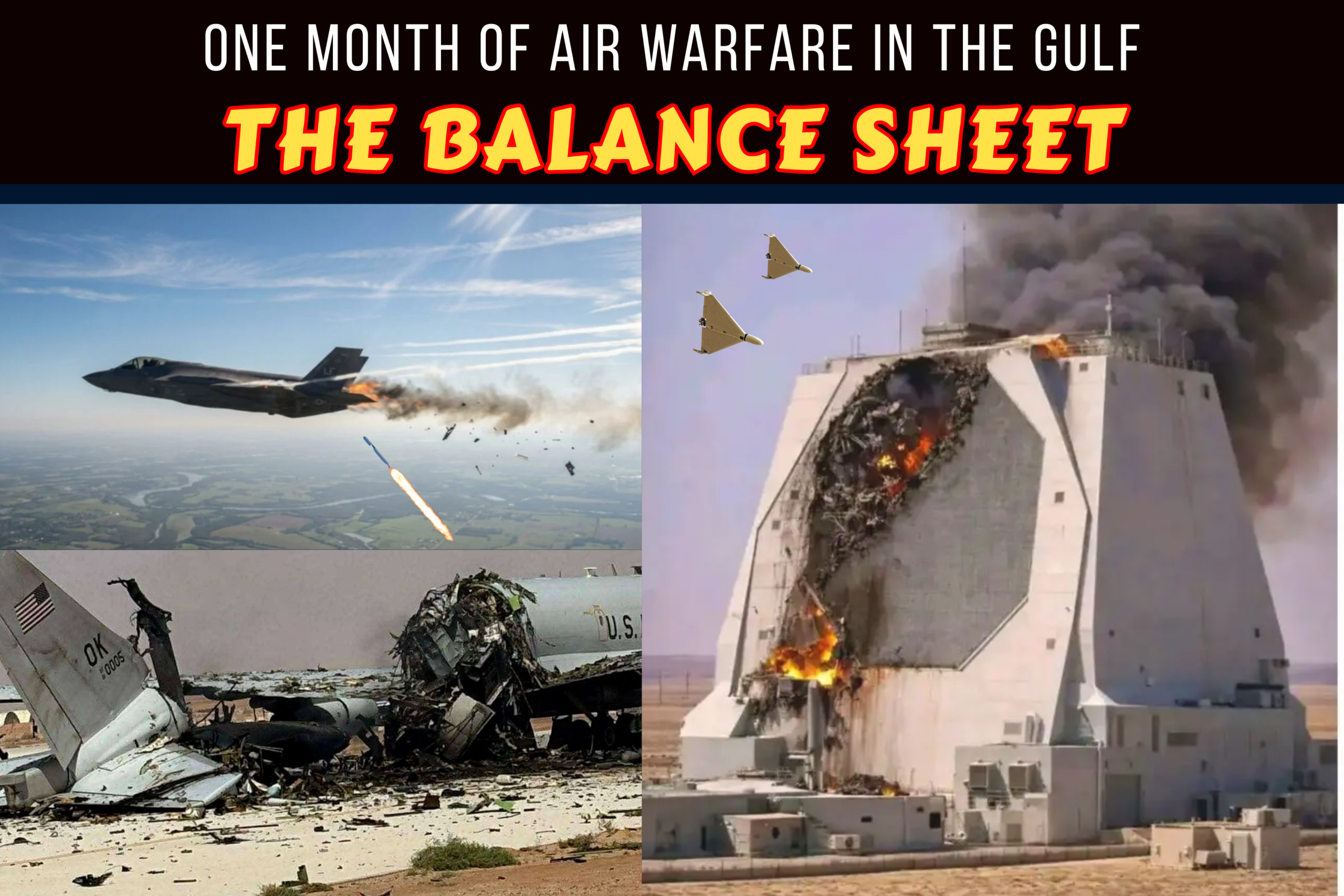
With 20 aircraft lost, an AWACS destroyed, and 10 radar sites hit, the conflict exposes fundamental vulnerabilities in U.S. sensor architecture—and the brutal reality of modern air combat attrition.
I. Introduction: Taking Stock
On April 1, 2026, President Donald Trump delivered a nationwide televised address, declaring that the conflict with Iran would continue until all strategic objectives were achieved. With that resolve firmly stated, it is time to take an unflinching look at the situation so far. One month into the Gulf war that began on February 28, 2026, we must move beyond initial impressions and conduct a systematic accounting. What does the balance sheet of air warfare look like after 30 days of high-intensity combat?
The visible evidence is stark: satellite imagery shows cratered runways in Iran, damaged infrastructure across Saudi Arabia and the UAE, and strike effects reaching Jordan and Israel. But the more strategically significant entries in this ledger are less photogenic. They involve the systematic degradation of the sensor and command architecture that enables modern air and missile defence.
This article presents a verified accounting of U.S. losses—not to sensationalize attrition, but to understand its strategic implications. The data reveals a pattern that should concern defence planners worldwide: when an adversary targets the eyes and nervous system of a military network rather than its fists, the entire defensive architecture can be compromised at disproportionate cost.
The bottom line: Aircraft losses, while significant, are replaceable. Sensor and command losses are not. With at least ten ground radar sites damaged, one historic AWACS loss, and severe attrition to aerial refueling capacity, the United States and its allies are confronting a new paradigm in high-intensity conflict.
II. The Verified Ledger: Documented U.S. Losses
By late March, a coherent picture of U.S. aviation and sensor losses had emerged from official statements, defence journalism, and commercial satellite analysis. The following represents the most credible accounting available from open sources.
Aircraft & Platform Losses: Itemized
| Platform | Quantity Lost | Primary Cause | Estimated Unit Cost | Replacement Timeline |
|---|---|---|---|---|
| MQ-9 Reaper | ~12 | Iranian air defence (10), accidents (2) | $16M (original) / $30M (MQ-9B replacement) | 12-18 months |
| F-15E Strike Eagle | 3 | Friendly fire (Kuwaiti F/A-18) | ~$100M | 18-24 months |
| F-35A Lightning II | 1 (damaged) | Proximity-fuze detonation | ~$80M | 24+ months |
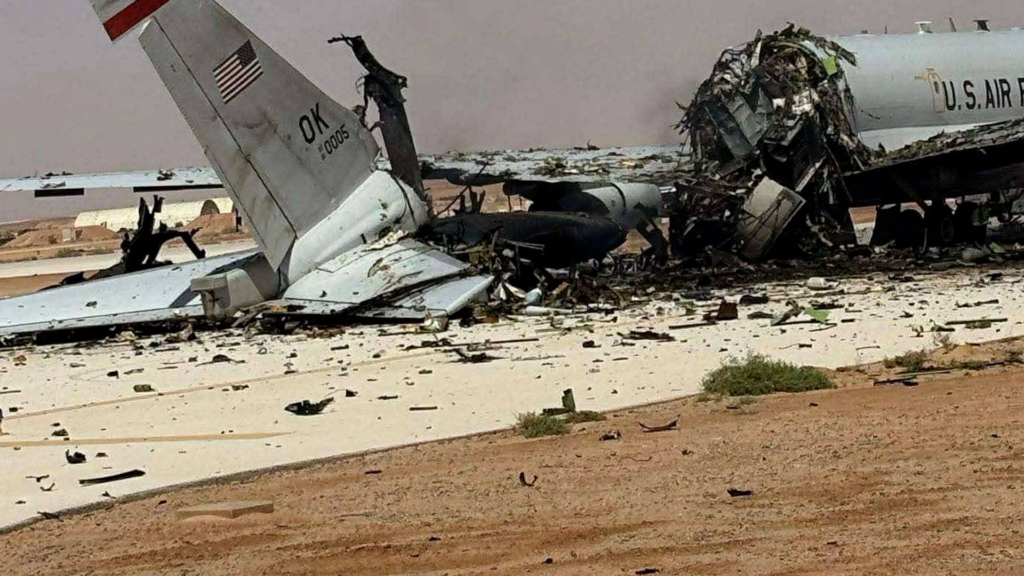
| E-3G Sentry AWACS | 1 (destroyed) | Precision ground strike | ~$700M | 18-36 months |
| KC-135 Stratotanker | ~7 (1 destroyed mid-air, ~6 damaged/destroyed on ground) | Mid-air collision; missile/drone strike | $165M (KC-46 replacement) | 24-48 months |
Key Notes:
- The E-3 Sentry loss marks the first combat destruction of an AWACS platform in U.S. history.
- KC-135 production ended in the 1960s; all replacements must come from the KC-46 Pegasus program.
- MQ-9 Reapers are no longer in production; replacements are the upgraded MQ-9B variant at nearly double the cost.
Ground Radar Losses: The Strategic Debit
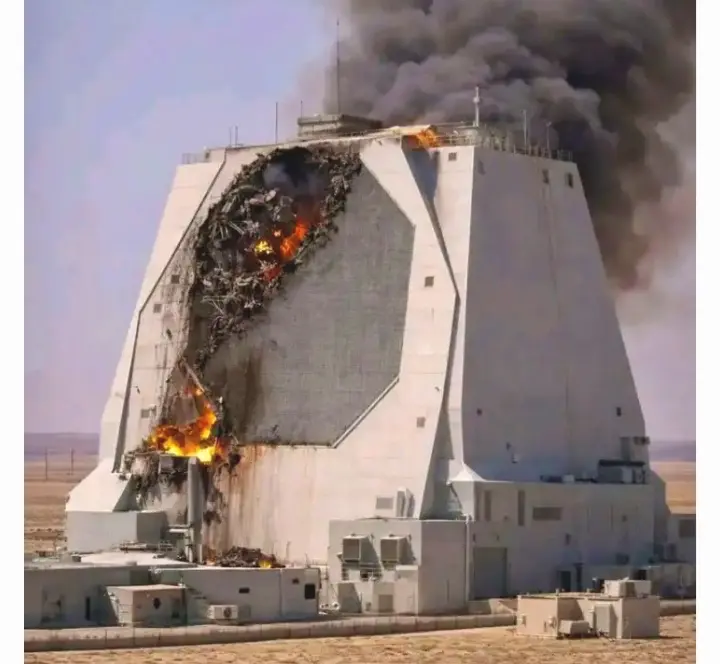
Analysis by ABC News, drawing on commercial satellite imagery and defence industry assessments, has verified strikes on at least ten radar sites across seven bases in five countries:
| Location | Base | Radar Type | Strategic Function | Estimated Replacement Cost |
|---|---|---|---|---|
| Qatar | Al Udeid AB | AN/FPS-132 | Regional early warning; THAAD cueing | $1.1B+ (original); $1.5B+ (replacement) |
| Saudi Arabia | Prince Sultan AB | AN/TPY-2 | THAAD fire control | ~$500M |
| UAE | Al Dhafra AB | AN/TPY-2 | THAAD fire control | ~$500M |
| UAE | Al Sader AB | AN/TPY-2 | THAAD fire control | ~$500M |
| Kuwait | Camp Arifjan | Radar site | Local air defence cueing | Classified |
| Kuwait | Kuwait Int’l Airport | Radar site | Civil-military coordination | Classified |
| Jordan | Muwaffaq al Salti AB | Radar site | Regional surveillance | Classified |
| Bahrain | Fifth Fleet HQ | Naval radar | Maritime early warning | Classified |
| Iraq | U.S. Embassy, Baghdad | Embassy radar | Force protection | Classified |
| Qatar | Al Udeid AB (second site) | Unspecified | Redundant coverage | Classified |
Operational Impact: The Bottom Line
The cumulative effect of these losses is already measurable:
- Interception rates: UAE reported a drop from ~95% to ~75% in successful intercepts of Iranian projectiles following the March 10 radar strikes.
- Coverage gaps: Damage to AN/TPY-2 and AN/FPS-132 systems degrades the tracking architecture for THAAD batteries, creating blind corridors in regional missile defence.
- Command degradation: The loss of the E-3 AWACS removes a mobile, high-altitude command node that previously provided flexible coverage and battle management across the theater.
- Refueling strain: With up to seven KC-135 tankers removed from service, aerial refueling capacity is constrained, potentially limiting sortie rates and mission endurance.
Total estimated attrition cost: $1.4–2.9 billion, per former Pentagon budget official Elen McCusker. The wide range reflects uncertainty about equipment age, depreciation, and replacement versus repair decisions.
III. The Sensor Vulnerability Equation: Why These Losses Matter
Modern air and missile defence rests on a fundamental equation: capability = sensors + shooters + command. Remove or degrade any variable, and the entire system’s effectiveness declines. Iranian strike planners have exploited this equation with precision.
The Fixed Sensor Paradox
Ground-based radars face an inescapable vulnerability: to function, they must emit electromagnetic radiation. The moment a radar activates, it broadcasts its location to adversaries equipped with modern electronic warfare suites, passive detection networks, or anti-radiation missiles. Unlike mobile launchers or fighter jets, large early-warning radars cannot operate from inside hardened bunkers. Their antennas must remain exposed to scan 360-degree horizons. They are, by design, stationary, high-value, and difficult to camouflage.
The AWACS Concentration Risk
Airborne platforms like the E-3 Sentry face a different but equally severe vulnerability: concentration of capability. While mobile and harder to target than fixed radars, AWACS aircraft are high-value, low-density assets. The U.S. operates only 31 E-3s globally. Losing one creates an immediate coverage gap that cannot be quickly backfilled. Moreover, AWACS must operate within predictable coverage corridors, often within range of long-range surface-to-air missiles.
The THAAD Dependency Multiplier
The Terminal High Altitude Area Defence (THAAD) system is America’s premier terminal-phase ballistic missile defence architecture. But THAAD is only as capable as its radar. The AN/TPY-2 provides the fire-control solution: without it, interceptors lack the targeting data needed to calculate engagement windows and kill zones. The United States possesses only eight THAAD batteries globally. With multiple AN/TPY-2 sites damaged, the defensive architecture is operating with degraded coverage, forcing commanders to prioritize certain corridors while leaving others exposed.
Expert Assessment
NATO defence analysts and former Pentagon officials characterize this as a structural mismatch. Fixed, high-emission radars and concentrated airborne command nodes were designed for an era when adversarial strike capabilities were limited to aircraft or unguided artillery. Today, they face precision-guided drones, loitering munitions, and ballistic missiles equipped with terminal guidance. As one former senior Pentagon budget official noted, the attrition sustained reflects the cost of fighting yesterday’s war with tomorrow’s threats.
IV. Historical Context: Attrition in the Ledger
The shock surrounding U.S. losses often stems from a public perception that technological dominance should guarantee near-zero casualties. History, however, tells a different story. Attrition is an inherent feature of high-intensity air campaigns, regardless of the technological gap.
Vietnam War (1965–1973): The Baseline
- Sorties flown: ~5.25 million
- Aircraft lost: 2,251 total (2,197 fixed-wing; 54 helicopters)
- Loss attribution: 1,737 to hostile action; 514 to accidents
- Loss rate: ~0.4 aircraft per 1,000 sorties (1 per 2,500 missions)
- Key insight: North Vietnam possessed a minimal air force. Most U.S. losses were inflicted by ground-based air defences, particularly Soviet-supplied SA-2 Guideline missiles.
Operation Desert Storm (1991): The High-Tech Benchmark
- Air campaign duration: 37 days
- Sorties flown: ~100,000
- Munitions dropped: 88,500 tons
- Aircraft lost: 52 fixed-wing; 23 helicopters
- Personnel: 46 KIA/MIA; 8 captured
- Key insight: Despite overwhelming air superiority, electronic warfare dominance, and stealth technology, coalition forces still suffered measurable attrition from ground-based defences.
The 2026 Gulf Conflict: The New Variable
These historical benchmarks demonstrate a consistent reality: air superiority reduces risk but does not eliminate it. The critical difference in the 2026 Gulf conflict is the delivery mechanism and targeting philosophy. Iran is employing drone swarms, precision-guided cruise missiles, and ballistic munitions coordinated through modern targeting networks. The volume, accuracy, and cost-efficiency of these systems have shifted the attrition calculus dramatically.
V. Strategic Implications: What the Balance Sheet Tells Us
The sensor and platform losses in the Gulf are not merely tactical debits. They represent a strategic inflection point that will reshape defence procurement, force posture, and allied security architectures for decades.
The Cost Asymmetry Equation
| U.S. Asset | Approximate Cost | Iranian Counter | Approximate Cost | Ratio |
|---|---|---|---|---|
| AN/FPS-132 radar | $1.1B+ | Precision cruise missile | $1-3M | ~500:1 |
| E-3 Sentry AWACS | ~$700M | Loitering munition swarm | $20K-50K each | ~14,000:1 |
| MQ-9 Reaper | $16M (original) | Short-range ballistic missile | $200K-500K | ~30:1 |
| KC-46 Pegasus | $165M | Anti-radiation drone | $100K-300K | ~500:1 |
This asymmetry favors the attacker. An adversary need not match U.S. capability volume; it need only impose unsustainable replacement costs over time.
The Industrial Base Constraint
The U.S. defence industrial base cannot surge production of complex sensor systems:
- Phased-array radars require specialized semiconductors, rare-earth minerals, and years of calibration.
- AWACS airframes require specialized avionics and lengthy certification processes.
- Critical materials: China dominates global rare-earth processing, creating supply chain vulnerabilities.
When replacement timelines stretch into months or years, peacetime procurement decisions become wartime strategic constraints.
Emerging Doctrinal Shifts
Defence planners are already drawing lessons. The most immediate shift will likely be toward distributed, mobile, and resilient sensor architectures:
- Mobile, rapidly relocatable ground systems: Shorter deployment times, harder to target, easier to camouflage.
- Passive and low-probability-of-intercept (LPI) radars: Minimizing electromagnetic signatures to avoid detection.
- Distributed airborne sensing: Leveraging multiple smaller ISR platforms, commercial satellite constellations, and loyal wingman drones to replace single-point AWACS reliance.
- Networked sensor fusion: Distributing tracking and command functions across multiple cheaper, survivable nodes rather than concentrating them in single high-value assets.
Implications for U.S. Allies
The sensor vulnerability is not confined to American forces. Allied militaries are closely watching the Gulf conflict and adjusting their own procurement and posture:
India: Recently cleared acquisition of five additional S-400 batteries and ordered 31 MQ-9B drones. The Gulf conflict reinforces the need for hardened, dispersed basing, indigenous sensor development, and layered airborne early warning networks. New Delhi is likely to accelerate investments in mobile, long-range air defence systems and prioritize survivability over centralized capability in future procurement cycles.
Pakistan: Islamabad’s defence architecture—built on a hybrid mix of U.S.-origin F-16s, Chinese JF-17s, and indigenous systems—faces its own reckoning. Pakistan has historically invested in fixed, high-value radar sites along its eastern and western borders, often with Chinese technical assistance (e.g., YLC-8B, YLC-18 early-warning radars). The Gulf conflict’s lessons on sensor vulnerability may prompt Pakistan to:
- Reassess the survivability of fixed radar infrastructure in high-intensity scenarios
- Accelerate development of mobile, low-probability-of-intercept (LPI) sensor systems, potentially in partnership with China
- Prioritize electronic warfare and cyber-defence capabilities to protect command-and-control nodes
- Explore distributed airborne early warning options, including potential procurement of Chinese KJ-500 AEW&C platforms or indigenous alternatives
Economically constrained yet strategically exposed, Pakistan faces a difficult calculus: invest in expensive, survivable sensor architectures, or accept higher risk in exchange for quantity and affordability. The Gulf conflict suggests that hedging—diversifying suppliers, emphasizing mobility, and building redundancy—may be the most prudent path forward.
GCC States: Heavy investments in U.S.-made fixed radar and missile defence systems have been exposed to precision strike. Gulf capitals may accelerate investments in mobile air defence, cyber-electronic warfare capabilities, and regional sensor-sharing networks.
NATO and European Partners: European air defence architectures remain heavily integrated with U.S. radar and AWACS data streams. The degradation of Middle Eastern nodes raises questions about redundancy, sovereign tracking capabilities, and the resilience of transatlantic defence supply chains.
VI. The Fog of War: Unresolved Entries
Despite the clarity emerging from satellite imagery and official briefings, significant information gaps remain. Acknowledging them is essential for accurate strategic assessment.
Satellite Blackout and Damage Concealment
Commercial satellite imagery providers initially released near-real-time photos of strike damage. By mid-March, however, several companies implemented a 14-day delay on new Gulf conflict imagery. This gap allows for debris removal, temporary repairs, camouflage netting, and the relocation of surviving equipment. As a result, the true extent of radar degradation, AWACS loss, and tanker attrition may be underreported or temporarily obscured.
Iranian Losses: The Other Side of the Ledger
Open-source reporting on Iranian losses remains fragmented due to restricted media access and state-controlled information environments. U.S. and Israeli strikes have likely degraded Iranian air defence networks, command centers, and critical infrastructure. A complete balance sheet requires accounting for both sides’ attrition which is not available at this point of time.
Operational Tempo and Adaptation
It remains unclear how U.S. sortie rates, strike targeting, and coalition burden-sharing have shifted in response to sensor degradation. Are commanders accepting reduced coverage in certain sectors? Has the operational tempo slowed to preserve remaining assets? These questions will shape the conflict’s trajectory in its second month.
Transparency and Democratic Accountability
While some adversaries conceal losses, democracies struggle to maintain secrecy indefinitely. Tactical opacity may serve short-term operational security, but strategic accountability requires transparency. Public understanding of attrition, replacement costs, and doctrinal adaptation is essential for sustaining political support and informing defence policy.
VII. Conclusion: The Strategic Bottom Line
One month into the Gulf conflict, the strategic ledger is crystallizing. Aircraft losses, while significant, are replaceable. Sensor and command losses are not. The systematic targeting of U.S. early-warning radars, airborne AWACS platforms, and aerial refueling tankers has exposed a fundamental vulnerability in modern air defence architecture: fixed, high-value, high-emission systems are inherently fragile in an era of precision saturation strike.
Four conclusions emerge from this balance sheet:
- Attrition is structural, not exceptional. Modern conflicts will degrade even the most advanced militaries. Planning must account for loss, not assume its absence.
- Cost asymmetry favors precision over volume. Cheap, accurate munitions can neutralize billion-dollar infrastructure. Defence architectures must prioritize survivability and redundancy over centralized capability.
- Industrial capacity dictates strategic resilience. When replacement timelines stretch into months or years, and critical materials are geopolitically constrained, peacetime procurement becomes a wartime vulnerability.
- Doctrinal adaptation is non-negotiable. The shift from monolithic to distributed, from fixed to mobile, from expensive to expendable, is no longer theoretical. It is operational necessity.
As the conflict enters its second month, the United States and its allies face a strategic crossroads. They can continue optimizing for the last war, or they can redesign for the next one. The question is no longer whether losses will occur, but whether military architectures can absorb them, adapt to them, and continue to achieve operational objectives.
In accounting terms: the Gulf conflict has revealed that the most valuable assets on the balance sheet are also the most vulnerable. The lesson must not be written off.