(By Khalid Masood)
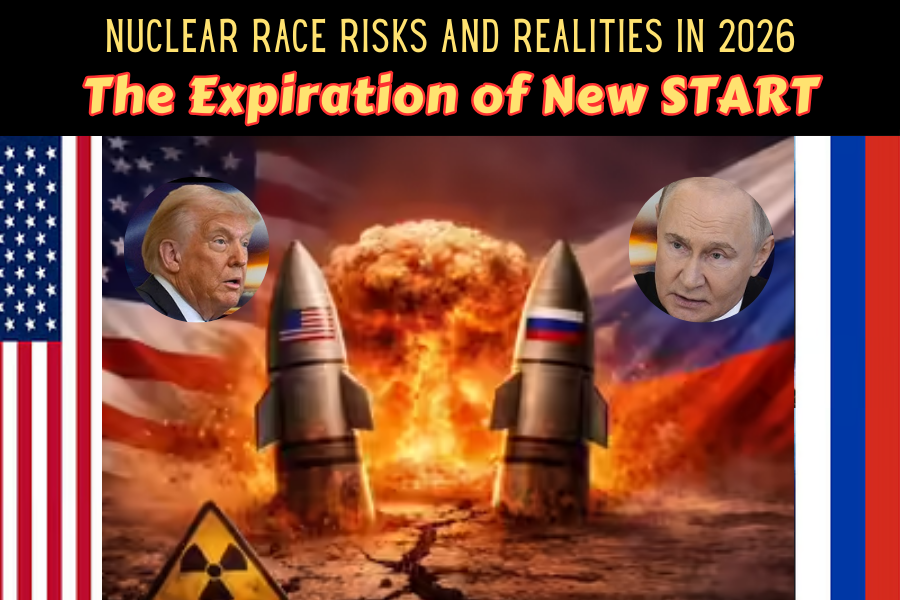
On February 5, 2026, at midnight GMT, the Treaty on Measures for the Further Reduction and Limitation of Strategic Offensive Arms—commonly known as New START—officially expired. This event marks a profound shift in global nuclear security. For the first time in more than half a century, the world’s two largest nuclear powers, the United States and the Russian Federation, are no longer bound by any verifiable, legally enforceable limits on their strategic nuclear arsenals. United Nations Secretary-General António Guterres described the moment as a “grave moment for international peace and security,” emphasizing that “the risk of a nuclear weapon being used is the highest in decades.” This expiration does not merely end a bilateral agreement; it signals the potential onset of a multipolar nuclear competition involving the U.S., Russia, and a rapidly expanding China, with far-reaching implications for strategic stability, crisis management, and global non-proliferation efforts.
What Was New START and Why Did It Matter?
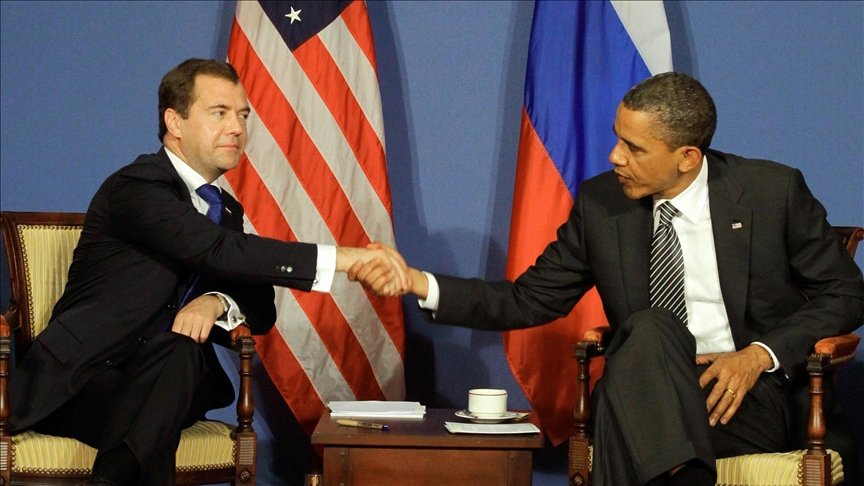
The New START Treaty was signed in Prague on April 8, 2010, by U.S. President Barack Obama and Russian President Dmitry Medvedev, entering into force on February 5, 2011. It represented a continuation of post-Cold War arms control efforts that began with the Strategic Arms Limitation Talks (SALT) in the late 1960s and evolved through treaties like START I (1991) and the Strategic Offensive Reductions Treaty (SORT, 2002).
At its core, New START imposed verifiable caps on strategic offensive nuclear forces:
- No more than 1,550 deployed strategic nuclear warheads per side (counted on intercontinental ballistic missiles (ICBMs), submarine-launched ballistic missiles (SLBMs), and heavy bombers equipped for nuclear armaments).
- Limits on deployed delivery vehicles: up to 700 deployed ICBMs, SLBMs, and heavy bombers; and a total of 800 deployed and non-deployed launchers and bombers.
Crucially, the treaty included robust verification mechanisms that provided unprecedented transparency. These included biannual data exchanges on force levels, notifications of movements and changes, and up to 18 on-site inspections per year per side. These measures built confidence, reduced the risk of surprise attacks or miscalculations, and allowed both nations to plan their defenses with greater certainty rather than assuming worst-case scenarios.
New START built on decades of bilateral reductions that saw U.S. and Russian strategic arsenals shrink dramatically from Cold War peaks of over 10,000 warheads each. By maintaining these limits, the treaty helped stabilize the bilateral nuclear balance amid deteriorating relations, including tensions over Ukraine, missile defenses, and emerging technologies like hypersonic weapons.
The Road to Expiration
The treaty’s original duration was 10 years, with a single five-year extension option. In February 2021, under the Biden administration, the U.S. and Russia agreed to that extension, keeping the treaty in force until February 4/5, 2026. This extension came amid strained relations but reflected mutual recognition of the treaty’s value for strategic predictability.
However, implementation faltered. In February 2023, Russia suspended participation in most verification provisions—inspections, data exchanges, and notifications—citing U.S. support for Ukraine and alleged Western interference with Russian inspection rights. The U.S. responded by mirroring the suspension of inspections. Despite these steps, both sides publicly asserted continued adherence to the numerical limits until expiration.
Efforts to salvage or replace the treaty intensified in 2025. In September 2025, Russian President Vladimir Putin proposed that both countries voluntarily observe New START’s quantitative limits for one additional year post-expiration to facilitate negotiations, with the possibility of further extensions. U.S. President Donald Trump initially described the idea as sounding like a “good idea.” However, Trump later expressed indifference, stating in a January 2026 New York Times interview, “If it expires, it expires. We’ll do a better agreement.” He repeatedly emphasized the need for a trilateral deal including China, a condition Beijing has consistently rejected. No formal agreement emerged, and the treaty lapsed without successor arrangements or even a binding commitment to maintain the old caps.
This outcome stems from deep geopolitical mistrust, domestic political priorities, and incompatible demands: the U.S. insists on including China in any future framework, Russia demands inclusion of France and the UK, and China refuses limits while its arsenal remains smaller.

The Emerging Multipolar Arms Race
With New START gone, the nuclear landscape shifts toward unconstrained competition. The U.S. and Russia together hold approximately 90% of the world’s nuclear warheads, with total global inventories estimated at around 12,241 warheads as of early 2025 (per SIPRI data), of which about 9,614 are in military stockpiles.
- U.S.-Russia Dynamics: Both nations can now “upload” additional warheads to existing delivery systems or accelerate deployments without verification. Russia has invested heavily in modernization, including new systems like the Sarmat ICBM, Avangard hypersonic glide vehicles, and Poseidon nuclear-powered torpedoes. The U.S. pursues its own triad refresh: the Sentinel ICBM program, Columbia-class submarines, and B-21 bombers. While immediate massive buildups are unlikely due to high costs and long lead times, the absence of limits and transparency invites hedging and escalation in force planning.
- China’s Rapid Expansion: China’s arsenal, estimated at around 600 warheads in 2025 (up from about 300-500 in recent years), is growing faster than any other nuclear state’s. Projections suggest China could reach 1,000 warheads by 2030 and potentially approach parity with U.S. and Russian levels by mid-century. Beijing is constructing new silo fields for ICBMs, developing submarine-launched systems, and enhancing its bomber capabilities. China maintains a no-first-use policy and refuses trilateral talks, arguing its forces are defensive and far smaller.
This creates a triangular dynamic: U.S. planners now face a “two-tier” deterrence challenge from Russia and China combined. Bilateral U.S.-Russia arms control becomes insufficient when one party must account for a third unconstrained actor. The result is a potential feedback loop where each power’s buildup justifies the others’.
Risks and Consequences
The lapse heightens several interlocking dangers:
- Instability and Miscalculation: Without data exchanges or inspections, suspicions grow. A missile test or satellite anomaly could be misinterpreted as preparation for attack, raising escalation risks in crises (e.g., over Ukraine, Taiwan, or the Arctic).
- Technological Erosion of Stability: Hypersonic weapons, AI-enabled systems, space-based assets, and cyber threats compress decision timelines, undermining mutual assured destruction’s stabilizing logic.
- Global Ripple Effects: Allies reliant on U.S. extended deterrence (e.g., NATO members, Japan, South Korea) may question commitments or pursue their own capabilities. The Nuclear Non-Proliferation Treaty (NPT) regime weakens if major powers appear unwilling to restrain arsenals, potentially encouraging proliferation in volatile regions like the Middle East or South Asia.
- Proliferation and Tactical Nuclear Risks: Russia maintains a large stockpile of non-strategic (tactical) nuclear weapons (~1,477 per SIPRI). Unconstrained strategic forces could spill over into tactical domains, lowering use thresholds.
Experts from organizations like SIPRI, ICAN, and the Arms Control Association warn that this could mark not a temporary gap but a prolonged suspension of effective arms control, leading to higher numbers, greater diversity of systems, and increased global nuclear dangers.
What Comes Next? Possible Paths Forward
Short-term options include voluntary restraint: both sides could unilaterally commit to New START-like limits, resume limited data sharing, or adopt confidence-building measures (e.g., notifications of major exercises). Russia’s 2025 proposal remains on the table, though U.S. rejection of indefinite adherence without a broader deal dims prospects.
Medium-term, new negotiations are essential but challenging. A bilateral follow-on could cover emerging technologies and missile defenses. A trilateral framework faces steep hurdles, given China’s stance. Multilateral efforts—perhaps involving European powers or the UN—could build momentum, but geopolitical divides make progress slow.
The path forward demands renewed diplomacy: recognizing mutual vulnerability, prioritizing dialogue channels (e.g., crisis hotlines), and addressing root causes like regional conflicts. Public pressure, including from civil society and allies, could incentivize leaders to act.
Conclusion
The expiration of New START on February 5, 2026, closes a chapter of bilateral nuclear restraint that helped prevent catastrophe for decades. In its place emerges a riskier world of unconstrained competition, where the U.S., Russia, and China drive an emerging arms race amid eroded transparency and heightened mistrust.
Yet restraint serves everyone’s interests: nuclear war benefits no one. The end of New START does not have to mean the end of arms control. Leaders in Washington, Moscow, and Beijing must prioritize renewed talks—bilateral or otherwise—to cap arsenals, restore verification, and adapt frameworks to multipolar realities. Failure to do so risks multiplying dangers in an already tense global environment. In 2026 and beyond, the choice is clear: recommit to diplomacy, or allow history’s most destructive weapons to slip further from control.